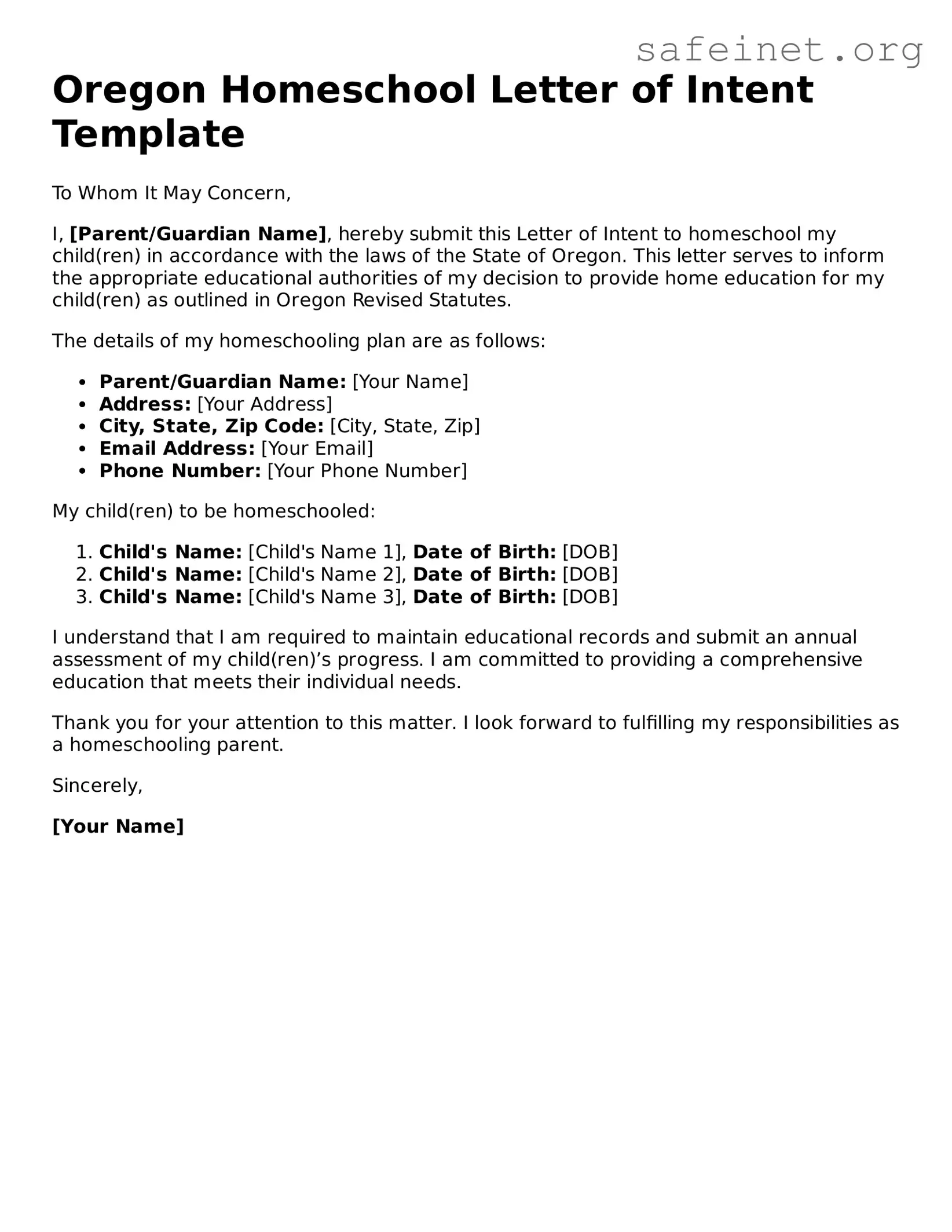
The Oregon Homeschool Letter of Intent form serves as a crucial document for families choosing to educate their children at home. This form must be submitted to the local education agency, signaling the intent to homeschool and ensuring compliance with state regulations. Parents or guardians are required to provide basic information, including the names and ages of the children being homeschooled. Additionally, the form outlines the educational plan, which can vary widely among families, reflecting diverse teaching methods and curricula. By submitting this letter, families formally notify the state of their educational choice, allowing them to take advantage of the freedoms and responsibilities that come with homeschooling. Understanding the requirements and implications of this form is essential for any family considering this educational path in Oregon.
Oregon Homeschool Letter of Intent Template
To Whom It May Concern,
I, [Parent/Guardian Name], hereby submit this Letter of Intent to homeschool my child(ren) in accordance with the laws of the State of Oregon. This letter serves to inform the appropriate educational authorities of my decision to provide home education for my child(ren) as outlined in Oregon Revised Statutes.
The details of my homeschooling plan are as follows:
My child(ren) to be homeschooled:
I understand that I am required to maintain educational records and submit an annual assessment of my child(ren)’s progress. I am committed to providing a comprehensive education that meets their individual needs.
Thank you for your attention to this matter. I look forward to fulfilling my responsibilities as a homeschooling parent.
Sincerely,
[Your Name]
| Fact Name | Description |
|---|---|
| Purpose | The Oregon Homeschool Letter of Intent form notifies the local education district of a family's decision to homeschool their child. |
| Governing Law | The form is governed by Oregon Revised Statutes (ORS) 339.030 and ORS 339.035. |
| Submission Deadline | Parents must submit the Letter of Intent within 10 days of beginning homeschooling. |
| Required Information | The form requires the child's name, age, and the address of the homeschooling location. |
| Annual Notification | Families must submit a new Letter of Intent each year to continue homeschooling. |
| Educational Philosophy | While not required, families may include their educational philosophy or approach in the letter. |
| Record Keeping | Parents are encouraged to keep a copy of the submitted Letter of Intent for their records. |
| District Response | School districts may not require additional information beyond what is included in the Letter of Intent. |
| Special Needs | Parents of children with special needs can still homeschool and should indicate any special considerations. |
| Access to Resources | Homeschooling families may access some public school resources, but this varies by district. |
Once you have decided to homeschool your child in Oregon, the next step involves completing the Homeschool Letter of Intent form. This form notifies the local school district of your intent to provide home education. After submitting the form, you will receive confirmation from the district, and you can begin your homeschooling journey.
What is the Oregon Homeschool Letter of Intent?
The Oregon Homeschool Letter of Intent is a document that parents or guardians must submit to their local school district to formally notify them of their intent to homeschool their child. This letter is a requirement for families who choose to educate their children at home rather than in a traditional school setting.
Who needs to submit the Letter of Intent?
Any parent or guardian who wishes to homeschool a child aged 7 to 18 in Oregon must submit the Letter of Intent. This includes families who are starting homeschooling for the first time as well as those who have previously homeschooled but are changing their educational approach.
When should the Letter of Intent be submitted?
The Letter of Intent should be submitted to the local school district before the start of the school year. It is advisable to submit the letter at least a few weeks in advance to ensure that the district has sufficient time to process the notification.
What information is required in the Letter of Intent?
The Letter of Intent must include the name of the child, the child's date of birth, and the address of the homeschooling family. Additionally, it should specify the educational program or curriculum that will be used for homeschooling.
Is there a specific format for the Letter of Intent?
While there is no mandated format for the Letter of Intent, it is recommended to keep the letter clear and concise. Including all required information in a straightforward manner will help facilitate the process. Some families may choose to use a template to ensure all necessary details are included.
What happens after the Letter of Intent is submitted?
Once the Letter of Intent is submitted, the local school district will typically acknowledge receipt. They may provide additional information regarding homeschooling regulations and resources available to families. It is important to maintain communication with the district for any further requirements.
Are there any consequences for not submitting the Letter of Intent?
Failure to submit the Letter of Intent may result in the child being considered truant. This could lead to legal consequences, including potential intervention by the school district. Therefore, it is crucial to submit the letter on time to avoid any issues.
Can the Letter of Intent be revoked?
Yes, parents or guardians can revoke the Letter of Intent at any time. If a family decides to return to a traditional school setting or discontinue homeschooling, they should notify the local school district accordingly.
Where can I find the Oregon Homeschool Letter of Intent form?
The Oregon Homeschool Letter of Intent form can typically be found on the website of your local school district. Many districts provide downloadable forms or templates that can be filled out and submitted electronically or by mail.
Incomplete Information: Failing to provide all required personal details can delay the process. Ensure that names, addresses, and contact information are fully filled out.
Incorrect Age Range: Not specifying the correct age range of the children being homeschooled can lead to confusion. Double-check the ages to ensure compliance.
Missing Signatures: Omitting the necessary signatures can render the form invalid. Always sign and date the document before submission.
Failure to Submit on Time: Each year, the letter must be submitted by a specific deadline. Mark your calendar to avoid late submissions.
Not Keeping a Copy: After submission, not retaining a copy for personal records can lead to issues later. Always keep a copy for your files.
Ignoring Local Requirements: Some districts may have additional requirements. Research local guidelines to ensure compliance with any extra steps.
Overlooking Educational Plans: While not always required, including a brief educational plan can enhance clarity. Consider outlining your teaching methods and curriculum.
When families decide to homeschool in Oregon, several documents may accompany the Homeschool Letter of Intent form. Each of these documents serves a specific purpose and helps ensure compliance with state regulations while providing necessary information about the homeschooling process.
These documents work together to create a comprehensive framework for homeschooling in Oregon. By preparing them alongside the Homeschool Letter of Intent, families can ensure a smooth and compliant homeschooling experience.
The Oregon Homeschool Letter of Intent form is similar to the Notice of Intent form used in other states for families wishing to homeschool their children. This document serves as a formal notification to the local school district that parents or guardians intend to educate their children at home. Both forms typically require basic information such as the names of the children being homeschooled and the address of the family. The purpose is to ensure that local education authorities are aware of the homeschooling arrangement and can provide any necessary resources or support.
Another document that resembles the Oregon Homeschool Letter of Intent is the Affidavit of Intent to Homeschool. This document is often used in states that require parents to submit a sworn statement affirming their intention to homeschool. Like the Oregon form, it usually includes information about the child and the parent. The affidavit can serve as a legal declaration, providing an additional layer of assurance to school districts regarding the family's commitment to homeschooling.
The Home Education Registration form, used in some states, is also comparable. This document typically requires parents to register their homeschool program with the state or local education authority. Similar to the Oregon form, it collects essential information about the students and the educational plan. This registration process helps ensure that the homeschooling environment meets certain educational standards, which can vary by state.
In many states, the Declaration of Intent to Homeschool is another document that functions similarly. This declaration serves as an official statement made by parents to inform the school district of their choice to homeschool. It often includes similar information as the Oregon form, such as the names and ages of the children. The declaration can be a simple yet essential step in the homeschooling process, allowing families to comply with state regulations.
The Educational Plan form may also be similar to the Oregon Homeschool Letter of Intent. While this document focuses more on outlining the educational curriculum and objectives for the homeschooling year, it often accompanies the letter of intent. Both documents work together to provide a comprehensive overview of the homeschooling approach, ensuring that educational goals are clear and aligned with state requirements.
In some jurisdictions, the Homeschool Notification form serves a purpose akin to the Oregon form. This document is submitted to local education authorities to inform them of the family's decision to homeschool. It typically requires basic information about the children and the educational approach. The notification helps keep school officials informed about homeschooling families within their district.
The Intent to Homeschool form, used in various states, is another document that shares similarities with the Oregon Homeschool Letter of Intent. This form acts as a formal notification to the school district, indicating that parents plan to educate their children at home. It usually requires similar details, such as the names of the children and the educational plan, ensuring that the school district is aware of the family's educational choices.
The Home Schooling Notification form is also comparable. This document is often required by local education authorities and serves to inform them of the family's homeschooling decision. Like the Oregon form, it typically collects basic information about the children and the family's educational philosophy. This notification can help facilitate communication between homeschooling families and local school officials.
Lastly, the Letter of Intent to Homeschool is a document used in various states that parallels the Oregon form. This letter serves as a simple and straightforward way for parents to communicate their decision to homeschool. It generally includes the names and ages of the children, similar to the Oregon form. The letter can be an essential first step in establishing a homeschooling program and ensuring compliance with state regulations.
When filling out the Oregon Homeschool Letter of Intent form, it's essential to follow certain guidelines to ensure a smooth process. Here are eight key points to consider:
Homeschooling in Oregon is a popular choice for many families, but several misconceptions about the Homeschool Letter of Intent form can lead to confusion. Here are eight common misunderstandings:
This is false. Homeschooling is a legal and recognized form of education in Oregon, provided that families follow the required procedures, including submitting a Letter of Intent.
Many believe that children must first be enrolled in a public school before transitioning to homeschooling. In fact, families can choose to homeschool from the beginning, without any prior public school enrollment.
While families must submit a Letter of Intent when they begin homeschooling, they are not required to submit it annually. Once the initial letter is on file, families can continue homeschooling without resubmitting each year.
Oregon law does not dictate specific subjects that must be covered in a homeschool curriculum. Parents have the flexibility to design their own educational programs based on their children's needs and interests.
This misconception suggests that only certified teachers can educate their children at home. In reality, parents do not need formal teaching credentials to homeschool their children in Oregon.
Some people think that homeschooling is only suitable for specific family structures or backgrounds. However, families from diverse backgrounds and situations can successfully homeschool their children.
While the process may seem daunting, submitting the Letter of Intent is relatively straightforward. Families can easily find the necessary forms and instructions online.
Many believe that homeschooling isolates children from their peers. In reality, homeschoolers often engage in various social activities, including co-ops, sports, and community events, providing ample opportunities for social interaction.
The Oregon Homeschool Letter of Intent form is an important document for families choosing to educate their children at home. Here are some key takeaways regarding its use and completion: