In Oregon, the Durable Power of Attorney form plays a crucial role in ensuring that your financial and healthcare decisions are managed according to your wishes, even if you become unable to make those decisions yourself. This legal document allows you to appoint someone you trust—often referred to as your agent—to act on your behalf. It covers a wide range of responsibilities, from handling your finances and paying bills to making medical decisions in emergencies. The form remains effective even if you become incapacitated, which is what makes it “durable.” It’s important to understand that you have the flexibility to specify the extent of your agent's powers, whether they are broad or limited to specific tasks. Additionally, you can revoke or change the document at any time as long as you are still capable of making decisions. Understanding these aspects can empower you to take control of your future and ensure your preferences are respected, providing peace of mind for both you and your loved ones.
Oregon Durable Power of Attorney Template
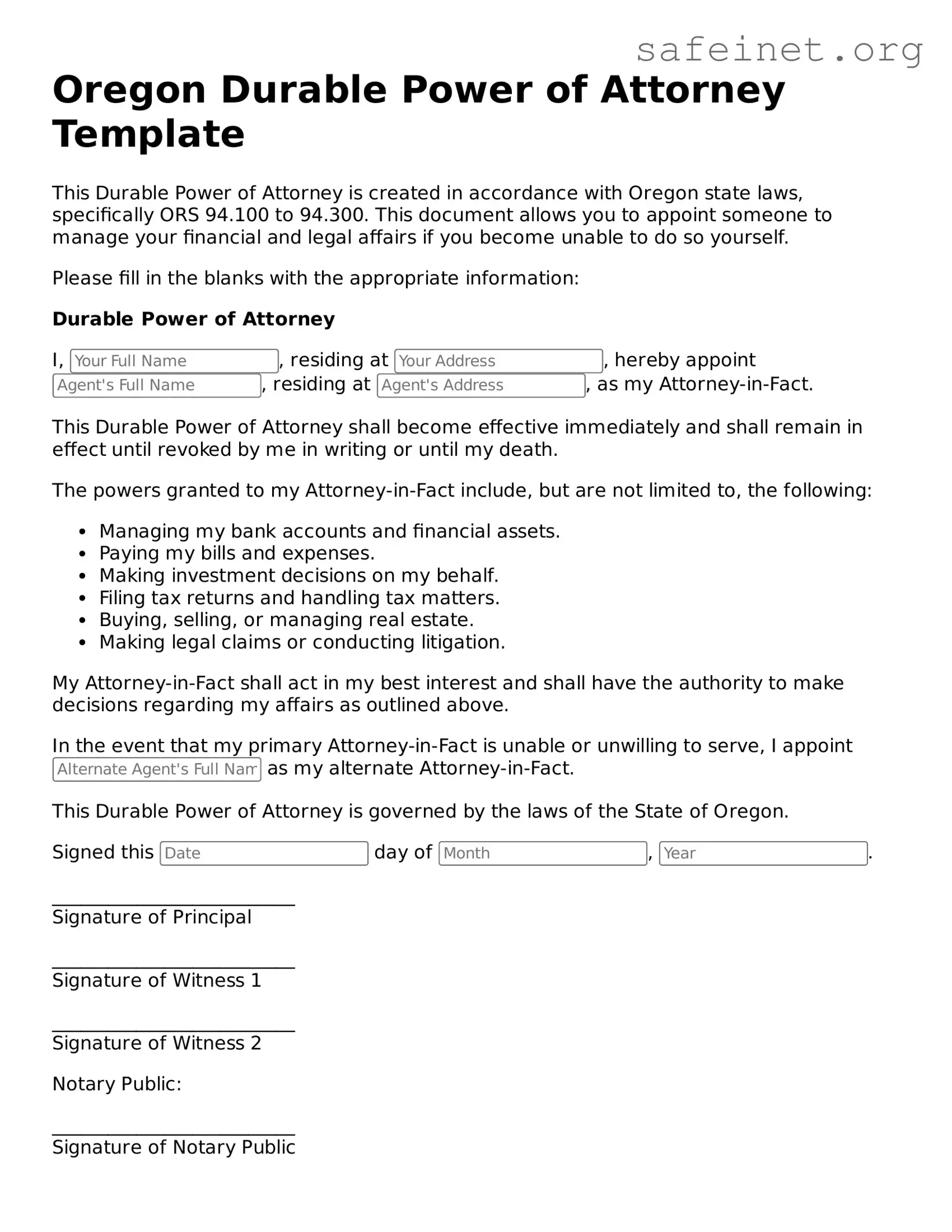
This Durable Power of Attorney is created in accordance with Oregon state laws, specifically ORS 94.100 to 94.300. This document allows you to appoint someone to manage your financial and legal affairs if you become unable to do so yourself.
Please fill in the blanks with the appropriate information:
Durable Power of Attorney
I, , residing at , hereby appoint , residing at , as my Attorney-in-Fact.
This Durable Power of Attorney shall become effective immediately and shall remain in effect until revoked by me in writing or until my death.
The powers granted to my Attorney-in-Fact include, but are not limited to, the following:
My Attorney-in-Fact shall act in my best interest and shall have the authority to make decisions regarding my affairs as outlined above.
In the event that my primary Attorney-in-Fact is unable or unwilling to serve, I appoint as my alternate Attorney-in-Fact.
This Durable Power of Attorney is governed by the laws of the State of Oregon.
Signed this day of , .
__________________________
Signature of Principal
__________________________
Signature of Witness 1
__________________________
Signature of Witness 2
Notary Public:
__________________________
Signature of Notary Public
My Commission Expires: ________________
| Fact Name | Description |
|---|---|
| Definition | A Durable Power of Attorney in Oregon allows an individual (the principal) to designate another person (the agent) to make financial or legal decisions on their behalf. |
| Durability | This document remains effective even if the principal becomes incapacitated, distinguishing it from a standard Power of Attorney. |
| Governing Law | The Oregon Durable Power of Attorney is governed by Oregon Revised Statutes, specifically ORS 94.626 to 94.638. |
| Agent's Authority | The agent can have broad or limited authority as specified by the principal in the document, allowing for tailored decision-making power. |
| Execution Requirements | The form must be signed by the principal and witnessed by two individuals or notarized to be valid. |
| Revocation | The principal can revoke the Durable Power of Attorney at any time, as long as they are competent to do so. |
| Agent's Duties | Agents have a fiduciary duty to act in the best interest of the principal, ensuring that decisions align with the principal’s wishes. |
| Limitations | Some decisions, such as those related to health care, may require a separate advance directive or health care power of attorney. |
| Use Cases | Common scenarios for using a Durable Power of Attorney include managing finances during illness, travel, or incapacity. |
Completing the Oregon Durable Power of Attorney form is an important step in ensuring that your financial and legal matters are managed according to your wishes. Follow these steps carefully to fill out the form correctly.
Once you have completed these steps, ensure that you discuss your decisions with your appointed agent. This communication will help clarify your intentions and ensure that your wishes are understood.
What is a Durable Power of Attorney in Oregon?
A Durable Power of Attorney (DPOA) is a legal document that allows you to appoint someone you trust to make decisions on your behalf if you become unable to do so. This could be due to illness, injury, or other circumstances. Unlike a regular Power of Attorney, a DPOA remains effective even if you lose the capacity to make your own decisions.
Who can be appointed as an agent under a Durable Power of Attorney?
You can choose anyone to be your agent, as long as they are at least 18 years old and mentally competent. This could be a family member, friend, or even a professional, such as an attorney. It's important to select someone who understands your values and wishes.
What powers can I grant to my agent?
You have the flexibility to grant a wide range of powers to your agent. These can include managing your financial affairs, making healthcare decisions, and handling real estate transactions. You can specify which powers you want to give and even limit them based on your preferences.
How do I create a Durable Power of Attorney in Oregon?
Creating a DPOA in Oregon involves filling out a specific form, which can often be found online or through legal resources. You must sign the document in front of a notary public or two witnesses. Once completed, it’s wise to share copies with your agent and any relevant institutions, such as banks or healthcare providers.
Can I revoke my Durable Power of Attorney?
Yes, you can revoke your DPOA at any time as long as you are mentally competent. To do this, you must create a written revocation document and notify your agent and any institutions that may have a copy of the original DPOA. This ensures that your wishes are clear and up to date.
What happens if I do not have a Durable Power of Attorney?
If you do not have a DPOA and become unable to make decisions for yourself, your loved ones may need to go through a legal process called guardianship. This can be time-consuming and costly, and it may not reflect your personal wishes. Having a DPOA in place helps avoid this situation.
Is a Durable Power of Attorney only for financial matters?
No, a DPOA can cover both financial and healthcare decisions. You can create a comprehensive DPOA that addresses various aspects of your life, or you can have separate documents for financial and healthcare powers. It’s essential to think about what decisions you want your agent to make on your behalf.
How does a Durable Power of Attorney affect my medical decisions?
If your DPOA includes healthcare powers, your agent will be able to make medical decisions for you if you are unable to communicate your wishes. This can include decisions about treatment options, surgeries, or end-of-life care. It’s crucial to discuss your healthcare preferences with your agent to ensure they understand your values.
Can I have more than one Durable Power of Attorney?
Yes, you can have multiple DPOAs, but it’s important to ensure they do not conflict with each other. For example, you might have one DPOA for financial matters and another for healthcare decisions. Just make sure to clearly communicate your wishes and keep all parties informed to avoid confusion.
Not specifying the powers granted: Many individuals fail to clearly outline the specific powers they wish to grant their agent. This can lead to confusion and disputes later on.
Choosing the wrong agent: Selecting someone who may not act in your best interest or who lacks the necessary skills can undermine the purpose of the Durable Power of Attorney.
Not signing the document properly: A common mistake is neglecting to sign the form correctly. In Oregon, the principal’s signature must be witnessed or notarized to be valid.
Failing to update the document: Life circumstances change. Failing to revise the Durable Power of Attorney after major life events—such as marriage, divorce, or the death of an agent—can create complications.
Ignoring state-specific requirements: Each state has its own rules regarding Durable Powers of Attorney. Not adhering to Oregon’s specific guidelines can render the document ineffective.
Not discussing the decision with the agent: It is crucial to have a conversation with the person you designate as your agent. Failing to do so can lead to misunderstandings about your wishes.
Overlooking alternate agents: Choosing only one agent without considering a backup can be risky. If the primary agent is unavailable or unwilling to act, the document may become ineffective.
When creating a Durable Power of Attorney in Oregon, it's often helpful to consider additional forms and documents that can support your intentions and ensure your wishes are honored. Here are four commonly used documents that complement the Durable Power of Attorney:
These documents can work together to provide comprehensive support for your legal and healthcare needs. By preparing them alongside your Durable Power of Attorney, you help ensure that your preferences are respected and that your chosen representatives have the necessary authority to act on your behalf.
The Oregon Durable Power of Attorney (DPOA) is a vital legal document that allows someone to make decisions on your behalf if you become unable to do so. It shares similarities with several other documents that serve similar purposes in different contexts. Understanding these documents can help you make informed decisions about your legal needs.
The General Power of Attorney is one of the most closely related documents. Like the DPOA, it grants authority to an agent to act on your behalf. However, the key difference lies in its durability. A General Power of Attorney typically becomes void if you become incapacitated, while the Durable Power of Attorney remains effective even in such situations. This makes the DPOA a more suitable choice for long-term planning.
A Healthcare Power of Attorney is another document that shares similarities with the DPOA. This form specifically allows someone to make medical decisions for you if you are unable to communicate your wishes. While the DPOA can cover financial matters, the Healthcare Power of Attorney is focused solely on health-related decisions. Both documents emphasize the importance of having a trusted individual in place to act on your behalf.
The Living Will is often mentioned alongside the Durable Power of Attorney. While a DPOA allows someone to make decisions on your behalf, a Living Will outlines your preferences regarding medical treatment in the event of terminal illness or incapacitation. It serves as a guide for your healthcare agent, ensuring that your wishes are honored. Together, these documents provide a comprehensive approach to both health and financial matters.
The Revocable Trust is another document that can serve a similar purpose. While a DPOA grants authority to an agent, a Revocable Trust allows you to transfer assets into a trust, managed by a trustee. This can help avoid probate and ensure that your assets are distributed according to your wishes. However, unlike the DPOA, a Revocable Trust does not directly address decision-making in the event of incapacity.
The Advance Directive is closely related to both the Healthcare Power of Attorney and the Living Will. It combines elements of both documents, allowing you to specify your healthcare preferences and appoint an agent to make decisions on your behalf. This document ensures that your medical wishes are clear and respected, similar to the Durable Power of Attorney's role in financial matters.
The Guardianship Petition is a legal document used to establish a guardian for an individual who is unable to make decisions due to incapacity. While the DPOA allows you to choose someone to act on your behalf, a Guardianship Petition involves a court process to appoint a guardian. This can be a more formal and often more complex route than establishing a DPOA, which can be done privately and without court intervention.
The Conservatorship is similar to the Guardianship Petition, but it specifically pertains to financial matters. When a conservator is appointed, they manage the financial affairs of an individual deemed incapable of doing so. Like the Guardianship, this process involves the court, making it more formal than the DPOA. The DPOA allows for a smoother, more personal approach to managing finances without the need for court oversight.
Finally, the Will is another important document that relates to the distribution of your assets after death. While the DPOA is focused on decision-making during your lifetime, a Will outlines how your assets should be handled once you pass away. Both documents are essential for comprehensive estate planning, but they serve different purposes—one for the present and one for the future.
When filling out the Oregon Durable Power of Attorney form, it is important to follow specific guidelines to ensure the document is valid and effective. Below are some key things to do and avoid during this process.
Things to Do:
Things to Avoid:
When it comes to the Oregon Durable Power of Attorney form, many people hold misconceptions that can lead to confusion and potentially serious issues. Here are five common misunderstandings:
While many believe that a Durable Power of Attorney (DPOA) is solely for managing financial decisions, it can also cover health care decisions if specified. This means that you can designate someone to make medical choices on your behalf if you become unable to do so.
Contrary to this belief, a Durable Power of Attorney remains effective even if you become incapacitated. This is what makes it "durable." It allows your designated agent to act on your behalf when you are unable to manage your affairs.
While it’s true that you can choose anyone to be your agent, there are some limitations. For example, your agent must be at least 18 years old and should ideally be someone you trust to act in your best interests.
This is a common misconception. You can revoke or change your Durable Power of Attorney at any time, as long as you are mentally competent. It’s important to keep your documents updated to reflect your current wishes.
In Oregon, a Durable Power of Attorney does not necessarily need to be notarized, but having it notarized can add an extra layer of protection. It helps ensure that the document is valid and can be accepted by financial institutions and medical providers.
Understanding these misconceptions can help you make informed decisions about your Durable Power of Attorney and ensure that your wishes are honored when it matters most.
When considering the Oregon Durable Power of Attorney form, it's essential to understand its purpose and implications. Here are some key takeaways to keep in mind: