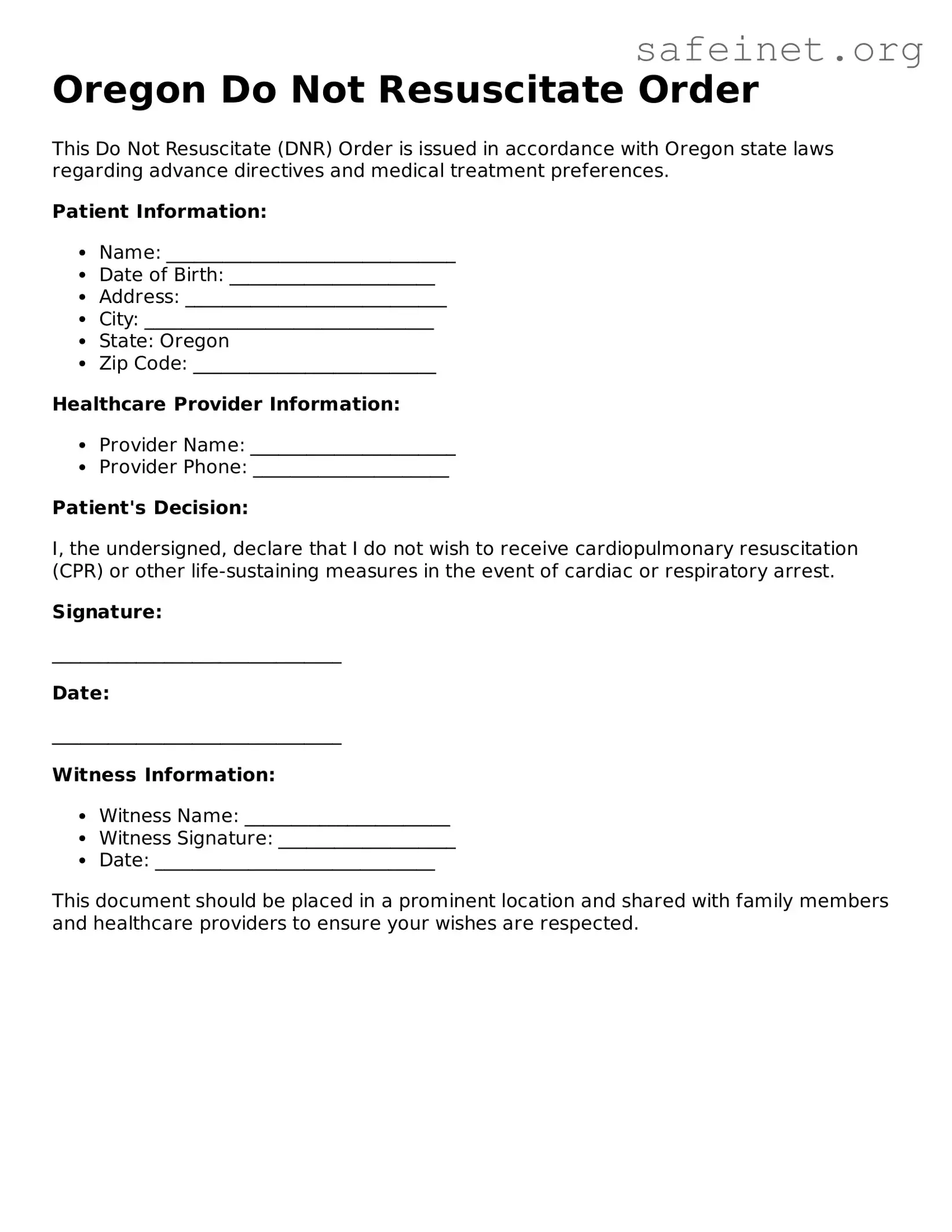
The Oregon Do Not Resuscitate (DNR) Order form is an essential document for individuals who wish to express their preferences regarding medical treatment in emergency situations. This form allows patients to specify that they do not want resuscitation efforts, such as chest compressions or intubation, if their heart stops or they stop breathing. It is designed for those who are facing serious health issues and want to ensure their wishes are respected in critical moments. The DNR Order must be signed by a licensed physician and should be readily accessible to medical personnel, ensuring that emergency responders are aware of the patient's wishes. Additionally, the form may include space for the patient or their legal representative to provide additional instructions or preferences regarding end-of-life care. Understanding the implications of this form is crucial, as it can guide medical professionals in making decisions that align with the patient's values and desires during a medical emergency.
Oregon Do Not Resuscitate Order
This Do Not Resuscitate (DNR) Order is issued in accordance with Oregon state laws regarding advance directives and medical treatment preferences.
Patient Information:
Healthcare Provider Information:
Patient's Decision:
I, the undersigned, declare that I do not wish to receive cardiopulmonary resuscitation (CPR) or other life-sustaining measures in the event of cardiac or respiratory arrest.
Signature:
_______________________________
Date:
_______________________________
Witness Information:
This document should be placed in a prominent location and shared with family members and healthcare providers to ensure your wishes are respected.
| Fact Name | Description |
|---|---|
| Definition | The Oregon Do Not Resuscitate (DNR) Order form allows individuals to refuse resuscitation in the event of cardiac or respiratory arrest. |
| Governing Law | The DNR Order in Oregon is governed by ORS 97.973 to 97.985. |
| Eligibility | Any adult can complete a DNR Order, provided they are capable of making their own medical decisions. |
| Signature Requirement | The form must be signed by the individual or their legal representative to be valid. |
| Healthcare Provider's Role | A healthcare provider must sign the DNR Order to confirm its validity and ensure it is recognized by medical personnel. |
| Location of Form | The completed DNR Order should be kept in a prominent place, such as on the refrigerator or with medical records. |
| Revocation | Individuals can revoke their DNR Order at any time, either verbally or in writing. |
| Emergency Medical Services | Emergency medical services (EMS) personnel are required to honor a valid DNR Order during emergencies. |
| Communication | It is important to communicate the existence of a DNR Order to family members and healthcare providers. |
| Additional Considerations | Individuals should discuss their DNR Order with their healthcare team to ensure it aligns with their overall treatment plan. |
Filling out the Oregon Do Not Resuscitate Order form is an important step in communicating your healthcare preferences. After completing the form, it should be shared with your healthcare providers and kept in an easily accessible location. This ensures that your wishes are respected in medical situations where they may need to be referenced.
What is the Oregon Do Not Resuscitate Order form?
The Oregon Do Not Resuscitate (DNR) Order form is a legal document that allows individuals to express their wishes regarding resuscitation in the event of a medical emergency. This form specifically indicates that a person does not want to receive cardiopulmonary resuscitation (CPR) or other life-saving measures if their heart stops beating or they stop breathing.
Who can complete the Oregon DNR Order form?
Any adult who is capable of making informed decisions about their medical care can complete the Oregon DNR Order form. This includes individuals with terminal illnesses, severe health conditions, or those who simply wish to have their end-of-life preferences documented. It is recommended that individuals discuss their wishes with their healthcare provider before completing the form.
How do I obtain an Oregon DNR Order form?
The Oregon DNR Order form can be obtained from various sources, including healthcare providers, hospitals, and online resources. The Oregon Health Authority’s website provides a downloadable version of the form. It is important to ensure that the most current version is used, as regulations may change.
What should I do after completing the DNR Order form?
After completing the DNR Order form, it is crucial to sign and date it. Ensure that it is witnessed by an adult who is not related to you or named in the document. Keep the original form in an easily accessible location, and provide copies to your healthcare provider, family members, and anyone else involved in your care.
Can I change or revoke my DNR Order?
Yes, you can change or revoke your DNR Order at any time. To do so, simply complete a new DNR Order form and ensure it is properly signed and witnessed. Inform your healthcare provider and family members of the change to ensure your wishes are respected.
Is a DNR Order valid in all healthcare settings?
The Oregon DNR Order is generally recognized across various healthcare settings, including hospitals, nursing homes, and emergency medical services. However, it is advisable to confirm with your healthcare provider to ensure that your DNR Order will be honored in specific situations, especially during emergencies.
Failing to clearly indicate the patient's wishes. It's crucial to ensure that the decision to not resuscitate is explicitly stated.
Not signing the form. A signature is required to validate the order. Without it, the document holds no legal weight.
Neglecting to date the form. The date of signing is important as it establishes the timeline of the patient's wishes.
Using outdated forms. Always check for the most current version of the Do Not Resuscitate Order form to ensure compliance with state regulations.
Not discussing the decision with healthcare providers. Open communication is essential to ensure that medical staff understand and respect the order.
Forgetting to inform family members. Keeping loved ones in the loop about these decisions can prevent confusion and emotional distress later.
Overlooking the need for periodic reviews. As circumstances change, so may a person's wishes regarding resuscitation. Regularly revisiting the order is advisable.
When considering end-of-life care preferences, it is essential to understand the various documents that complement the Oregon Do Not Resuscitate (DNR) Order. Each of these forms serves a unique purpose and helps ensure that an individual’s wishes are respected. Below is a list of commonly used documents that may accompany a DNR order.
Understanding these documents can empower individuals and their families to make informed decisions about healthcare and end-of-life preferences. It is crucial to have open conversations about these topics to ensure that everyone is on the same page regarding wishes and expectations.
The Oregon Do Not Resuscitate (DNR) Order form shares similarities with the Advance Directive. Both documents allow individuals to express their healthcare preferences in advance, particularly concerning life-sustaining treatments. An Advance Directive can cover a broader range of medical decisions, including who will make decisions on behalf of the individual if they are unable to do so. This document is crucial for ensuring that a person's wishes are respected in various medical situations, not just during a cardiac arrest.
Another document akin to the Oregon DNR is the Physician Orders for Life-Sustaining Treatment (POLST) form. While the DNR focuses specifically on resuscitation, the POLST provides a more comprehensive approach to end-of-life care. It includes orders for various medical interventions, such as artificial nutrition or hydration, and is intended to be used by healthcare providers to guide treatment decisions. Both documents are designed to communicate a patient's wishes, but POLST offers more detailed options.
The Living Will is also similar to the Oregon DNR, as it allows individuals to outline their preferences regarding medical treatment in the event they become incapacitated. While a DNR specifically addresses resuscitation efforts, a Living Will can cover a wider array of medical scenarios, such as terminal illness or irreversible conditions. This document serves as a legal guide for healthcare providers and family members, ensuring that a person's desires are honored even when they cannot voice them.
A Healthcare Power of Attorney (HPOA) is another related document. This legal instrument designates a specific person to make medical decisions on behalf of an individual if they are unable to do so. While the Oregon DNR outlines specific wishes regarding resuscitation, the HPOA provides a broader framework for decision-making. The appointed agent can consider the individual's values and preferences, allowing for more personalized care in various medical situations.
Similar to the Oregon DNR is the Do Not Intubate (DNI) order. This document specifically instructs healthcare providers not to perform intubation, which is the process of placing a tube in the airway to assist with breathing. While a DNR focuses on resuscitation efforts, a DNI is more targeted and often used in conjunction with a DNR. Both documents emphasize the importance of respecting a patient’s wishes regarding life-sustaining interventions.
Lastly, the Comfort Care Order is comparable to the Oregon DNR. This document prioritizes comfort and quality of life over aggressive medical interventions. While the DNR indicates a refusal of resuscitation, the Comfort Care Order emphasizes palliative care measures, such as pain relief and emotional support. Both documents align with the philosophy of respecting patient autonomy and ensuring that individuals receive care that aligns with their values and preferences.
When filling out the Oregon Do Not Resuscitate Order form, it’s important to approach the process with care. Here are some key dos and don’ts to keep in mind:
By following these guidelines, you can ensure that your preferences are respected and clearly understood.
Understanding the Oregon Do Not Resuscitate (DNR) Order form can be challenging. Many people hold misconceptions that can lead to confusion about its purpose and implications. Here are ten common misconceptions:
This is not true. A DNR specifically refers to not performing CPR in the event of cardiac arrest. Other medical treatments can still be administered.
A DNR can be requested by anyone who wishes to avoid resuscitation, regardless of their health status. It is a personal choice.
The Oregon DNR Order is valid in any setting, including homes, nursing facilities, and other healthcare environments.
This misconception can discourage individuals from making informed choices. A DNR reflects a person's wishes regarding specific medical interventions, not their overall desire for care.
Individuals can revoke or modify their DNR at any time. It’s essential to communicate any changes to healthcare providers.
Not all providers may be aware of your DNR status. It is crucial to ensure that your DNR form is accessible and communicated to all relevant parties.
While both documents relate to end-of-life care, an advance directive covers a broader range of healthcare decisions beyond resuscitation preferences.
A DNR form can be completed without legal assistance. However, consulting with a healthcare provider can help ensure it meets all necessary requirements.
A DNR only applies to resuscitation efforts. Other treatments, including medications and interventions, will still be provided as needed.
A DNR can be updated or revoked at any time. Regularly reviewing your wishes with your healthcare provider is advisable.
Being informed about these misconceptions can empower individuals to make choices that align with their values and healthcare preferences. Open communication with healthcare providers is key to ensuring that one's wishes are respected.
Understanding the Oregon Do Not Resuscitate (DNR) Order form is crucial for individuals who wish to make their healthcare preferences known. Here are some key takeaways to consider:
By taking these steps, you can ensure that your healthcare wishes are respected and understood in critical situations.