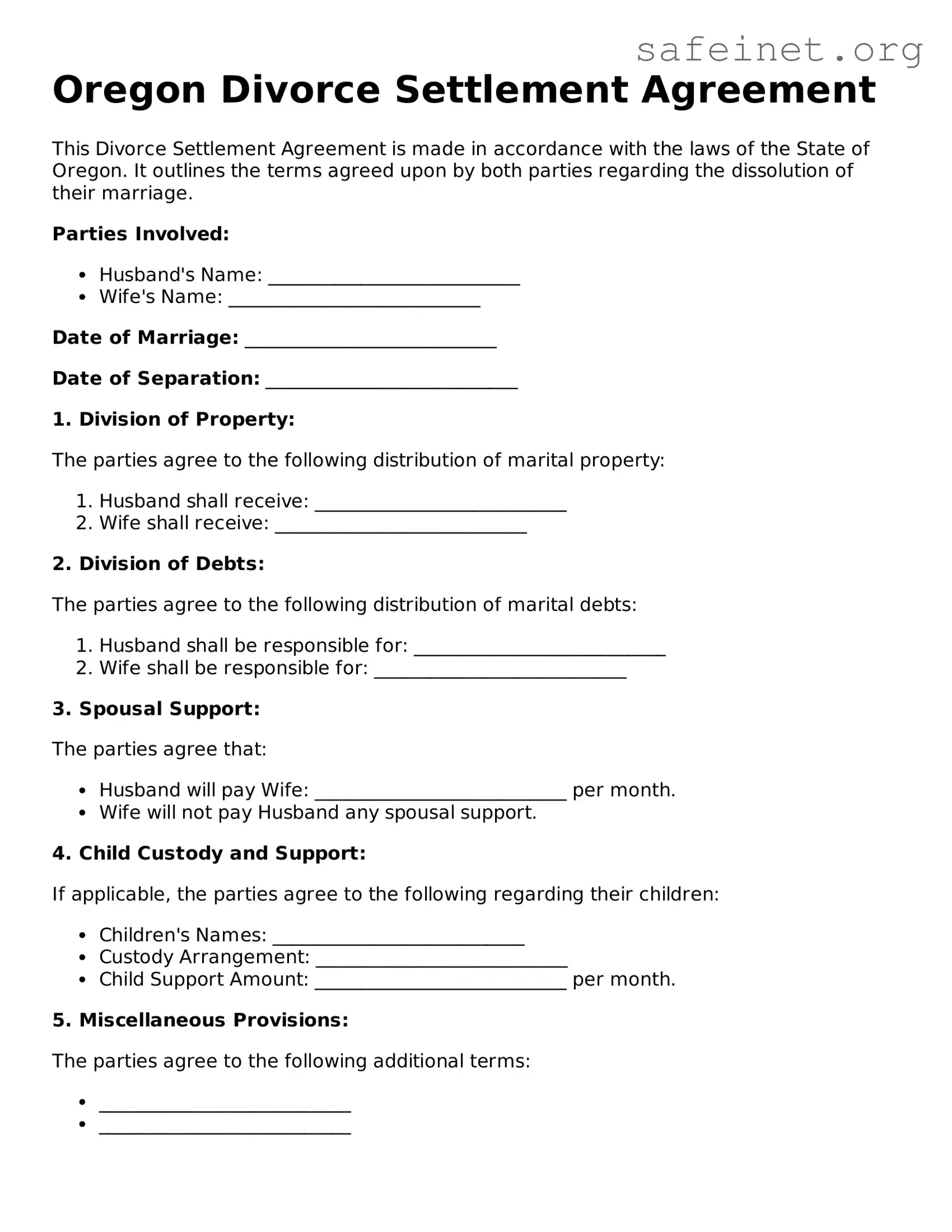
The Oregon Divorce Settlement Agreement form plays a crucial role in the divorce process, serving as a comprehensive document that outlines the terms agreed upon by both parties. This form addresses various aspects of the divorce, including the division of property, spousal support, child custody, and child support arrangements. By clearly detailing these agreements, the form helps to ensure that both parties have a mutual understanding of their rights and responsibilities following the divorce. Additionally, the document may include provisions for the division of debts and any other relevant financial matters. Completing this form accurately is essential, as it can significantly impact the lives of those involved. Understanding the components of the agreement is vital for individuals navigating the complexities of divorce in Oregon.
Oregon Divorce Settlement Agreement
This Divorce Settlement Agreement is made in accordance with the laws of the State of Oregon. It outlines the terms agreed upon by both parties regarding the dissolution of their marriage.
Parties Involved:
Date of Marriage: ___________________________
Date of Separation: ___________________________
1. Division of Property:
The parties agree to the following distribution of marital property:
2. Division of Debts:
The parties agree to the following distribution of marital debts:
3. Spousal Support:
The parties agree that:
4. Child Custody and Support:
If applicable, the parties agree to the following regarding their children:
5. Miscellaneous Provisions:
The parties agree to the following additional terms:
This agreement is binding and enforceable under Oregon law. Both parties acknowledge that they have read and understood the terms of this agreement.
Signatures:
Husband: ___________________________ Date: _______________
Wife: ___________________________ Date: _______________
| Fact Name | Details |
|---|---|
| Purpose | The Oregon Divorce Settlement Agreement form outlines the terms agreed upon by both spouses regarding the division of assets, debts, and other relevant matters during a divorce. |
| Governing Law | This form is governed by the Oregon Revised Statutes, particularly ORS Chapter 107, which deals with dissolution of marriage. |
| Mutual Agreement | Both parties must mutually agree on the terms included in the settlement to ensure the document is valid and enforceable. |
| Filing Requirement | Once completed and signed, the agreement must be filed with the court as part of the divorce proceedings. |
| Modification | The terms of the agreement can be modified if both parties consent and the court approves the changes. |
| Legal Representation | While not required, it is advisable for each party to seek independent legal advice before signing the agreement. |
| Child Custody and Support | If children are involved, the agreement must also address child custody and support, which are critical components of the settlement. |
| Enforceability | The agreement becomes legally binding once it is signed by both parties and approved by the court. |
Completing the Oregon Divorce Settlement Agreement form is an essential step in finalizing your divorce. This form outlines the agreements between both parties regarding property division, debt allocation, and other important matters. Once filled out, you will submit it to the court for approval, which will help ensure a smooth transition into your next chapter.
What is a Divorce Settlement Agreement in Oregon?
A Divorce Settlement Agreement is a legal document that outlines the terms of a divorce between two parties. It covers various aspects, including the division of assets, debts, child custody, and support arrangements. This agreement is crucial as it helps both parties reach a mutual understanding and can simplify the divorce process.
Who needs to use the Divorce Settlement Agreement form?
This form is typically used by couples who are going through a divorce in Oregon and have reached an agreement on the terms of their separation. If both parties are in agreement regarding the division of property, child custody, and other issues, this form can facilitate a smoother legal process.
What should be included in the Divorce Settlement Agreement?
Your Divorce Settlement Agreement should include details about the division of marital property, how debts will be handled, child custody arrangements, and any child or spousal support obligations. Clarity is key; the more detailed the agreement, the less likely disputes will arise later.
Is it necessary to have an attorney review the Divorce Settlement Agreement?
How do I file the Divorce Settlement Agreement in Oregon?
Once both parties have signed the Divorce Settlement Agreement, you will need to file it with the court as part of your divorce proceedings. This usually involves submitting the agreement along with your divorce petition and any other required documents to the appropriate court in your county.
Can the terms of the Divorce Settlement Agreement be modified later?
Yes, the terms of the Divorce Settlement Agreement can be modified, but both parties must agree to the changes. If circumstances change significantly, such as a change in income or living situation, you can petition the court to modify the agreement. Documentation will be necessary to support your request.
What happens if one party does not comply with the Divorce Settlement Agreement?
If one party fails to comply with the terms of the agreement, the other party can seek enforcement through the court. This may involve filing a motion for enforcement or contempt. The court can impose penalties or require compliance to ensure that the terms of the agreement are honored.
How long does it take to finalize a divorce with a Settlement Agreement?
The timeline for finalizing a divorce with a Settlement Agreement can vary. Generally, once the agreement is filed and approved by the court, the divorce can be finalized relatively quickly. However, the overall process may take several months, depending on court schedules and any additional issues that may arise.
Failing to provide complete information. Many individuals overlook the importance of filling in all required fields. Incomplete forms can lead to delays or even rejection.
Not understanding the terms. Some people sign the agreement without fully grasping the implications of the terms. It is crucial to comprehend what each clause means before agreeing.
Omitting assets or debts. Individuals sometimes forget to list all assets or debts. This can result in unfair distributions later on.
Ignoring state laws. Each state has specific requirements for divorce settlements. Not adhering to Oregon’s regulations can invalidate the agreement.
Neglecting to address future changes. Some people do not consider how future life changes—like job loss or relocation—might affect the agreement. Planning for contingencies is essential.
Rushing the process. Filling out the form hastily can lead to mistakes. Taking time to review each section carefully helps ensure accuracy.
Not consulting a professional. Some individuals choose to complete the form without seeking advice. Consulting a legal expert can provide valuable insights and help avoid pitfalls.
Failing to sign and date properly. It is vital to ensure that all parties sign and date the document correctly. Missing signatures can render the agreement unenforceable.
When navigating the complexities of divorce, several forms and documents accompany the Oregon Divorce Settlement Agreement. Each of these plays a vital role in ensuring that the divorce process is thorough and fair for both parties involved. Below is a list of key documents that are often used alongside the Divorce Settlement Agreement.
Understanding these documents can significantly ease the divorce process. Each one serves a specific purpose and contributes to a fair resolution for both parties. Being well-informed about these forms can help individuals navigate their divorce with confidence and clarity.
The Oregon Divorce Settlement Agreement form shares similarities with the Marital Settlement Agreement. Both documents outline the terms agreed upon by spouses regarding the division of property, debts, and any arrangements related to child custody and support. Each agreement aims to resolve issues amicably, allowing both parties to move forward without further litigation. The clarity and detail in these documents help prevent future disputes and provide a clear framework for both parties to follow.
Another related document is the Separation Agreement. This document is often used when couples decide to live apart but are not yet ready to file for divorce. Like the Divorce Settlement Agreement, it addresses issues such as asset division, spousal support, and child custody. The primary difference lies in the fact that a Separation Agreement may be temporary, while the Divorce Settlement Agreement is finalized upon divorce.
The Child Custody Agreement is also similar, focusing specifically on the arrangements for children. This document details custody arrangements, visitation schedules, and parental responsibilities. While the Divorce Settlement Agreement may include custody terms, the Child Custody Agreement provides a more focused approach, ensuring that the best interests of the children are prioritized.
In addition, the Property Settlement Agreement is closely related. This document specifically addresses the division of marital property and debts. It serves as a formal record of how assets will be divided, which is also a key component of the Divorce Settlement Agreement. Both documents aim to ensure that each party understands their rights and obligations regarding property division.
The Parenting Plan is another document that complements the Divorce Settlement Agreement. This plan outlines how parents will raise their children post-divorce, detailing schedules, decision-making processes, and communication methods. While the Divorce Settlement Agreement may touch on parenting arrangements, the Parenting Plan provides a comprehensive guide to co-parenting, ensuring that both parents are on the same page.
The Spousal Support Agreement, or Alimony Agreement, is relevant as well. This document specifies the terms of financial support one spouse will provide to the other after separation or divorce. While the Divorce Settlement Agreement may include provisions for spousal support, this separate agreement focuses solely on financial obligations, making it easier for both parties to understand their responsibilities.
Lastly, the Financial Disclosure Statement is crucial in the context of divorce. This document requires both parties to disclose their financial situations, including income, assets, and debts. It ensures transparency and fairness in the divorce process. The information provided in the Financial Disclosure Statement often informs the terms of the Divorce Settlement Agreement, making it an essential component of the overall divorce proceedings.
When filling out the Oregon Divorce Settlement Agreement form, it is crucial to approach the process with care. Here are ten important do's and don'ts to consider:
When it comes to the Oregon Divorce Settlement Agreement form, several misconceptions often arise. Understanding these can help individuals navigate the divorce process more smoothly. Here are four common misconceptions:
Understanding these misconceptions can empower individuals to approach their divorce with clarity and confidence.
When navigating the Oregon Divorce Settlement Agreement form, it’s essential to keep several key points in mind. Here are some important takeaways to consider:
By keeping these takeaways in mind, you can navigate the Oregon Divorce Settlement Agreement form more effectively, ensuring a smoother process during a challenging time.