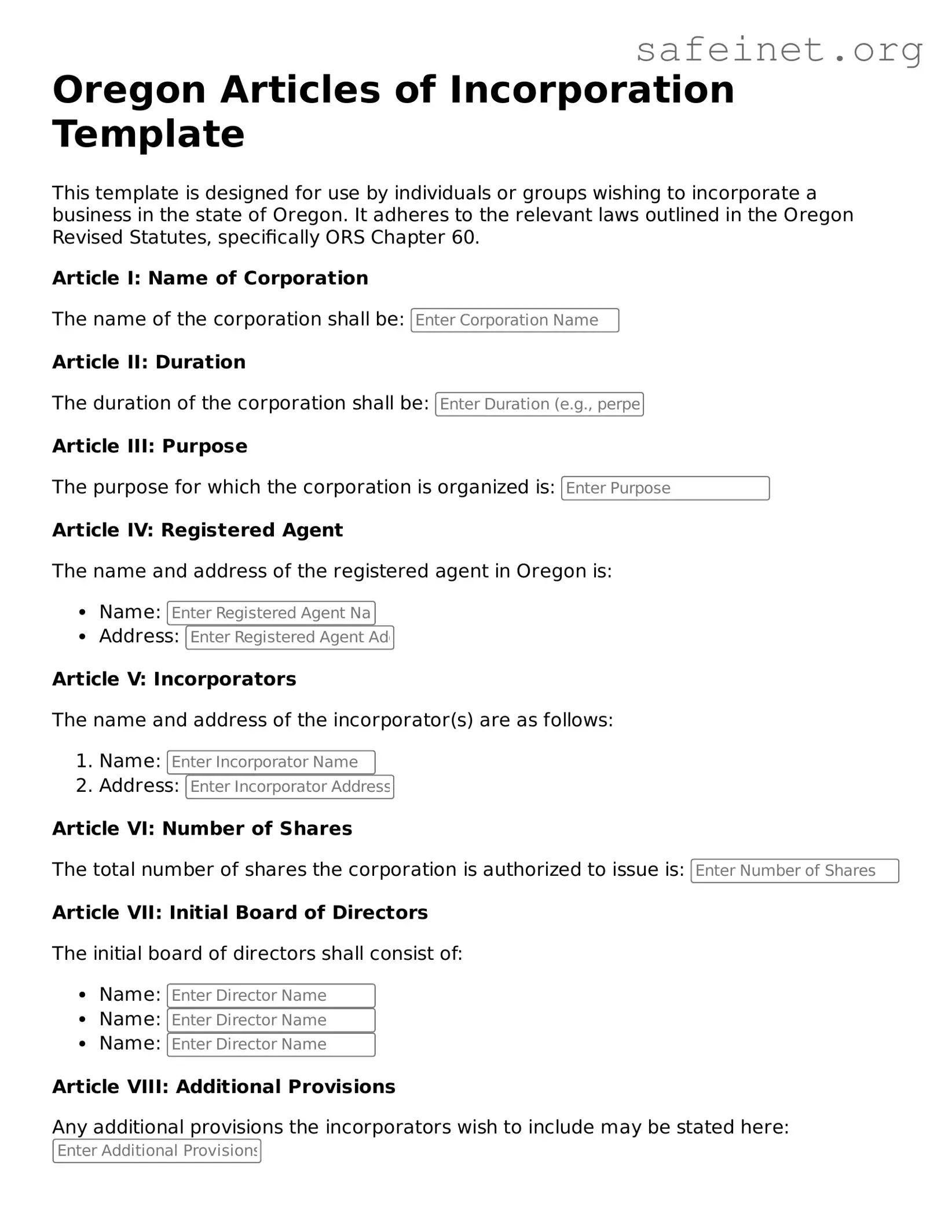
Starting a business in Oregon involves several important steps, and one of the first is completing the Articles of Incorporation form. This document serves as a foundational piece for your corporation, outlining essential details that define your business structure. Key aspects include the corporation's name, which must be unique and compliant with state regulations. You'll also need to provide the purpose of your corporation, ensuring it aligns with legal requirements. The form requires information about the registered agent, who will handle official communications on behalf of the corporation. Additionally, it asks for details about the number of shares the corporation is authorized to issue, which is crucial for potential investors and shareholders. By carefully filling out this form, you set the stage for your corporation's legal existence and establish a framework for its operations in Oregon.
Oregon Articles of Incorporation Template
This template is designed for use by individuals or groups wishing to incorporate a business in the state of Oregon. It adheres to the relevant laws outlined in the Oregon Revised Statutes, specifically ORS Chapter 60.
Article I: Name of Corporation
The name of the corporation shall be:
Article II: Duration
The duration of the corporation shall be:
Article III: Purpose
The purpose for which the corporation is organized is:
Article IV: Registered Agent
The name and address of the registered agent in Oregon is:
Article V: Incorporators
The name and address of the incorporator(s) are as follows:
Article VI: Number of Shares
The total number of shares the corporation is authorized to issue is:
Article VII: Initial Board of Directors
The initial board of directors shall consist of:
Article VIII: Additional Provisions
Any additional provisions the incorporators wish to include may be stated here:
IN WITNESS WHEREOF, the undersigned incorporator(s) have executed these Articles of Incorporation on this ____ day of __________, 20__.
Signature of Incorporator: ____________________________
Print Name:
| Fact Name | Description |
|---|---|
| Purpose | The Articles of Incorporation establish a corporation as a legal entity in Oregon. |
| Governing Law | The form is governed by the Oregon Business Corporation Act (ORS Chapter 60). |
| Filing Fee | A filing fee is required when submitting the Articles of Incorporation to the state. |
| Required Information | Key information includes the corporation's name, registered agent, and business address. |
| Duration | The corporation can be established for a specific period or indefinitely. |
| Number of Directors | The form must specify the number of initial directors, which can be as few as one. |
| Effective Date | The Articles can specify an effective date, which may differ from the filing date. |
| Amendments | Changes to the Articles of Incorporation can be made through a formal amendment process. |
After you complete the Oregon Articles of Incorporation form, you'll need to submit it to the Secretary of State along with the required filing fee. This will officially register your business in Oregon.
What is the purpose of the Oregon Articles of Incorporation form?
The Oregon Articles of Incorporation form is a crucial document for anyone looking to establish a corporation in the state of Oregon. This form officially creates your corporation, outlining its basic structure and purpose. It serves as a public record, detailing important information such as the corporation's name, the registered agent, and the number of shares authorized for issuance. Filing this form is the first step in the process of becoming a legally recognized business entity in Oregon.
Who needs to file the Articles of Incorporation?
Any individual or group planning to form a corporation in Oregon must file the Articles of Incorporation. This includes businesses of all sizes, from small startups to larger enterprises. If you intend to operate as a corporation, completing and submitting this form is a necessary requirement to ensure compliance with state laws.
What information is required on the form?
The form requires several key pieces of information. You will need to provide the name of your corporation, which must be unique and not already in use by another entity in Oregon. Additionally, you must include the address of the corporation's principal office, the name and address of the registered agent, and details about the corporation's authorized shares. Other optional provisions may also be included, depending on your specific needs.
How do I file the Articles of Incorporation?
Filing the Articles of Incorporation can be done online or by mail. If you choose to file online, you can visit the Oregon Secretary of State's website, where you will find the necessary forms and instructions. For mail filings, you can download the form, complete it, and send it to the appropriate office along with the required filing fee. Make sure to double-check that all information is accurate to avoid delays in processing.
What is the filing fee for the Articles of Incorporation?
The filing fee for the Articles of Incorporation in Oregon is typically around $100, but this amount can vary depending on the specifics of your filing. Always check the latest fee schedule on the Oregon Secretary of State's website to ensure you have the correct amount. Payment can be made via credit card if filing online or by check if filing by mail.
How long does it take for the Articles of Incorporation to be processed?
The processing time for the Articles of Incorporation can vary. Generally, if you file online, you may receive confirmation of your filing within a few business days. Mail filings may take longer, sometimes up to several weeks. It is advisable to plan accordingly, especially if you have specific deadlines for your business operations.
What happens after my Articles of Incorporation are approved?
Once your Articles of Incorporation are approved, your corporation is officially recognized by the state of Oregon. You will receive a certificate of incorporation, which serves as proof of your corporation's existence. Afterward, you will need to comply with ongoing requirements, such as filing annual reports and maintaining good standing with the state. This is an important step to ensure your corporation continues to operate legally and effectively.
Failing to provide the correct name of the corporation. The name must be unique and not similar to existing businesses in Oregon.
Omitting the purpose of the corporation. A clear statement of purpose is required to inform the state of the corporation's intended activities.
Not including the registered agent's information. Every corporation must designate a registered agent with a physical address in Oregon.
Incorrectly listing the number of shares authorized. The form requires specific details about the share structure, which should be accurately reflected.
Neglecting to sign and date the form. The Articles of Incorporation must be signed by the incorporators to be valid.
When forming a corporation in Oregon, the Articles of Incorporation is a crucial document. However, there are several other forms and documents that are often required or beneficial to complete the incorporation process. Here’s a brief overview of these essential documents.
Completing these documents accurately is essential for a smooth incorporation process in Oregon. Each plays a vital role in ensuring that the corporation operates within the law and establishes a solid foundation for future growth.
The Articles of Incorporation in Oregon share similarities with the Certificate of Incorporation commonly used in other states. Both documents serve as foundational legal papers that establish a corporation's existence. They typically include essential information such as the corporation's name, its purpose, the registered agent, and the number of shares it is authorized to issue. The Certificate of Incorporation, like the Articles of Incorporation, is filed with the state government and is crucial for obtaining legal recognition and protection for the corporation's name and structure.
Another document that parallels the Articles of Incorporation is the Bylaws of a corporation. While the Articles of Incorporation lay the groundwork for the corporation's existence, the Bylaws provide the internal rules and procedures for governance. They detail how meetings are conducted, how directors are elected, and how decisions are made within the corporation. Both documents are essential for legal compliance and operational clarity, but they serve different functions within the corporate framework.
The Operating Agreement used by Limited Liability Companies (LLCs) is also comparable to the Articles of Incorporation. Like the Articles, an Operating Agreement outlines the structure and operational guidelines of the business entity. It specifies the roles of members, management procedures, and profit distribution, thus ensuring clarity among owners. While the Articles of Incorporation pertain specifically to corporations, the Operating Agreement serves a similar purpose for LLCs, both providing a legal framework for the respective entities.
Lastly, the Statement of Information is another document that bears resemblance to the Articles of Incorporation. This document is often required shortly after incorporation and provides updated information about the corporation's address, officers, and business activities. While the Articles of Incorporation establish the corporation, the Statement of Information serves to keep the state informed about any changes, ensuring that the corporation remains in good standing. Both documents are vital for maintaining transparency and compliance with state regulations.
When filling out the Oregon Articles of Incorporation form, it’s important to follow certain guidelines. Here are ten things you should and shouldn’t do:
Following these guidelines can help ensure a smoother process when incorporating your business in Oregon.
The Articles of Incorporation are a crucial step in establishing a corporation in Oregon, yet many misconceptions surround this process. Understanding these misconceptions can help individuals navigate the incorporation process more effectively.
In Oregon, filing Articles of Incorporation is mandatory for corporations. Without this formal document, a business cannot be recognized as a corporation by the state.
While there is no strict deadline for filing, it is advisable to submit the Articles of Incorporation before conducting business activities. This ensures legal protection and compliance from the outset.
This is not true. Nonprofit organizations in Oregon must also file Articles of Incorporation to gain legal status and eligibility for tax exemptions.
A registered agent is required for the incorporation process. This individual or business entity acts as the official point of contact for legal documents and notices.
These two documents serve different purposes. The Articles of Incorporation establish the corporation's legal existence, while a business license allows the business to operate legally within a specific locality.
In fact, amendments can be made to the Articles of Incorporation after they have been filed. This allows for flexibility as the business evolves.
On the contrary, certain information is necessary, including the corporation's name, purpose, registered agent, and the number of shares authorized. Omitting this information can lead to delays or rejection.
While filing is an important step, it does not ensure success. A solid business plan, effective management, and market research are essential for achieving long-term viability.
Filling out and using the Oregon Articles of Incorporation form is an important step for anyone looking to establish a corporation in the state. Here are some key takeaways to consider: