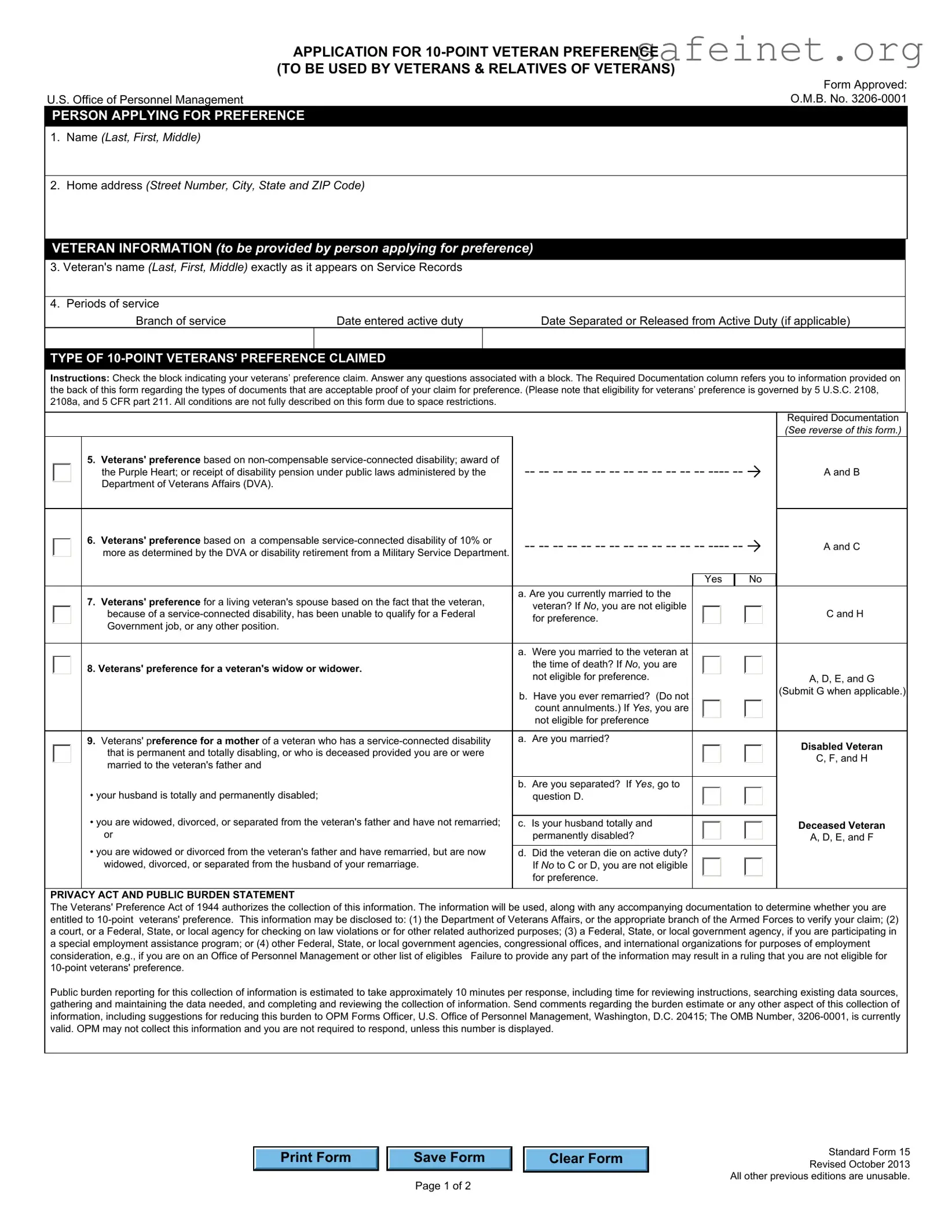
The OPM Standard Form 15 is a crucial document for individuals seeking to apply for federal employment under the Veterans' Preference Act. This form plays a significant role in ensuring that eligible veterans receive the benefits and considerations they deserve during the hiring process. It is designed to gather essential information about the applicant's military service, including dates of service, discharge status, and any relevant documentation that supports their claim for preference. Completing this form accurately is vital, as it directly impacts the applicant's standing in competitive hiring situations. Additionally, the form serves as a means to verify eligibility for various veterans' benefits, making it an important step for those who have served in the military. Understanding the requirements and implications of the OPM Standard Form 15 is essential for veterans looking to navigate the federal job market effectively.
|
APPLICATION FOR |
|
(TO BE USED BY VETERANS & RELATIVES OF VETERANS) |
|
Form Approved: |
U.S. Office of Personnel Management |
O.M.B. No. |
PERSON APPLYING FOR PREFERENCE
1.Name (Last, First, Middle)
2.Home address (Street Number, City, State and ZIP Code)
VETERAN INFORMATION (to be provided by person applying for preference)
3.Veteran's name (Last, First, Middle) exactly as it appears on Service Records
4.Periods of service
Branch of service |
Date entered active duty |
Date Separated or Released from Active Duty (if applicable) |
TYPE OF
Instructions: Check the block indicating your veterans’ preference claim. Answer any questions associated with a block. The Required Documentation column refers you to information provided on the back of this form regarding the types of documents that are acceptable proof of your claim for preference. (Please note that eligibility for veterans’ preference is governed by 5 U.S.C. 2108, 2108a, and 5 CFR part 211. All conditions are not fully described on this form due to space restrictions.
|
|
|
|
|
|
|
|
|
|
|
|
|
Required Documentation |
|
|
|
|
|
|
|
|
|
|
|
|
|
(See reverse of this form.) |
|
|
5. Veterans' preference based on |
|
||||||||||
|
|
|
the Purple Heart; or receipt of disability pension under public laws administered by the |
A and B |
|||||||||
|
|
|
Department of Veterans Affairs (DVA). |
|
|
|
|
|
|
|
|
|
|
|
|
|
|
|
|
|
|
|
|
|
|
|
|
|
|
6. |
Veterans' preference based on a compensable |
A and C |
|||||||||
|
|
||||||||||||
|
|
|
more as determined by the DVA or disability retirement from a Military Service Department. |
||||||||||
|
|
|
|
|
|
|
|
|
|
|
|||
|
|
|
|
|
|
|
Yes |
|
No |
|
|||
|
|
7. Veterans' preference for a living veteran's spouse based on the fact that the veteran, |
a. Are you currently married to the |
|
|
|
|||||||
|
|
veteran? If No, you are not eligible |
|
|
|
|
|
|
|
||||
|
|
|
because of a |
for preference. |
|
|
|
|
|
|
C and H |
||
|
|
|
Government job, or any other position. |
|
|
|
|
|
|
|
|
|
|
|
|
|
|
|
|
|
|
|
|
|
|
|
|
|
|
|
|
|
a. Were you married to the veteran at |
|
|
|
|
|
|
|
|
|
|
8. Veterans' preference for a veteran's widow or widower. |
the time of death? If No, you are |
|
|
|
|
|
|
||||
|
|
not eligible for preference. |
|
|
|
|
|
|
A, D, E, and G |
||||
|
|
|
|
|
|
|
|
|
|
||||
|
|
|
|
|
b. Have you ever remarried? (Do not |
|
|
|
|
|
|
(Submit G when applicable.) |
|
|
|
|
|
|
count annulments.) If Yes, you are |
|
|
|
|
|
|
|
|
|
|
|
|
|
not eligible for preference |
|
|
|
|
|
|
||
|
|
|
|
|
|
|
|
|
|
|
|
|
|
|
|
9. |
Veterans' preference for a mother of a veteran who has a |
a. Are you married? |
|
|
|
|
|
|
Disabled Veteran |
||
|
|
|
that is permanent and totally disabling, or who is deceased provided you are or were |
|
|
|
|
|
|
|
|
||
|
|
|
|
|
|
|
|
|
|
|
C, F, and H |
||
|
|
|
married to the veteran's father and |
|
|
|
|
|
|
|
|
|
|
|
|
|
|
|
|
|
|
|
|
|
|
|
|
|
|
• your husband is totally and permanently disabled; |
b. Are you separated? If Yes, go to |
|
|
|
|
|
|
|
|||
|
|
question D. |
|
|
|
|
|
|
|
||||
|
|
|
|
|
|
|
|
|
|
|
|||
|
|
• you are widowed, divorced, or separated from the veteran's father and have not remarried; |
|
c. Is your husband totally and |
|
|
|
|
|
|
Deceased Veteran |
||
|
|
|
|
|
|
|
|
||||||
|
|
|
or |
permanently disabled? |
|
|
|
|
|
A, D, E, and F |
|||
|
|
|
|
|
|
|
|
||||||
|
|
• you are widowed or divorced from the veteran's father and have remarried, but are now |
|
d. Did the veteran die on active duty? |
|
|
|
||||||
|
|
|
widowed, divorced, or separated from the husband of your remarriage. |
If No to C or D, you are not eligible |
|
|
|
|
|
|
|
||
|
|
|
|
|
for preference. |
|
|
|
|
|
|
||
PRIVACY ACT AND PUBLIC BURDEN STATEMENT
The Veterans' Preference Act of 1944 authorizes the collection of this information. The information will be used, along with any accompanying documentation to determine whether you are entitled to
Public burden reporting for this collection of information is estimated to take approximately 10 minutes per response, including time for reviewing instructions, searching existing data sources, gathering and maintaining the data needed, and completing and reviewing the collection of information. Send comments regarding the burden estimate or any other aspect of this collection of information, including suggestions for reducing this burden to OPM Forms Officer, U.S. Office of Personnel Management, Washington, D.C. 20415; The OMB Number,
Print Form
Save Form
Page 1 of 2
Clear Form
Standard Form 15 Revised October 2013 All other previous editions are unusable.

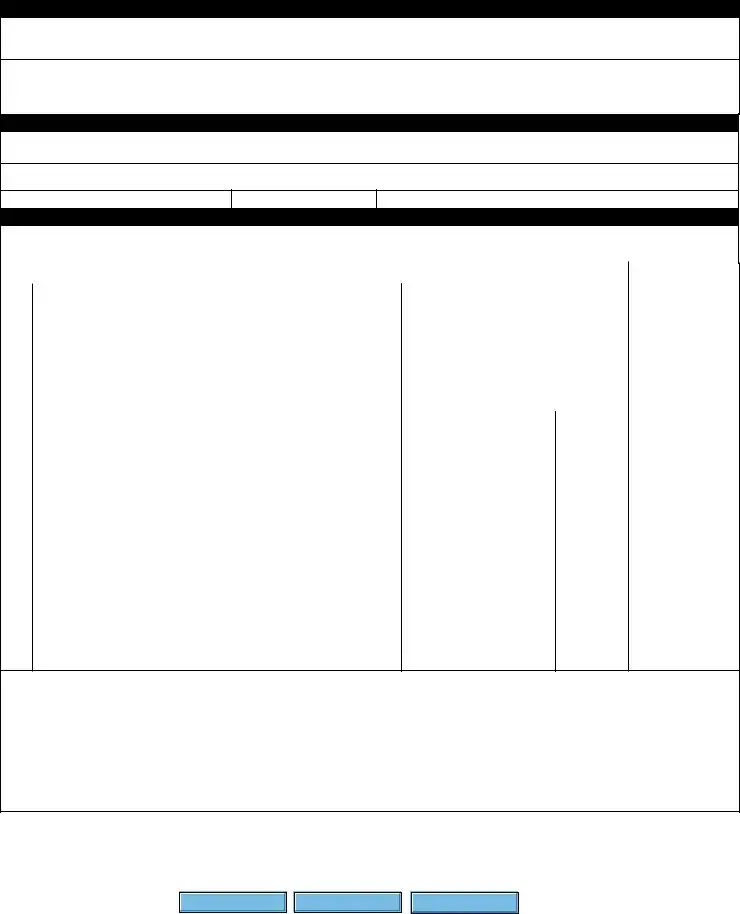
DOCUMENTATION REQUIRED - READ CAREFULLY
Please submit photocopies of documents because they will not be returned.
A. Documentation of Service and Separation. |
For spouses and mothers of disabled veterans, who checked item 7 or |
||
Any official document or statement from the Armed Forces showing |
9, submit the following: |
||
|
|
||
separation, discharge or release from active duty is under honorable |
An official statement, dated 1991 or later, from the Department of |
||
conditions (Honorable or General Discharge). Note: Only the branch of |
Veterans Affairs, or from a branch of the Armed Forces, certifying: |
||
service in which the individual served can certify active duty service |
• |
the present existence of the veterans |
|
was performed “Under Honorable Conditions.” Such documents |
|||
include, but are not limited to: |
• |
the percentage and nature of the |
|
• |
|
disabilities (including the combined percentage); and |
|
• |
Retirement or separation orders |
• |
a notation as to whether or not the |
• |
Documents showing transfer to any of the reserve corps of the Armed |
|
rated as permanent and total. |
|
|
||
|
Forces |
D. Documentation of Veteran's Death |
|
• |
Certification: any written document from the armed forces that certifies |
• |
If death occurred while not on active military duty, submit certified |
|
the service member is expected to be discharged or released from |
|
copy of death certificate. |
|
active duty service in the armed forces under honorable conditions not |
• |
When a veteran dies on active duty, the family does not receive a DD |
|
later than 120 days after the date the certification is signed. |
||
• |
Official statement from military personnel records center |
|
Form 214; the family receives a DD Form 1300, Report of Casualty, on |
|
which there is no place to record the character of service. Thus, when |
||
B. Documentation of |
|
a veteran dies on active duty, his or her service should be presumed to |
|
|
be under honorable conditions unless the military service specifically |
||
(less than 10%); Purple Heart, and |
|
||
|
indicates otherwise. |
||
Pension. Such documents include, but are not limited to: |
|
||
|
|
||
•An official statement, dated 1991 or later, from the Department of E. Documentation of Service or Death During a War, in a Campaign or
Veterans Affairs or from a branch of the Armed Forces, certifying to the |
Expedition for which a Campaign Badge is Authorized, or During |
|
present existence of the veteran's |
the Period Authorized, or During the Period of April 28, 1952 |
|
than 10%. |
through July 1, 1955. |
|
• An official citation, document, or discharge certificate, issued by a |
Submit documentation of service or death during a war or during the |
|
branch of the Armed Forces, showing the award to the veteran of the |
period April 28, 1952, through July 1,1955, or during a campaign or |
|
Purple Heart. |
expedition for which a campaign badge is authorized. |
|
•. An official statement, dated 1991 or later, from the Department of |
F. Documentation of Deceased or Disabled Veteran's Mother's Claim |
|
Veterans Affairs, certifying that the veteran is receiving a nonservice- |
||
for Preference because of Her Husband's Total and Permanent |
||
connected disability pension. |
||
Disability. |
||
C. Documentation of Compensable |
||
Submit a statement from husband's physician showing the prognosis |
||
(10% or more). Such documents include, but are not limited to: |
||
of his disease and percentage of his disability. |
||
|
•An official document, dated 1991 or later, from the Department of
Veterans Affairs, or from a branch of the Armed Forces, certifying that G. Documentation of Annulment of Remarriage by Widow or Widower
|
|
the veteran has a |
of Veteran. |
|
|
|
|
|
|
|
|
|
|
|||
|
• An official document or retired orders from a branch of the Armed |
Submit either: |
|
|
|
|
|
|
|
|
|
|
||||
|
|
Forces, showing that the veteran was retired due to a service- |
|
|
|
|
|
|
|
|
|
|
|
|
||
|
|
connected disability or has been transferred to a Disability Retirement |
• |
Certification from the Department of Veterans Affairs that entitlement to |
||||||||||||
|
|
List with a |
|
pension or compensation was restored due to annulment; or |
|
|||||||||||
|
|
|
|
|
• |
A certified copy of the court decree of annulment. |
|
|
|
|
|
|||||
|
|
|
|
|
H. Documentation of Veteran's Inability to Work Because of a Service- |
|||||||||||
|
|
|
|
|
Connected Disability. |
|
|
|
|
|
|
|
|
|
||
|
|
|
|
|
Answer questions |
|
|
|
|
|
|
|
||||
|
|
|
|
|
|
|
|
|
|
|
||||||
1. |
Is the veteran currently working? If No, go to Item 3. |
2. If currently working, what is the veteran's present occupation? |
|
|
|
|
|
|||||||||
|
|
Yes |
No |
|
|
|
|
|
|
|
|
|
|
|
|
|
|
|
|
|
|
|
|
|
|
|
|
|
|
|
|
||
|
|
|
|
|
|
|
|
|
|
|
|
|
||||
3. |
What was the veteran's occupation, if any, before military service? |
|
|
|
|
|
4. What was the veteran's military occupation |
|||||||||
|
|
|
|
|
|
|
|
|
|
|
at the time of separation? |
|
||||
|
|
|
|
|
|
|
|
|
|
|
||||||
5. |
Has the veteran been employed, or is he/she now employed, by the Federal civil service or D.C. Government? |
|
|
|
|
|
|
|
Yes |
No |
||||||
|
|
|
|
|
|
|
||||||||||
|
|
|
|
|
|
|
|
|
||||||||
A. Title and Grade of position most recently, or currently, held |
B. Name and address of agency |
|
|
|
C. Dates of employment |
|
||||||||||
|
|
|
|
|
|
|
|
|
|
From: |
To: |
|
||||
6. Has the veteran resigned from, been disqualified for, or separated from a position in the Federal civil service or D.C. Government |
|
|
|
|
|
|||||||||||
|
along the lines of his/her usual occupation because of |
|
|
|
|
|
|
|
|
|
Yes |
No |
||||
|
If Yes, submit documentation of the resignation, disqualification, or separation. |
|
|
|
|
|
|
|
|
|
|
|||||
|
|
|
|
|
|
|
|
|
|
|
|
|
|
|
|
|
7. Is the veteran receiving a civil service retirement pension? |
|
|
|
Yes |
No |
|
|
|
|
|
|
|
||||
|
If Yes, give the Civil Service annuity (CSA) or Federal employee retirement annuity number. |
|
CSA# |
|
|
|
|
|
||||||||
Standard Form 15
Page 2 of 2Revised October 2013 All other previous editions are unusable.
| Fact Name | Details |
|---|---|
| Purpose | The OPM Standard Form 15 is used to apply for disability retirement under the Federal Employees Retirement System (FERS) and the Civil Service Retirement System (CSRS). |
| Eligibility | To qualify, an applicant must be a federal employee who has completed at least 18 months of service and is unable to perform their job due to a medical condition. |
| Submission Process | The form must be submitted to the appropriate retirement office, along with supporting medical documentation. |
| Governing Law | This form is governed by federal laws pertaining to federal employee retirement, including the Federal Employees Retirement System Act. |
| Medical Documentation | Applicants need to provide comprehensive medical records, including a diagnosis and prognosis from a qualified healthcare provider. |
| Review Timeline | The review process can take several months, as the Office of Personnel Management evaluates the application and supporting documents. |
| Notification | Applicants will receive a notification regarding the approval or denial of their application once the review is complete. |
| Appeal Process | If denied, applicants have the right to appeal the decision within a specified timeframe, following the guidelines provided in the notification. |
Filling out the OPM Standard Form 15 is an important step for those seeking specific benefits. Completing this form accurately ensures that your request will be processed efficiently. Here are the steps to guide you through the process of filling out the form.
What is the OPM Standard Form 15?
The OPM Standard Form 15, also known as the Application for 10-Point Veteran Preference, is a form used by veterans to claim preference in federal employment. This preference is important as it provides veterans with a competitive edge when applying for jobs within the federal government. The form allows veterans to document their service and any disabilities they may have incurred, which can qualify them for additional points during the hiring process.
Who is eligible to use the OPM Standard Form 15?
Eligibility for using the OPM Standard Form 15 is primarily for veterans who have served in the military and have a service-connected disability. Specifically, veterans who have a disability rating of 10 percent or more from the Department of Veterans Affairs can apply for this preference. Additionally, certain family members of veterans may also be eligible under specific circumstances, such as surviving spouses or parents of deceased veterans.
How do I complete the OPM Standard Form 15?
Completing the OPM Standard Form 15 involves several steps. First, you will need to provide personal information, including your name, contact details, and military service history. Next, you will need to indicate your disability status and provide documentation to support your claim, such as your VA disability rating letter. It’s important to fill out the form accurately and completely, as any missing information may delay the processing of your application.
Where do I submit the OPM Standard Form 15?
Once you have completed the OPM Standard Form 15, you should submit it to the agency where you are applying for a job. Each federal agency may have its own submission process, so it’s essential to follow the instructions provided in the job announcement. Typically, you can submit the form electronically or by mail, depending on the agency's requirements.
What happens after I submit the OPM Standard Form 15?
After submitting the OPM Standard Form 15, the agency will review your application and the supporting documents you provided. If everything is in order, you will receive the appropriate veteran preference points added to your application. This can significantly enhance your chances of being selected for an interview or job offer. If there are any issues with your application, the agency may contact you for clarification or additional information.
Failing to provide complete personal information. Ensure that all fields, including name, address, and contact details, are filled out accurately.
Neglecting to sign and date the form. A signature is required to validate the submission, and the date indicates when the form was completed.
Inaccurate or inconsistent information. Double-check all entries for correctness to avoid discrepancies that could delay processing.
Omitting required documentation. Review the instructions carefully to ensure that all necessary supporting documents are included with the form.
Using incorrect or outdated versions of the form. Always download the latest version from the official OPM website to ensure compliance with current requirements.
Not following the submission guidelines. Adhere to the specified method of submission, whether it be electronic or paper, as outlined in the instructions.
Ignoring deadlines. Timely submission is crucial; missing a deadline can result in disqualification or delays.
Providing insufficient details about medical conditions. Clearly describe the nature and extent of any medical issues to support your claims.
Failing to keep copies of the submitted form and documents. Retain copies for your records in case of future inquiries or issues.
The OPM Standard Form 15 is essential for individuals seeking a disability retirement from federal service. However, several other forms and documents are often required to support the application process. Below is a list of these documents, each serving a unique purpose in the overall application procedure.
Each of these forms and documents plays a crucial role in ensuring a comprehensive application for disability retirement. Properly preparing and submitting these materials can significantly impact the outcome of the retirement request.
The OPM Standard Form 15, also known as the Application for 10-Point Veteran Preference, is designed for veterans seeking employment benefits. It serves a specific purpose, but several other forms share similarities in intent or structure. Understanding these documents can provide insight into how they function within the realm of veteran affairs and employment preferences.
One such document is the Standard Form 180 (SF-180), which is used to request military service records. Like the SF-15, the SF-180 is crucial for veterans seeking to establish their eligibility for benefits. Both forms require personal information and details about military service, ensuring that veterans can access the necessary documentation to support their claims.
Another similar document is the VA Form 21-526EZ, which is the Application for Disability Compensation and Related Compensation Benefits. This form is essential for veterans who want to apply for disability benefits. Both the SF-15 and VA Form 21-526EZ help veterans navigate the benefits system, requiring detailed information about military service and any disabilities incurred during that time.
The DD Form 214 is also comparable, as it serves as a certificate of release or discharge from active duty. This document is vital for veterans, providing proof of service that can be used in conjunction with the SF-15 to claim veteran preference in hiring. Both forms emphasize the importance of accurate military documentation in securing benefits and opportunities.
The Federal Employment Opportunity Commission (EEOC) Form 462 is another document that shares similarities. This form is used to file a complaint regarding employment discrimination. While its focus is different, both the SF-15 and EEOC Form 462 advocate for the rights of individuals in the employment context, underscoring the significance of fair treatment for veterans in the workforce.
Moreover, the VA Form 21-534EZ, which is the Application for DIC, Death Pension, and Accrued Benefits, is similar in that it addresses benefits for veterans and their families. Both forms require detailed personal and military information, facilitating the process of claiming benefits based on service and sacrifice.
The Standard Form 50 (SF-50) is also relevant, as it is used to document personnel actions for federal employees. This form is often used to verify employment status, which can be important for veterans applying for preference under the SF-15. Both forms highlight the significance of accurate employment records in securing veteran benefits.
Additionally, the VA Form 10-10EZ, which is the Application for Health Benefits, serves a similar purpose by enabling veterans to access healthcare services. Like the SF-15, this form requires comprehensive personal information to determine eligibility, emphasizing the need for veterans to have streamlined access to various benefits.
The Standard Form 86 (SF-86), used for security clearance applications, also shares some characteristics. While its primary focus is on national security, both forms require extensive personal history and background information. This process helps ensure that veterans are eligible for positions that may require security clearance, further integrating them into the workforce.
Finally, the VA Form 21-4192, known as the Request for Employment Information in Connection with Claim for Disability Benefits, is another related document. It is used to gather information about a veteran's employment history, which can be essential when filing for benefits. Both the SF-15 and VA Form 21-4192 play critical roles in helping veterans navigate the complex landscape of benefits and employment opportunities.
When filling out the OPM Standard Form 15, it’s important to approach the process with care. Here are some key points to keep in mind:
Understanding the OPM Standard Form 15 is important for those seeking to apply for disability retirement benefits. However, several misconceptions can lead to confusion. Here are eight common misunderstandings:
This is not true. While the form is designed for federal employees, others can also benefit from understanding its purpose and requirements.
Submitting the form does not automatically mean that your application will be approved. Each case is evaluated on its own merits.
While severe conditions are often considered, less severe conditions can also qualify if they significantly impact your ability to work.
Form 15 is important, but additional documentation may be necessary to support your application.
You can amend your application if new information arises or if you realize you made an error.
Processing times can vary widely based on individual circumstances and the volume of applications received.
This form can also be used for those who have temporary disabilities that may affect their ability to work.
By addressing these misconceptions, individuals can approach the application process with a clearer understanding and greater confidence.
When filling out and using the OPM Standard Form 15, consider the following key takeaways: