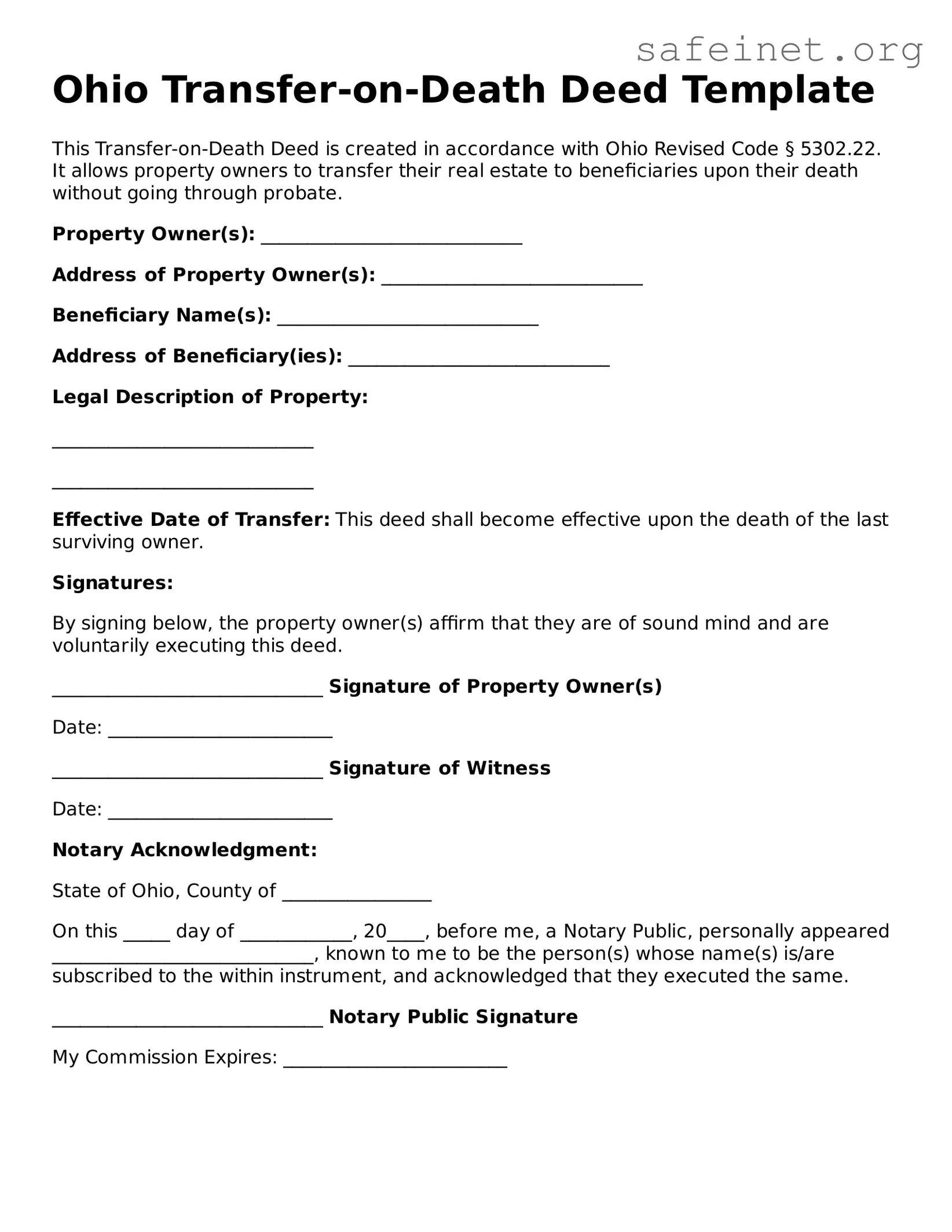
The Ohio Transfer-on-Death Deed form serves as a valuable estate planning tool, allowing property owners to designate beneficiaries who will automatically receive their real estate upon their death. This deed effectively bypasses the lengthy and often costly probate process, providing a straightforward means of transferring property without the need for court intervention. By utilizing this form, individuals can maintain control over their assets during their lifetime while ensuring a seamless transition to their chosen heirs. The form requires clear identification of the property and the beneficiaries, along with the signatures of the property owner and a witness. Additionally, it must be filed with the county recorder’s office to be legally effective. Understanding the nuances of this form is essential for anyone looking to simplify their estate planning and secure their loved ones' future. With its straightforward approach, the Transfer-on-Death Deed reflects a growing trend toward efficient and accessible estate management in Ohio.
Ohio Transfer-on-Death Deed Template
This Transfer-on-Death Deed is created in accordance with Ohio Revised Code § 5302.22. It allows property owners to transfer their real estate to beneficiaries upon their death without going through probate.
Property Owner(s): ____________________________
Address of Property Owner(s): ____________________________
Beneficiary Name(s): ____________________________
Address of Beneficiary(ies): ____________________________
Legal Description of Property:
____________________________
____________________________
Effective Date of Transfer: This deed shall become effective upon the death of the last surviving owner.
Signatures:
By signing below, the property owner(s) affirm that they are of sound mind and are voluntarily executing this deed.
_____________________________ Signature of Property Owner(s)
Date: ________________________
_____________________________ Signature of Witness
Date: ________________________
Notary Acknowledgment:
State of Ohio, County of ________________
On this _____ day of ____________, 20____, before me, a Notary Public, personally appeared ____________________________, known to me to be the person(s) whose name(s) is/are subscribed to the within instrument, and acknowledged that they executed the same.
_____________________________ Notary Public Signature
My Commission Expires: ________________________
| Fact Name | Detail |
|---|---|
| Purpose | The Ohio Transfer-on-Death Deed allows property owners to transfer real estate to beneficiaries upon their death without going through probate. |
| Governing Law | This deed is governed by Ohio Revised Code Section 5302.22. |
| Requirements | The deed must be signed by the property owner and notarized. It should also be recorded with the county recorder's office. |
| Revocation | Property owners can revoke the Transfer-on-Death Deed at any time before their death by recording a new deed or a revocation form. |
Once you have the Ohio Transfer-on-Death Deed form ready, you can proceed to fill it out with the necessary information. This form allows you to designate beneficiaries for your property, ensuring that it transfers smoothly upon your passing. Follow these steps carefully to complete the form accurately.
What is a Transfer-on-Death Deed in Ohio?
A Transfer-on-Death Deed (TOD) is a legal document that allows a property owner in Ohio to transfer real estate to a designated beneficiary upon their death. This deed does not affect the property owner’s rights during their lifetime and allows for a seamless transfer of ownership without the need for probate.
How does a Transfer-on-Death Deed work?
The property owner completes the TOD deed, naming one or more beneficiaries. Once the owner passes away, the property automatically transfers to the beneficiaries without going through probate. This process simplifies the transfer and can save time and money for the beneficiaries.
Who can be a beneficiary on a Transfer-on-Death Deed?
Any individual or entity can be named as a beneficiary on a TOD deed. This includes family members, friends, or even organizations. However, it is important to ensure that the beneficiary is legally capable of receiving the property.
Can a Transfer-on-Death Deed be revoked or changed?
Yes, a property owner can revoke or change a TOD deed at any time during their lifetime. This can be done by executing a new deed that explicitly revokes the previous one or by filing a formal revocation document with the county recorder’s office.
Is a Transfer-on-Death Deed subject to creditors?
Generally, a Transfer-on-Death Deed does not protect the property from creditors. If the deceased had outstanding debts, creditors may still have the right to claim against the property before it is transferred to the beneficiaries.
What are the requirements for executing a Transfer-on-Death Deed in Ohio?
To execute a valid TOD deed in Ohio, the property owner must be at least 18 years old and of sound mind. The deed must be signed by the owner in the presence of a notary public and then recorded with the county recorder’s office where the property is located.
Are there any tax implications associated with a Transfer-on-Death Deed?
While the transfer of property through a TOD deed typically does not incur immediate tax consequences, it is advisable to consult with a tax professional. Beneficiaries may be subject to property taxes or capital gains taxes upon the sale of the property after the transfer.
Can a Transfer-on-Death Deed be used for all types of property?
In Ohio, a Transfer-on-Death Deed can be used for most types of real estate, including residential and commercial properties. However, it cannot be used for personal property, such as vehicles or bank accounts, which require different transfer methods.
What happens if the beneficiary predeceases the property owner?
If a named beneficiary dies before the property owner, the TOD deed typically becomes void for that beneficiary. The property owner can then designate a new beneficiary or allow the property to pass according to their will or Ohio’s intestacy laws if no will exists.
Incomplete Information: Many individuals fail to provide all necessary details, such as the full legal names of the property owners or the beneficiaries. This can lead to confusion or delays in the transfer process.
Incorrect Property Description: A common mistake is not accurately describing the property. This includes missing details like the parcel number or the legal description, which are crucial for identifying the property.
Not Signing the Deed: Some people forget to sign the deed. A signature is essential for the deed to be valid and enforceable. Without it, the transfer cannot take place.
Failure to Notarize: The deed must be notarized to be legally binding. Omitting this step can invalidate the transfer, causing unnecessary complications for the beneficiaries.
Not Understanding the Implications: Some individuals do not fully grasp how a Transfer-on-Death Deed works. It’s important to understand that this deed does not affect ownership during the owner’s lifetime.
Ignoring State Laws: Each state has specific requirements for Transfer-on-Death Deeds. Failing to adhere to Ohio's laws can result in the deed being rejected or challenged.
Not Informing Beneficiaries: It’s vital to communicate with the beneficiaries about the deed. Not doing so can lead to misunderstandings or disputes after the property owner passes away.
When dealing with property transfers in Ohio, the Transfer-on-Death Deed is a useful tool. However, several other forms and documents often accompany this deed to ensure a smooth transfer process and to address various legal requirements. Below is a list of these documents, along with a brief description of each.
Understanding these documents can help individuals navigate the complexities of property transfer in Ohio. Each plays a vital role in ensuring that assets are managed and distributed according to the owner's wishes.
The Ohio Transfer-on-Death Deed (TOD) is similar to a Last Will and Testament. Both documents allow individuals to dictate how their property will be distributed after their passing. However, while a will goes through probate, which can be a lengthy process, a TOD deed allows for a more straightforward transfer of property without the need for probate. This can save time and reduce stress for loved ones during a difficult period.
An Affidavit of Heirship shares similarities with the TOD deed as well. This document is used to establish the rightful heirs of a deceased person's estate when there is no will. Both documents aim to clarify property ownership after death. However, the Affidavit of Heirship is often used when a person passes away without a will, while the TOD deed is a proactive measure taken by property owners to ensure their wishes are followed.
Filling out the Ohio Transfer-on-Death Deed form can be straightforward, but it's important to approach it carefully. Here’s a list of things you should and shouldn’t do to ensure the process goes smoothly.
By following these guidelines, you can help ensure that your Transfer-on-Death Deed is filled out correctly and meets all necessary requirements.
The Ohio Transfer-on-Death Deed (TODD) form is a useful tool for estate planning, but several misconceptions can lead to confusion. Understanding these misconceptions can help individuals make informed decisions about their property and estate. Here are eight common misunderstandings regarding the Ohio Transfer-on-Death Deed:
Clarifying these misconceptions can help individuals better navigate their estate planning options and make choices that align with their wishes and needs.
The Ohio Transfer-on-Death Deed allows property owners to transfer real estate to beneficiaries upon their death without going through probate.
To be valid, the deed must be signed by the property owner and notarized.
It is essential to record the deed with the county recorder's office where the property is located to ensure its effectiveness.
Beneficiaries do not have any rights to the property until the owner's death, which means the owner can sell or mortgage the property during their lifetime.
Property owners can revoke or change the deed at any time before their death, providing flexibility in estate planning.
Consulting with a legal professional is advisable to ensure the deed complies with state laws and accurately reflects the owner’s wishes.