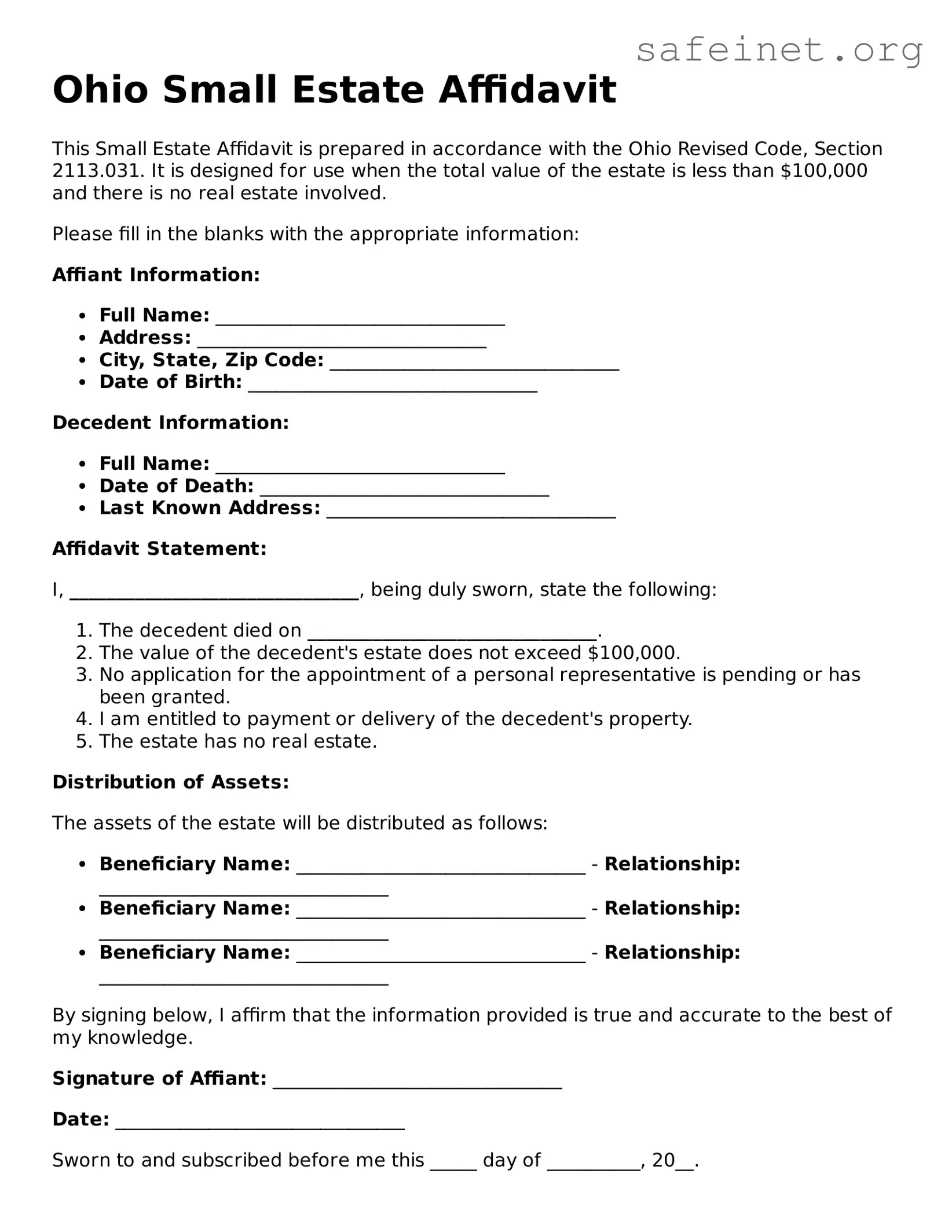
Navigating the complexities of estate matters can often feel overwhelming, especially during a time of loss. For those in Ohio, the Small Estate Affidavit provides a streamlined process for settling the estates of individuals who have passed away, making it easier for heirs to access assets without the need for lengthy probate proceedings. This form is particularly beneficial for estates valued at $100,000 or less, excluding real estate. By utilizing the Small Estate Affidavit, heirs can claim personal property and financial assets more efficiently, allowing for a smoother transition during an already challenging time. The process involves gathering necessary information about the deceased’s assets, debts, and the rightful heirs, ensuring that all parties involved are treated fairly. With the right guidance, completing this form can empower families to handle their loved one's estate with dignity and respect.
Ohio Small Estate Affidavit
This Small Estate Affidavit is prepared in accordance with the Ohio Revised Code, Section 2113.031. It is designed for use when the total value of the estate is less than $100,000 and there is no real estate involved.
Please fill in the blanks with the appropriate information:
Affiant Information:
Decedent Information:
Affidavit Statement:
I, _______________________________, being duly sworn, state the following:
Distribution of Assets:
The assets of the estate will be distributed as follows:
By signing below, I affirm that the information provided is true and accurate to the best of my knowledge.
Signature of Affiant: _______________________________
Date: _______________________________
Sworn to and subscribed before me this _____ day of __________, 20__.
Notary Public: _______________________________
My Commission Expires: _______________________________
| Fact Name | Details |
|---|---|
| Purpose | The Ohio Small Estate Affidavit is used to simplify the process of transferring assets from a deceased person's estate. |
| Eligibility | It is applicable when the total value of the estate is $100,000 or less, excluding real estate. |
| Governing Law | The affidavit is governed by Ohio Revised Code Section 2113.031. |
| Filing Requirements | The form must be signed by the person claiming the estate and notarized. |
| Assets Covered | It can be used for various assets, including bank accounts, personal property, and vehicles. |
| Real Estate Exclusion | Real estate is not included in the $100,000 limit for the small estate affidavit. |
| Timeframe | The affidavit should be submitted within a reasonable time after the death of the individual. |
| Multiple Affidavits | Multiple heirs can file separate affidavits for their respective shares of the estate. |
After gathering the necessary information and documents, you can begin filling out the Ohio Small Estate Affidavit form. This form is used to simplify the process of settling a small estate without going through probate. Ensure that you have all relevant details at hand before starting.
Once the form is filled out and notarized, it can be submitted to the probate court in the county where the decedent lived. Be prepared to provide any additional documentation that may be required by the court.
What is the Ohio Small Estate Affidavit?
The Ohio Small Estate Affidavit is a legal document that allows heirs to claim the assets of a deceased person without going through the lengthy probate process. This form is particularly useful for estates that do not exceed a certain value, making it a more efficient option for settling smaller estates.
Who can use the Small Estate Affidavit in Ohio?
Generally, any person who is entitled to inherit under Ohio law can use the Small Estate Affidavit. This typically includes spouses, children, and other close relatives. However, it's important to ensure that the total value of the estate falls below the threshold set by Ohio law, which is currently $100,000 in personal property and $300,000 in real property.
What assets can be claimed using the Small Estate Affidavit?
With the Small Estate Affidavit, you can claim a variety of assets, including bank accounts, vehicles, and personal belongings. Real estate can also be included, but the total value must remain within the limits specified by law. Always verify the current thresholds, as they can change over time.
How do I complete the Small Estate Affidavit?
Completing the Small Estate Affidavit involves filling out the form with details about the deceased, the heirs, and the assets. You will need to provide information such as the date of death, the value of the estate, and any debts owed. Once completed, the affidavit must be signed in the presence of a notary public.
Do I need to file the Small Estate Affidavit with the court?
No, the Small Estate Affidavit does not need to be filed with the probate court. Instead, you can present it directly to the institutions holding the deceased’s assets, such as banks or title companies. They will use the affidavit to transfer the assets to the rightful heirs.
Is there a deadline for using the Small Estate Affidavit?
There is no specific deadline for filing a Small Estate Affidavit in Ohio. However, it is advisable to act promptly after the death of the individual. Delaying the process can complicate matters, especially if there are outstanding debts or claims against the estate.
What if there are disputes among heirs regarding the Small Estate Affidavit?
If disputes arise among heirs, it may complicate the use of the Small Estate Affidavit. In such cases, it might be necessary to seek legal advice or consider going through the formal probate process. Open communication among heirs can often help resolve issues before they escalate.
Not Including All Required Information: One common mistake is failing to provide all necessary details. Make sure to include the decedent's full name, date of death, and the value of the estate. Omitting even one piece of information can lead to delays or rejections.
Improper Signatures: Signatures are crucial. Ensure that all required parties sign the affidavit. If someone is supposed to sign but doesn’t, it can invalidate the document.
Incorrect Value Estimation: Accurately estimating the total value of the estate is essential. Underestimating or overestimating can cause issues. If the estate exceeds the small estate limit, you may need to pursue a different legal route.
Failure to Notify Heirs: It's important to inform all heirs about the filing of the Small Estate Affidavit. Neglecting this step can lead to disputes later on, as heirs may not be aware of their rights.
Not Following Local Court Rules: Each county may have specific rules regarding the Small Estate Affidavit. Ignoring these local guidelines can result in complications. Always check with your local court for any unique requirements.
When navigating the process of settling a small estate in Ohio, various forms and documents may be required in conjunction with the Ohio Small Estate Affidavit. Each of these documents serves a specific purpose in ensuring a smooth transition of assets and responsibilities. Below is a list of commonly used forms that can aid in this process.
Understanding these documents and their roles in the estate settlement process can significantly ease the burden during a challenging time. Being prepared with the necessary forms can help ensure that the wishes of the deceased are honored and that the heirs can move forward with clarity and confidence.
The Ohio Small Estate Affidavit is similar to a Last Will and Testament in that both documents are used to distribute a deceased person's assets. A Last Will outlines the wishes of the deceased regarding the distribution of their property and may appoint an executor to manage the estate. However, the Small Estate Affidavit serves a different purpose. It allows heirs to bypass the formal probate process for smaller estates, enabling them to claim assets directly without the need for court intervention, provided the estate meets certain value thresholds.
Another document that shares similarities is the Affidavit of Heirship. This document is often used when someone dies without a will. It serves to establish the rightful heirs of the deceased's estate. Like the Small Estate Affidavit, the Affidavit of Heirship can simplify the transfer of property. However, it typically requires additional proof of the relationship between the deceased and the heirs, while the Small Estate Affidavit focuses more on the value of the estate and the heirs’ rights to claim it.
The Power of Attorney can also be likened to the Small Estate Affidavit in that both involve the management of an individual's assets. A Power of Attorney allows a person to designate someone else to make financial decisions on their behalf, which can be crucial if they become incapacitated. In contrast, the Small Estate Affidavit comes into play after death, facilitating the transfer of assets to heirs without formal probate proceedings.
Another related document is the Petition for Probate. This legal document is filed to initiate the probate process, allowing the court to oversee the distribution of a deceased person's estate. While the Small Estate Affidavit provides a streamlined alternative for smaller estates, the Petition for Probate is necessary for larger estates or when disputes arise. The key difference lies in the requirement of court involvement in probate versus the self-executing nature of the Small Estate Affidavit.
The Declaration of Trust can also be compared to the Small Estate Affidavit. A trust is a legal arrangement where one party holds property for the benefit of another. When a person passes away, assets held in a trust typically do not go through probate, similar to how a Small Estate Affidavit allows heirs to claim assets without court intervention. However, trusts require more formal setup and management, while the Small Estate Affidavit is a simpler, more direct method for transferring small estates.
The Release of Claim is another document that bears resemblance to the Small Estate Affidavit. It is used when an heir or beneficiary agrees to relinquish their right to a portion of an estate, often in exchange for something else. While the Small Estate Affidavit confirms the right to claim assets, a Release of Claim formalizes the decision to give up those rights. Both documents can facilitate smoother transactions among heirs but serve different purposes in the estate settlement process.
The Certificate of Trust is another document that can be likened to the Small Estate Affidavit. This certificate is used to verify the existence of a trust and the authority of the trustee. When a trust is involved, it can simplify the transfer of assets upon death, similar to how the Small Estate Affidavit allows for the quick transfer of small estates. However, a Certificate of Trust is specifically tied to trusts, while the Small Estate Affidavit pertains to estates without the need for probate.
Lastly, the Estate Inventory is similar in that it provides a detailed list of a deceased person's assets. This document is often required during the probate process to inform the court of what the estate contains. While the Small Estate Affidavit does not require a full inventory for smaller estates, it does require a declaration of the estate's value. Both documents aim to clarify the assets involved, but the Estate Inventory is more comprehensive and is used within the formal probate context.
When dealing with the Ohio Small Estate Affidavit, it’s essential to navigate the process carefully. Here’s a helpful list of what to do and what to avoid to ensure your application goes smoothly.
By following these guidelines, you can help ensure that your Small Estate Affidavit is processed efficiently and effectively.
The Ohio Small Estate Affidavit form is a useful tool for settling the estates of individuals who have passed away. However, several misconceptions surround its use. Here are four common misunderstandings:
Only estates under a certain value can use the affidavit. Many people believe that the Small Estate Affidavit can only be used for estates below a specific dollar amount. In Ohio, the threshold is currently set at $100,000 for personal property. However, this does not mean that only estates under this amount can utilize the form; it simply establishes the limit for eligibility.
The affidavit can replace a will. Some individuals mistakenly think that the Small Estate Affidavit serves as a substitute for a will. In reality, the affidavit is a tool for settling an estate when no formal probate process is necessary. It does not replace the need for a will, which outlines an individual's wishes regarding asset distribution.
Only heirs can file the affidavit. A common belief is that only heirs can submit the Small Estate Affidavit. While heirs typically file the affidavit, it can also be completed by a person who has been granted authority to act on behalf of the estate, such as an executor or administrator.
The process is quick and straightforward. Many assume that completing the Small Estate Affidavit is a simple and fast process. While it is designed to simplify estate settlement, it still requires careful attention to detail and compliance with specific legal requirements. Delays can occur if the form is not filled out correctly or if supporting documentation is missing.
Understanding these misconceptions can help individuals navigate the Small Estate Affidavit process more effectively and ensure that they are prepared to manage the estate of a loved one.
When dealing with the Ohio Small Estate Affidavit form, there are several important points to keep in mind. Below are key takeaways that can help guide you through the process:
By understanding these key aspects, individuals can navigate the Ohio Small Estate Affidavit process more effectively, ensuring a smoother transition of assets.