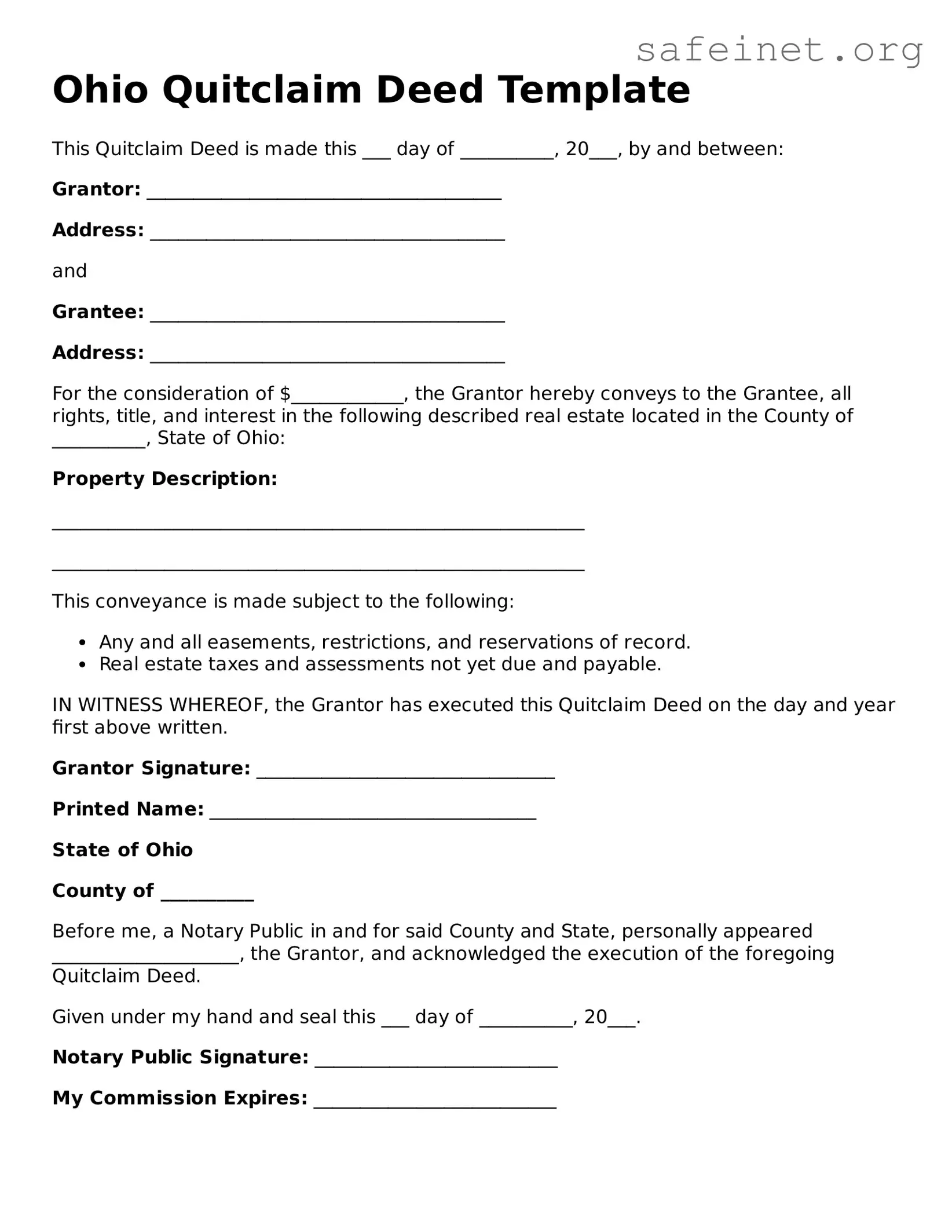
The Ohio Quitclaim Deed form serves as a crucial legal instrument for transferring property rights from one party to another. This document is particularly useful when the transferor—often referred to as the grantor—wishes to convey their interest in a property without making any warranties regarding the title. The simplicity of the Quitclaim Deed allows for efficient transactions, especially in situations where the parties involved have a pre-existing relationship, such as family members or friends. It is important to note that while this form facilitates the transfer of ownership, it does not guarantee that the title is free from liens or other encumbrances. Additionally, the Quitclaim Deed must be properly executed, including the signature of the grantor and, in some cases, the acknowledgment by a notary public. Once completed, the form should be filed with the county recorder's office to ensure that the change in ownership is officially recognized. Understanding the nuances of the Ohio Quitclaim Deed is essential for anyone considering property transfers, as it helps safeguard the interests of both the grantor and the grantee.
Ohio Quitclaim Deed Template
This Quitclaim Deed is made this ___ day of __________, 20___, by and between:
Grantor: ______________________________________
Address: ______________________________________
and
Grantee: ______________________________________
Address: ______________________________________
For the consideration of $____________, the Grantor hereby conveys to the Grantee, all rights, title, and interest in the following described real estate located in the County of __________, State of Ohio:
Property Description:
_________________________________________________________
_________________________________________________________
This conveyance is made subject to the following:
IN WITNESS WHEREOF, the Grantor has executed this Quitclaim Deed on the day and year first above written.
Grantor Signature: ________________________________
Printed Name: ___________________________________
State of Ohio
County of __________
Before me, a Notary Public in and for said County and State, personally appeared ____________________, the Grantor, and acknowledged the execution of the foregoing Quitclaim Deed.
Given under my hand and seal this ___ day of __________, 20___.
Notary Public Signature: __________________________
My Commission Expires: __________________________
| Fact Name | Description |
|---|---|
| Purpose | An Ohio Quitclaim Deed is used to transfer ownership of property from one person to another without guaranteeing that the title is clear. |
| Governing Law | The Ohio Revised Code, specifically Section 5302.11, governs the use and requirements of Quitclaim Deeds in Ohio. |
| No Warranty | Unlike other types of deeds, a Quitclaim Deed offers no warranty or guarantee about the property’s title, meaning the grantor is not responsible for any claims against it. |
| Common Uses | Quitclaim Deeds are often used in situations like transferring property between family members, divorces, or clearing up title issues. |
| Filing Requirements | After signing, the Quitclaim Deed must be filed with the county recorder’s office in the county where the property is located to be effective. |
After obtaining the Ohio Quitclaim Deed form, you’ll be ready to fill it out. This process involves providing specific information about the property and the parties involved in the transfer. Completing the form accurately is essential to ensure a smooth transfer of ownership.
What is a Quitclaim Deed in Ohio?
A Quitclaim Deed is a legal document used to transfer ownership of real estate from one party to another without any warranties. In Ohio, this type of deed allows the grantor to convey their interest in a property, but it does not guarantee that the title is clear or free from claims. It is often used in situations like transferring property between family members or in divorce settlements.
When should I use a Quitclaim Deed?
You might consider using a Quitclaim Deed when you want to transfer property ownership without the need for a title search or when you trust the recipient. Common scenarios include gifting property to a relative, adding a spouse to the title, or transferring property in a divorce. However, it is important to understand the implications, as the new owner may inherit any existing liens or claims against the property.
How do I complete a Quitclaim Deed in Ohio?
To complete a Quitclaim Deed in Ohio, you need to provide specific information. This includes the names of the grantor (the person transferring the property) and the grantee (the person receiving the property), a legal description of the property, and the date of the transfer. Once the form is filled out, it must be signed by the grantor in the presence of a notary public. The deed should then be filed with the county recorder's office where the property is located.
Is a Quitclaim Deed the same as a Warranty Deed?
No, a Quitclaim Deed is not the same as a Warranty Deed. A Warranty Deed provides a guarantee that the grantor holds clear title to the property and has the right to transfer it. In contrast, a Quitclaim Deed offers no such guarantees. The recipient accepts the property "as is," which means they assume any risks associated with the title.
Do I need a lawyer to prepare a Quitclaim Deed?
Are there any fees associated with filing a Quitclaim Deed?
Yes, there are typically fees associated with filing a Quitclaim Deed in Ohio. These fees can vary by county, so it is best to check with your local county recorder's office for the exact amount. Additionally, there may be costs related to notarization if you choose to have the deed notarized.
Can a Quitclaim Deed be revoked?
Once a Quitclaim Deed is executed and recorded, it generally cannot be revoked unilaterally. The transfer is considered final, and the grantee becomes the new owner of the property. If the grantor wishes to regain ownership, they may need to execute another deed to transfer the property back, which can involve additional legal processes.
What happens if the grantor has debts?
If the grantor has debts, those debts may still affect the property even after a Quitclaim Deed is executed. Creditors can place liens on the property, which means that the new owner could be responsible for those debts. It is crucial for the grantee to conduct due diligence and understand any potential financial obligations tied to the property before accepting a Quitclaim Deed.
Where can I obtain a Quitclaim Deed form in Ohio?
You can obtain a Quitclaim Deed form from various sources. Many county recorder's offices provide downloadable forms on their websites. Additionally, legal stationery stores and online legal form services offer templates that can be customized for your needs. Always ensure that the form you choose complies with Ohio state laws.
Incorrect Names: Ensure that the names of all parties involved are spelled correctly. Any errors can lead to complications in the transfer of property.
Missing Signatures: All grantors must sign the deed. Failing to include all necessary signatures can invalidate the document.
Improper Notarization: The deed must be notarized. If it isn’t properly notarized, it may not be recognized by the county recorder.
Incorrect Property Description: The property must be accurately described. Use the legal description found on the current deed, not just the address.
Omitting Consideration: You must indicate the consideration, or the amount paid for the property. Even if it’s a gift, this needs to be stated.
Failure to Record: After completing the deed, it must be recorded with the county. Not recording it can lead to disputes about ownership.
When transferring property in Ohio, the Quitclaim Deed is often used, but several other documents may accompany it to ensure a smooth transaction. Understanding these forms can help clarify the process and protect your interests. Below is a list of commonly used documents that may be necessary alongside the Quitclaim Deed.
By familiarizing yourself with these documents, you can navigate the property transfer process more effectively. Each form plays a vital role in ensuring that the transaction is legally sound and that both parties are protected throughout the process.
A warranty deed is a legal document that transfers property ownership with a guarantee. Unlike a quitclaim deed, which offers no warranties, a warranty deed assures the buyer that the seller holds clear title to the property and has the right to sell it. This means if any issues arise regarding ownership, the seller is responsible for resolving them. Buyers often prefer warranty deeds for this added protection.
A special warranty deed is similar to a warranty deed but with a key difference. It only guarantees that the seller has not caused any title issues during their ownership. If problems existed before the seller acquired the property, the seller is not liable. This type of deed provides some assurance to the buyer, but not as much as a full warranty deed.
A bargain and sale deed transfers property without any warranties. It implies that the seller has the right to sell the property but does not guarantee a clear title. This deed is often used in foreclosure sales or between parties who know each other well, as the lack of warranties can be risky for the buyer.
A grant deed is another document that conveys property. It offers some assurances to the buyer, such as confirming that the seller has not sold the property to anyone else. However, like a quitclaim deed, it does not guarantee a clear title. Grant deeds are commonly used in many states and provide a middle ground between quitclaim and warranty deeds.
A deed of trust is a document used in real estate transactions involving a loan. It transfers the title of the property to a trustee, who holds it as security for the loan. If the borrower defaults, the trustee can sell the property to recover the owed amount. While it serves a different purpose than a quitclaim deed, both documents involve the transfer of property rights.
An easement deed grants a person or entity the right to use a portion of someone else's property for a specific purpose. This could include access to a road or utility lines. While it does not transfer ownership, it establishes a legal right similar to how a quitclaim deed transfers ownership without warranties.
A lease agreement allows one party to use another's property for a specified time in exchange for rent. While it does not transfer ownership, it creates a legal relationship regarding property use. Like a quitclaim deed, a lease agreement can be straightforward, but it lacks the complexities of ownership transfer.
A life estate deed conveys property to a person for their lifetime. After their death, the property passes to another designated individual. This document allows for continued use and enjoyment of the property, similar to how a quitclaim deed allows for the transfer of ownership rights.
A foreclosure deed is issued when a property is sold at a foreclosure auction. It transfers ownership from the borrower to the winning bidder. While this deed signifies a change in ownership, it often comes with risks, similar to those found in a quitclaim deed, as buyers may face title issues.
Finally, a release deed is used to relinquish a party's interest in a property. This can occur when a mortgage is paid off or when a co-owner wants to transfer their share. While it does not create new ownership, it serves to clarify property rights, much like a quitclaim deed does during a transfer.
When filling out the Ohio Quitclaim Deed form, there are important guidelines to follow. Here’s a list of things you should and shouldn’t do:
When dealing with real estate transactions in Ohio, it's important to understand the Quitclaim Deed form. However, several misconceptions can lead to confusion. Here are four common misunderstandings:
Many believe that a quitclaim deed guarantees a complete transfer of ownership. While it does transfer whatever interest the grantor has, it does not guarantee that the grantor has any ownership to transfer.
Some think quitclaim deeds are exclusively used for family transactions. In reality, they can be used in various situations, including sales between unrelated parties or to clear up title issues.
A common misconception is that a quitclaim deed comes with title insurance. However, title insurance must be purchased separately, and a quitclaim deed does not protect against any claims or liens on the property.
Not all quitclaim deeds are created equal. Variations may exist based on specific state requirements or individual circumstances, so it’s essential to ensure that the deed complies with Ohio law.
Understanding these misconceptions can help individuals navigate property transfers more effectively and avoid potential pitfalls.
When it comes to transferring property ownership in Ohio, the Quitclaim Deed is a common choice. Here are some key takeaways to keep in mind when filling out and using this form:
By keeping these points in mind, individuals can navigate the Quitclaim Deed process more confidently and effectively.