Prenuptial agreements, often referred to as "prenups," serve as a vital tool for couples planning to marry in Ohio. These legal documents outline the financial and property rights of each partner in the event of a divorce or separation. By addressing issues such as asset division, debt responsibility, and spousal support, a prenuptial agreement can provide clarity and peace of mind for both parties. In Ohio, the prenup must be in writing and signed by both individuals to be enforceable. Additionally, it’s important that both partners fully disclose their financial situations before signing. This transparency helps ensure that the agreement is fair and equitable. Couples may also include provisions for any future children, outlining how assets will be managed and protected. Understanding the key components of the Ohio Prenuptial Agreement form can help couples navigate this important step in their relationship with confidence.
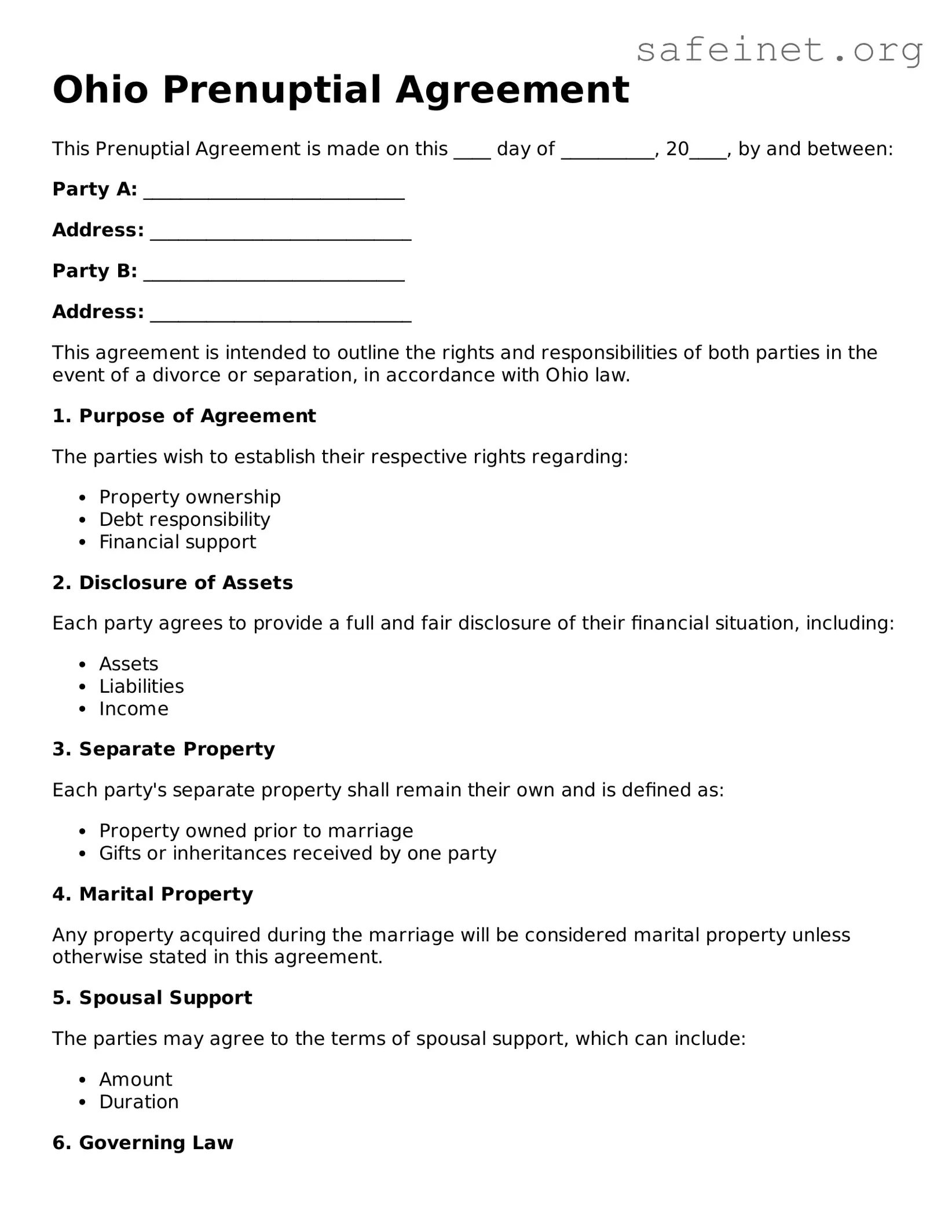
Ohio Prenuptial Agreement
This Prenuptial Agreement is made on this ____ day of __________, 20____, by and between:
Party A: ____________________________
Address: ____________________________
Party B: ____________________________
Address: ____________________________
This agreement is intended to outline the rights and responsibilities of both parties in the event of a divorce or separation, in accordance with Ohio law.
1. Purpose of Agreement
The parties wish to establish their respective rights regarding:
2. Disclosure of Assets
Each party agrees to provide a full and fair disclosure of their financial situation, including:
3. Separate Property
Each party's separate property shall remain their own and is defined as:
4. Marital Property
Any property acquired during the marriage will be considered marital property unless otherwise stated in this agreement.
5. Spousal Support
The parties may agree to the terms of spousal support, which can include:
6. Governing Law
This agreement shall be governed by the laws of the State of Ohio.
7. Amendments
This agreement can only be amended in writing and signed by both parties.
8. Acknowledgment
Both parties acknowledge that they have read and understood this agreement and have had the opportunity to consult with legal counsel.
IN WITNESS WHEREOF, the parties have executed this Prenuptial Agreement as of the date first above written.
_____________________________ _____________________________
Party A Signature Party B Signature
_____________________________ _____________________________
Date Date
| Fact Name | Details |
|---|---|
| Definition | An Ohio prenuptial agreement is a legal document that outlines the distribution of assets and responsibilities in the event of a divorce or separation. |
| Governing Law | Ohio Revised Code Section 3103.06 governs prenuptial agreements in Ohio. |
| Requirements | Both parties must voluntarily sign the agreement, and it should be in writing to be enforceable. |
| Disclosure | Full financial disclosure is required for the agreement to be valid, ensuring both parties understand their financial situations. |
| Enforceability | Courts may invalidate a prenuptial agreement if it is found to be unconscionable or if one party did not have adequate representation. |
Filling out the Ohio Prenuptial Agreement form is a straightforward process. It requires careful attention to detail to ensure that all necessary information is accurately provided. Once completed, the form will be ready for both parties to review and sign.
After filling out the form, ensure that both parties retain a signed copy for their records. It is advisable to consult with a legal professional to confirm that the agreement meets all legal requirements and adequately reflects both parties' intentions.
What is a prenuptial agreement in Ohio?
A prenuptial agreement, often called a prenup, is a legal contract made by two people before they get married. It outlines how assets and debts will be divided in the event of a divorce or separation. This agreement can also address other matters such as spousal support and property rights. In Ohio, both parties must agree to the terms for the prenup to be valid.
Why should couples consider a prenuptial agreement?
Couples may consider a prenup for various reasons. It can provide clarity and security regarding financial matters, especially if one or both partners have significant assets, business interests, or children from previous relationships. A prenup can help prevent conflicts in the future by clearly defining expectations and responsibilities.
What are the requirements for a valid prenuptial agreement in Ohio?
For a prenuptial agreement to be valid in Ohio, it must be in writing and signed by both parties. Each person should fully disclose their financial situation, including assets, debts, and income. Additionally, the agreement should be fair and not heavily favor one party over the other. It's advisable for both parties to seek independent legal advice to ensure their rights are protected.
Can a prenuptial agreement be changed after marriage?
Yes, a prenuptial agreement can be modified or revoked after marriage. Both parties must agree to the changes in writing. It’s important to follow the same legal formalities as the original agreement, including full disclosure of financial information and obtaining legal advice if necessary.
What happens if a couple gets divorced and has a prenuptial agreement?
If a couple with a valid prenuptial agreement gets divorced, the terms of the agreement will typically dictate how assets and debts are divided. Courts generally uphold prenuptial agreements as long as they were created fairly and both parties understood what they were signing. However, if there are concerns about fairness or if the agreement was signed under duress, a court may choose to disregard it.
Is it necessary to hire a lawyer for a prenuptial agreement in Ohio?
While it’s not legally required to hire a lawyer for a prenuptial agreement in Ohio, it is highly recommended. A lawyer can help ensure that the agreement is legally sound, fair, and tailored to the specific needs of both parties. Having legal representation can also help avoid potential disputes in the future.
How can couples create a prenuptial agreement in Ohio?
Couples can create a prenuptial agreement by drafting the document themselves or using an online template. However, consulting with a lawyer is the best approach to ensure that all legal requirements are met. Both parties should discuss their financial situations and what they want included in the agreement. Once the terms are agreed upon, the document must be signed by both parties to be enforceable.
Not fully disclosing assets and debts. Both parties should provide a complete picture of their financial situation. This includes bank accounts, property, and any outstanding loans.
Failing to consult with a legal professional. It is important to seek guidance from an attorney who specializes in family law. This can help ensure that the agreement is valid and enforceable.
Using vague or unclear language. Clarity is key in a prenuptial agreement. Ambiguous terms can lead to misunderstandings and disputes later on.
Not considering future changes. Life circumstances can change, such as having children or changes in income. It is wise to include provisions that address potential future scenarios.
Signing under pressure or without adequate time to review. Both parties should have enough time to read and understand the agreement before signing. Rushing this process can lead to regret later.
When preparing for marriage, many couples consider a prenuptial agreement to outline their financial arrangements and protect their individual assets. However, this document is often accompanied by several others that help clarify and support the terms of the agreement. Below is a list of common forms and documents that are frequently used alongside the Ohio Prenuptial Agreement.
Each of these documents serves a specific purpose and can complement the Ohio Prenuptial Agreement. Understanding their roles can help couples navigate the complexities of marriage and financial planning, ensuring that both parties feel secure and informed.
The Ohio Prenuptial Agreement form shares similarities with a Marital Settlement Agreement. Both documents serve to outline the terms of asset division and responsibilities during a marriage and in the event of a divorce. A Marital Settlement Agreement is typically created after marriage, while a prenuptial agreement is established before marriage. However, both aim to provide clarity and prevent disputes regarding financial matters and property rights.
Another document akin to the Ohio Prenuptial Agreement is the Cohabitation Agreement. This type of agreement is used by couples who choose to live together without marrying. Like a prenuptial agreement, it addresses the division of assets and responsibilities, ensuring both parties understand their rights and obligations. The primary difference lies in the legal status of the relationship, with prenuptial agreements applying specifically to married couples.
A Postnuptial Agreement is also similar to the Ohio Prenuptial Agreement. This document is created after marriage, serving a similar purpose in outlining the division of assets and financial responsibilities. Both agreements are designed to protect individual interests, but a postnuptial agreement may be used to address changes in circumstances that occur after marriage, such as the acquisition of new assets or changes in income.
The Separation Agreement bears resemblance to the Ohio Prenuptial Agreement as well. This document is typically executed when a couple decides to live apart and outlines the terms of their separation, including asset division and support obligations. While a prenuptial agreement is proactive, a separation agreement is often reactive, responding to the realities of a couple’s decision to separate.
Similar to the Ohio Prenuptial Agreement is the Domestic Partnership Agreement. This document is used by couples in a domestic partnership, which may not have the same legal recognition as marriage. Like prenuptial agreements, domestic partnership agreements define the rights and responsibilities of each partner, particularly concerning property and financial matters.
The Ohio Prenuptial Agreement can also be compared to a Will. While a will primarily addresses the distribution of assets upon death, both documents require careful consideration of how assets will be handled. A prenuptial agreement focuses on asset management during a marriage and in the event of divorce, while a will is concerned with posthumous distribution.
Another document that shares characteristics with the Ohio Prenuptial Agreement is a Trust Agreement. Trusts are often used to manage assets for beneficiaries, similar to how a prenuptial agreement manages assets between spouses. Both documents can include provisions for asset protection, although trusts are typically more focused on estate planning and long-term management of assets.
The Ohio Prenuptial Agreement is also similar to a Financial Disclosure Statement. This document is often part of the prenuptial process, requiring each party to disclose their financial situation. Transparency is essential in both documents to ensure that both parties understand their financial rights and obligations, thereby minimizing potential disputes.
Finally, the Ohio Prenuptial Agreement can be likened to a Non-Disclosure Agreement (NDA) in certain contexts. An NDA is used to protect sensitive information, while a prenuptial agreement may include clauses that protect financial information or personal assets from public disclosure. Both documents aim to safeguard the interests of the parties involved, albeit in different contexts.
When filling out the Ohio Prenuptial Agreement form, it’s essential to approach the process thoughtfully. Here are some important dos and don’ts to keep in mind:
Many people have misunderstandings about prenuptial agreements, particularly in Ohio. Here are seven common misconceptions:
This is not true. Prenuptial agreements can benefit couples of all income levels. They help clarify financial responsibilities and protect individual assets, regardless of wealth.
While they do provide clarity in case of divorce, these agreements can also outline financial expectations during the marriage. They serve as a tool for communication about finances.
When properly drafted, prenuptial agreements are generally enforceable in Ohio courts. They must meet specific legal requirements to ensure their validity.
There are limitations on what can be included. Courts will not enforce provisions related to child custody or child support, as these issues are determined based on the child's best interests.
Many couples view them as a practical step toward financial transparency. Discussing a prenup can lead to better communication about finances.
Couples can modify or revoke a prenuptial agreement at any time, as long as both parties agree to the changes and follow the legal process.
Individuals entering second or subsequent marriages often find prenuptial agreements especially useful. They can help protect children from previous relationships and clarify asset distribution.
When considering a prenuptial agreement in Ohio, it is important to understand several key aspects to ensure the document serves its intended purpose. Below are essential takeaways regarding the process and usage of the Ohio Prenuptial Agreement form:
By keeping these points in mind, individuals can create a prenuptial agreement that protects their interests and fosters a sense of security in their marriage.