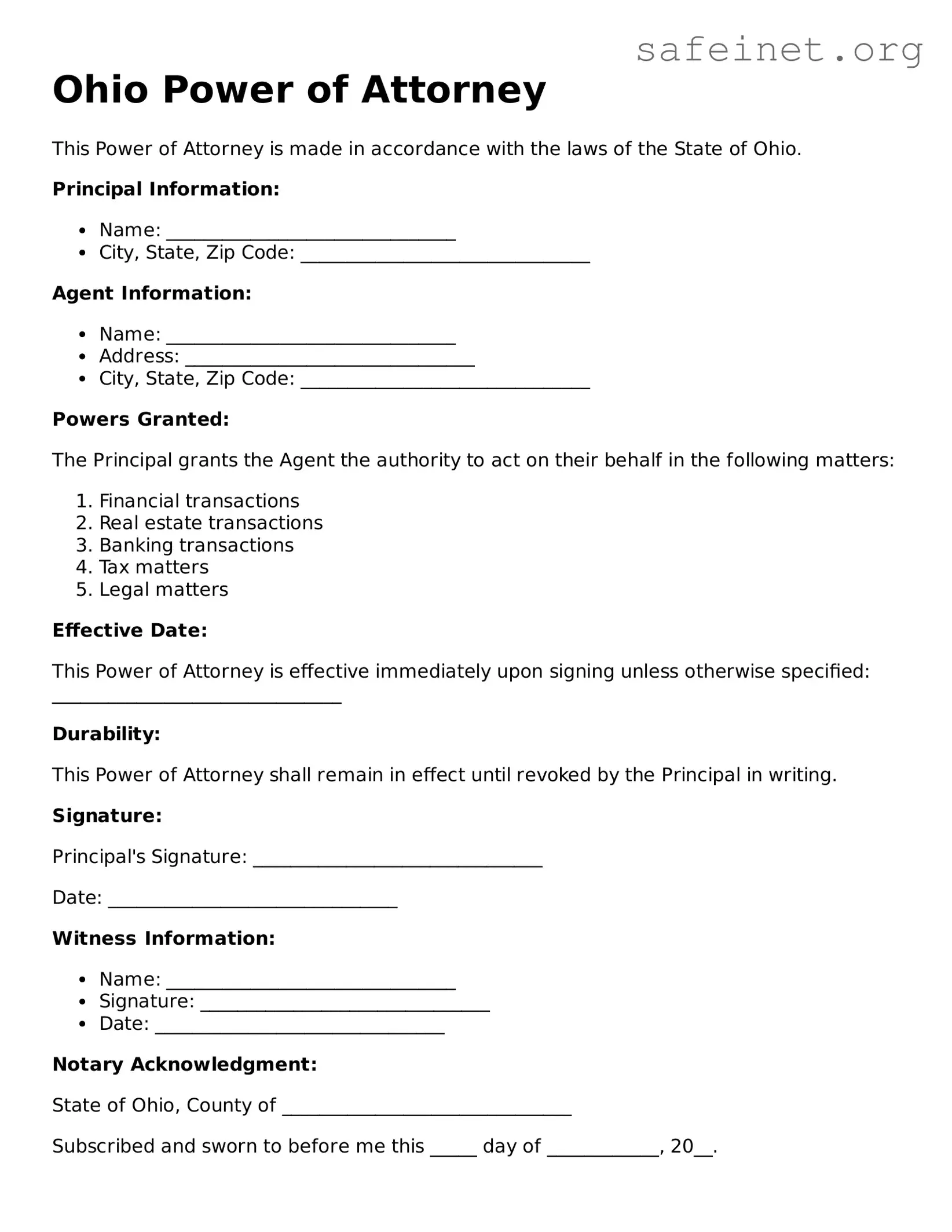
In Ohio, a Power of Attorney (POA) form serves as a vital legal tool that allows individuals to appoint someone they trust to make decisions on their behalf. This important document can cover a range of responsibilities, from managing financial affairs to making healthcare decisions, depending on the type of POA established. It can be tailored to be effective immediately or become effective only when the principal is unable to make decisions for themselves. The form must be signed and notarized to ensure its validity, providing both the principal and the agent with a clear understanding of their rights and responsibilities. Additionally, Ohio law outlines specific requirements and protections to safeguard the interests of the individual granting the authority, making it essential for anyone considering this option to understand the implications and nuances involved. By preparing a Power of Attorney, individuals can ensure that their wishes are respected, even when they may not be in a position to express them directly.
Ohio Power of Attorney
This Power of Attorney is made in accordance with the laws of the State of Ohio.
Principal Information:
Agent Information:
Powers Granted:
The Principal grants the Agent the authority to act on their behalf in the following matters:
Effective Date:
This Power of Attorney is effective immediately upon signing unless otherwise specified: _______________________________
Durability:
This Power of Attorney shall remain in effect until revoked by the Principal in writing.
Signature:
Principal's Signature: _______________________________
Date: _______________________________
Witness Information:
Notary Acknowledgment:
State of Ohio, County of _______________________________
Subscribed and sworn to before me this _____ day of ____________, 20__.
Notary Public Signature: _______________________________
My Commission Expires: _______________________________
| Fact Name | Description |
|---|---|
| Definition | A Power of Attorney (POA) in Ohio is a legal document that allows one person to act on behalf of another in financial or legal matters. |
| Types of POA | Ohio recognizes several types of Power of Attorney, including durable, springing, and limited POA. |
| Governing Law | The Ohio Power of Attorney is governed by Ohio Revised Code § 1337.21 to § 1337.64. |
| Durability | A durable Power of Attorney remains effective even if the principal becomes incapacitated. |
| Springing POA | A springing Power of Attorney only becomes effective upon the occurrence of a specified event, such as the principal's incapacitation. |
| Revocation | The principal can revoke a Power of Attorney at any time, provided they are mentally competent to do so. |
| Notarization | In Ohio, a Power of Attorney must be signed in the presence of a notary public to be valid. |
After obtaining the Ohio Power of Attorney form, it is essential to complete it accurately to ensure it serves its intended purpose. Follow the steps below to fill out the form correctly.
What is a Power of Attorney in Ohio?
A Power of Attorney (POA) in Ohio is a legal document that allows one person, known as the principal, to appoint another person, known as the agent or attorney-in-fact, to make decisions on their behalf. This can include managing finances, handling legal matters, or making healthcare decisions. The POA can be general, giving broad powers, or limited, restricting the agent's authority to specific tasks.
What types of Power of Attorney are available in Ohio?
Ohio recognizes several types of Power of Attorney. The most common are the Durable Power of Attorney, which remains effective even if the principal becomes incapacitated, and the Healthcare Power of Attorney, which specifically grants the agent authority to make medical decisions. Additionally, a Limited Power of Attorney can be created for specific transactions or time periods.
How do I create a Power of Attorney in Ohio?
To create a Power of Attorney in Ohio, the principal must complete a written document that clearly states their intentions. It should identify the agent and outline the powers granted. The document must be signed by the principal and witnessed by at least one person or notarized. It is advisable to consult with a legal professional to ensure the document meets all legal requirements.
Can I revoke a Power of Attorney in Ohio?
Yes, a Power of Attorney can be revoked in Ohio at any time as long as the principal is competent. To revoke a POA, the principal should create a written revocation document and notify the agent and any institutions or individuals who may have relied on the original POA. This ensures that the agent no longer has authority to act on behalf of the principal.
What happens if the principal becomes incapacitated?
If the principal becomes incapacitated and has executed a Durable Power of Attorney, the agent can continue to act on their behalf. This is a significant advantage of a Durable POA, as it allows for uninterrupted management of the principal's affairs. If a non-durable POA is in place, it will become invalid upon the principal's incapacity.
Do I need to file a Power of Attorney with the court in Ohio?
Generally, you do not need to file a Power of Attorney with the court in Ohio. However, certain situations may require filing, such as when the agent needs to act on behalf of the principal in a legal matter or if the POA is being used for real estate transactions. It is important to check with the relevant institutions or consult a lawyer if you have questions about filing.
Not specifying the powers granted: Many individuals fail to clearly outline the specific powers they wish to grant to the agent. This can lead to confusion and limit the agent's ability to act on behalf of the principal.
Incorrectly identifying the agent: It is crucial to provide the full legal name and address of the agent. Omitting this information or using nicknames can create complications when the agent needs to exercise their authority.
Not signing the document: A common oversight is neglecting to sign the Power of Attorney form. Without a signature, the document is not valid and cannot be used to grant authority.
Failing to date the form: Some individuals forget to include the date on which the Power of Attorney is signed. This omission can lead to disputes regarding when the authority takes effect.
Not having witnesses or notarization: Depending on the type of Power of Attorney, some forms require witnesses or notarization. Skipping this step can invalidate the document.
When creating a Power of Attorney (POA) in Ohio, it’s often beneficial to consider additional documents that can complement or enhance the effectiveness of your POA. These documents can help ensure that your wishes are clearly communicated and legally upheld in various situations. Here’s a list of some commonly used forms and documents that you might encounter alongside the Ohio Power of Attorney form.
Incorporating these documents alongside your Ohio Power of Attorney can provide clarity and ensure that your wishes are honored in various circumstances. It is essential to understand each document's purpose and how they interact with one another to create a comprehensive plan for your future.
The Ohio Power of Attorney (POA) form is similar to a Living Will, which allows individuals to express their wishes regarding medical treatment in the event they become unable to communicate. Both documents empower someone to make decisions on behalf of another person. However, while a POA can cover a wide range of decisions, a Living Will specifically focuses on healthcare choices, ensuring that a person’s medical preferences are honored when they cannot speak for themselves.
Another document akin to the Power of Attorney is the Health Care Proxy. This document designates a specific individual to make healthcare decisions for someone who is incapacitated. Like the POA, it requires clear communication of the principal's wishes. However, the Health Care Proxy is limited to medical decisions, whereas a POA can also include financial and legal matters, offering broader authority to the appointed agent.
The Durable Power of Attorney is a variation that remains effective even if the principal becomes incapacitated. This document is similar to the standard POA but specifically addresses the principal's ability to maintain control over their affairs even when they can no longer make decisions themselves. This durability feature ensures that the appointed agent can continue to act on behalf of the principal without interruption.
A Revocable Living Trust is another related document. It allows individuals to place their assets into a trust during their lifetime, which can be managed by a trustee. Like a POA, it provides a mechanism for managing assets if the individual becomes incapacitated. However, a trust can also avoid probate, providing a smoother transition of assets after death, while a POA does not affect asset distribution after the principal's passing.
The Advance Directive is a broader document that combines elements of both a Living Will and a Health Care Proxy. It allows individuals to outline their medical preferences and designate someone to make healthcare decisions if they are unable to do so. This document shares similarities with the POA in its intent to ensure that personal wishes are respected, but it is specifically focused on health-related matters.
A Guardianship is another legal arrangement that can be compared to a Power of Attorney. In a guardianship, the court appoints someone to make decisions for an individual deemed unable to manage their own affairs. Unlike a POA, which is established voluntarily by the principal, guardianship is often a court-mandated process that can be more restrictive, as it removes some personal autonomy from the individual.
Lastly, the Financial Power of Attorney is a specific type of POA that focuses solely on financial matters. This document grants an agent the authority to handle financial transactions, such as managing bank accounts or paying bills. While it serves a similar purpose to the broader Power of Attorney, it is limited to financial decisions, making it a useful tool for individuals who want to delegate specific financial responsibilities without granting authority over other areas.
When filling out the Ohio Power of Attorney form, it's important to approach the process with care. Here are some key points to consider:
Following these guidelines can help ensure that the Power of Attorney form is filled out correctly and meets your needs.
Understanding the Ohio Power of Attorney form is crucial for effective decision-making. Here are five common misconceptions about this important document:
This is not true. While many people associate a Power of Attorney (POA) with financial decisions, it can also cover health care and other personal matters. You can specify the areas where the agent has authority.
This is a misconception. You can revoke or modify a Power of Attorney at any time, as long as you are mentally competent. Just make sure to follow the proper procedures to ensure the changes are valid.
Not necessarily. A Power of Attorney can be set up to take effect immediately upon signing or only when you become incapacitated. The choice is yours, and it should be clearly stated in the document.
This is misleading. The agent must act in your best interest and follow the guidelines set forth in the POA. Their authority is limited to what you specify in the document.
A will only takes effect after your death. A Power of Attorney is essential for making decisions on your behalf while you are still alive, especially if you become unable to communicate your wishes.
When filling out and using the Ohio Power of Attorney form, there are several important points to keep in mind. Understanding these can help ensure that the process goes smoothly and that your intentions are clearly communicated.
By following these key takeaways, you can navigate the process of creating and using a Power of Attorney in Ohio with confidence and clarity.