In Ohio, the Power of Attorney for a Child form is an essential legal document that empowers a designated individual to make decisions on behalf of a minor child. This form is particularly useful for parents or guardians who need to delegate authority temporarily, whether due to travel, medical needs, or other circumstances that may prevent them from being present. The document outlines the specific powers granted, which can include decisions related to education, healthcare, and general welfare. It is important to note that the authority granted can be limited to specific time frames or circumstances, ensuring that the child’s best interests remain the priority. Additionally, the form must be signed and notarized to be legally valid, providing a clear framework for the appointed agent to act on the child's behalf. Understanding the nuances of this form can help ensure that caregivers are prepared to make informed decisions when the need arises.
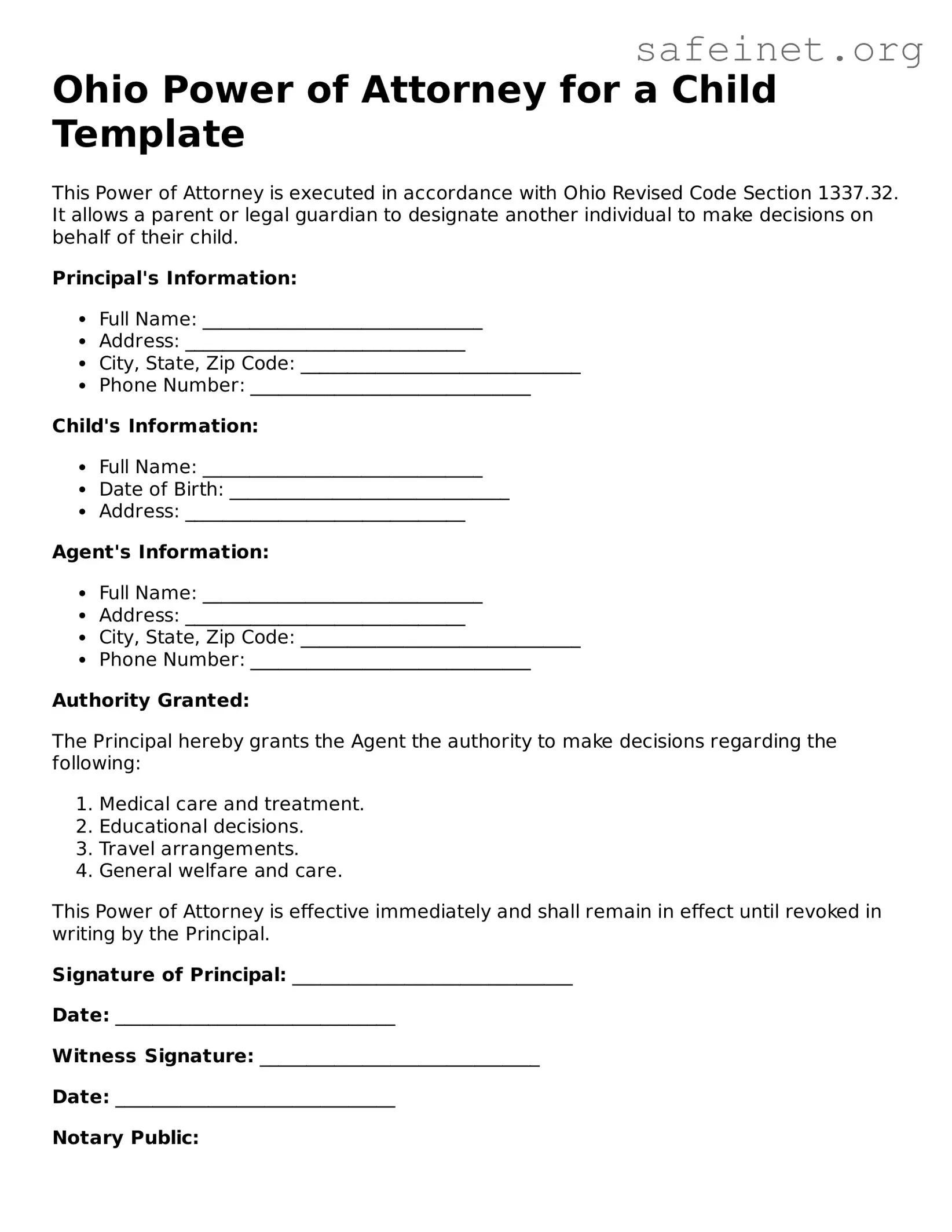
Ohio Power of Attorney for a Child Template
This Power of Attorney is executed in accordance with Ohio Revised Code Section 1337.32. It allows a parent or legal guardian to designate another individual to make decisions on behalf of their child.
Principal's Information:
Child's Information:
Agent's Information:
Authority Granted:
The Principal hereby grants the Agent the authority to make decisions regarding the following:
This Power of Attorney is effective immediately and shall remain in effect until revoked in writing by the Principal.
Signature of Principal: ______________________________
Date: ______________________________
Witness Signature: ______________________________
Date: ______________________________
Notary Public:
State of Ohio, County of ________________
Subscribed and sworn before me this _____ day of __________, 20__.
_______________________________
Notary Public Signature
My commission expires: ________________
| Fact Name | Description |
|---|---|
| Purpose | The Ohio Power of Attorney for a Child form allows a parent or legal guardian to grant temporary authority to another adult to make decisions on behalf of their child. |
| Governing Law | This form is governed by Ohio Revised Code Section 1337.24, which outlines the requirements for a valid power of attorney. |
| Duration | The authority granted can be specified for a limited time or until revoked by the parent or guardian. |
| Who Can Act | The designated adult can be a relative, family friend, or anyone the parent trusts to care for the child. |
| Limitations | The form does not allow the designated adult to make decisions regarding the child’s medical care unless specifically authorized. |
| Notarization | While notarization is not strictly required, having the form notarized can provide additional legal protection and clarity. |
| Revocation | The parent or guardian can revoke the power of attorney at any time, as long as they do so in writing. |
| Filing | The form does not need to be filed with any government agency but should be kept in a safe place where it can be easily accessed. |
Completing the Ohio Power of Attorney for a Child form requires careful attention to detail. This document allows a parent or legal guardian to designate another individual to make decisions regarding the child's care and welfare. Follow the steps below to fill out the form accurately.
After completing the form, ensure that all information is accurate and that signatures are properly executed. Keep a copy for your records and provide a copy to the Agent for their reference.
What is a Power of Attorney for a Child in Ohio?
A Power of Attorney for a Child in Ohio is a legal document that allows a parent or guardian to designate another adult to make decisions on behalf of their child. This can include decisions about education, healthcare, and general welfare. It is particularly useful when parents are unable to care for their child temporarily, such as during travel or medical emergencies.
Who can be designated as an agent in the Power of Attorney for a Child?
Any responsible adult can be designated as an agent in the Power of Attorney for a Child. This includes relatives, family friends, or trusted neighbors. However, it is crucial to choose someone who is reliable and understands the responsibilities involved in caring for your child.
Do both parents need to sign the Power of Attorney for a Child?
In most cases, both parents should sign the document if they share legal custody. If one parent is unavailable or has sole custody, only that parent needs to sign. It is advisable to check with local laws or a legal professional to ensure compliance with specific requirements.
How long is the Power of Attorney for a Child valid?
The Power of Attorney for a Child is generally valid until the specified expiration date stated in the document or until the child reaches the age of majority, which is 18 years old in Ohio. Parents can also revoke the Power of Attorney at any time, as long as they provide written notice to the agent and any other relevant parties.
Can the Power of Attorney for a Child be used for medical decisions?
Yes, the Power of Attorney for a Child can grant the agent authority to make medical decisions on behalf of the child. However, it is essential to clearly specify this authority in the document. Parents should also consider whether they want to include any limitations or specific instructions regarding medical care.
Is it necessary to have the Power of Attorney for a Child notarized?
While notarization is not always required, having the Power of Attorney for a Child notarized can add an extra layer of validity and help prevent disputes. It is advisable to check local regulations to determine if notarization is necessary for your specific situation.
What happens if the Power of Attorney for a Child is not in place?
If a Power of Attorney for a Child is not in place and the parents are unavailable, it may become challenging for someone else to make important decisions regarding the child’s welfare. In such cases, a court may need to appoint a guardian, which can be a lengthy and complicated process.
Can the Power of Attorney for a Child be revoked?
Yes, parents can revoke the Power of Attorney for a Child at any time. This can be done by providing written notice to the agent and any other relevant parties. It is important to keep a copy of the revocation for your records and to inform the agent that their authority has ended.
Are there any limitations to what the agent can do?
Yes, parents can specify limitations within the Power of Attorney for a Child document. For example, they may restrict the agent from making certain medical decisions or limit their authority to specific situations. Clear communication of these limitations is essential to ensure the agent understands their responsibilities.
Where can I obtain a Power of Attorney for a Child form in Ohio?
You can obtain a Power of Attorney for a Child form from various sources, including legal websites, local government offices, or family law attorneys. It is important to ensure that the form complies with Ohio laws and meets your specific needs.
Not Specifying the Duration: Many individuals forget to indicate how long the power of attorney will be in effect. It's important to clearly state the start and end dates to avoid confusion.
Missing Signatures: Some people neglect to have all required parties sign the document. Ensure that both the parent or guardian and the agent sign the form to validate it.
Failing to Include Necessary Details: Important information, such as the child's full name, date of birth, and the agent's contact information, may be overlooked. Providing complete details helps prevent misunderstandings.
Not Notarizing the Document: In Ohio, a power of attorney for a child often needs to be notarized. Skipping this step can render the document invalid.
Ignoring State-Specific Requirements: Each state has its own rules regarding power of attorney forms. Failing to follow Ohio's specific guidelines can lead to complications.
When preparing a Power of Attorney for a Child in Ohio, several other documents may be useful or necessary to ensure comprehensive care and legal authority. Below is a list of forms and documents that often accompany the Power of Attorney for a Child form, each serving a specific purpose.
Having these documents ready can help ensure that a caregiver has the necessary authority and information to act in the best interest of the child. Each document plays a vital role in supporting the child's well-being and ensuring smooth communication among all parties involved.
The Ohio Power of Attorney for a Child form shares similarities with the General Power of Attorney. Both documents allow individuals to appoint someone else to make decisions on their behalf. However, while the General Power of Attorney can cover a wide range of decisions, including financial and medical matters, the Power of Attorney for a Child specifically focuses on the care and custody of a minor. This distinction is crucial, as it ensures that the appointed agent can act in the best interest of the child without overstepping into areas unrelated to their care.
Another similar document is the Medical Power of Attorney. This form allows an individual to designate someone to make medical decisions if they become unable to do so themselves. Like the Power of Attorney for a Child, the Medical Power of Attorney emphasizes the importance of having a trusted person in charge of critical decisions. However, the Medical Power of Attorney is specifically tailored to healthcare matters, while the Power of Attorney for a Child encompasses broader aspects of a child's upbringing and welfare.
The Guardianship Agreement is also comparable to the Ohio Power of Attorney for a Child. Both documents establish a relationship where one party has the authority to make decisions for another. However, a Guardianship Agreement typically requires court approval and is often more permanent, while a Power of Attorney can be more flexible and easily revoked. The Power of Attorney for a Child allows parents to temporarily delegate their authority without the need for court intervention, making it a more straightforward option for short-term situations.
Similarly, the Child Custody Agreement is another document that shares common ground with the Power of Attorney for a Child. Both documents address the care and living arrangements for a child. However, a Child Custody Agreement is usually the result of a legal proceeding and outlines the rights and responsibilities of parents or guardians after a separation or divorce. In contrast, the Power of Attorney for a Child can be established without court involvement and is often used to facilitate day-to-day care and decision-making for a child.
The Temporary Custody Order also has parallels with the Power of Attorney for a Child. Both documents grant specific rights regarding the care of a child, but a Temporary Custody Order is issued by a court and often follows a legal process. This order typically comes into play during situations where immediate intervention is necessary, such as cases of abuse or neglect. In contrast, the Power of Attorney for a Child allows parents to delegate authority voluntarily, often for convenience or travel purposes.
The Adoption Agreement is another document that bears resemblance to the Power of Attorney for a Child. Both involve the care and custody of a child, but they differ significantly in their permanence and legal implications. An Adoption Agreement creates a permanent legal relationship between the adoptive parents and the child, severing the legal ties to the biological parents. On the other hand, the Power of Attorney for a Child is temporary and can be revoked at any time, maintaining the biological parents' rights.
The Standby Guardianship form is similar as well. This document allows parents to designate a guardian for their child in the event that they become unable to care for them. Like the Power of Attorney for a Child, it ensures that someone is prepared to take over the child's care. However, the Standby Guardianship is intended for more long-term situations, whereas the Power of Attorney is often used for shorter durations, such as during travel or emergencies.
Another related document is the Consent to Medical Treatment form. This form allows a parent or guardian to authorize medical treatment for a child when they are not available. Similar to the Power of Attorney for a Child, it ensures that a trusted individual can make important decisions on behalf of the child. However, the Consent to Medical Treatment form is specifically focused on healthcare decisions, while the Power of Attorney encompasses broader aspects of a child's life, including education and general welfare.
Lastly, the Special Power of Attorney is akin to the Ohio Power of Attorney for a Child in that it allows for the delegation of specific powers. This document can be tailored to grant authority for particular tasks, such as managing financial affairs or making medical decisions. However, the Special Power of Attorney is often limited to specific actions, whereas the Power of Attorney for a Child encompasses a wider range of responsibilities related to the child's upbringing and care.
When filling out the Ohio Power of Attorney for a Child form, it's important to approach the process with care and attention. Here are some essential do's and don'ts to keep in mind:
By following these guidelines, you can help ensure that the Power of Attorney for a Child form is filled out correctly and serves its intended purpose effectively.
When it comes to the Ohio Power of Attorney for a Child form, several misconceptions can lead to confusion for parents and guardians. Understanding these misunderstandings is crucial for making informed decisions about child care and legal responsibilities.
This form is not permanent. It is intended to be temporary and can be revoked at any time by the parent or guardian who created it.
While consulting a lawyer can be beneficial, parents can fill out the form themselves without legal assistance, as long as they understand the requirements and implications.
This is incorrect. The form allows the designated agent to make specific decisions regarding the child's care but does not transfer custody rights permanently.
The Ohio Power of Attorney for a Child is primarily valid within Ohio. However, some states may recognize it, especially if the child travels or resides temporarily in another state.
While many adults can serve as agents, they must be at least 18 years old and capable of making responsible decisions regarding the child's welfare.
This form specifically addresses the care and custody of the child, not financial matters. For financial decisions, a different type of Power of Attorney is necessary.
When filling out and using the Ohio Power of Attorney for a Child form, it is important to consider the following key takeaways: