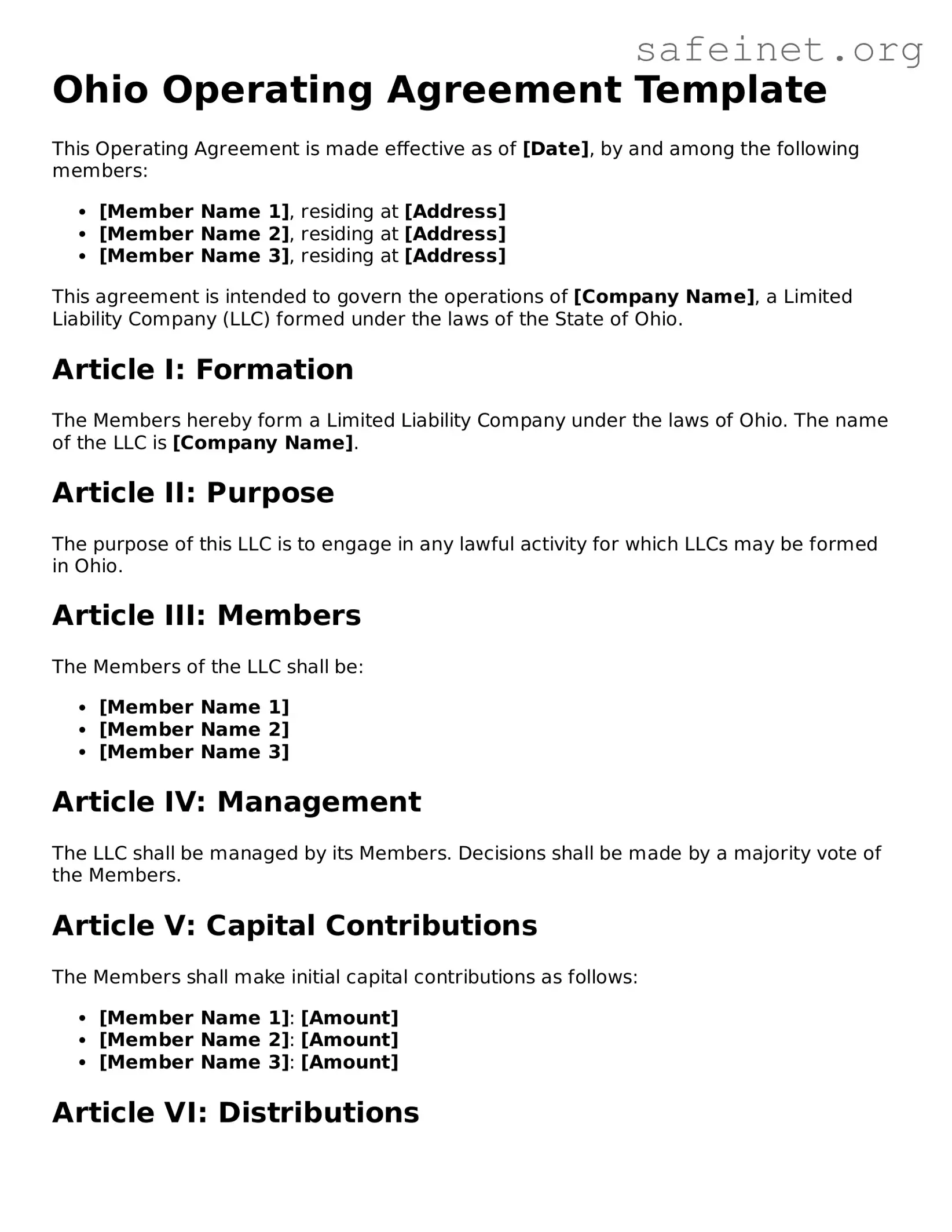
When starting a business in Ohio, one important document to consider is the Operating Agreement. This form serves as a foundational blueprint for how a business will operate and outlines the roles and responsibilities of its members. It typically includes details about management structure, decision-making processes, and profit distribution. Additionally, it can address how to handle disputes and what happens if a member wants to leave the business. By having an Operating Agreement in place, members can ensure clarity and reduce potential conflicts in the future. This document is not just a formality; it can provide a framework that supports the business's growth and stability.
Ohio Operating Agreement Template
This Operating Agreement is made effective as of [Date], by and among the following members:
This agreement is intended to govern the operations of [Company Name], a Limited Liability Company (LLC) formed under the laws of the State of Ohio.
Article I: Formation
The Members hereby form a Limited Liability Company under the laws of Ohio. The name of the LLC is [Company Name].
Article II: Purpose
The purpose of this LLC is to engage in any lawful activity for which LLCs may be formed in Ohio.
Article III: Members
The Members of the LLC shall be:
Article IV: Management
The LLC shall be managed by its Members. Decisions shall be made by a majority vote of the Members.
Article V: Capital Contributions
The Members shall make initial capital contributions as follows:
Article VI: Distributions
Profits and losses shall be allocated to the Members in proportion to their respective capital contributions.
Article VII: Meetings
Meetings of the Members shall be held at least annually. Special meetings may be called by any Member.
Article VIII: Amendments
This Operating Agreement may be amended only by a written agreement signed by all Members.
Article IX: Governing Law
This Agreement shall be governed by and construed in accordance with the laws of the State of Ohio.
IN WITNESS WHEREOF, the Members have executed this Operating Agreement as of the date first above written.
_____________________________
[Member Name 1]
_____________________________
[Member Name 2]
_____________________________
[Member Name 3]
| Fact Name | Description |
|---|---|
| Purpose | The Ohio Operating Agreement outlines the management structure and operational procedures of a limited liability company (LLC). |
| Governing Law | This agreement is governed by the Ohio Revised Code, specifically Chapter 1705. |
| Members' Rights | It specifies the rights and responsibilities of the LLC members, ensuring clarity in operations. |
| Flexibility | Ohio allows LLCs to customize their operating agreements to fit their unique needs. |
| Not Mandatory | While it's highly recommended, an operating agreement is not legally required in Ohio. |
| Dispute Resolution | Many agreements include provisions for resolving disputes among members, which can help avoid costly litigation. |
| Amendments | The operating agreement can be amended as needed, allowing for adjustments as the business evolves. |
Once you have the Ohio Operating Agreement form ready, you can begin filling it out. This document is essential for outlining the structure and operations of your business. By completing it accurately, you will set a solid foundation for your company’s governance and management. Follow these steps to ensure you fill out the form correctly.
What is an Ohio Operating Agreement?
An Ohio Operating Agreement is a legal document that outlines the management structure and operating procedures of a limited liability company (LLC) in Ohio. It serves as an internal guideline for the members of the LLC, detailing their rights, responsibilities, and the distribution of profits and losses.
Why do I need an Operating Agreement for my LLC?
Having an Operating Agreement is essential for several reasons. It helps clarify the roles and responsibilities of each member, reduces the risk of disputes, and provides a clear framework for decision-making. Additionally, it can help protect your limited liability status by demonstrating that your LLC is a separate entity from its owners.
Is an Operating Agreement required in Ohio?
While Ohio law does not require LLCs to have an Operating Agreement, it is highly recommended. Without one, your LLC will be governed by the default rules set by Ohio law, which may not align with your intentions for the business.
What should be included in an Operating Agreement?
Your Operating Agreement should include key details such as the LLC's name, purpose, member information, management structure, voting rights, profit distribution, and procedures for adding or removing members. It may also address how to handle disputes and what happens if a member wants to leave the LLC.
Can I create my own Operating Agreement?
Yes, you can create your own Operating Agreement. Many templates are available online, but it's important to tailor the document to fit your specific business needs. You may also want to consult with a legal professional to ensure that your agreement complies with Ohio laws and adequately protects your interests.
How do I amend an Operating Agreement?
To amend an Operating Agreement, follow the procedures outlined within the document itself. Typically, this involves drafting the amendment, obtaining the necessary approvals from the members, and documenting the changes in writing. Keep a copy of the amended agreement with your original documents for reference.
Where should I store my Operating Agreement?
Store your Operating Agreement in a safe and accessible location, such as a secure file cabinet or a digital storage system. All members should have access to the document, as it serves as a vital reference for the operations and governance of the LLC.
What if I don’t have an Operating Agreement?
If you don’t have an Operating Agreement, your LLC will be subject to Ohio's default laws regarding LLCs. This may lead to unintended consequences regarding management, profit sharing, and member responsibilities. It's best to create an Operating Agreement as soon as possible to avoid potential issues down the road.
Failing to include all members: It's crucial to list every member of the LLC. Omitting a member can lead to confusion and disputes down the line.
Not specifying the management structure: Clearly outline whether the LLC will be member-managed or manager-managed. This decision impacts how the business operates.
Ignoring the distribution of profits and losses: Be explicit about how profits and losses will be shared among members. Vague language can cause disagreements later.
Leaving out important provisions: Include details about decision-making processes, member responsibilities, and procedures for adding or removing members. These elements are essential for smooth operations.
Not updating the agreement: As the business evolves, the Operating Agreement should be revised. Failing to do so can result in outdated practices that no longer fit the LLC's needs.
Overlooking state-specific requirements: Each state has its own rules regarding Operating Agreements. Make sure to comply with Ohio's specific requirements to avoid legal issues.
When forming a Limited Liability Company (LLC) in Ohio, an Operating Agreement is a crucial document. However, there are several other forms and documents that are often used in conjunction with it. Each serves a unique purpose in the formation and operation of your LLC. Below is a list of these important documents.
Understanding these documents is vital for a smooth operation of your LLC. Each one plays a significant role in protecting your interests and ensuring that your business runs effectively. Always consider consulting with a professional to ensure all necessary documents are prepared correctly.
The Ohio Operating Agreement is similar to a Partnership Agreement, which outlines the roles, responsibilities, and profit-sharing arrangements among partners in a business. Like the Operating Agreement, a Partnership Agreement serves to clarify the expectations of each partner, ensuring that all parties understand their contributions and the distribution of profits or losses. Both documents help prevent disputes by providing a clear framework for decision-making and conflict resolution within the partnership.
Another document that shares similarities with the Ohio Operating Agreement is the Bylaws of a corporation. Bylaws govern the internal management of a corporation, detailing the roles of directors and officers, the process for holding meetings, and the voting procedures. Both the Operating Agreement and Bylaws serve to establish the rules and procedures that guide the organization, ensuring that all members or shareholders are aware of their rights and responsibilities within the entity.
The Shareholders Agreement is also comparable to the Ohio Operating Agreement. This document is crucial for corporations, as it outlines the rights and obligations of shareholders. Similar to the Operating Agreement, a Shareholders Agreement addresses issues such as voting rights, transfer of shares, and the procedures for resolving disputes among shareholders. Both documents are essential for maintaining harmony and clarity within the organization, providing a framework for governance and accountability.
The Joint Venture Agreement is yet another document that resembles the Ohio Operating Agreement. This agreement is formed when two or more parties come together to undertake a specific project while retaining their separate legal identities. Like the Operating Agreement, a Joint Venture Agreement delineates the roles and contributions of each party, as well as how profits and losses will be shared. Both documents help manage expectations and responsibilities, facilitating smoother collaboration between the involved parties.
Lastly, the Limited Liability Company (LLC) Membership Agreement shares key characteristics with the Ohio Operating Agreement. This document is used to outline the rights and responsibilities of members within an LLC. Similar to the Operating Agreement, the Membership Agreement details aspects such as capital contributions, profit distribution, and the process for admitting new members. Both documents are essential for establishing a clear understanding among members, thereby reducing the likelihood of conflicts and misunderstandings in the future.
When filling out the Ohio Operating Agreement form, it's important to follow certain guidelines to ensure accuracy and compliance. Here’s a list of things you should and shouldn’t do:
Understanding the Ohio Operating Agreement form is crucial for anyone involved in a limited liability company (LLC). However, several misconceptions can lead to confusion. Here are seven common myths about this important document:
Clearing up these misconceptions can help ensure that your LLC operates smoothly and is prepared for any challenges that may arise. Always consider consulting with a professional when drafting or revising your Operating Agreement to ensure it meets your specific needs.
When filling out and using the Ohio Operating Agreement form, there are several important considerations to keep in mind. Here are some key takeaways:
By following these guidelines, you can ensure that your Operating Agreement is a valuable tool for your LLC's success.