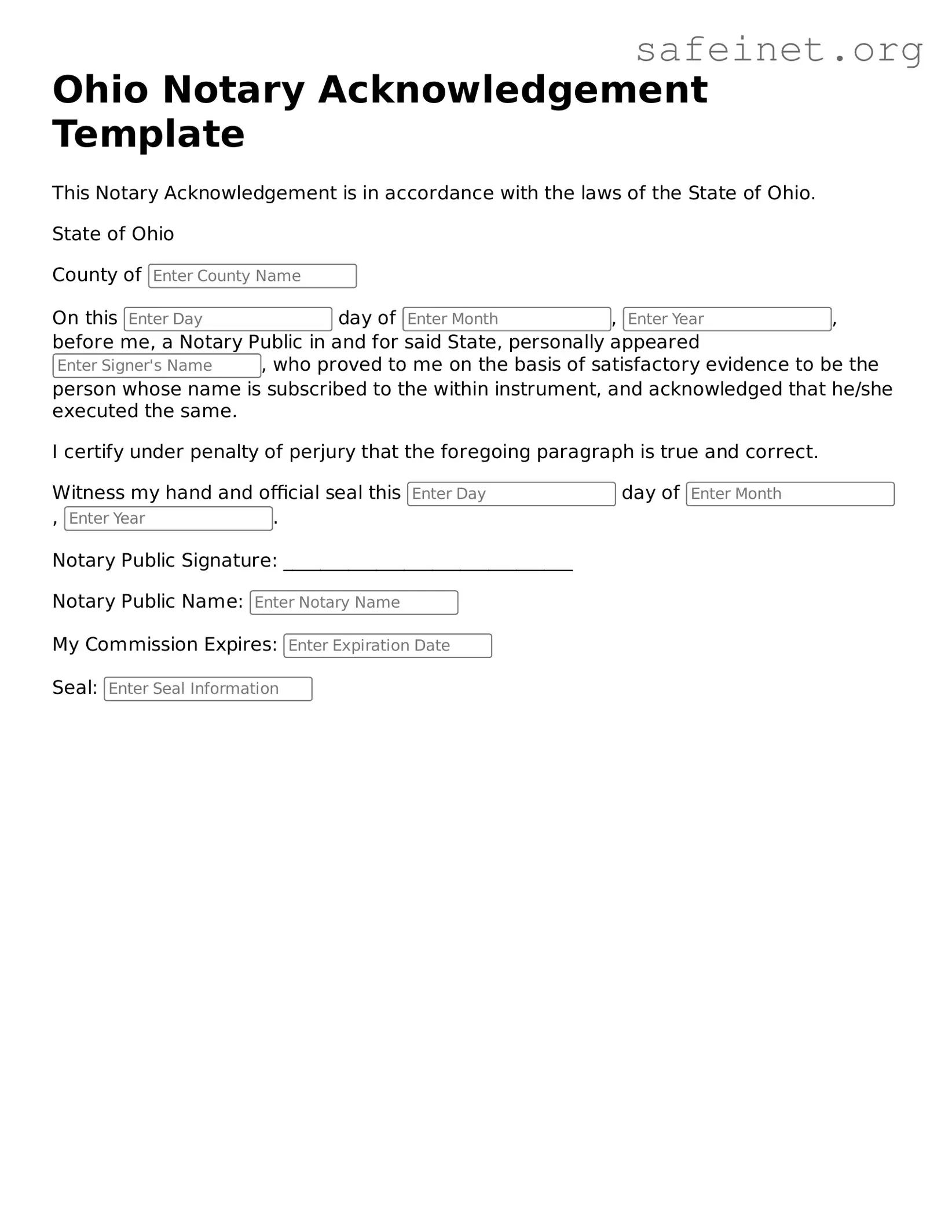
The Ohio Notary Acknowledgement form plays a crucial role in various legal transactions, ensuring that documents are properly authenticated. This form serves as a formal declaration by a notary public, confirming that the individual signing the document has done so willingly and is who they claim to be. Key elements of the form include the notary's signature, seal, and the date of acknowledgment, all of which validate the authenticity of the document. In Ohio, this form is often required for deeds, powers of attorney, and other important agreements, providing a layer of protection against fraud. Understanding how to complete and utilize this form effectively can streamline the notarization process and reinforce the legal standing of the documents involved.
Ohio Notary Acknowledgement Template
This Notary Acknowledgement is in accordance with the laws of the State of Ohio.
State of Ohio
County of
On this day of , , before me, a Notary Public in and for said State, personally appeared , who proved to me on the basis of satisfactory evidence to be the person whose name is subscribed to the within instrument, and acknowledged that he/she executed the same.
I certify under penalty of perjury that the foregoing paragraph is true and correct.
Witness my hand and official seal this day of , .
Notary Public Signature: _______________________________
Notary Public Name:
My Commission Expires:
Seal:
| Fact Name | Description |
|---|---|
| Governing Law | The Ohio Notary Acknowledgment form is governed by Ohio Revised Code Section 147.54. |
| Purpose | This form is used to verify the identity of a signer and confirm that they signed a document willingly. |
| Signature Requirement | The signer must provide their signature in the presence of the notary. |
| Notary's Role | The notary public must witness the signing and complete the acknowledgment form. |
| Identification | The signer must present valid identification to the notary at the time of signing. |
| Form Availability | The Ohio Notary Acknowledgment form can be obtained online or from local notary offices. |
| Language | The form is available in English, and it is recommended that all parties understand the language used. |
| Notary Seal | A notary seal must be affixed to the acknowledgment to validate it. |
| Record Keeping | Notaries are required to keep a record of all acknowledgments performed in their notary journal. |
After you have gathered the necessary information and documents, you can proceed to fill out the Ohio Notary Acknowledgement form. This form serves a specific purpose in the notarization process, and completing it accurately is essential for it to be valid.
What is an Ohio Notary Acknowledgement form?
The Ohio Notary Acknowledgement form is a legal document that verifies the identity of a signer and confirms that they willingly signed a document. This form is often used in conjunction with various legal documents, such as contracts, deeds, and affidavits, to ensure their validity. By having a notary public acknowledge the signature, it adds a layer of authenticity and helps prevent fraud.
Who can serve as a notary public in Ohio?
In Ohio, a notary public must be at least 18 years old, a resident of Ohio or have a place of business in the state, and must complete the required training and examination. Additionally, they must apply for a notary commission through the Secretary of State’s office. Once appointed, notaries are authorized to perform various duties, including taking acknowledgments, administering oaths, and certifying documents.
How do I complete an Ohio Notary Acknowledgement form?
To complete the form, the signer must appear before the notary public. The notary will ask the signer to provide valid identification. Once the identity is confirmed, the signer will then sign the document in the presence of the notary. The notary will fill out the acknowledgement section, including their signature, seal, and the date of the acknowledgment. It is crucial that the signer does not sign the document before meeting with the notary.
Is there a fee for notarization in Ohio?
Yes, notaries in Ohio are allowed to charge a fee for their services. The maximum fee for an acknowledgment is typically set by state law. While many notaries may charge around $5 per signature, it’s advisable to confirm the fee beforehand. Some notaries may offer their services for free, especially if they are part of a community service initiative or if the notarization is for a specific organization.
Do I need witnesses when using an Ohio Notary Acknowledgement form?
Generally, witnesses are not required when using an Ohio Notary Acknowledgement form. The presence of the notary public is sufficient to validate the signature. However, certain documents may have specific requirements, so it is essential to check the individual document’s requirements or consult with a legal professional if in doubt.
How long is an Ohio Notary Acknowledgement valid?
The validity of an Ohio Notary Acknowledgement does not have a specific expiration date. However, the underlying document's validity may vary based on its own terms or conditions. It is important to ensure that the document is executed in accordance with any relevant laws or regulations that may affect its enforceability over time.
Missing Signatures: One of the most common mistakes is forgetting to sign the form. It's essential that both the notary and the person acknowledging the document provide their signatures. Without these, the form is incomplete and may not hold up in legal situations.
Incorrect Dates: Another frequent error is writing the wrong date. The date should reflect when the acknowledgment takes place. If you put a future date or a date that has already passed, it can create confusion and invalidate the document.
Inaccurate Notary Information: Notaries must fill in their information accurately. This includes their name, commission number, and expiration date. Any inaccuracies can lead to questions about the legitimacy of the notarization.
Failure to Use the Correct Format: The acknowledgment must be formatted correctly. For instance, if the form requires specific wording or structure, deviating from that can result in issues. Always double-check that you’re using the correct version of the form.
Not Using a Seal: A notary's seal is a crucial part of the acknowledgment process. Some people forget to affix the seal, which can render the notarization ineffective. Ensure that the seal is clear and properly placed on the document.
When working with the Ohio Notary Acknowledgment form, several other documents often accompany it. These forms help ensure that the notarization process is smooth and that all necessary information is accurately recorded. Below is a list of commonly used documents that may be needed in conjunction with the Notary Acknowledgment form.
Understanding these documents can help streamline the notarization process and ensure that everything is in order. Always consult with a legal professional if you have questions about specific forms or their requirements.
The Ohio Notary Acknowledgment form shares similarities with the Affidavit. An affidavit is a written statement confirmed by oath or affirmation, often used as evidence in legal proceedings. Both documents require a notary public to witness the signing and verify the identity of the signer. This ensures that the information provided is credible and can be relied upon in a legal context. Just like the acknowledgment form, an affidavit must be signed in the presence of the notary, reinforcing the authenticity of the declaration made by the individual.
Another document akin to the Ohio Notary Acknowledgment is the Power of Attorney. This legal document allows one person to act on behalf of another in legal or financial matters. Both require notarization to validate the identity of the parties involved and to confirm that the document was signed voluntarily. The notary's role is crucial in preventing fraud and ensuring that the principal understands the implications of granting such authority.
The Deed also bears similarities to the Ohio Notary Acknowledgment form. A deed is a legal document that conveys ownership of property from one party to another. Like the acknowledgment form, a deed must be notarized to be effective. The notary's verification adds a layer of security, confirming that the parties involved are who they claim to be and that they have willingly entered into the transaction.
Similarly, the Bill of Sale is another document that aligns with the Ohio Notary Acknowledgment. A bill of sale transfers ownership of personal property from one individual to another. Notarization is often utilized to validate the transaction, providing proof that the sale was conducted fairly and that both parties agreed to the terms. This process protects both the buyer and the seller, ensuring that the transfer is legitimate.
The Lease Agreement is also comparable to the Ohio Notary Acknowledgment form. While not always required to be notarized, many landlords and tenants choose to have their lease agreements notarized to enhance the document's credibility. This practice helps to confirm that both parties have entered into the agreement willingly and with full understanding of the terms, similar to the acknowledgment process.
Lastly, the Consent Form is another document that parallels the Ohio Notary Acknowledgment. Consent forms are often used in various contexts, including medical and legal situations, to obtain permission from individuals. Notarization adds an extra layer of assurance, confirming that the person granting consent understands what they are agreeing to and that their decision is made freely. This is crucial in maintaining transparency and trust in the process.
When filling out the Ohio Notary Acknowledgement form, it is important to follow certain guidelines to ensure accuracy and compliance. Here are five things you should and shouldn't do:
Understanding the Ohio Notary Acknowledgement form is crucial for anyone involved in notarization. However, several misconceptions can lead to confusion. Here are eight common misconceptions:
This is false. In Ohio, notaries cannot certify copies of documents unless specifically authorized by law.
Not every document requires notarization. Only specific documents, like deeds or powers of attorney, typically need a notary acknowledgment.
This is a misconception. Notaries verify the identity of the signer and witness the signing but do not assess the document's content.
This is not true. To become a notary in Ohio, one must meet specific eligibility requirements, including being a resident and completing an application process.
While both involve a notary, an acknowledgment specifically verifies that a signer willingly signed a document.
This is misleading. While the acknowledgment itself does not expire, the notary's commission does, and it must be renewed to continue performing notarizations.
Notaries must have valid reasons to refuse notarization, such as lack of proper identification or if the signer appears under duress.
This is incorrect. In Ohio, electronic signatures can still require notarization, depending on the type of document and its intended use.
Being aware of these misconceptions can help individuals navigate the notarization process more effectively. Understanding the role of a notary and the requirements for acknowledgment can prevent potential issues.
When filling out and using the Ohio Notary Acknowledgement form, keep these key takeaways in mind: