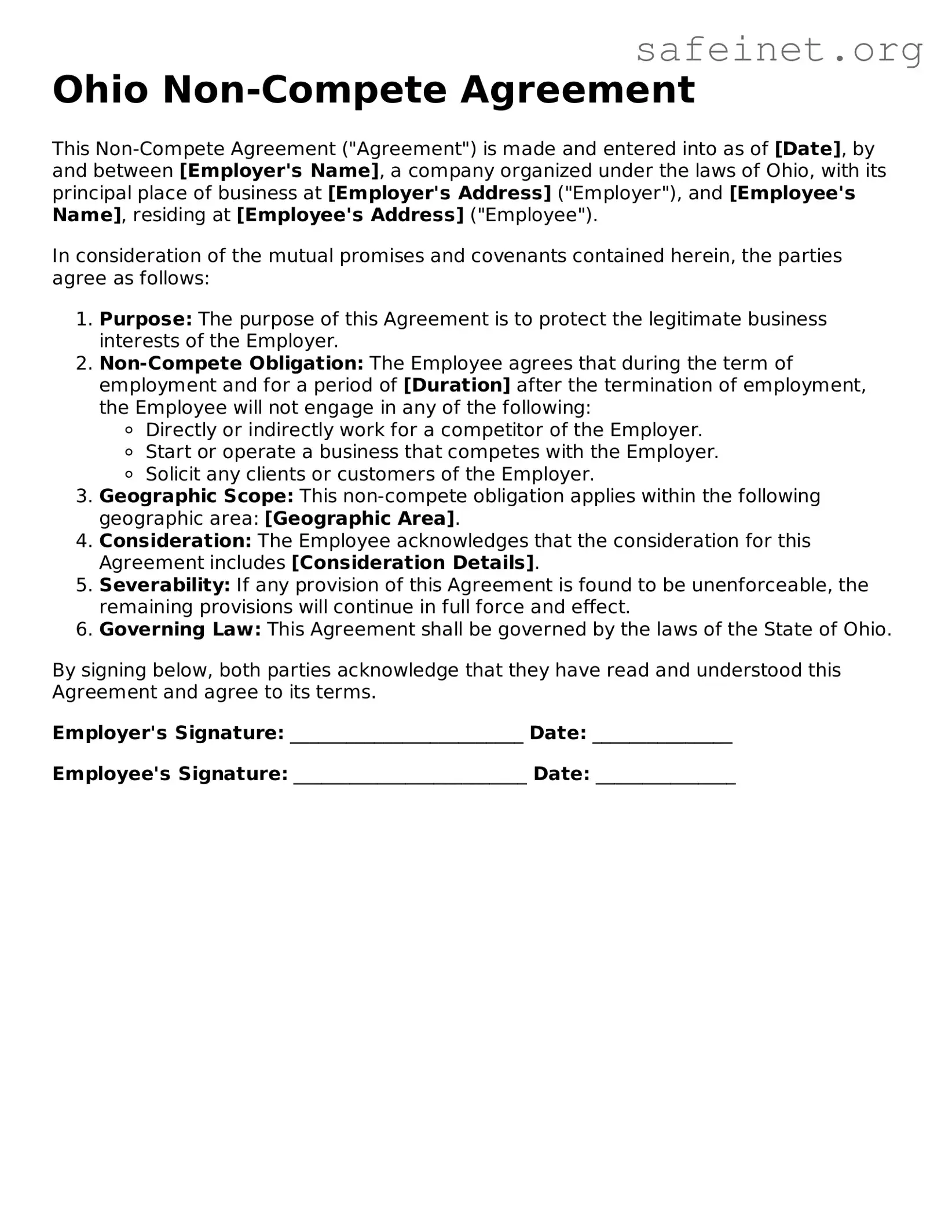
The Ohio Non-compete Agreement form serves as a crucial tool for employers seeking to protect their business interests while simultaneously outlining the rights and obligations of employees. This document typically addresses several key elements, including the duration of the non-compete clause, the geographical scope in which the restrictions apply, and the specific activities that are prohibited after employment ends. Employers often use these agreements to prevent former employees from sharing proprietary information or engaging in direct competition, thereby safeguarding trade secrets and maintaining market position. The form also emphasizes the necessity of consideration, which is a legal term for something of value exchanged between the parties, ensuring that the agreement is enforceable under Ohio law. Understanding the nuances of this agreement is essential for both employers and employees, as it can significantly impact career trajectories and business operations. In Ohio, courts generally uphold non-compete agreements as long as they are reasonable in scope and duration, making it imperative for both parties to carefully review the terms laid out in this form.
Ohio Non-Compete Agreement
This Non-Compete Agreement ("Agreement") is made and entered into as of [Date], by and between [Employer's Name], a company organized under the laws of Ohio, with its principal place of business at [Employer's Address] ("Employer"), and [Employee's Name], residing at [Employee's Address] ("Employee").
In consideration of the mutual promises and covenants contained herein, the parties agree as follows:
By signing below, both parties acknowledge that they have read and understood this Agreement and agree to its terms.
Employer's Signature: _________________________ Date: _______________
Employee's Signature: _________________________ Date: _______________
| Fact Name | Description |
|---|---|
| Governing Law | Ohio law governs non-compete agreements in the state. |
| Enforceability | Non-compete agreements must be reasonable in duration, geographic area, and scope of activity. |
| Consideration | There must be valid consideration, such as employment or access to confidential information. |
| Duration | Typically, a duration of one to two years is considered reasonable in Ohio. |
| Geographic Scope | The geographic area must be limited to where the employee worked or had influence. |
| Judicial Review | Courts may modify or void unreasonable non-compete clauses to make them enforceable. |
Filling out the Ohio Non-compete Agreement form is a straightforward process that requires careful attention to detail. By following the steps outlined below, you can ensure that all necessary information is accurately provided. This will help in creating a clear and enforceable agreement between the parties involved.
Once you have completed these steps, the agreement is ready to be implemented. It is advisable to keep the signed document in a safe place, as it may be necessary to refer to it in the future.
What is a Non-compete Agreement in Ohio?
A Non-compete Agreement is a legal contract between an employer and an employee. It restricts the employee from working for competitors or starting a competing business for a specified period after leaving the company. In Ohio, these agreements are enforceable under certain conditions to protect legitimate business interests.
What are the key elements of a valid Non-compete Agreement in Ohio?
For a Non-compete Agreement to be enforceable in Ohio, it must be reasonable in duration, geographic area, and scope of activity. It should protect the employer's legitimate business interests, such as trade secrets or customer relationships, without imposing an undue hardship on the employee.
How long can a Non-compete Agreement last in Ohio?
The duration of a Non-compete Agreement in Ohio can vary, but it typically ranges from six months to two years. Courts will evaluate whether the time frame is reasonable based on the nature of the business and the employee's role.
Are there any geographic limitations for a Non-compete Agreement in Ohio?
Yes, a Non-compete Agreement must specify a geographic area where the restrictions apply. This area should be reasonable and not overly broad. For example, it may be limited to a specific city, county, or region where the employer operates.
Can an employee negotiate the terms of a Non-compete Agreement?
Yes, employees can negotiate the terms of a Non-compete Agreement before signing. It is advisable to discuss any concerns with the employer and seek modifications that make the agreement more favorable. Legal counsel can also provide assistance during negotiations.
What happens if an employee violates a Non-compete Agreement in Ohio?
If an employee violates the terms of a Non-compete Agreement, the employer may take legal action. This could include seeking an injunction to prevent the employee from working with a competitor or pursuing damages for losses incurred due to the violation.
Are Non-compete Agreements enforceable for all employees in Ohio?
No, Non-compete Agreements are not enforceable for all employees. Courts may not enforce these agreements for low-wage workers or employees who lack access to sensitive information. The enforceability often depends on the employee's role and the nature of the business.
How can an employee challenge a Non-compete Agreement in Ohio?
An employee may challenge a Non-compete Agreement by arguing that it is overly broad, unreasonable, or lacks consideration. Legal counsel can help assess the situation and determine the best course of action based on the specific circumstances.
Is it necessary to have a lawyer review a Non-compete Agreement before signing?
While it is not legally required, having a lawyer review a Non-compete Agreement is highly recommended. A legal professional can help identify potential issues, explain the implications, and ensure that the employee's rights are protected.
Not Clearly Defining the Scope of the Agreement: Many individuals fail to specify the exact nature of the business activities that are restricted. This can lead to confusion about what is permissible and what is not. Clearly outlining the scope helps both parties understand their rights and obligations.
Ignoring Geographic Limitations: Some people overlook the importance of defining the geographic area where the non-compete applies. A vague or overly broad geographic scope may be unenforceable in court. It is essential to limit the area to where the business operates.
Overlooking Duration of the Agreement: Another common mistake is not specifying the duration of the non-compete clause. If the time frame is too long, it may be deemed unreasonable. A reasonable duration is crucial for the agreement to be enforceable.
Failing to Consider State Laws: Each state has its own regulations regarding non-compete agreements. People often neglect to research Ohio's specific laws, which can lead to issues with enforceability. Understanding state requirements is vital for creating a valid agreement.
When entering into a Non-compete Agreement in Ohio, several other forms and documents may be relevant to ensure clarity and legal compliance. Each of these documents serves a specific purpose and can help protect the interests of both parties involved. Below is a list of commonly used forms that accompany a Non-compete Agreement.
Understanding these accompanying documents can provide a comprehensive framework for the employment relationship and ensure that all parties are aware of their rights and obligations. It is essential to approach these agreements thoughtfully, as they can significantly impact future professional opportunities and business operations.
The Ohio Non-compete Agreement is often compared to the Employment Agreement, which outlines the terms of employment between an employer and an employee. While the Non-compete Agreement focuses specifically on restrictions regarding future employment with competitors, the Employment Agreement encompasses a broader range of employment terms, including job responsibilities, compensation, and benefits. Both documents aim to protect the employer's interests, but the Non-compete Agreement is more narrowly tailored to prevent competitive behavior post-employment.
Another document similar to the Non-compete Agreement is the Non-disclosure Agreement (NDA). An NDA protects confidential information shared between parties during the course of a business relationship. While the Non-compete Agreement restricts where an employee can work after leaving a company, the NDA prohibits the sharing of sensitive information with competitors or the public. Both agreements serve to safeguard a company's proprietary information and trade secrets, albeit through different mechanisms.
The Confidentiality Agreement also bears resemblance to the Non-compete Agreement. Like an NDA, a Confidentiality Agreement focuses on protecting sensitive information. However, it may also include clauses that limit the use of that information in a competitive manner. While the Non-compete Agreement restricts employment opportunities, the Confidentiality Agreement ensures that employees cannot misuse the knowledge gained during their tenure to benefit a competitor. Together, they create a comprehensive approach to protecting a business's interests.
The Intellectual Property Assignment Agreement is another document that shares similarities with the Non-compete Agreement. This agreement ensures that any inventions or creative works developed by an employee during their employment become the property of the employer. While the Non-compete Agreement restricts future employment options, the Intellectual Property Assignment Agreement secures the employer's rights to innovations and ideas generated by employees. Both documents are essential for protecting a company's competitive edge.
The Partnership Agreement is also comparable to the Non-compete Agreement, particularly in situations where business partners agree to certain restrictions regarding competition. In a Partnership Agreement, partners may outline their roles and responsibilities, as well as any limitations on competing with the partnership after its dissolution. Similar to the Non-compete Agreement, this document aims to protect the business interests of all partners involved and ensure a fair distribution of opportunities.
Lastly, the Severance Agreement can be likened to the Non-compete Agreement. A Severance Agreement often includes terms that restrict an employee's ability to work for competitors after leaving a company, in exchange for severance pay or other benefits. While the primary purpose of a Severance Agreement is to provide financial support during the transition period, it can also incorporate non-compete clauses to protect the employer's interests. Both documents serve to outline the terms of an employee's exit while safeguarding the company's future.
When filling out the Ohio Non-compete Agreement form, it is essential to approach the process with care. Here are five important things to consider:
By following these guidelines, you can navigate the Ohio Non-compete Agreement form with confidence and clarity.
When it comes to non-compete agreements in Ohio, many people hold misconceptions that can lead to confusion and potential legal issues. Here are nine common misunderstandings:
This is not true. While many non-compete agreements are valid, they must meet specific legal standards to be enforceable. Courts will consider factors such as reasonableness and the protection of legitimate business interests.
Not every employee is required to sign one. Typically, non-compete agreements are more common for employees in key positions or those with access to sensitive information.
Ohio courts generally require that the duration of a non-compete agreement be reasonable. Agreements that last too long may be deemed unenforceable.
While both agreements protect business interests, they serve different purposes. A non-compete restricts where and how an employee can work after leaving, while a non-disclosure agreement focuses on protecting confidential information.
This is a misconception. Non-compete agreements typically limit employment for a specific period and within a defined geographic area, but they do not permanently bar you from your profession.
This is misleading. Non-compete agreements can apply to various positions, including sales representatives and even lower-level employees, depending on the nature of the business and the information accessed.
While some employers may require a non-compete agreement as a condition of employment, you have the right to negotiate its terms or decline to sign it altogether.
This is incorrect. Non-compete agreements can be enforced in many states, but each state has its own laws and standards regarding their enforceability.
This is not accurate. Non-compete agreements typically remain in effect for the duration specified in the contract, even after you leave the company.
Understanding these misconceptions can help you navigate the complexities of non-compete agreements in Ohio more effectively. Always consider seeking legal advice if you're unsure about your rights and obligations under such agreements.
When dealing with the Ohio Non-compete Agreement form, several important considerations should be kept in mind. Here are ten key takeaways:
By keeping these points in mind, both employers and employees can navigate the complexities of non-compete agreements more effectively.