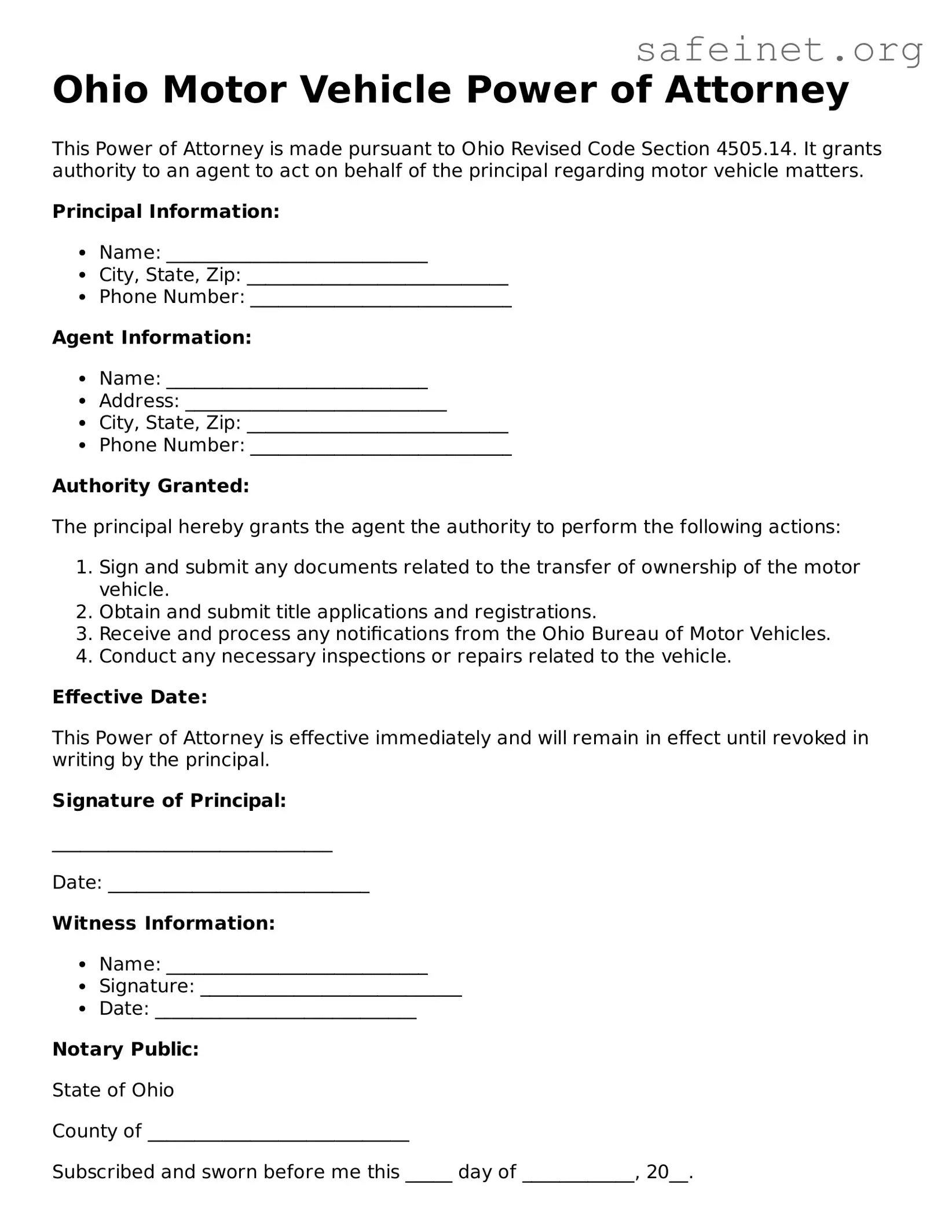
The Ohio Motor Vehicle Power of Attorney form serves as a crucial tool for individuals needing to delegate authority regarding their motor vehicle transactions. This legal document allows one person, known as the principal, to appoint another individual, the agent, to act on their behalf. The agent can handle various tasks, including signing documents related to the sale, transfer, or registration of a vehicle. This form is particularly useful in situations where the principal cannot be present to complete these transactions, such as during travel or illness. It simplifies the process by granting specific powers, ensuring that the agent can make decisions in the principal's best interest. Additionally, the form requires clear identification of both parties and a description of the vehicle involved, which helps prevent any potential misunderstandings. Understanding the implications and proper use of this form is essential for anyone looking to navigate vehicle-related matters efficiently and effectively in Ohio.
Ohio Motor Vehicle Power of Attorney
This Power of Attorney is made pursuant to Ohio Revised Code Section 4505.14. It grants authority to an agent to act on behalf of the principal regarding motor vehicle matters.
Principal Information:
Agent Information:
Authority Granted:
The principal hereby grants the agent the authority to perform the following actions:
Effective Date:
This Power of Attorney is effective immediately and will remain in effect until revoked in writing by the principal.
Signature of Principal:
______________________________
Date: ____________________________
Witness Information:
Notary Public:
State of Ohio
County of ____________________________
Subscribed and sworn before me this _____ day of ____________, 20__.
______________________________
Notary Public Signature
My Commission Expires: ____________________________
| Fact Name | Description |
|---|---|
| Purpose | The Ohio Motor Vehicle Power of Attorney form allows an individual to designate another person to act on their behalf regarding motor vehicle transactions. |
| Governing Law | This form is governed by the Ohio Revised Code, specifically sections related to powers of attorney and motor vehicle transactions. |
| Principal | The individual granting authority is referred to as the "principal." This person must be of sound mind and legal age. |
| Agent | The person designated to act on behalf of the principal is known as the "agent." This individual must also be of legal age. |
| Scope of Authority | The form specifies the powers granted, which may include signing titles, transferring ownership, and handling registration matters. |
| Duration | The authority granted through this form can be limited to a specific transaction or remain effective until revoked. |
| Revocation | The principal has the right to revoke the power of attorney at any time, provided they notify the agent and any relevant parties. |
| Notarization | While notarization is not always required, having the document notarized can enhance its validity and acceptance. |
To fill out the Ohio Motor Vehicle Power of Attorney form, you will need to provide specific information about the principal and the attorney-in-fact. Once completed, this form will allow the designated person to act on your behalf regarding motor vehicle transactions.
What is the Ohio Motor Vehicle Power of Attorney form?
The Ohio Motor Vehicle Power of Attorney form is a legal document that allows an individual (the principal) to authorize another person (the agent) to act on their behalf regarding motor vehicle transactions. This can include tasks such as signing titles, registering vehicles, and handling other related matters with the Ohio Bureau of Motor Vehicles (BMV).
Who can serve as an agent on the Power of Attorney form?
Any competent adult can serve as an agent under the Ohio Motor Vehicle Power of Attorney form. This means the person must be at least 18 years old and capable of understanding the responsibilities involved. It is common for individuals to choose trusted friends, family members, or professionals to act as their agents.
How do I complete the Ohio Motor Vehicle Power of Attorney form?
To complete the form, you will need to provide specific information, including your name, the name of your agent, and details about the vehicle involved, such as the make, model, and Vehicle Identification Number (VIN). Ensure that both you and your agent sign the document. It may also be helpful to have the form notarized to enhance its validity.
Is the Power of Attorney form valid in other states?
The Ohio Motor Vehicle Power of Attorney form is specifically designed for use within Ohio. While some states may recognize out-of-state powers of attorney, it is advisable to check the laws in the relevant state before using the form there. If you plan to conduct transactions in another state, consider consulting that state's requirements.
How long does the Power of Attorney remain in effect?
The Power of Attorney remains in effect until you revoke it or until the specific transaction for which it was created is completed. If you wish to revoke the authority granted to your agent, you must do so in writing and notify your agent and any relevant parties, such as the BMV.
Can I limit the authority granted to my agent?
Yes, you can specify the scope of authority granted to your agent in the Power of Attorney form. You may choose to allow your agent to handle only certain transactions or limit their authority in other ways. Clearly outlining these limitations in the document can help prevent misunderstandings.
What should I do if my agent misuses the Power of Attorney?
If you suspect that your agent is misusing the Power of Attorney, it is essential to act quickly. You can revoke the Power of Attorney immediately by providing written notice to your agent and any institutions or individuals that may be affected. If necessary, consult a legal professional for further assistance on how to protect your interests.
Not using the correct form. Many people mistakenly use a different power of attorney form instead of the specific Ohio Motor Vehicle Power of Attorney form. It’s crucial to ensure you have the right document for vehicle-related matters.
Failing to provide complete information. Incomplete details can lead to confusion. Make sure to fill in all required fields, including the names, addresses, and vehicle information. Missing information can delay the process.
Not signing the form. Some individuals forget to sign the document. A signature is essential for the power of attorney to be valid. Without it, the form will not be accepted.
Not having a witness or notarization. Depending on the requirements, some forms need to be witnessed or notarized. Failing to include this step can invalidate the document.
Ignoring state-specific rules. Each state has its own regulations regarding power of attorney forms. It’s important to review Ohio’s specific rules to ensure compliance and avoid any issues.
When dealing with motor vehicle transactions in Ohio, the Motor Vehicle Power of Attorney form is often accompanied by several other important documents. These forms help ensure that the process runs smoothly and that all necessary legal requirements are met. Below are some commonly used forms that may be needed alongside the Power of Attorney.
Understanding these documents can make the process of buying or selling a vehicle much more straightforward. Having the right paperwork in place not only helps protect your interests but also ensures compliance with Ohio's motor vehicle laws.
The Ohio Durable Power of Attorney is similar to the Motor Vehicle Power of Attorney in that both documents allow an individual to appoint someone else to act on their behalf. This can include making decisions regarding financial matters or property. While the Motor Vehicle Power of Attorney specifically focuses on vehicle-related transactions, the Durable Power of Attorney is broader and remains effective even if the principal becomes incapacitated. This ensures that the appointed agent can continue to manage the principal’s affairs without interruption.
The Ohio Health Care Power of Attorney also shares similarities with the Motor Vehicle Power of Attorney. Both documents empower a designated individual to make decisions on behalf of another person. However, the Health Care Power of Attorney specifically pertains to medical decisions and health care preferences. Like the Motor Vehicle version, it allows for the appointment of an agent, but it focuses on ensuring that an individual's health care wishes are honored when they are unable to communicate them.
The Ohio Financial Power of Attorney is another document that resembles the Motor Vehicle Power of Attorney. Both forms enable a person to designate an agent to handle specific transactions. The Financial Power of Attorney covers a wide range of financial matters, including banking, investments, and real estate. In contrast, the Motor Vehicle Power of Attorney is limited to vehicle transactions. Nonetheless, both documents serve to facilitate important decisions and actions on behalf of the principal.
The Ohio Real Estate Power of Attorney is similar in function to the Motor Vehicle Power of Attorney, as it allows an individual to appoint someone to manage real estate transactions. While the Motor Vehicle Power of Attorney focuses on vehicle-related matters, the Real Estate Power of Attorney specifically addresses property transactions such as buying, selling, or leasing real estate. Both documents require the principal's signature and ensure that their interests are represented when they are unable to act personally.
When filling out the Ohio Motor Vehicle Power of Attorney form, it’s important to follow specific guidelines to ensure that the document is valid and effective. Here’s a helpful list of things you should and shouldn’t do:
By following these guidelines, you can confidently complete the Ohio Motor Vehicle Power of Attorney form and ensure that your intentions are clear and legally recognized.
There are several misconceptions surrounding the Ohio Motor Vehicle Power of Attorney form. Understanding these can help individuals navigate the process more effectively. Below are six common misconceptions:
This is not true. Individuals can create a Power of Attorney form on their own, provided it meets the state’s requirements. However, consulting a lawyer can ensure that the form is completed correctly.
While many people associate Power of Attorney with financial decisions, it can also be used for motor vehicle transactions. This includes buying, selling, or registering a vehicle.
This is a misconception. A Power of Attorney can be revoked at any time by the person who created it, as long as they are mentally competent to do so.
Different types of Powers of Attorney exist, each serving specific purposes. The Ohio Motor Vehicle Power of Attorney is specifically tailored for vehicle-related transactions.
In Ohio, notarization is typically required for the Motor Vehicle Power of Attorney to be valid. This helps to prevent fraud and ensures the document is legally recognized.
This is misleading. The principal must designate a specific individual as their agent. This person will have the authority to act on their behalf for motor vehicle matters.
Filling out and using the Ohio Motor Vehicle Power of Attorney form can be straightforward if you keep a few key points in mind. Below are essential takeaways to consider:
Using this form effectively can simplify the process of managing vehicle-related matters when you are unable to do so yourself.