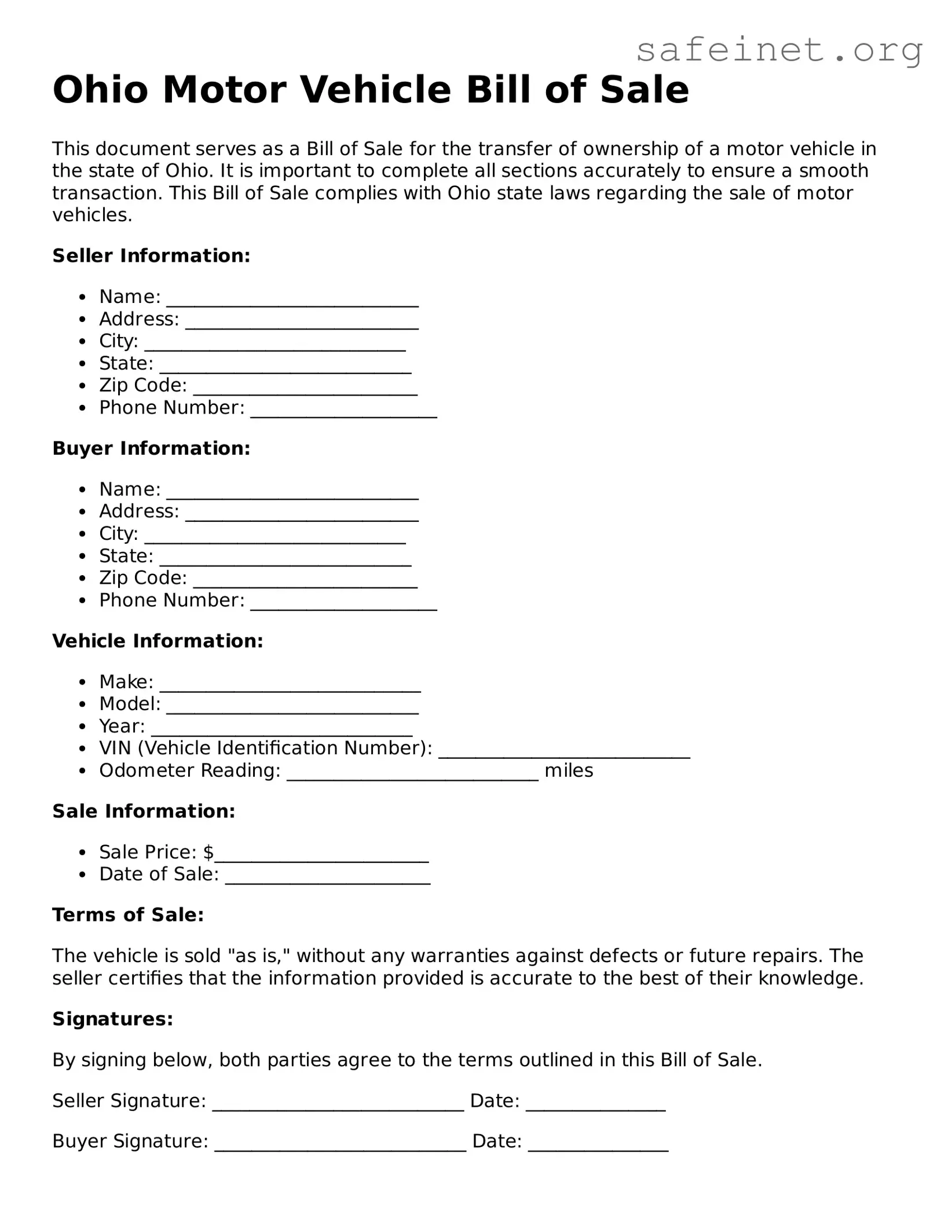
The Ohio Motor Vehicle Bill of Sale form serves as a crucial document in the process of transferring ownership of a vehicle. This form not only provides a record of the sale but also protects both the buyer and the seller by detailing essential information about the transaction. Key components of the form include the names and addresses of both parties involved, the vehicle's identification number (VIN), make, model, and year, as well as the sale price. Additionally, the form may contain spaces for the odometer reading at the time of sale and any warranties or conditions related to the vehicle. By accurately completing this document, individuals can ensure a smooth transfer of ownership while adhering to Ohio state requirements. Understanding the significance of the Bill of Sale is vital for anyone engaged in buying or selling a vehicle, as it establishes a clear record that can be referenced in the future, should any disputes arise.
Ohio Motor Vehicle Bill of Sale
This document serves as a Bill of Sale for the transfer of ownership of a motor vehicle in the state of Ohio. It is important to complete all sections accurately to ensure a smooth transaction. This Bill of Sale complies with Ohio state laws regarding the sale of motor vehicles.
Seller Information:
Buyer Information:
Vehicle Information:
Sale Information:
Terms of Sale:
The vehicle is sold "as is," without any warranties against defects or future repairs. The seller certifies that the information provided is accurate to the best of their knowledge.
Signatures:
By signing below, both parties agree to the terms outlined in this Bill of Sale.
Seller Signature: ___________________________ Date: _______________
Buyer Signature: ___________________________ Date: _______________
This Bill of Sale should be kept for your records. Both the seller and buyer should retain a copy for future reference.
| Fact Name | Description |
|---|---|
| Purpose | The Ohio Motor Vehicle Bill of Sale is used to document the sale or transfer of a vehicle between a seller and a buyer. |
| Governing Law | This form is governed by the Ohio Revised Code, specifically sections related to motor vehicle transactions. |
| Required Information | It typically requires details such as the vehicle identification number (VIN), make, model, year, and odometer reading. |
| Signatures | Both the seller and the buyer must sign the form to validate the transaction. |
| Notarization | While notarization is not required, it is recommended for added legal protection. |
| Use for Registration | This document is often needed when registering the vehicle in the new owner's name. |
| Availability | The form can be obtained online through the Ohio Bureau of Motor Vehicles or other legal resources. |
After obtaining the Ohio Motor Vehicle Bill of Sale form, it is essential to fill it out accurately to ensure a smooth transfer of ownership. Once completed, this form will serve as a crucial document for both the buyer and the seller during the transaction.
What is a Motor Vehicle Bill of Sale in Ohio?
A Motor Vehicle Bill of Sale in Ohio is a legal document that records the transfer of ownership of a vehicle from one party to another. It serves as proof of the transaction and includes essential details about the vehicle, the buyer, and the seller. This document can be crucial for both parties, especially when it comes to registering the vehicle or resolving any disputes in the future.
Is a Bill of Sale required in Ohio?
While a Bill of Sale is not legally required for every vehicle sale in Ohio, it is highly recommended. Having a Bill of Sale provides a clear record of the transaction and can help protect both the buyer and the seller. It is especially important when dealing with private sales, as it can prevent misunderstandings about the terms of the sale.
What information should be included in the Ohio Motor Vehicle Bill of Sale?
The Ohio Motor Vehicle Bill of Sale should include several key pieces of information. This includes the names and addresses of both the buyer and the seller, the vehicle identification number (VIN), the make, model, and year of the vehicle, the sale price, and the date of the transaction. It’s also wise to include any disclosures about the vehicle's condition or any warranties, if applicable.
Do I need to have the Bill of Sale notarized?
No, Ohio does not require a Bill of Sale to be notarized for it to be valid. However, having it notarized can add an extra layer of security and authenticity to the document. It may also be beneficial if you ever need to prove the transaction in court.
How does a Bill of Sale affect vehicle registration?
The Bill of Sale is often required when registering a vehicle with the Ohio Bureau of Motor Vehicles (BMV). It provides proof of ownership and the details necessary to transfer the title. Buyers should keep the Bill of Sale for their records and present it when applying for a new title and registration.
Can I create my own Bill of Sale?
Yes, you can create your own Bill of Sale in Ohio, as long as it includes all the necessary information. There are many templates available online that can help you draft a comprehensive document. Just ensure that it meets the requirements outlined by Ohio law to avoid any issues during the vehicle registration process.
What should I do if I lose my Bill of Sale?
If you lose your Bill of Sale, it’s advisable to try to obtain a copy from the other party involved in the transaction, if possible. If that’s not feasible, you may need to draft a new Bill of Sale, including all the original details, and have both parties sign it again. Keeping a copy of all important documents is always a good practice to avoid such situations.
Not including the date of sale. This is crucial for establishing when the transaction occurred.
Failing to provide accurate vehicle identification number (VIN). An incorrect VIN can lead to complications in registration.
Omitting the purchase price. This information is necessary for tax purposes and for the buyer's records.
Not including the full names and addresses of both the buyer and seller. Complete identification helps avoid future disputes.
Forgetting to sign the form. Both parties need to sign to validate the sale.
Leaving out the odometer reading. This is important for determining the vehicle's condition and value.
Using incorrect or outdated forms. Always ensure you have the latest version of the Ohio Motor Vehicle Bill of Sale.
Not keeping a copy of the completed form. Both parties should retain a copy for their records.
The Ohio Motor Vehicle Bill of Sale form is an essential document for transferring ownership of a vehicle. When completing this transaction, several other forms and documents may be necessary to ensure a smooth process. Below is a list of commonly used documents that accompany the Bill of Sale in Ohio.
Having these documents ready can facilitate the transfer of ownership and ensure compliance with Ohio laws. Always check with local authorities for any additional requirements specific to your situation.
The Ohio Motor Vehicle Bill of Sale form is similar to the General Bill of Sale. This document serves as proof of a transaction between a buyer and a seller for various items, not just vehicles. Like the Motor Vehicle Bill of Sale, it includes essential details such as the names of both parties, a description of the item sold, and the sale price. Both documents protect the interests of the buyer and seller by providing a record of the transaction.
Another document that resembles the Ohio Motor Vehicle Bill of Sale is the Boat Bill of Sale. This form is used when transferring ownership of a boat. It includes similar information, such as the boat’s make, model, and hull identification number, along with the buyer and seller’s details. Both documents ensure that ownership is legally transferred and recorded, making them essential for future reference.
The Motorcycle Bill of Sale is also comparable to the Ohio Motor Vehicle Bill of Sale. It serves a similar purpose for motorcycle transactions. This document captures the necessary details about the motorcycle, including its VIN, and provides a record of the sale. Just like the motor vehicle form, it protects both parties involved in the transaction.
A Car Title Transfer form is another document that shares similarities with the Ohio Motor Vehicle Bill of Sale. While the bill of sale documents the sale, the title transfer form officially changes the ownership of the vehicle in the state’s records. Both documents are often used together to ensure that the transaction is complete and recognized by the state.
The Equipment Bill of Sale is also relevant. This document is used for selling equipment, such as tools or machinery. It includes details about the equipment, similar to how the Motor Vehicle Bill of Sale describes the vehicle. Both documents serve to establish ownership and provide a record of the sale.
The Personal Property Bill of Sale is akin to the Ohio Motor Vehicle Bill of Sale as well. This form can be used for a variety of personal items, ranging from furniture to electronics. It includes information about the item and the transaction, ensuring both parties have a clear understanding of the sale, much like the motor vehicle document.
The Firearm Bill of Sale is another document that parallels the Ohio Motor Vehicle Bill of Sale. It is specifically used for the sale of firearms and includes details such as the make, model, and serial number of the firearm. Both forms protect the rights of the buyer and seller while documenting the transfer of ownership.
The RV Bill of Sale is similar in nature, used for the sale of recreational vehicles. This document captures the specifics of the RV, including its VIN and other identifying information. Like the Motor Vehicle Bill of Sale, it serves to protect both parties and provides a record of the transaction.
The Mobile Home Bill of Sale is also comparable. It is used when selling mobile homes and includes pertinent details such as the make, model, and serial number. Both documents ensure that the transfer of ownership is clear and legally recognized, providing peace of mind for both the buyer and seller.
Lastly, the Lease Agreement can be considered similar in that it outlines the terms of a temporary transfer of possession, though it does not transfer ownership. Both documents detail the involved parties and the item in question. While the Bill of Sale signifies a sale, the Lease Agreement establishes a rental arrangement, highlighting the importance of clear documentation in both scenarios.
When filling out the Ohio Motor Vehicle Bill of Sale form, attention to detail is crucial. Here are ten important things to keep in mind:
The Ohio Motor Vehicle Bill of Sale form is a crucial document in the process of buying or selling a vehicle. However, several misconceptions about this form can lead to confusion. Here are seven common misunderstandings:
Many people believe that a Bill of Sale is only required for certain types of transactions. In Ohio, a Bill of Sale is recommended for all vehicle sales, regardless of whether the transaction is between individuals or dealerships.
Some assume that only the seller's signature is necessary. In reality, both the buyer and the seller should sign the Bill of Sale to confirm the transaction and protect their interests.
While notarization adds an extra layer of security, it is not a requirement for the Ohio Bill of Sale. The form is valid as long as both parties sign it.
Another misconception is that the Bill of Sale can be filled out after the transaction has occurred. It is best practice to complete the form at the time of sale to ensure accuracy and avoid disputes later.
Some individuals think that the Bill of Sale is only relevant for private transactions. However, it can also be used for sales through dealerships, ensuring that all parties have a record of the sale.
There is a belief that general information is sufficient. In fact, the Bill of Sale should include specific details about the vehicle, such as the make, model, year, and VIN, to avoid any confusion.
Some people think that a Bill of Sale is merely a formality and lacks legal weight. On the contrary, it serves as a legal document that can be used in disputes, making it an important part of the transaction.
Understanding these misconceptions can help buyers and sellers navigate the vehicle sales process more effectively. A well-completed Bill of Sale can provide peace of mind and serve as a valuable record of the transaction.
When filling out and using the Ohio Motor Vehicle Bill of Sale form, several important points should be considered to ensure a smooth transaction. Here are key takeaways:
By following these guidelines, both buyers and sellers can navigate the process of vehicle sale in Ohio with greater confidence and clarity.