In Ohio, the Living Will form serves as a crucial tool for individuals wishing to outline their healthcare preferences in the event they become unable to communicate their wishes due to a medical condition. This legal document allows you to express your desires regarding life-sustaining treatment, such as resuscitation efforts and the use of feeding tubes. By completing a Living Will, you ensure that your values and choices are respected, even when you cannot voice them. The form typically requires your signature and the signatures of two witnesses or a notary public, making it essential to follow the proper procedures to validate your document. Additionally, it’s important to understand that a Living Will is not the same as a durable power of attorney for healthcare, which designates someone to make medical decisions on your behalf. Instead, a Living Will focuses specifically on your treatment preferences. Understanding these distinctions and the implications of your choices can empower you to make informed decisions about your future healthcare. This article will delve deeper into the specifics of the Ohio Living Will form, including how to fill it out, the importance of discussing your wishes with family members, and how to ensure your preferences are honored in a medical setting.
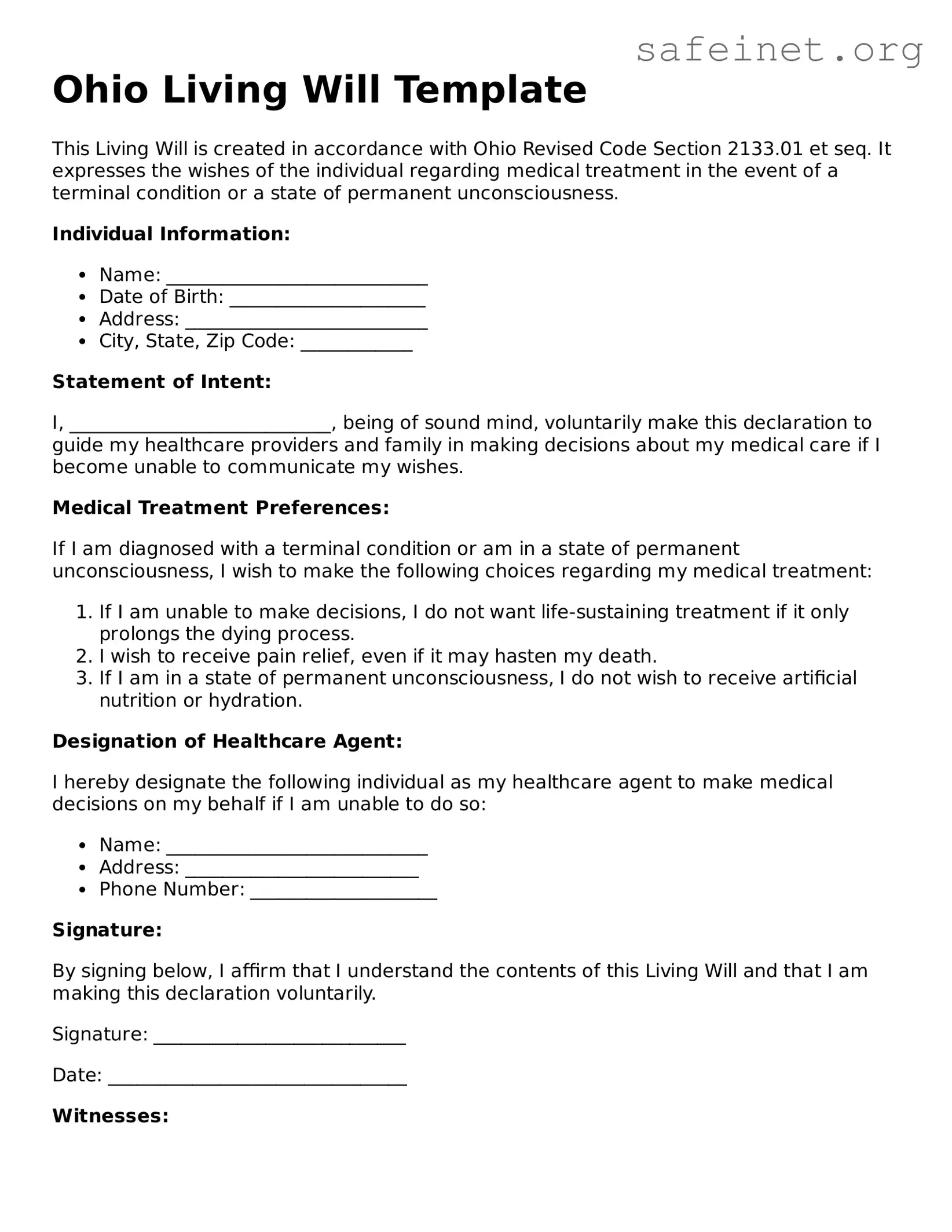
Ohio Living Will Template
This Living Will is created in accordance with Ohio Revised Code Section 2133.01 et seq. It expresses the wishes of the individual regarding medical treatment in the event of a terminal condition or a state of permanent unconsciousness.
Individual Information:
Statement of Intent:
I, ____________________________, being of sound mind, voluntarily make this declaration to guide my healthcare providers and family in making decisions about my medical care if I become unable to communicate my wishes.
Medical Treatment Preferences:
If I am diagnosed with a terminal condition or am in a state of permanent unconsciousness, I wish to make the following choices regarding my medical treatment:
Designation of Healthcare Agent:
I hereby designate the following individual as my healthcare agent to make medical decisions on my behalf if I am unable to do so:
Signature:
By signing below, I affirm that I understand the contents of this Living Will and that I am making this declaration voluntarily.
Signature: ___________________________
Date: ________________________________
Witnesses:
This document must be signed in the presence of two witnesses who are at least 18 years old and who are not related to me by blood or marriage.
| Fact Name | Description |
|---|---|
| Governing Law | The Ohio Living Will form is governed by Ohio Revised Code Section 2133. |
| Purpose | This form allows individuals to express their wishes regarding medical treatment in the event they become unable to communicate. |
| Eligibility | Any adult who is of sound mind can complete a Living Will in Ohio. |
| Witness Requirement | The form must be signed in the presence of two witnesses or notarized. |
| Revocation | Individuals can revoke their Living Will at any time, provided they communicate their decision clearly. |
| Health Care Providers | Health care providers are required to follow the directives outlined in a valid Living Will. |
| Advance Directives | A Living Will is a type of advance directive, which is a broader category of documents regarding health care preferences. |
| Durable Power of Attorney | A Living Will is distinct from a Durable Power of Attorney for Health Care, which designates someone to make decisions on behalf of the individual. |
| Storage | It is advisable to keep the Living Will in a safe place and provide copies to family members and health care providers. |
| Standard Form | The Ohio Department of Health provides a standard form for individuals to complete their Living Will. |
Filling out the Ohio Living Will form is an important step in expressing your healthcare preferences. After completing the form, you will need to sign it in the presence of witnesses or a notary, depending on your choice. This ensures that your wishes are documented and legally recognized.
What is a Living Will in Ohio?
A Living Will is a legal document that allows individuals to express their wishes regarding medical treatment in the event they become unable to communicate their preferences. In Ohio, this document specifically addresses end-of-life care, detailing what types of medical interventions a person does or does not want if they are terminally ill or permanently unconscious.
Who can create a Living Will in Ohio?
Any competent adult, 18 years or older, can create a Living Will in Ohio. It is essential that the individual understands the implications of their decisions and is able to communicate their wishes clearly. If someone has been declared incompetent, they cannot create or modify a Living Will.
How do I create a Living Will in Ohio?
To create a Living Will in Ohio, you need to complete a specific form that complies with state laws. This form must be signed by you and witnessed by two individuals, or you can have it notarized. It’s important to ensure that your witnesses are not related to you or beneficiaries of your estate to avoid any conflicts of interest.
Can I change or revoke my Living Will?
Yes, you can change or revoke your Living Will at any time, as long as you are competent. To revoke it, you can destroy the document, create a new one, or communicate your wishes to your healthcare provider. It’s a good idea to inform your family and healthcare agents about any changes you make.
What happens if I don’t have a Living Will?
If you do not have a Living Will, medical decisions may be made by your family members or legal representatives based on what they believe your wishes would be. This can lead to confusion and disagreements during a difficult time. Having a Living Will can provide clarity and ensure your preferences are respected.
Is a Living Will the same as a Power of Attorney?
No, a Living Will and a Power of Attorney are different documents. A Living Will focuses specifically on your medical treatment preferences, while a Power of Attorney allows you to designate someone to make decisions on your behalf, including financial and healthcare decisions. You can have both documents to cover different aspects of your care.
Where should I keep my Living Will?
It is important to keep your Living Will in a safe but accessible place. Consider giving copies to your healthcare provider, family members, and anyone designated as your healthcare agent. Make sure that those close to you know where to find it in case of an emergency.
Not Clearly Defining Medical Preferences: Many individuals fail to specify their wishes regarding life-sustaining treatments. It's crucial to detail what types of interventions you want or do not want, such as resuscitation, mechanical ventilation, or feeding tubes.
Forgetting to Sign and Date: A common oversight is neglecting to sign and date the form. Without your signature and the date, the document may not be considered valid, rendering your wishes unenforceable.
Not Discussing with Family or Healthcare Providers: Filling out the form without discussing it with loved ones or healthcare professionals can lead to confusion. Engaging in conversations about your choices ensures everyone understands your preferences and can advocate for them.
Failing to Update the Document: Life circumstances change, and so can your medical preferences. Neglecting to review and update your Living Will regularly can lead to outdated directives that no longer reflect your wishes.
When preparing a Living Will in Ohio, it's important to consider other related documents that can help clarify your wishes and ensure your preferences are honored. Here’s a list of some commonly used forms and documents that complement the Ohio Living Will form.
Each of these documents plays a vital role in ensuring your healthcare and personal preferences are respected. It’s essential to have these forms in place, so your wishes are clearly communicated and honored when it matters most.
The Ohio Living Will form is similar to the Advance Directive, which allows individuals to express their healthcare preferences in advance. Both documents enable a person to outline their wishes regarding medical treatment if they become unable to communicate. This ensures that healthcare providers and family members understand the individual’s desires, providing peace of mind during difficult times.
Another document that shares similarities is the Durable Power of Attorney for Healthcare. This form designates a trusted person to make medical decisions on behalf of someone if they cannot do so themselves. Like the Living Will, it focuses on healthcare choices, but it allows for more flexibility by appointing an agent to interpret the individual's wishes as circumstances change.
The Healthcare Proxy is also akin to the Living Will. This document appoints someone to make healthcare decisions on your behalf. While the Living Will states specific wishes, the Healthcare Proxy provides a person who can respond to unforeseen medical situations, ensuring that the individual’s preferences are honored even when they cannot voice them.
Another related document is the Do Not Resuscitate (DNR) order. This form specifically instructs healthcare providers not to perform CPR if a person's heart stops or they stop breathing. While the Living Will covers broader healthcare wishes, a DNR focuses on a specific aspect of end-of-life care, making the individual’s preferences clear in critical situations.
The Physician Orders for Life-Sustaining Treatment (POLST) form is also similar. It translates a person's wishes regarding life-sustaining treatments into actionable medical orders. Unlike the Living Will, which is often broader, the POLST form provides specific instructions that healthcare professionals must follow, ensuring that the individual’s desires are respected in emergencies.
Lastly, the Advance Care Plan is comparable to the Ohio Living Will. This document encourages discussions about future healthcare decisions and outlines preferences in a comprehensive manner. It often includes various aspects of care, such as pain management and organ donation, giving a fuller picture of the individual’s values and wishes when it comes to their health care.
When filling out the Ohio Living Will form, it's important to be careful and thoughtful. Here are some guidelines to help you navigate the process effectively.
There are several misconceptions regarding the Ohio Living Will form that can lead to confusion. Below are five common misunderstandings.
This is not accurate. The Ohio Living Will can address a variety of medical situations, including those where individuals may be permanently unconscious or unable to make decisions about their own care.
This misconception overlooks the fact that anyone, regardless of age, can benefit from having a Living Will. Unexpected medical emergencies can occur at any time.
While both documents deal with medical treatment preferences, they serve different purposes. A Living Will outlines broader wishes regarding end-of-life care, whereas a DNR specifically addresses resuscitation efforts.
This is incorrect. Individuals can modify or revoke their Living Will at any time, provided they are of sound mind and able to communicate their wishes.
This is a misunderstanding. A Living Will allows individuals to specify their preferences regarding certain types of treatment but does not prevent them from receiving necessary medical care that aligns with their wishes.
When considering the Ohio Living Will form, it is important to understand its purpose and the implications of filling it out. Here are some key takeaways: