Creating a Last Will and Testament is an essential step for anyone looking to ensure their wishes are honored after they pass away. In Ohio, this legal document serves as a vital tool for outlining how your assets should be distributed, who will care for your minor children, and who will execute your final wishes. The Ohio Last Will and Testament form allows you to specify beneficiaries, designate guardians for dependents, and appoint an executor to manage your estate. Additionally, it provides a space for you to express any special requests regarding your funeral arrangements or the handling of personal belongings. Understanding the key components of this form can help you navigate the process more confidently, ensuring that your intentions are clearly communicated and legally binding. By taking the time to create a well-thought-out will, you can provide peace of mind for both yourself and your loved ones during a challenging time.
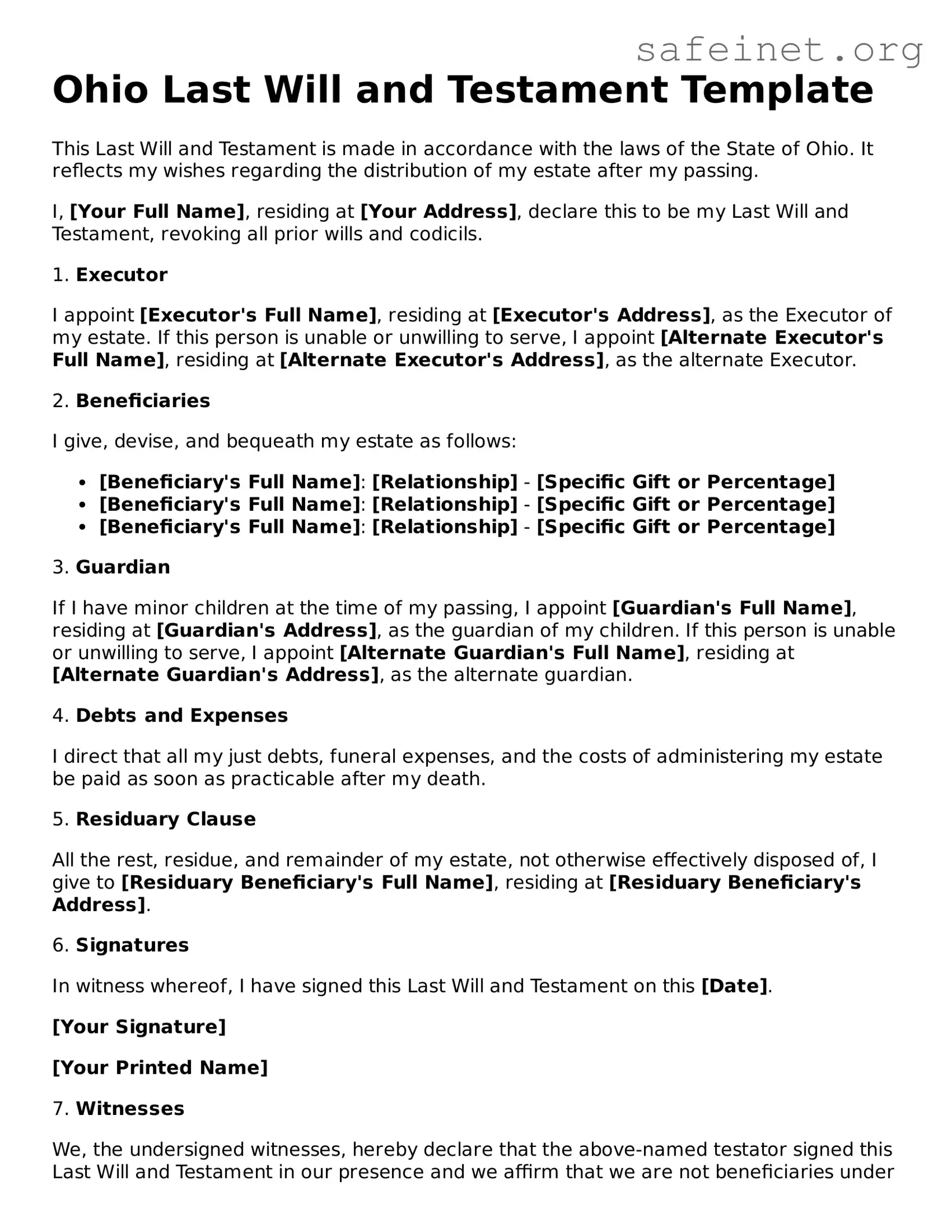
Ohio Last Will and Testament Template
This Last Will and Testament is made in accordance with the laws of the State of Ohio. It reflects my wishes regarding the distribution of my estate after my passing.
I, [Your Full Name], residing at [Your Address], declare this to be my Last Will and Testament, revoking all prior wills and codicils.
1. Executor
I appoint [Executor's Full Name], residing at [Executor's Address], as the Executor of my estate. If this person is unable or unwilling to serve, I appoint [Alternate Executor's Full Name], residing at [Alternate Executor's Address], as the alternate Executor.
2. Beneficiaries
I give, devise, and bequeath my estate as follows:
3. Guardian
If I have minor children at the time of my passing, I appoint [Guardian's Full Name], residing at [Guardian's Address], as the guardian of my children. If this person is unable or unwilling to serve, I appoint [Alternate Guardian's Full Name], residing at [Alternate Guardian's Address], as the alternate guardian.
4. Debts and Expenses
I direct that all my just debts, funeral expenses, and the costs of administering my estate be paid as soon as practicable after my death.
5. Residuary Clause
All the rest, residue, and remainder of my estate, not otherwise effectively disposed of, I give to [Residuary Beneficiary's Full Name], residing at [Residuary Beneficiary's Address].
6. Signatures
In witness whereof, I have signed this Last Will and Testament on this [Date].
[Your Signature]
[Your Printed Name]
7. Witnesses
We, the undersigned witnesses, hereby declare that the above-named testator signed this Last Will and Testament in our presence and we affirm that we are not beneficiaries under this will.
Witness 1:
[Witness 1 Signature]
[Witness 1 Printed Name]
[Witness 1 Address]
Witness 2:
[Witness 2 Signature]
[Witness 2 Printed Name]
[Witness 2 Address]
This document is intended to serve as a template. It is advisable to consult with a legal professional to ensure it meets all necessary legal requirements and accurately reflects your wishes.
| Fact Name | Details |
|---|---|
| Governing Law | The Ohio Last Will and Testament is governed by Ohio Revised Code Section 2107.01 et seq. |
| Requirements for Validity | To be valid, the will must be in writing, signed by the testator, and witnessed by at least two individuals. |
| Holographic Wills | Ohio recognizes holographic wills, which are handwritten and signed by the testator, as valid under certain conditions. |
| Revocation of Wills | A will can be revoked by the testator at any time through a subsequent will or by destroying the original document. |
After gathering the necessary information, you will proceed to fill out the Ohio Last Will and Testament form. This document allows you to specify how your assets will be distributed after your passing, and who will manage your estate. It is important to ensure that all information is accurate and complete to avoid complications later.
What is a Last Will and Testament in Ohio?
A Last Will and Testament is a legal document that outlines how a person wishes their assets and property to be distributed after their death. In Ohio, this document can also appoint guardians for minor children and specify funeral arrangements. It serves as a critical tool for ensuring that your wishes are honored and can help avoid disputes among family members.
Who can create a Last Will and Testament in Ohio?
In Ohio, any individual who is at least 18 years old and of sound mind can create a Last Will and Testament. This means that the person must understand the nature of their actions and the consequences of their decisions. It is important to ensure that the will reflects the individual's true intentions and is not created under duress.
What are the requirements for a valid Last Will and Testament in Ohio?
For a Last Will and Testament to be considered valid in Ohio, it must be written, signed by the testator (the person making the will), and witnessed by at least two individuals. These witnesses must be present at the same time when the testator signs the will. Additionally, the witnesses should not be beneficiaries of the will to avoid potential conflicts of interest.
Can I change or revoke my Last Will and Testament?
Yes, you can change or revoke your Last Will and Testament at any time while you are still alive and of sound mind. To make changes, you can create a new will that explicitly revokes the previous one, or you can add a codicil, which is an amendment to the existing will. It is crucial to follow the same formalities for signing and witnessing as required for the original will to ensure that any changes are valid.
What happens if I die without a Last Will and Testament in Ohio?
If you die without a will, you are said to have died "intestate." In this case, Ohio law dictates how your assets will be distributed. Generally, your property will go to your closest relatives, such as your spouse, children, or parents, depending on your family situation. This process can lead to outcomes that may not align with your wishes, making it important to have a will in place.
How can I ensure my Last Will and Testament is executed properly?
To ensure that your Last Will and Testament is executed properly, consider consulting with an attorney who specializes in estate planning. They can help you navigate the legal requirements and ensure that your will reflects your wishes accurately. Additionally, storing your will in a safe place and informing your loved ones of its location can help facilitate the process after your passing.
Is it necessary to have an attorney to create a Last Will and Testament in Ohio?
While it is not legally required to have an attorney to create a Last Will and Testament in Ohio, consulting with one is highly advisable. An attorney can provide valuable guidance on the legal requirements, help you avoid common pitfalls, and ensure that your will is tailored to your specific needs and circumstances.
Can I include specific bequests in my Last Will and Testament?
Yes, you can include specific bequests in your Last Will and Testament. This means you can designate particular items or amounts of money to specific individuals. For example, you might leave a family heirloom to a child or a certain sum to a friend. Clearly outlining these bequests helps to prevent confusion and ensures that your wishes are carried out as intended.
Not properly identifying themselves: Individuals often forget to include their full legal name and address. This information is crucial for validating the will.
Failing to sign the document: Some people neglect to sign their will. A signature is essential for the will to be considered valid.
Ignoring witness requirements: Ohio law mandates that a will must be witnessed by at least two individuals. Failing to have the necessary witnesses can invalidate the will.
Not updating the will: People often forget to revise their wills after significant life events, such as marriage, divorce, or the birth of a child. An outdated will may not reflect current wishes.
When preparing a Last Will and Testament in Ohio, there are several other documents that may be useful to ensure your wishes are clearly outlined and legally recognized. Here’s a list of common forms and documents that often accompany a will.
Having these documents prepared can help ensure that your wishes are respected and that your loved ones are taken care of. It’s always a good idea to consult with a professional to make sure everything is in order.
The Ohio Last Will and Testament form shares similarities with a Living Will, which is a legal document that outlines an individual's preferences regarding medical treatment in the event they become incapacitated. While the Last Will and Testament primarily addresses the distribution of assets after death, a Living Will focuses on healthcare decisions during a person's lifetime. Both documents reflect the individual's wishes and ensure that their desires are honored, whether in the realm of asset distribution or medical care. Importantly, both documents require the testator's clear intentions and must be executed according to state laws to be valid.
An Advance Directive is another document that resembles the Ohio Last Will and Testament. This document combines elements of a Living Will and a Durable Power of Attorney for Healthcare. It allows individuals to specify their healthcare preferences and appoint someone to make medical decisions on their behalf if they are unable to do so. Like a Last Will, an Advance Directive is crucial for ensuring that an individual's wishes are respected. Both documents serve to protect the individual's interests, though they apply to different scenarios—one for after death and the other for medical situations during life.
Lastly, a Power of Attorney is similar to the Ohio Last Will and Testament in that it allows individuals to designate someone to act on their behalf in legal or financial matters. While the Last Will becomes effective upon death, a Power of Attorney operates during the individual's lifetime and can be crucial in managing affairs if the person becomes incapacitated. Both documents empower individuals to ensure their interests are managed according to their preferences, albeit in different contexts—one for after death and the other for situations requiring immediate decision-making.
When filling out the Ohio Last Will and Testament form, it's important to follow certain guidelines to ensure your wishes are clear and legally binding. Here are six things to keep in mind:
Understanding the Ohio Last Will and Testament form is essential for effective estate planning. However, several misconceptions can lead to confusion. Here are four common misunderstandings:
Being aware of these misconceptions can help ensure that your estate planning is effective and that your wishes are honored.
Filling out and using the Ohio Last Will and Testament form is a significant step in ensuring that one's wishes are honored after death. Here are some key takeaways to consider: