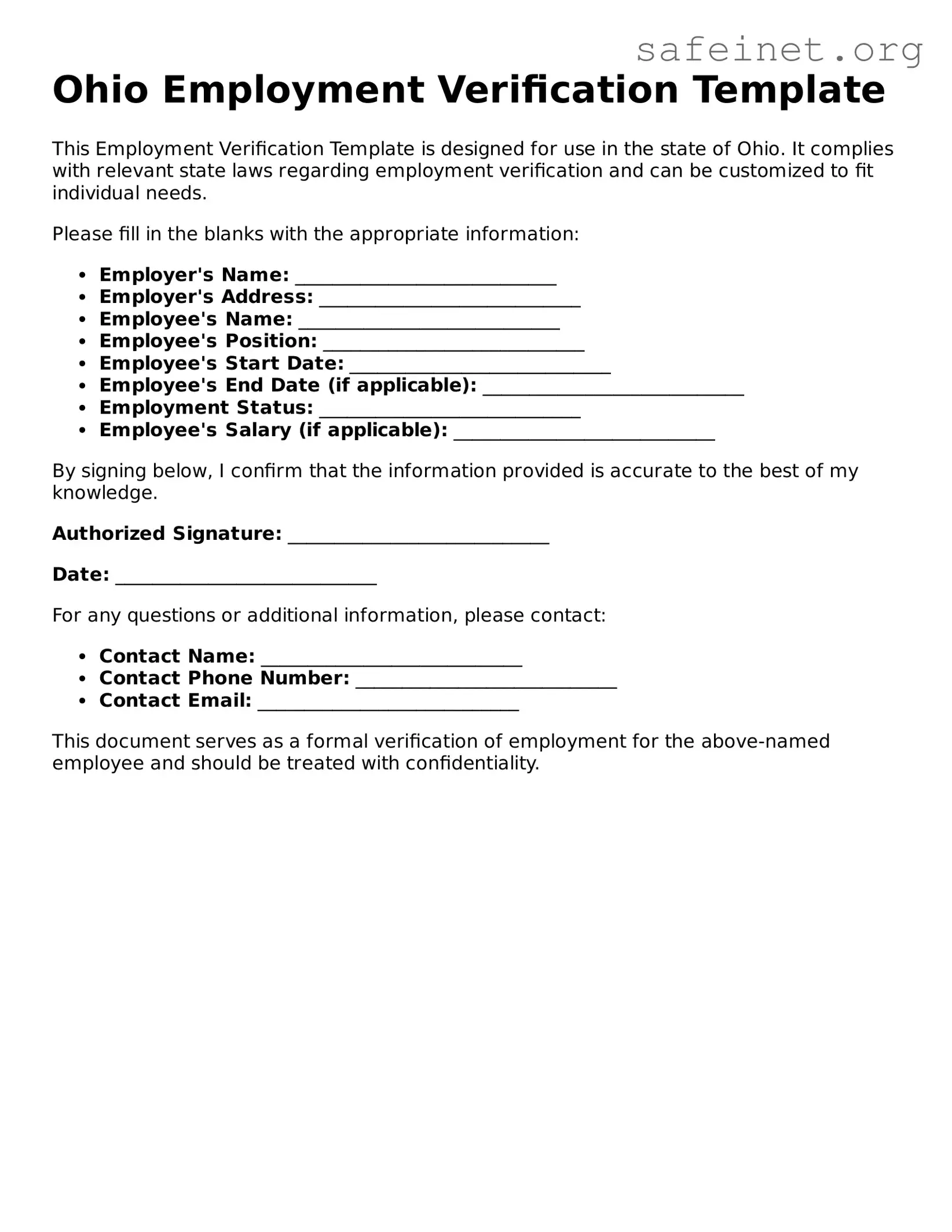
The Ohio Employment Verification form plays a crucial role in the hiring process, serving as a key document for employers and employees alike. This form is essential for confirming an individual's employment status, job title, and duration of employment. It helps to ensure that all information is accurate and up-to-date, which is vital for both tax purposes and benefits eligibility. Employers typically use this form to provide verification to third parties, such as lenders or government agencies, who may require proof of employment for various reasons. Completing the form accurately is important, as it reflects the credibility of the employee and the organization. Understanding the components of the Ohio Employment Verification form can help streamline the process and alleviate any concerns about employment status verification.
Ohio Employment Verification Template
This Employment Verification Template is designed for use in the state of Ohio. It complies with relevant state laws regarding employment verification and can be customized to fit individual needs.
Please fill in the blanks with the appropriate information:
By signing below, I confirm that the information provided is accurate to the best of my knowledge.
Authorized Signature: ____________________________
Date: ____________________________
For any questions or additional information, please contact:
This document serves as a formal verification of employment for the above-named employee and should be treated with confidentiality.
| Fact Name | Details |
|---|---|
| Purpose | The Ohio Employment Verification form is used to confirm an individual's employment status and details for various purposes, including government benefits and loan applications. |
| Required Information | The form typically requires the employee's name, Social Security number, job title, employment dates, and employer's contact information. |
| Governing Law | Ohio Revised Code Section 4111.14 governs employment verification practices in Ohio, ensuring compliance with state employment laws. |
| Submission Process | Employers must complete the form and submit it to the requesting party, which could be a government agency or financial institution. |
| Confidentiality | Employers must ensure that the information provided on the form is kept confidential and only shared with authorized entities. |
After obtaining the Ohio Employment Verification form, it’s important to complete it accurately to ensure a smooth verification process. Follow these steps carefully to fill out the form correctly.
Once the form is completed, it should be submitted to the appropriate party for processing. Ensure that all information is accurate and that the form is submitted promptly to avoid any delays in verification.
What is the Ohio Employment Verification form?
The Ohio Employment Verification form is a document used to confirm an individual's employment status. Employers fill out this form to provide information about a current or former employee's job title, dates of employment, and salary, among other details. This form is often requested by banks, landlords, or other entities that require proof of employment for various purposes.
Who can request an Ohio Employment Verification form?
Typically, the employee or a third party, such as a lender or landlord, may request the form. Employers are responsible for completing it accurately and promptly. Employees often need this verification for loan applications, rental agreements, or other situations where proof of income is necessary.
How does an employee request the form?
An employee can request the form directly from their employer's human resources department. It's best to make the request in writing, either via email or a formal letter, to ensure there is a record of the request. Some companies may have a specific process in place for handling employment verification requests, so it's important to follow any outlined procedures.
What information is typically included in the form?
The form generally includes the employee's name, job title, dates of employment, salary information, and sometimes additional details like employment status (full-time or part-time). Employers may also include information about the employee's performance or other relevant notes, depending on their policies.
Is there a fee for obtaining the Ohio Employment Verification form?
In most cases, there is no fee for obtaining the employment verification form. Employers are usually required to provide this information as part of their obligation to their employees. However, if a third party requests the verification, they might have to pay a fee if the employer has a policy in place for processing such requests.
How long does it take to receive the completed form?
The time it takes to receive the completed Ohio Employment Verification form can vary. Generally, employers should respond within a few business days, but this can depend on the company’s policies and workload. If the request is urgent, it’s advisable for the employee to communicate that clearly when making the request.
What should an employee do if their employer refuses to complete the form?
If an employer refuses to complete the form, the employee should first ask for the reason. There may be company policies or legal considerations at play. If the refusal seems unjustified, the employee can consider discussing the matter with a supervisor or human resources representative. In some cases, seeking legal advice may also be appropriate.
Can the information on the form be disputed?
Yes, if an employee believes the information provided on the employment verification form is inaccurate, they have the right to dispute it. The employee should address their concerns with their employer, providing any necessary documentation to support their claim. Employers are generally obligated to correct any errors if they are proven to be incorrect.
Failing to provide complete information. Many individuals neglect to fill in all required fields, such as the employee's full name, job title, and dates of employment. Incomplete forms can lead to delays in processing.
Using incorrect or outdated information. Sometimes, people mistakenly provide previous job titles or employment dates. Always double-check the details before submission to ensure accuracy.
Not signing the form. A common oversight is forgetting to sign the verification form. An unsigned form is often considered invalid and may be returned for correction.
Submitting the form to the wrong department. Individuals may send the verification to a department not responsible for processing employment verification. This mistake can significantly delay the verification process.
Ignoring the instructions. Each Employment Verification form comes with specific guidelines. Failing to read these instructions can lead to errors that could have been easily avoided.
Not keeping a copy of the submitted form. After sending the verification, it’s crucial to retain a copy for personal records. This can be helpful if there are any follow-up questions or issues.
Overlooking the deadline. Some situations require timely submission of the Employment Verification form. Missing a deadline can have significant repercussions, particularly in job applications or legal matters.
Failing to verify the contact information. If the contact details for the employer or HR department are incorrect, it can lead to complications in the verification process. Always confirm that this information is up-to-date.
When completing the Ohio Employment Verification form, you may need to provide additional documents to support your application or verification process. These documents help establish your employment history and ensure that all information is accurate. Below are some common forms and documents that are often used alongside the Employment Verification form.
Gathering these documents can streamline the verification process and provide a comprehensive view of your employment background. Make sure to keep copies for your records as well.
The I-9 form is a critical document for employment verification in the United States. Like the Ohio Employment Verification form, it is used to confirm an employee's identity and eligibility to work. Employers must complete the I-9 for every new hire, ensuring that they have the necessary documentation to support the employee's legal status. Both forms help maintain compliance with federal and state employment laws.
The W-4 form is another important document related to employment. While it does not verify employment directly, it is essential for tax purposes. Employees use the W-4 to indicate their tax withholding preferences. Similar to the Ohio Employment Verification form, it is filled out by the employee and submitted to the employer, ensuring that the correct amount of taxes is withheld from their paycheck.
The state unemployment insurance (UI) form is another document that bears similarities to the Ohio Employment Verification form. This form is used to report employee information for unemployment benefits. Employers must provide accurate data about their employees, similar to the requirements of the Ohio form. Both documents aim to protect workers' rights and ensure they receive benefits when needed.
The Form 1099 is used for reporting income for independent contractors. While it serves a different purpose than the Ohio Employment Verification form, both documents require accurate information about the worker. Employers use the 1099 to report payments made to freelancers or contractors, ensuring that tax obligations are met, much like the verification process for regular employees.
The Fair Labor Standards Act (FLSA) documentation is relevant for verifying compliance with wage and hour laws. Employers must keep records that demonstrate adherence to these regulations. Similar to the Ohio Employment Verification form, FLSA documentation helps ensure that employees are treated fairly and receive the correct compensation for their work.
The Employee Identification Number (EIN) application is another document that shares similarities. Employers must obtain an EIN to report taxes and manage employee records. Just like the Ohio Employment Verification form, it is essential for maintaining accurate records and ensuring compliance with tax laws. Both documents play a vital role in the employment process.
The Labor Condition Application (LCA) is used for certain visa applications, specifically for foreign workers. It ensures that employers comply with labor laws when hiring non-U.S. citizens. Similar to the Ohio Employment Verification form, the LCA requires detailed information about the employee and the job position, ensuring that all legal requirements are met for employment.
Finally, the state-specific employment application is another document that resembles the Ohio Employment Verification form. This application collects information from job seekers and is often used as part of the hiring process. Both forms gather essential data about the employee, helping employers make informed hiring decisions while ensuring compliance with state laws.
When filling out the Ohio Employment Verification form, there are some important dos and don'ts to keep in mind. Following these guidelines can help ensure that your form is completed accurately and efficiently.
Misconceptions about the Ohio Employment Verification form can lead to confusion. Here are seven common misunderstandings:
When filling out and using the Ohio Employment Verification form, it is essential to understand its purpose and the necessary steps involved. Here are some key takeaways to consider: