The Ohio Durable Power of Attorney form is a crucial legal document that allows individuals to appoint someone they trust to make decisions on their behalf when they are unable to do so. This form is especially important for managing financial matters, healthcare choices, and other personal affairs. It remains effective even if the person who created it becomes incapacitated, ensuring that their wishes are respected and carried out. The appointed individual, known as the agent or attorney-in-fact, can handle a variety of tasks, from paying bills to making medical decisions. Understanding the nuances of this form is essential for anyone considering it, as it provides a framework for decision-making during challenging times. Properly completing the Durable Power of Attorney form can offer peace of mind, knowing that one's affairs are in capable hands, and that specific wishes regarding healthcare and finances are clearly outlined and legally binding.
Ohio Durable Power of Attorney
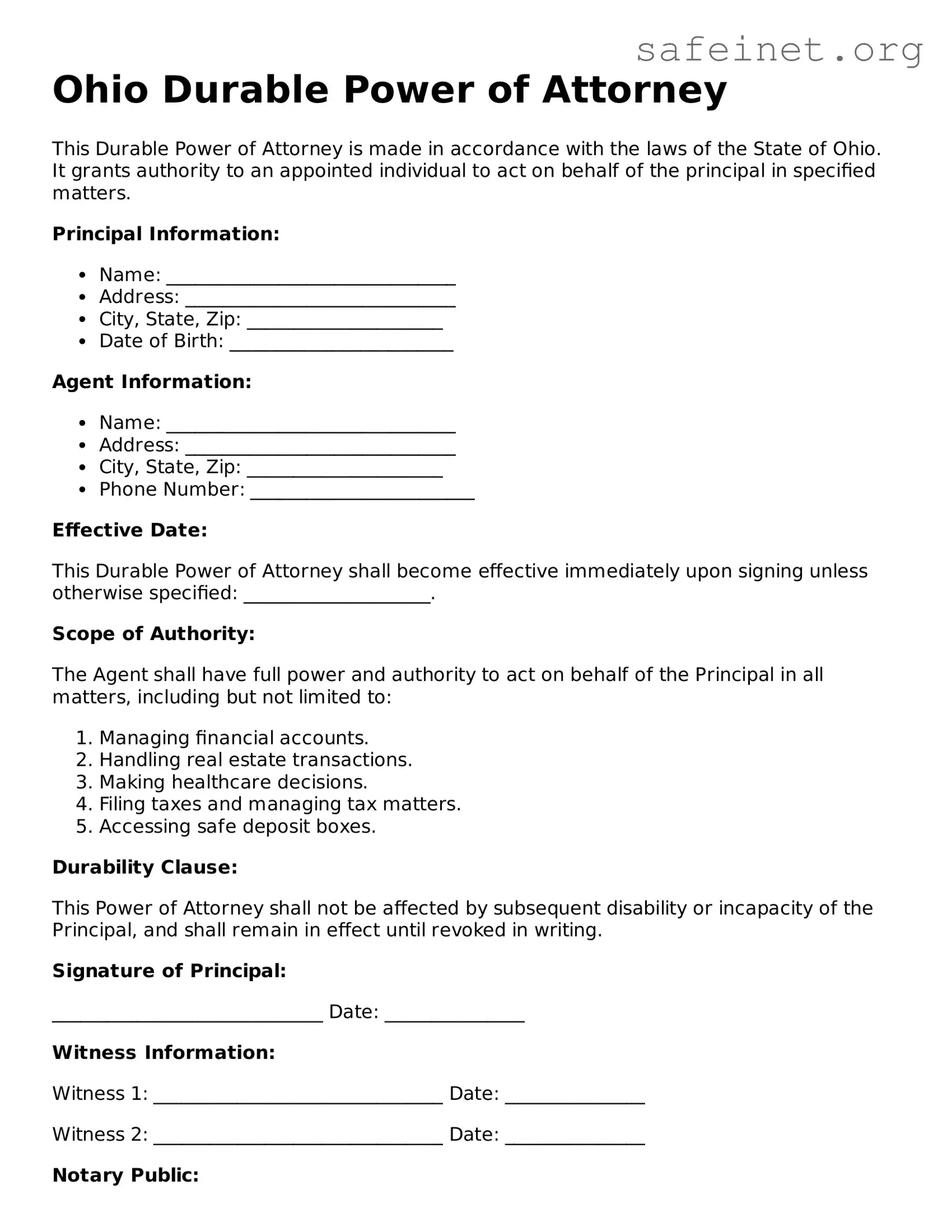
This Durable Power of Attorney is made in accordance with the laws of the State of Ohio. It grants authority to an appointed individual to act on behalf of the principal in specified matters.
Principal Information:
Agent Information:
Effective Date:
This Durable Power of Attorney shall become effective immediately upon signing unless otherwise specified: ____________________.
Scope of Authority:
The Agent shall have full power and authority to act on behalf of the Principal in all matters, including but not limited to:
Durability Clause:
This Power of Attorney shall not be affected by subsequent disability or incapacity of the Principal, and shall remain in effect until revoked in writing.
Signature of Principal:
_____________________________ Date: _______________
Witness Information:
Witness 1: _______________________________ Date: _______________
Witness 2: _______________________________ Date: _______________
Notary Public:
State of Ohio
County of ____________________________
Subscribed and sworn before me this _____ day of ______________, 20____.
_____________________________
Notary Public
My Commission Expires: ________________
| Fact Name | Description |
|---|---|
| Purpose | The Ohio Durable Power of Attorney allows an individual to appoint someone to make financial decisions on their behalf, even if they become incapacitated. |
| Governing Law | This form is governed by Ohio Revised Code Section 1337.24, which outlines the requirements and powers granted under a Durable Power of Attorney. |
| Durability | This document remains effective even if the principal becomes mentally incompetent, ensuring that financial matters can still be managed. |
| Revocation | The principal can revoke the Durable Power of Attorney at any time, as long as they are mentally competent to do so. |
| Notarization | To be valid, the Ohio Durable Power of Attorney must be signed in the presence of a notary public. |
Filling out the Ohio Durable Power of Attorney form is a straightforward process. This document allows you to appoint someone to make decisions on your behalf regarding financial and legal matters. Follow these steps carefully to ensure the form is completed correctly.
What is a Durable Power of Attorney in Ohio?
A Durable Power of Attorney is a legal document that allows you to appoint someone to make decisions on your behalf, even if you become incapacitated. This person, known as your agent or attorney-in-fact, can manage your financial affairs, make healthcare decisions, or handle other specified tasks. The term "durable" indicates that the authority granted to your agent remains effective even if you lose the ability to make decisions for yourself.
How do I create a Durable Power of Attorney in Ohio?
To create a Durable Power of Attorney in Ohio, you must complete a specific form that outlines the powers you wish to grant to your agent. You can find templates online or consult with an attorney for assistance. After filling out the form, you must sign it in the presence of a notary public. It’s essential to ensure that the document complies with Ohio law to be valid and enforceable.
Can I revoke my Durable Power of Attorney once it is established?
Yes, you have the right to revoke your Durable Power of Attorney at any time, as long as you are mentally competent. To do this, you should create a written revocation notice, clearly stating your intention to cancel the previous document. It’s advisable to notify your agent and any institutions or individuals who were aware of the original Durable Power of Attorney to avoid confusion.
What powers can I grant to my agent under a Durable Power of Attorney?
You can grant a wide range of powers to your agent, including the ability to manage your bank accounts, pay bills, buy or sell property, and make healthcare decisions. However, it’s crucial to specify the powers you wish to grant clearly. You can also limit certain powers or include specific instructions on how you want your affairs handled.
Is a Durable Power of Attorney the same as a healthcare proxy?
No, a Durable Power of Attorney and a healthcare proxy are not the same, although they can overlap. A Durable Power of Attorney generally focuses on financial and legal matters, while a healthcare proxy specifically designates someone to make medical decisions on your behalf if you are unable to do so. In Ohio, you can create both documents to ensure that your financial and healthcare wishes are respected.
Failing to specify the powers granted. It's crucial to clearly outline what authority the agent will have.
Not including a date. A date is necessary to establish when the document becomes effective.
Overlooking the requirement for signatures. Both the principal and the agent must sign the form for it to be valid.
Neglecting to have witnesses. Ohio law requires that the document be witnessed by at least one person.
Using outdated forms. Always use the most current version of the Durable Power of Attorney form to ensure compliance with the law.
Not discussing the document with the agent. Communication is key. The agent should understand their responsibilities and the principal's wishes.
Failing to revoke previous documents. If there are prior powers of attorney, they must be revoked to avoid confusion.
Leaving out alternate agents. It’s wise to name a backup agent in case the primary agent is unable or unwilling to act.
Not considering specific limitations. If there are certain actions you want to restrict, make sure to include those limitations clearly.
Ignoring state-specific requirements. Each state has unique laws regarding powers of attorney. Familiarize yourself with Ohio's specific requirements.
When creating a Durable Power of Attorney (DPOA) in Ohio, it’s important to consider other documents that can complement this legal instrument. Each of these forms serves a unique purpose, ensuring that your wishes are respected and that your affairs are managed according to your preferences. Below is a list of documents often used alongside the Ohio Durable Power of Attorney form.
These documents can work together to create a comprehensive plan for your healthcare and financial needs. Taking the time to prepare them can provide peace of mind, knowing that your wishes will be respected even when you can’t voice them yourself.
The Ohio Durable Power of Attorney (DPOA) form is similar to a general power of attorney. Both documents allow an individual, known as the principal, to designate another person, the agent, to act on their behalf. However, the DPOA remains effective even if the principal becomes incapacitated, while a general power of attorney may become void in such circumstances. This distinction is crucial for ensuring that financial and legal matters are managed during periods of incapacity.
Another document that shares similarities with the DPOA is the medical power of attorney. This form specifically grants an agent the authority to make healthcare decisions for the principal if they are unable to do so themselves. Like the DPOA, it allows for the delegation of decision-making authority, but it focuses solely on medical matters rather than financial or legal issues.
The living will is another document that complements the DPOA. While the DPOA allows an agent to make decisions, a living will outlines the principal's wishes regarding medical treatment in end-of-life situations. Both documents work together to ensure that an individual’s preferences are honored when they cannot communicate them directly.
A revocable trust is also similar to the DPOA in that it allows for the management of assets. In a revocable trust, the principal can transfer their assets into the trust and appoint a trustee to manage those assets. Unlike the DPOA, which grants authority to an agent, a revocable trust provides a structured way to manage and distribute assets during the principal's lifetime and after death.
The healthcare proxy is closely related to the medical power of attorney. It designates an individual to make healthcare decisions on behalf of the principal. While the medical power of attorney is specifically for healthcare decisions, the healthcare proxy may encompass broader aspects of medical care, ensuring that the principal's preferences are respected.
The guardianship document is another important legal instrument. It appoints a guardian to make decisions for someone who is unable to care for themselves due to incapacity. While the DPOA allows the principal to choose their agent, guardianship is often established through a court process, which may not reflect the principal's preferences as directly as a DPOA.
The financial power of attorney is akin to the DPOA but typically does not have the durability aspect. A financial power of attorney grants authority to manage financial matters but may become ineffective if the principal becomes incapacitated. This distinction can be critical for individuals who want to ensure their financial affairs are managed regardless of their health status.
A springing power of attorney is another related document. It becomes effective only upon the occurrence of a specific event, such as the principal’s incapacity. This contrasts with the DPOA, which is effective immediately upon signing. The springing power of attorney can provide an extra layer of control for individuals who want to maintain authority over their decisions until absolutely necessary.
The assignment of benefits document is similar in that it allows a principal to transfer their rights to receive benefits to another party. This is often used in insurance and healthcare contexts. While it does not provide broad powers like the DPOA, it allows for specific rights to be assigned, ensuring that benefits are managed according to the principal's wishes.
Lastly, the durable power of attorney for healthcare is another variation. This document specifically focuses on healthcare decisions and remains effective even if the principal becomes incapacitated. It is similar to the DPOA in its durability but is tailored exclusively for medical decision-making, ensuring that healthcare preferences are honored without interruption.
When filling out the Ohio Durable Power of Attorney form, it is crucial to approach the task with care and precision. Here are five essential do's and don'ts to guide you through the process:
Understanding the Ohio Durable Power of Attorney (DPOA) form is crucial for anyone considering this important legal document. However, several misconceptions can cloud people's understanding. Here are seven common myths surrounding the Ohio DPOA:
This is not true. Anyone, regardless of age, can benefit from a DPOA. It allows individuals to appoint someone they trust to make decisions on their behalf in case they become incapacitated.
While many people associate DPOAs with financial decisions, they can also cover healthcare decisions. You can specify what types of medical treatment you want or don’t want.
This misconception overlooks the fact that the authority granted in a DPOA is limited to what you specify in the document. You can outline the powers and restrictions to ensure your wishes are followed.
In reality, you can revoke a DPOA at any time, as long as you are mentally competent. This flexibility allows you to change your mind if your circumstances or relationships change.
Many people believe that a DPOA only becomes active upon incapacity. However, you can choose for it to be effective immediately or upon a specific event, such as a medical diagnosis.
Not all DPOA forms are created equal. Each state has its own requirements and laws regarding these documents. In Ohio, specific language and formalities must be followed for the form to be valid.
A DPOA and a will serve different purposes. A DPOA is about decision-making during your lifetime, while a will dictates how your assets will be distributed after your death. Both are essential for comprehensive estate planning.
By debunking these misconceptions, individuals can make informed decisions about creating a Durable Power of Attorney that aligns with their needs and wishes.
Filling out and using the Ohio Durable Power of Attorney form involves several important considerations. Below are key takeaways to keep in mind:
These considerations are crucial for ensuring that your financial matters are handled according to your wishes in the event of incapacity.