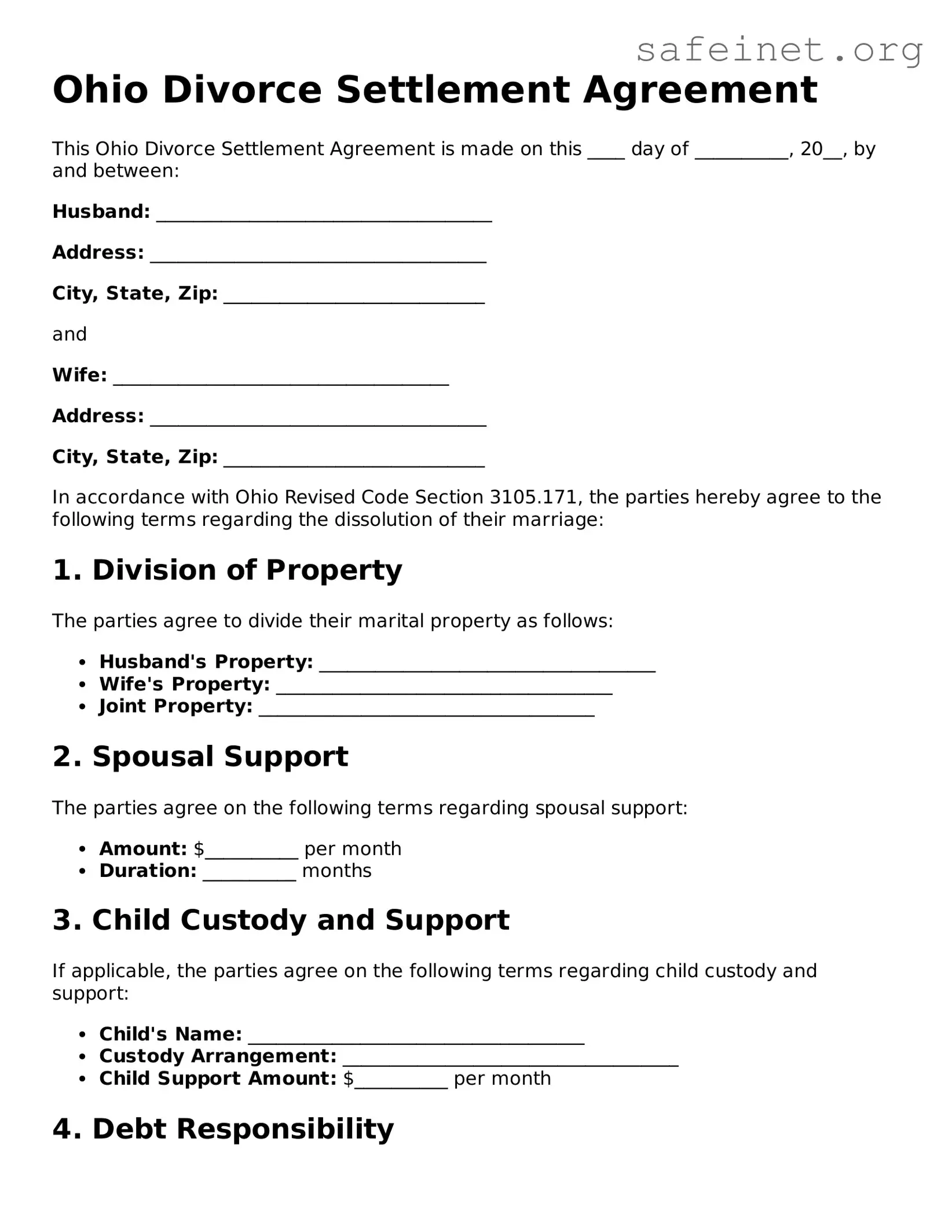
The Ohio Divorce Settlement Agreement form serves as a crucial document in the dissolution of marriage process, outlining the terms agreed upon by both parties. This form addresses various essential aspects, including the division of marital property, spousal support, and child custody arrangements. Each party's rights and responsibilities are clearly defined, ensuring that both individuals understand their obligations moving forward. Additionally, the agreement may cover child support payments, visitation schedules, and any other pertinent issues that arise during the divorce proceedings. By establishing a clear framework for these critical elements, the form aims to reduce potential conflicts and provide a smoother transition for families navigating the complexities of divorce. Understanding the significance of this document can empower individuals to make informed decisions that align with their best interests and those of their children.
Ohio Divorce Settlement Agreement
This Ohio Divorce Settlement Agreement is made on this ____ day of __________, 20__, by and between:
Husband: ____________________________________
Address: ____________________________________
City, State, Zip: ____________________________
and
Wife: ____________________________________
Address: ____________________________________
City, State, Zip: ____________________________
In accordance with Ohio Revised Code Section 3105.171, the parties hereby agree to the following terms regarding the dissolution of their marriage:
1. Division of Property
The parties agree to divide their marital property as follows:
2. Spousal Support
The parties agree on the following terms regarding spousal support:
3. Child Custody and Support
If applicable, the parties agree on the following terms regarding child custody and support:
4. Debt Responsibility
The parties agree on the following terms regarding the responsibility for debts:
5. Miscellaneous Provisions
The parties agree to the following additional terms:
By signing below, both parties acknowledge that they have read and understood this agreement and agree to its terms.
Husband's Signature: ____________________________ Date: __________
Wife's Signature: ____________________________ Date: __________
This agreement is executed in accordance with the laws of the State of Ohio.
| Fact Name | Description |
|---|---|
| Purpose | The Ohio Divorce Settlement Agreement form outlines the terms agreed upon by both parties regarding the division of assets, debts, and other relevant issues during a divorce. |
| Governing Law | This form is governed by Ohio Revised Code § 3105.171, which addresses the division of marital property in divorce proceedings. |
| Mutual Agreement | Both spouses must mutually agree on the terms outlined in the settlement for the form to be valid and enforceable. |
| Filing Requirement | The completed form must be submitted to the court as part of the divorce proceedings to ensure that the terms are recognized legally. |
| Modification | Once filed, the terms can be modified only through a court order, ensuring that any changes are legally binding. |
| Legal Advice | It is advisable for both parties to seek independent legal advice before signing the agreement to ensure that their rights are protected. |
Filling out the Ohio Divorce Settlement Agreement form is an important step in finalizing your divorce. Once you have completed the form, you will be able to move forward with the legal process and work towards a resolution that suits both parties.
After completing the form, you’ll need to file it with the appropriate court. Be sure to check local rules for any additional documents you may need to submit along with the agreement.
What is an Ohio Divorce Settlement Agreement?
An Ohio Divorce Settlement Agreement is a legal document that outlines the terms and conditions agreed upon by both spouses during a divorce. It typically includes details about property division, child custody, child support, and spousal support. This agreement is crucial for ensuring both parties understand their rights and responsibilities after the divorce is finalized.
How do I create a Divorce Settlement Agreement in Ohio?
To create a Divorce Settlement Agreement in Ohio, both parties should first discuss and negotiate the terms they want to include. It is advisable to draft the agreement in writing, covering all relevant topics such as asset division, debts, and parenting plans. Once both parties agree on the terms, they should sign the document in the presence of a notary public to ensure its validity.
Is a Divorce Settlement Agreement legally binding?
Yes, a Divorce Settlement Agreement is legally binding once it is signed by both parties and approved by the court. This means that both spouses are required to adhere to the terms outlined in the agreement. If one party fails to comply, the other party can seek enforcement through the court.
What happens if we cannot agree on the terms of the Divorce Settlement Agreement?
If both parties cannot reach an agreement, they may need to consider mediation or legal representation. Mediation involves a neutral third party who helps facilitate discussions and negotiations. If mediation fails, the case may go to court, where a judge will make the final decisions regarding the divorce terms.
Can a Divorce Settlement Agreement be modified after it is finalized?
Yes, a Divorce Settlement Agreement can be modified after it is finalized, but only under certain circumstances. For example, if there is a significant change in income, employment, or living situation, one party may request a modification. Both parties must agree to the changes, or a court may need to approve the modification if an agreement cannot be reached.
Incomplete Information: Failing to provide all necessary details can lead to delays. Each section must be filled out thoroughly.
Missing Signatures: Both parties must sign the agreement. Omitting a signature can render the document invalid.
Incorrect Dates: Ensure that all dates are accurate. Mistakes in dates can complicate the process and may require resubmission.
Inaccurate Financial Information: Providing incorrect income or asset values can lead to disputes later. Double-check all financial details.
Overlooking Child Support Guidelines: Not adhering to Ohio's child support guidelines may result in an unfair agreement. Review these guidelines carefully.
Neglecting to Address Debts: Failing to include how debts will be divided can lead to future misunderstandings. Be sure to specify this in the agreement.
Ignoring Tax Implications: Not considering the tax consequences of asset division can have financial repercussions. Consult a tax professional if needed.
Rushing the Process: Taking time to review the agreement is crucial. Rushing can lead to mistakes that may affect both parties in the long run.
When navigating a divorce in Ohio, several documents may accompany the Divorce Settlement Agreement. Each of these forms plays a crucial role in ensuring that the divorce process is smooth and that both parties understand their rights and obligations.
Understanding these documents can simplify the divorce process and help ensure that all necessary legal requirements are met. Proper preparation and attention to detail can lead to a more efficient resolution for both parties involved.
The Ohio Divorce Settlement Agreement form shares similarities with the Marital Settlement Agreement. Both documents outline the terms agreed upon by spouses during a divorce. They typically cover issues like property division, child custody, and support arrangements. The key difference lies in the jurisdiction; while the Ohio form is specific to that state, a Marital Settlement Agreement can be used in various states, adapting to local laws and requirements.
Another document that resembles the Ohio Divorce Settlement Agreement is the Separation Agreement. This document is often used when couples decide to live apart but are not yet ready to divorce. Like the Divorce Settlement Agreement, it addresses similar issues such as asset division and child custody. However, a Separation Agreement may remain in effect until the couple decides to finalize their divorce.
The Parenting Plan is also similar to the Ohio Divorce Settlement Agreement, particularly in cases involving children. This document outlines how parents will share responsibilities and make decisions regarding their children's upbringing. While the Divorce Settlement Agreement may include parenting arrangements, the Parenting Plan focuses specifically on the child's needs and parental roles.
In addition, the Property Settlement Agreement bears resemblance to the Ohio Divorce Settlement Agreement. This document specifically addresses how marital property will be divided between spouses. While the Divorce Settlement Agreement encompasses broader issues, the Property Settlement Agreement hones in on the financial aspects of a divorce, detailing who gets what.
The Child Support Agreement is another document that aligns closely with the Ohio Divorce Settlement Agreement. It specifically outlines the financial obligations of one parent to the other for the support of their children. This agreement can be included in the Divorce Settlement Agreement, but it can also stand alone, detailing the amount and frequency of payments required.
The Alimony Agreement is similar in that it addresses spousal support. This document specifies the terms under which one spouse will provide financial support to the other post-divorce. While the Divorce Settlement Agreement may include alimony terms, an Alimony Agreement focuses solely on the support aspect, detailing the amount, duration, and conditions of payments.
The Quitclaim Deed can also be compared to the Ohio Divorce Settlement Agreement, particularly in property division. This document transfers ownership of property from one spouse to another, often as part of the divorce settlement. While the Divorce Settlement Agreement outlines the division of assets, the Quitclaim Deed is the legal instrument that executes the transfer of property rights.
Lastly, the Joint Custody Agreement resembles the Ohio Divorce Settlement Agreement in its focus on shared parenting responsibilities. This document specifies how parents will share custody of their children, detailing visitation schedules and decision-making processes. While the Divorce Settlement Agreement may encompass custody arrangements, the Joint Custody Agreement is dedicated solely to parenting issues, ensuring clarity for both parents.
When completing the Ohio Divorce Settlement Agreement form, it's essential to follow certain guidelines to ensure accuracy and compliance. Here’s a list of things you should and shouldn’t do:
Many individuals have misunderstandings about the Ohio Divorce Settlement Agreement form. Here are eight common misconceptions and clarifications regarding them:
This is not true. Even in uncontested divorces, a Divorce Settlement Agreement is essential to outline the terms agreed upon by both parties.
While it is a critical document, it does not need to be filed before the divorce is finalized. It is typically submitted at the time of the final hearing.
While legal assistance can be beneficial, individuals can draft their own agreement as long as it meets Ohio's legal requirements.
The agreement encompasses various aspects, including child custody, support, and visitation rights, not just property division.
This is a misconception. Parties can modify the agreement if both agree to the changes and the court approves them.
Each agreement should be tailored to the specific circumstances of the individuals involved. There is no universal template that fits every situation.
The Divorce Settlement Agreement is necessary for all divorcing couples, regardless of whether children are involved.
While having a well-prepared agreement can expedite the process, the overall timeline depends on various factors, including court schedules and other legal requirements.
When navigating the Ohio Divorce Settlement Agreement form, it's essential to understand the key aspects that can significantly impact the outcome of your divorce. Here are some important takeaways to keep in mind:
By keeping these points in mind, you can approach the Divorce Settlement Agreement with confidence and clarity, paving the way for a smoother transition into the next chapter of your life.