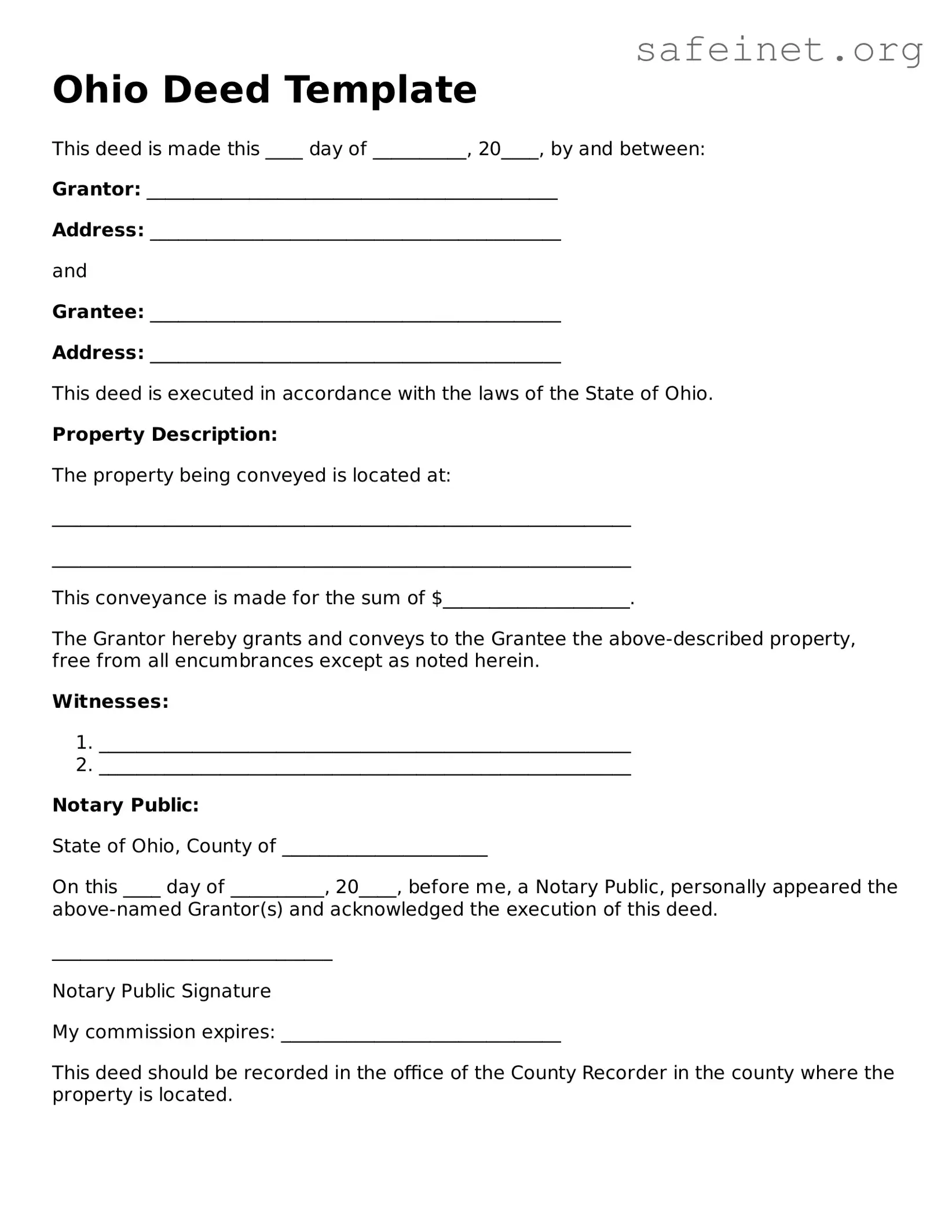
The Ohio Deed form serves as a crucial document in real estate transactions, facilitating the transfer of property ownership from one party to another. This form includes essential details such as the names of the grantor and grantee, a legal description of the property, and the signature of the grantor, which must be notarized to ensure authenticity. Various types of deeds exist, including warranty deeds, quitclaim deeds, and special warranty deeds, each serving different purposes and offering varying levels of protection to the grantee. Additionally, the form may require the payment of transfer taxes, which must be documented. Understanding these components is vital for anyone involved in property transactions in Ohio, as they ensure that all parties are aware of their rights and responsibilities throughout the process. Proper completion of the Ohio Deed form is essential to avoid future disputes and to secure a clear title for the new property owner.
Ohio Deed Template
This deed is made this ____ day of __________, 20____, by and between:
Grantor: ____________________________________________
Address: ____________________________________________
and
Grantee: ____________________________________________
Address: ____________________________________________
This deed is executed in accordance with the laws of the State of Ohio.
Property Description:
The property being conveyed is located at:
______________________________________________________________
______________________________________________________________
This conveyance is made for the sum of $____________________.
The Grantor hereby grants and conveys to the Grantee the above-described property, free from all encumbrances except as noted herein.
Witnesses:
Notary Public:
State of Ohio, County of ______________________
On this ____ day of __________, 20____, before me, a Notary Public, personally appeared the above-named Grantor(s) and acknowledged the execution of this deed.
______________________________
Notary Public Signature
My commission expires: ______________________________
This deed should be recorded in the office of the County Recorder in the county where the property is located.
| Fact Name | Description |
|---|---|
| Type of Deed | Ohio allows several types of deeds, including warranty deeds, quitclaim deeds, and special warranty deeds. |
| Governing Law | The Ohio Revised Code, specifically Section 5301, governs the execution and recording of deeds. |
| Signature Requirement | All grantors must sign the deed in the presence of a notary public for it to be valid. |
| Recording | Deeds must be recorded in the county where the property is located to provide public notice of ownership. |
| Consideration | Ohio law does not require a specific amount of consideration to be stated in the deed. |
| Property Description | A legal description of the property must be included in the deed to identify the exact location. |
| Transfer Tax | Ohio imposes a transfer tax on the sale of real estate, which varies by county. |
Once you have the Ohio Deed form ready, follow these steps to ensure it is filled out correctly. Completing the form accurately is essential for the transfer of property ownership.
What is an Ohio Deed form?
An Ohio Deed form is a legal document used to transfer ownership of real property from one party to another within the state of Ohio. This form outlines the details of the transaction, including the names of the parties involved, a description of the property, and any conditions or restrictions related to the transfer. It serves as a public record of the change in ownership.
What types of Deed forms are available in Ohio?
Ohio offers several types of Deed forms, including Warranty Deeds, Quitclaim Deeds, and Special Purpose Deeds. A Warranty Deed guarantees that the seller has clear title to the property and will defend against any claims. A Quitclaim Deed transfers whatever interest the seller has in the property without any guarantees. Special Purpose Deeds are used for specific situations, such as transferring property between family members or in a divorce settlement.
How do I complete an Ohio Deed form?
To complete an Ohio Deed form, you will need to provide the names and addresses of the grantor (seller) and grantee (buyer), a legal description of the property, and any additional terms of the transfer. It's essential to ensure that all information is accurate and complete. Once filled out, the form must be signed by the grantor in the presence of a notary public.
Do I need to have the Deed notarized?
Yes, in Ohio, the Deed must be notarized to be legally valid. The grantor must sign the Deed in front of a notary public, who will then affix their seal to the document. This step is crucial as it helps prevent fraud and ensures that the parties involved are who they claim to be.
Where do I file the Ohio Deed form?
The completed Ohio Deed form should be filed with the county recorder's office in the county where the property is located. This filing process makes the transfer of ownership a matter of public record. There may be a filing fee, which varies by county, so it’s advisable to check with the local recorder’s office for specific requirements.
Are there any taxes associated with transferring property in Ohio?
Yes, when transferring property in Ohio, there may be transfer taxes involved. The amount can vary based on the value of the property and the county where the property is located. It's important to check with the local tax authority to understand any applicable taxes and ensure compliance during the transfer process.
Not including all necessary parties. It's essential to list all individuals or entities involved in the transaction. Missing a name can lead to complications later.
Incorrectly identifying the property. The legal description of the property must be accurate. Errors in this section can result in disputes or issues with ownership.
Failing to sign the deed. All parties must sign the document for it to be valid. A missing signature can invalidate the deed.
Not having the deed notarized. In Ohio, a deed typically requires notarization. Without a notary's signature, the deed may not be accepted.
Using the wrong type of deed. Different deeds serve different purposes. Selecting the incorrect type can affect the rights and obligations of the parties involved.
Overlooking tax implications. Failing to consider transfer taxes or exemptions can lead to unexpected financial burdens.
Not recording the deed. After completing the deed, it must be filed with the county recorder's office. Neglecting this step means the public may not recognize the transfer of ownership.
Ignoring local requirements. Each county may have specific requirements or forms. Not adhering to these can cause delays or rejection of the deed.
When transferring property in Ohio, several documents often accompany the Ohio Deed form to ensure a smooth and legally sound transaction. Each of these documents serves a specific purpose and helps clarify the details of the property transfer.
These accompanying documents play a crucial role in the property transfer process in Ohio. Ensuring that all necessary forms are completed and submitted can help prevent legal issues and provide peace of mind for both parties involved in the transaction.
The Ohio Deed form shares similarities with the Warranty Deed, which provides a guarantee that the grantor holds clear title to the property. In both documents, the transfer of ownership is formalized, and the grantor assures the grantee that there are no undisclosed encumbrances. This assurance protects the grantee from future claims against the property, making it a secure option for property transfers.
Another document akin to the Ohio Deed is the Quitclaim Deed. Unlike the Warranty Deed, the Quitclaim Deed transfers whatever interest the grantor may have in the property without any guarantees. However, like the Ohio Deed, it serves to formally transfer ownership, making it a useful tool in situations where the grantor may not have a clear title or when transferring property between family members.
The Special Warranty Deed is also similar to the Ohio Deed. It provides limited warranties, only covering the period during which the grantor owned the property. This document is particularly useful in commercial transactions where the seller wants to limit their liability for any issues that may arise from previous owners. Both documents facilitate the transfer of property while offering different levels of protection to the grantee.
The Bargain and Sale Deed is another related document. It implies that the grantor has the right to sell the property but does not provide any warranties against encumbrances. Similar to the Ohio Deed, it effectively transfers ownership, but the lack of warranties may pose a risk to the grantee, who must conduct due diligence before accepting the property.
The Grant Deed is also comparable to the Ohio Deed. It guarantees that the grantor has not sold the property to anyone else and that the property is free from encumbrances made during the grantor's ownership. This document is often used in real estate transactions and ensures that the grantee receives a clear title, similar to the assurances provided in an Ohio Deed.
The Trustee’s Deed is another document that resembles the Ohio Deed, particularly in transactions involving trusts. This deed transfers property from a trustee to a beneficiary. While it may not offer the same level of warranties as a Warranty Deed, it serves to officially document the transfer of property, aligning with the purpose of the Ohio Deed in formalizing ownership changes.
The Executor’s Deed is similar as well, especially in the context of estate settlements. This document allows an executor to transfer property from a deceased person's estate to heirs or beneficiaries. Like the Ohio Deed, it serves as a legal instrument to finalize ownership and ensure that the property is transferred according to the deceased’s wishes.
The Affidavit of Heirship is another relevant document. While it does not transfer property itself, it serves as a sworn statement identifying heirs when someone dies without a will. This document can be used in conjunction with an Ohio Deed to clarify ownership when transferring property from an estate, ensuring that the rightful heirs are recognized in the transfer process.
Lastly, the Bill of Sale is similar in that it serves as a legal document to transfer ownership of personal property, although it is typically used for movable items rather than real estate. Both the Bill of Sale and the Ohio Deed formalize the transfer of ownership, providing a clear record of the transaction. While their applications differ, the underlying purpose of documenting ownership changes remains consistent.
Filling out a deed form in Ohio is an important step in transferring property ownership. To ensure the process goes smoothly, here are some essential dos and don’ts to keep in mind.
By following these guidelines, you can help ensure that your deed form is filled out correctly and that the property transfer proceeds without unnecessary complications.
Understanding the Ohio Deed form is crucial for property transactions. However, several misconceptions can lead to confusion. Here are nine common misunderstandings:
Not all deeds serve the same purpose. Different types of deeds, such as warranty deeds and quitclaim deeds, have distinct functions and implications for the parties involved.
A deed transfers ownership of property, while a title is the legal right to own that property. You can have a deed without a clear title.
While a deed is a legal document, it can be amended or revoked under certain circumstances. Understanding the process is essential for making changes.
In Ohio, a deed must be notarized to be valid. This step ensures that the signatures are authentic and that the document is legally binding.
Recording a deed is important. It provides public notice of ownership and protects the interests of the new owner against future claims.
All parties involved in the transaction, including the buyer and seller, must sign the deed for it to be valid.
Ohio law has specific timeframes for recording deeds. Failing to record within these periods can lead to complications.
Some properties, such as those held in trust or certain types of commercial properties, may require specific types of deeds or additional documentation.
Deeds are required for all types of property transfers, including commercial, industrial, and agricultural properties.
Being aware of these misconceptions can help individuals navigate the property transfer process more effectively. Understanding the role of the Ohio Deed form is a key step in ensuring a smooth transaction.
When filling out and using the Ohio Deed form, there are several important points to keep in mind. Here are five key takeaways:
By keeping these points in mind, individuals can navigate the process of filling out and using the Ohio Deed form more effectively.