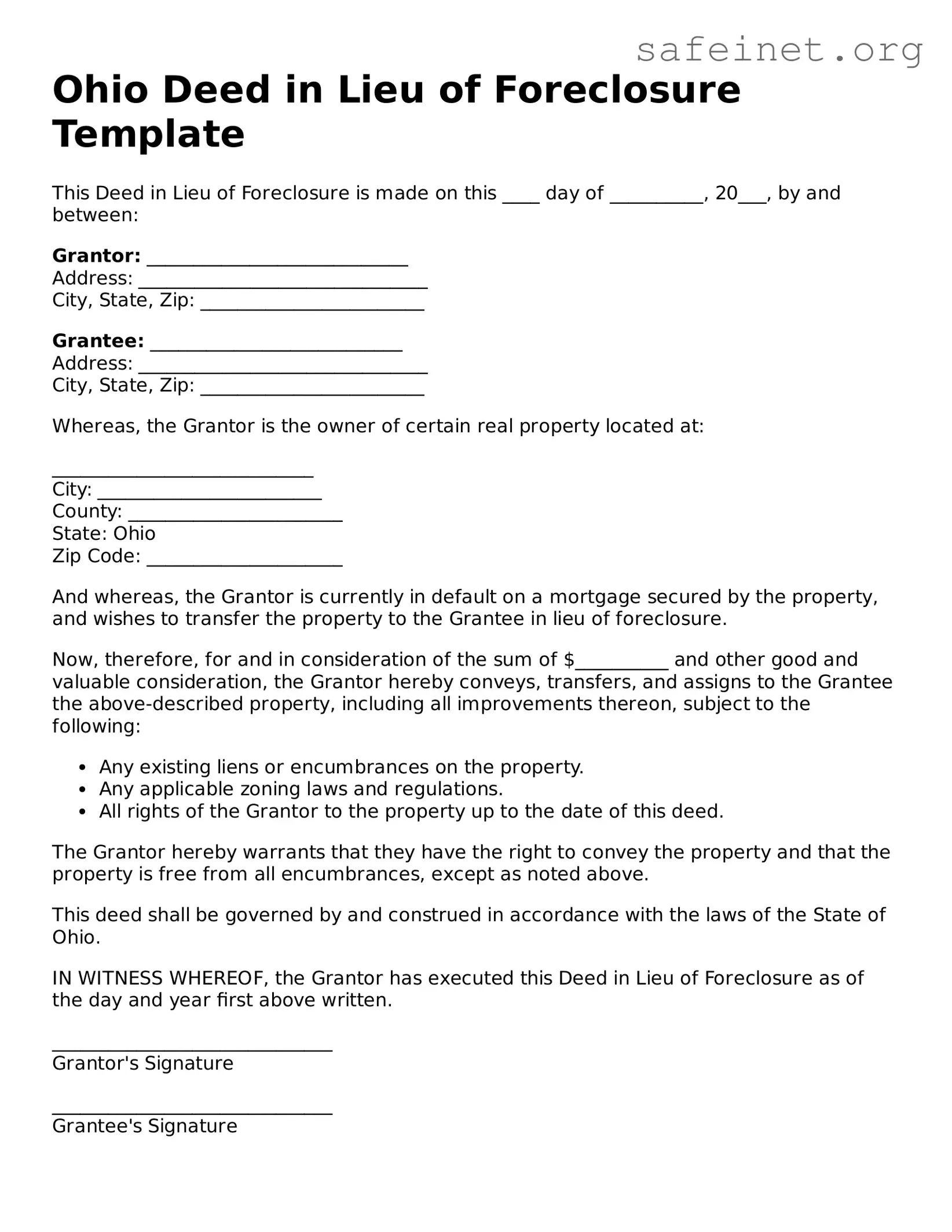
In Ohio, when homeowners face the looming threat of foreclosure, a Deed in Lieu of Foreclosure can serve as a viable alternative, providing a pathway to resolve financial difficulties without the lengthy and often stressful foreclosure process. This legal document allows a homeowner to voluntarily transfer ownership of their property back to the lender, effectively relinquishing their claim to the home in exchange for the cancellation of the mortgage debt. Key aspects of the form include the identification of the parties involved—the homeowner and the lender—as well as a clear description of the property being transferred. Additionally, the document outlines the terms under which the transfer occurs, ensuring that both parties understand their rights and obligations. By utilizing this form, homeowners can often avoid the negative impact of foreclosure on their credit score, while lenders can expedite the recovery of their investment. Overall, the Deed in Lieu of Foreclosure offers a structured solution that benefits both the homeowner and the lender, allowing for a more amicable resolution to financial distress.
Ohio Deed in Lieu of Foreclosure Template
This Deed in Lieu of Foreclosure is made on this ____ day of __________, 20___, by and between:
Grantor: ____________________________
Address: _______________________________
City, State, Zip: ________________________
Grantee: ___________________________
Address: _______________________________
City, State, Zip: ________________________
Whereas, the Grantor is the owner of certain real property located at:
____________________________
City: ________________________
County: _______________________
State: Ohio
Zip Code: _____________________
And whereas, the Grantor is currently in default on a mortgage secured by the property, and wishes to transfer the property to the Grantee in lieu of foreclosure.
Now, therefore, for and in consideration of the sum of $__________ and other good and valuable consideration, the Grantor hereby conveys, transfers, and assigns to the Grantee the above-described property, including all improvements thereon, subject to the following:
The Grantor hereby warrants that they have the right to convey the property and that the property is free from all encumbrances, except as noted above.
This deed shall be governed by and construed in accordance with the laws of the State of Ohio.
IN WITNESS WHEREOF, the Grantor has executed this Deed in Lieu of Foreclosure as of the day and year first above written.
______________________________
Grantor's Signature
______________________________
Grantee's Signature
State of Ohio
County of ______________________
On this ____ day of __________, 20___, before me, a Notary Public, personally appeared ____________________, known to me to be the person whose name is subscribed to the within instrument, and acknowledged that they executed the same.
______________________________
Notary Public
My commission expires: ________________
| Fact Name | Description |
|---|---|
| Definition | An Ohio Deed in Lieu of Foreclosure is a legal document where a borrower voluntarily transfers property ownership to the lender to avoid foreclosure. |
| Governing Law | This form is governed by Ohio Revised Code § 5301.01 and related statutes. |
| Purpose | The primary purpose is to allow borrowers to relinquish their property in exchange for relief from mortgage debt. |
| Eligibility | Homeowners facing financial difficulties may qualify, but they must be current on property taxes and have no other liens on the property. |
| Process | The borrower must submit a request to the lender, who will review the application before accepting the deed. |
| Impact on Credit | A deed in lieu of foreclosure can negatively impact credit scores, though it may be less damaging than a foreclosure. |
| Legal Advice | It is advisable for homeowners to seek legal counsel before proceeding with a deed in lieu of foreclosure to understand all implications. |
After completing the Ohio Deed in Lieu of Foreclosure form, the next steps involve submitting the form to the appropriate parties. This typically includes the lender and possibly local government offices. It is essential to ensure that all required documents are attached and that the form is filed correctly to avoid any delays in the process.
What is a Deed in Lieu of Foreclosure?
A Deed in Lieu of Foreclosure is a legal process that allows a homeowner to voluntarily transfer the ownership of their property to the lender to avoid foreclosure. This option can be beneficial for both the homeowner and the lender. The homeowner can avoid the lengthy and often stressful foreclosure process, while the lender can take possession of the property more quickly and with less expense.
Who is eligible to use a Deed in Lieu of Foreclosure in Ohio?
Eligibility for a Deed in Lieu of Foreclosure typically requires that the homeowner is facing financial difficulties and is unable to continue making mortgage payments. It is important to note that the homeowner must also be the legal owner of the property and must not have any other liens or encumbrances that could complicate the transfer. Lenders often have specific requirements, so it’s advisable to consult with them to understand their criteria.
What are the benefits of choosing a Deed in Lieu of Foreclosure?
There are several benefits to opting for a Deed in Lieu of Foreclosure. First, it can help preserve the homeowner's credit score compared to a foreclosure, which can have a more severe impact. Second, the process is generally quicker and less costly for both parties. Additionally, homeowners may be able to negotiate terms such as a cash incentive or assistance with relocation expenses. Finally, it allows for a more dignified exit from the property compared to the public nature of a foreclosure.
What are the potential drawbacks of a Deed in Lieu of Foreclosure?
While there are benefits, there are also potential drawbacks to consider. One major concern is that the homeowner may still be responsible for any remaining mortgage balance if the property sells for less than what is owed. Additionally, not all lenders accept Deeds in Lieu of Foreclosure, and some may prefer to proceed with foreclosure. Homeowners should also be aware that this option may still have an impact on their credit, albeit less severe than foreclosure.
How does the process work?
The process of executing a Deed in Lieu of Foreclosure typically begins with the homeowner contacting their lender to express interest in this option. The lender will then review the homeowner’s financial situation and the property’s value. If both parties agree, the homeowner will sign a deed transferring ownership of the property to the lender. This document must be recorded with the county recorder's office to finalize the transfer. It is advisable to seek legal assistance to ensure that all steps are completed correctly.
Can a Deed in Lieu of Foreclosure affect future home buying?
Yes, a Deed in Lieu of Foreclosure can impact a homeowner's ability to purchase a new home in the future. While it is generally less damaging than a foreclosure, it can still appear on a credit report and may influence lenders' decisions when applying for a mortgage. Homeowners may need to wait a certain period before qualifying for a new loan, depending on the lender’s policies. Understanding these implications is crucial for anyone considering this option.
Not providing complete information. It’s crucial to fill out all required fields. Missing details can delay the process.
Using incorrect property descriptions. Ensure that the property is accurately described. Double-check the address and legal description.
Failing to sign the document. All parties involved must sign the deed. An unsigned document is not valid.
Not including the right notary information. A notary must witness the signatures. Without this, the deed may not be accepted.
Overlooking tax implications. Understand the potential tax consequences of transferring the property. Consulting a tax professional can help.
Ignoring local laws and regulations. Each county may have specific requirements. Always check local guidelines before submission.
A Deed in Lieu of Foreclosure can be a practical solution for homeowners facing financial difficulties. It allows the homeowner to transfer ownership of their property to the lender, thereby avoiding the lengthy foreclosure process. However, several other documents may accompany this form to ensure a smooth transaction and clarify the terms involved. Below is a list of common forms and documents often used alongside the Ohio Deed in Lieu of Foreclosure.
Understanding these documents can help homeowners navigate the process more effectively. Each form plays a crucial role in ensuring that the Deed in Lieu of Foreclosure is executed properly and that both parties are protected throughout the transaction.
The Ohio Deed in Lieu of Foreclosure is similar to a mortgage release. Both documents serve to relieve a borrower from the burden of a mortgage when they can no longer keep up with payments. In a mortgage release, the lender formally agrees to release the borrower from their obligations, often after the borrower has sold the property or settled their debts. This process can help protect the borrower’s credit score and allow them to move on without the weight of an unpaid mortgage hanging over them.
Another document akin to the Deed in Lieu of Foreclosure is the short sale agreement. In a short sale, a homeowner sells their property for less than the amount owed on the mortgage, with the lender’s consent. This option allows the borrower to avoid foreclosure while still settling their debt. Both the short sale and the deed in lieu provide a way for borrowers to exit a financially burdensome situation, although they differ in that a short sale involves a sale to a third party, while the deed in lieu transfers ownership directly to the lender.
The loan modification agreement also shares similarities with the Deed in Lieu of Foreclosure. A loan modification involves changing the terms of an existing loan to make it more manageable for the borrower. While the deed in lieu results in the transfer of property ownership, a loan modification aims to keep the borrower in their home by adjusting payment terms, interest rates, or loan duration. Both documents are tools to assist borrowers facing financial difficulties, though they approach the situation from different angles.
Additionally, the foreclosure notice itself is related to the Deed in Lieu of Foreclosure. A foreclosure notice is a formal declaration that a lender intends to reclaim a property due to unpaid mortgage payments. While the deed in lieu is a proactive measure taken by a borrower to avoid the foreclosure process, the foreclosure notice is often the precursor to that process. Both documents highlight the consequences of defaulting on a mortgage and signal a borrower’s financial struggles.
The bankruptcy filing is another document that bears similarities to the Deed in Lieu of Foreclosure. When individuals file for bankruptcy, they seek relief from their debts, which can include their mortgage. In some cases, a borrower may choose to surrender their home through bankruptcy, which can function similarly to a deed in lieu by allowing them to relinquish ownership without going through a lengthy foreclosure process. Both options aim to provide a pathway for financial recovery, albeit through different legal frameworks.
Lastly, the property settlement agreement can be compared to the Deed in Lieu of Foreclosure, particularly in the context of divorce or separation. In a property settlement agreement, spouses divide their assets, which may include real estate. If one party cannot afford the mortgage, they may agree to transfer ownership to the other party or to the lender, similar to a deed in lieu. Both documents facilitate the transfer of property rights in the face of financial hardship, allowing individuals to navigate significant life changes while addressing their obligations.
When filling out the Ohio Deed in Lieu of Foreclosure form, it is important to follow certain guidelines to ensure the process goes smoothly. Here are six things to consider:
Understanding the Ohio Deed in Lieu of Foreclosure can be challenging. Many people have misconceptions about what it entails. Here are seven common misunderstandings:
Being aware of these misconceptions can help homeowners make informed decisions about their options when facing financial difficulties.
Filling out and using the Ohio Deed in Lieu of Foreclosure form involves several important considerations. Below are key takeaways to keep in mind:
These takeaways provide a foundational understanding of the deed in lieu of foreclosure process in Ohio, emphasizing the importance of careful consideration and professional guidance.