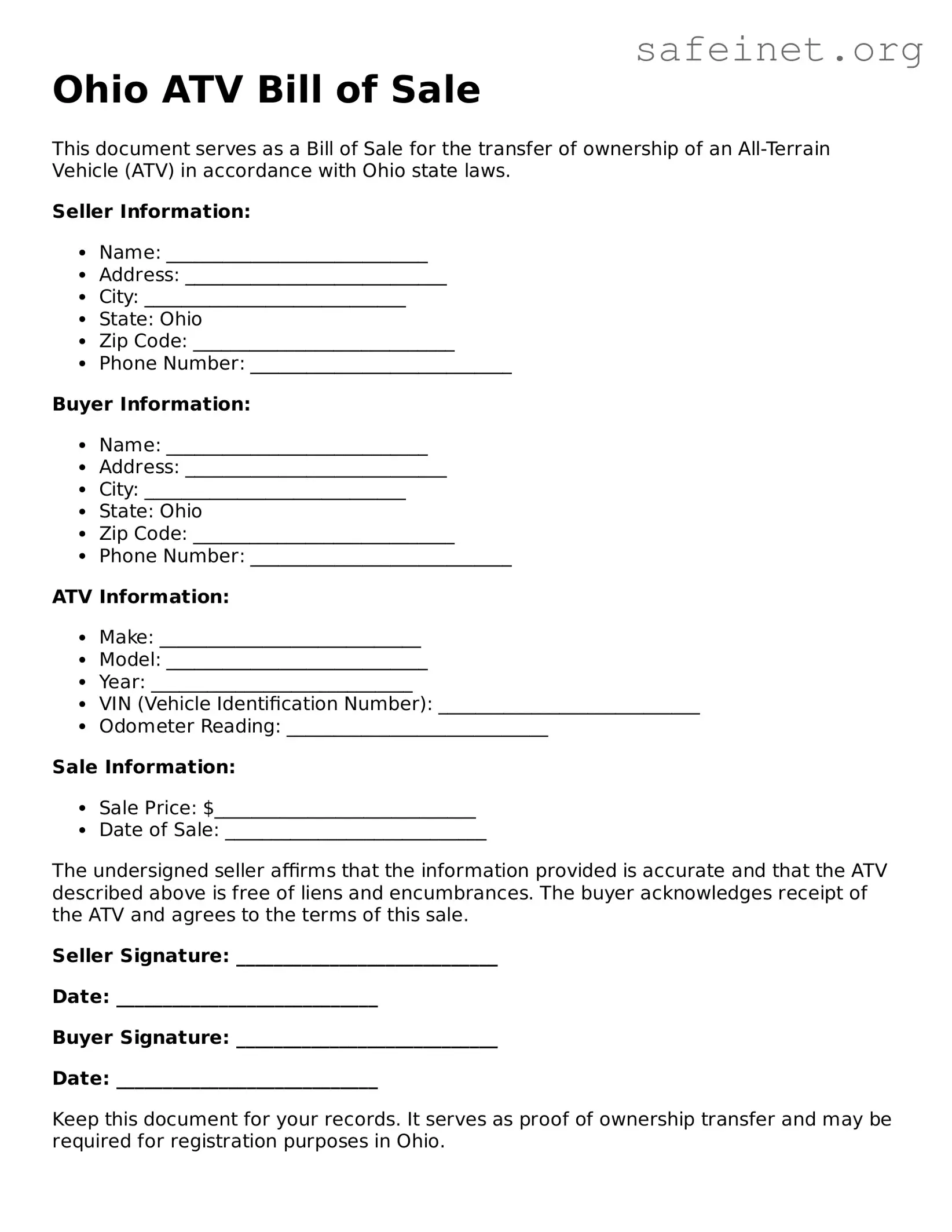
When purchasing or selling an all-terrain vehicle (ATV) in Ohio, having a properly executed bill of sale is essential for both parties involved in the transaction. This document serves as a legal record that outlines the details of the sale, including the names and addresses of the buyer and seller, the date of the transaction, and a description of the ATV itself, such as its make, model, year, and Vehicle Identification Number (VIN). Additionally, the bill of sale can specify the purchase price and any terms of the sale, such as whether the vehicle is sold "as is" or if any warranties apply. By using this form, both the buyer and seller can protect their interests, as it provides proof of ownership transfer and can be useful for registration and titling purposes with the Ohio Bureau of Motor Vehicles. Understanding the key components of the Ohio ATV Bill of Sale form can help ensure a smooth transaction and safeguard against potential disputes in the future.
Ohio ATV Bill of Sale
This document serves as a Bill of Sale for the transfer of ownership of an All-Terrain Vehicle (ATV) in accordance with Ohio state laws.
Seller Information:
Buyer Information:
ATV Information:
Sale Information:
The undersigned seller affirms that the information provided is accurate and that the ATV described above is free of liens and encumbrances. The buyer acknowledges receipt of the ATV and agrees to the terms of this sale.
Seller Signature: ____________________________
Date: ____________________________
Buyer Signature: ____________________________
Date: ____________________________
Keep this document for your records. It serves as proof of ownership transfer and may be required for registration purposes in Ohio.
| Fact Name | Description |
|---|---|
| Purpose | The Ohio ATV Bill of Sale form is used to document the sale and transfer of ownership of an all-terrain vehicle (ATV) in Ohio. |
| Governing Law | The form is governed by the Ohio Revised Code, specifically Section 4505.01, which pertains to vehicle registration and titles. |
| Required Information | It typically requires details such as the buyer's and seller's names, addresses, and the ATV's make, model, and VIN (Vehicle Identification Number). |
| Signatures | Both the seller and buyer must sign the form to validate the transaction and confirm the transfer of ownership. |
| Notarization | While notarization is not mandatory, it is highly recommended to ensure the authenticity of the signatures and protect against future disputes. |
| Record Keeping | It is advisable for both parties to keep a copy of the completed Bill of Sale for their records, as it serves as proof of the transaction. |
Once you have the Ohio ATV Bill of Sale form ready, you will need to provide specific information about the transaction. This includes details about the buyer, seller, and the ATV itself. Make sure to gather all necessary information before starting to fill out the form.
After completing the form, ensure that both parties retain a copy. This document will serve as proof of the transaction and may be necessary for registration purposes with the Ohio Bureau of Motor Vehicles.
What is an Ohio ATV Bill of Sale?
An Ohio ATV Bill of Sale is a legal document that records the sale of an all-terrain vehicle (ATV) in Ohio. It serves as proof of ownership transfer from the seller to the buyer. This document includes important details about the ATV, such as its make, model, year, and Vehicle Identification Number (VIN), as well as the names and addresses of both the buyer and seller.
Why do I need a Bill of Sale for my ATV?
A Bill of Sale is important for several reasons. It provides legal evidence of the transaction and protects both the buyer and seller. For the buyer, it proves ownership and can be used to register the ATV with the state. For the seller, it serves as proof that they have transferred ownership and are no longer responsible for the vehicle.
Is a Bill of Sale required in Ohio?
While a Bill of Sale is not legally required in Ohio for ATV transactions, it is highly recommended. Having a Bill of Sale helps avoid disputes in the future and makes the registration process smoother. It can also be beneficial if the buyer needs to prove ownership or if there are any legal issues regarding the sale.
What information should be included in the Bill of Sale?
The Bill of Sale should include the following information: the date of sale, the names and addresses of both the buyer and seller, a description of the ATV (make, model, year, and VIN), the purchase price, and any terms or conditions of the sale. Both parties should sign and date the document to make it official.
Can I create my own Bill of Sale?
Yes, you can create your own Bill of Sale. There are many templates available online that you can use as a guide. Just make sure to include all the necessary information to ensure that it is valid. Alternatively, you can also use a pre-made form that complies with Ohio laws.
Do I need to have the Bill of Sale notarized?
No, notarization is not required for an Ohio ATV Bill of Sale. However, having it notarized can add an extra layer of security and authenticity to the document. It may also help if any disputes arise in the future.
What should I do after completing the Bill of Sale?
After completing the Bill of Sale, both the buyer and seller should keep a copy for their records. The buyer will need to take the Bill of Sale to their local Ohio Bureau of Motor Vehicles (BMV) office to register the ATV in their name. The seller should also keep a copy as proof of the transaction.
What if the ATV has a lien on it?
If there is a lien on the ATV, the seller must disclose this information to the buyer. The Bill of Sale should reflect any outstanding liens, and the seller should provide documentation showing how the lien will be satisfied. It is crucial to resolve any liens before completing the sale to avoid future complications.
Incomplete Information: Many individuals fail to provide all necessary details. This includes the seller's and buyer's full names, addresses, and contact information. Missing any of these elements can lead to complications in the transfer of ownership.
Incorrect Vehicle Identification Number (VIN): Some people mistakenly enter an incorrect VIN. The VIN is crucial for identifying the ATV. A simple typo can render the document invalid and create issues with registration.
Failure to Sign: A common oversight is neglecting to sign the form. Both the seller and the buyer must sign the Bill of Sale for it to be legally binding. Without signatures, the document lacks authenticity.
Not Including Sale Price: Some individuals forget to write down the sale price. This information is important for both parties and may be needed for tax purposes. Omitting the sale price can lead to misunderstandings later.
When purchasing or selling an ATV in Ohio, several documents may be required in addition to the ATV Bill of Sale. Each document serves a specific purpose and helps ensure a smooth transaction. Below is a list of commonly used forms and documents.
Gathering these documents can facilitate a seamless transaction and protect both parties involved. Ensure that all paperwork is completed accurately to avoid complications in the future.
The Ohio ATV Bill of Sale form shares similarities with the general Vehicle Bill of Sale. Both documents serve as proof of transfer of ownership from one party to another. They typically include details such as the buyer and seller’s names, addresses, and signatures. Additionally, they outline the vehicle's make, model, year, and identification number. This ensures that both parties have a clear understanding of the transaction and helps prevent future disputes regarding ownership.
Another document similar to the ATV Bill of Sale is the Motorcycle Bill of Sale. Like the ATV Bill of Sale, this document is used when transferring ownership of a motorcycle. It contains essential information about the motorcycle, such as its VIN (Vehicle Identification Number), and details about the buyer and seller. Both documents serve the same purpose of providing legal proof of the sale and ensuring that the transaction is recorded accurately.
The Boat Bill of Sale also resembles the ATV Bill of Sale in its function. When someone buys or sells a boat, this document is used to record the transaction. It includes similar details, such as the boat's make, model, and hull identification number, along with the buyer and seller's information. Both documents help protect the interests of both parties involved in the sale, ensuring that ownership is transferred legally.
A Snowmobile Bill of Sale is another document that parallels the ATV Bill of Sale. This form is used when a snowmobile is sold or purchased, and it captures the necessary details about the transaction. Just like the ATV Bill of Sale, it requires information about the snowmobile, including its make and model, as well as the buyer and seller's contact information. This ensures that both parties are clear on the terms of the sale.
The Trailer Bill of Sale is also quite similar. When a trailer is sold, this document is often used to record the transaction. It includes the trailer's details, such as its VIN and specifications, along with the buyer and seller's information. This document serves the same purpose as the ATV Bill of Sale by providing proof of ownership transfer and protecting both parties' interests.
The Personal Watercraft Bill of Sale is another document that functions similarly to the ATV Bill of Sale. When someone buys or sells a personal watercraft, this form is used to document the transaction. It includes essential details about the watercraft, such as its make and model, and the buyer and seller's information. This helps ensure that ownership is clearly established and can be verified if needed.
A Mobile Home Bill of Sale is also comparable to the ATV Bill of Sale. This document is used when transferring ownership of a mobile home. It captures the essential details of the sale, including the mobile home’s identification number, along with the buyer and seller's names and signatures. Both documents serve to protect the interests of both parties and provide legal proof of the transaction.
The Firearm Bill of Sale is another document that has a similar purpose. When firearms are bought or sold, this document records the transaction details. It includes information about the firearm, such as its make, model, and serial number, as well as the buyer and seller's information. Both the Firearm Bill of Sale and the ATV Bill of Sale serve to document ownership transfer and ensure compliance with legal requirements.
Lastly, the Equipment Bill of Sale is similar in that it documents the sale of various types of equipment. This could include heavy machinery or tools. Like the ATV Bill of Sale, it includes the buyer and seller’s information, as well as details about the equipment being sold. This document serves to protect both parties and provides a clear record of the transaction.
When filling out the Ohio ATV Bill of Sale form, it’s essential to be thorough and accurate. Here’s a list of things you should and shouldn’t do to ensure the process goes smoothly.
By following these guidelines, you can help ensure a smooth transaction when buying or selling an ATV in Ohio.
The Ohio ATV Bill of Sale form is an important document for anyone buying or selling an all-terrain vehicle (ATV) in the state of Ohio. However, several misconceptions surround this form. Understanding these misconceptions can help ensure a smooth transaction.
Many people believe that a Bill of Sale is optional when buying or selling an ATV. In reality, having a Bill of Sale is crucial. It serves as proof of ownership and can protect both the buyer and seller in case of disputes.
Some individuals think that notarization is a requirement for the Bill of Sale to be valid. However, in Ohio, notarization is not necessary. A simple signed document is sufficient to validate the transaction.
Another common belief is that the Bill of Sale is only required for new ATVs. This is not true. Whether the ATV is new or used, a Bill of Sale is important for documenting the transfer of ownership.
Some sellers feel pressured to offer a warranty when selling an ATV. In Ohio, sellers are not legally obligated to provide a warranty unless explicitly stated in the Bill of Sale. Buyers should be aware of this when making a purchase.
While it is beneficial to include a detailed description, it is not a strict requirement. The form should include essential information, such as the make, model, and VIN, but extensive details are not mandatory.
Many believe that the Bill of Sale is only necessary for private transactions. However, it is also useful when purchasing from a dealer. A Bill of Sale can help clarify the terms of the sale and protect the buyer’s rights.
By understanding these misconceptions, both buyers and sellers can navigate the process of buying or selling an ATV in Ohio with greater confidence and clarity.
When dealing with the Ohio ATV Bill of Sale form, it's important to understand its purpose and how to complete it accurately. Here are some key takeaways to keep in mind:
By following these guidelines, individuals can ensure a smooth transaction when buying or selling an ATV in Ohio.