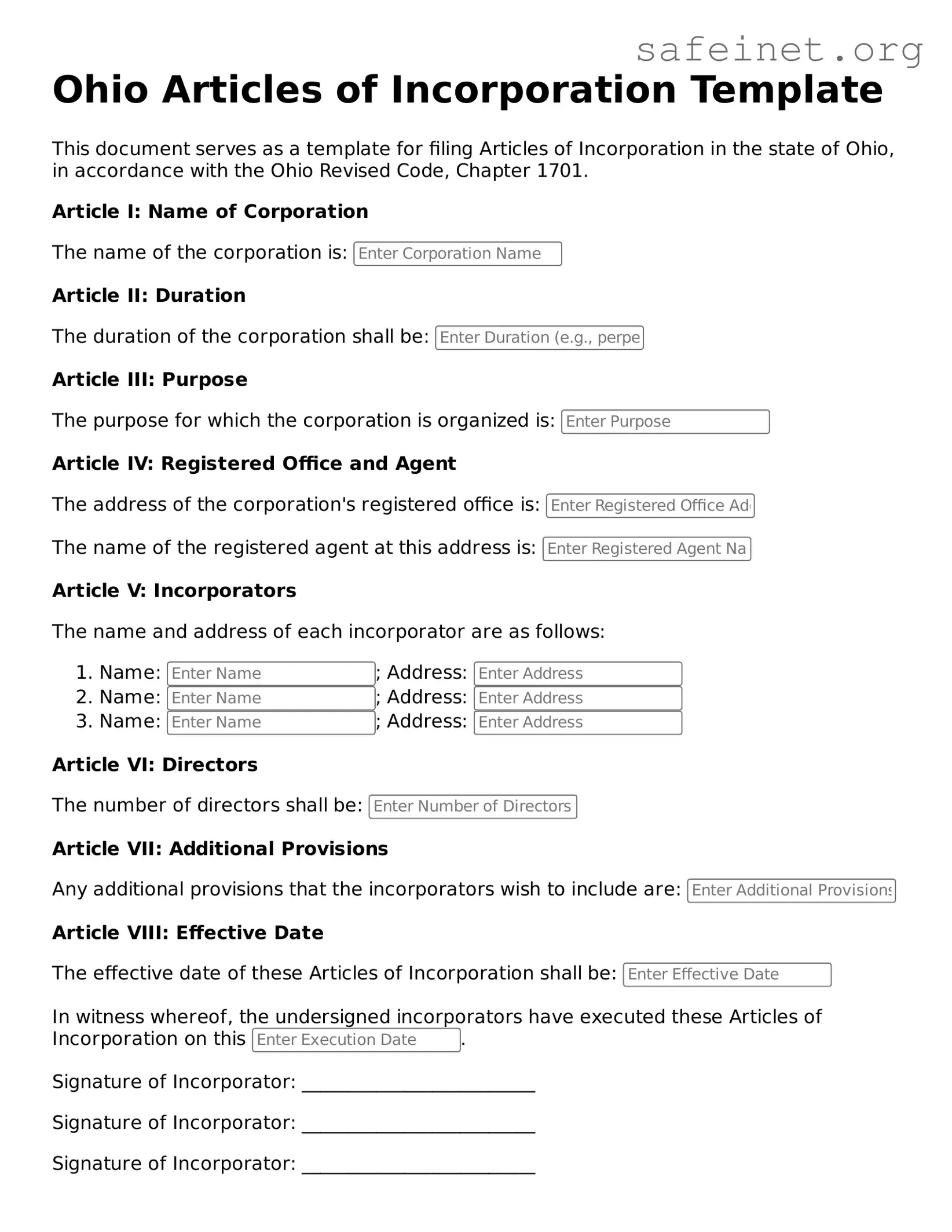
In the state of Ohio, the Articles of Incorporation form serves as a foundational document for those seeking to establish a corporation. This form encapsulates essential information about the corporation, including its name, the purpose of its existence, and the address of its principal office. Additionally, it requires the identification of the corporation's initial directors and the number of shares the corporation is authorized to issue. The form also addresses the duration of the corporation, which can be perpetual or for a specified period. Furthermore, it includes provisions for the registered agent, who serves as the official point of contact for legal matters. By completing and submitting this form to the Ohio Secretary of State, individuals take a significant step toward formalizing their business entity, thereby gaining legal recognition and certain protections under state law. Understanding the intricacies of this form is crucial for entrepreneurs and business owners as they navigate the process of incorporation, ensuring compliance with state requirements and laying the groundwork for future operations.
Ohio Articles of Incorporation Template
This document serves as a template for filing Articles of Incorporation in the state of Ohio, in accordance with the Ohio Revised Code, Chapter 1701.
Article I: Name of Corporation
The name of the corporation is:
Article II: Duration
The duration of the corporation shall be:
Article III: Purpose
The purpose for which the corporation is organized is:
Article IV: Registered Office and Agent
The address of the corporation's registered office is:
The name of the registered agent at this address is:
Article V: Incorporators
The name and address of each incorporator are as follows:
Article VI: Directors
The number of directors shall be:
Article VII: Additional Provisions
Any additional provisions that the incorporators wish to include are:
Article VIII: Effective Date
The effective date of these Articles of Incorporation shall be:
In witness whereof, the undersigned incorporators have executed these Articles of Incorporation on this .
Signature of Incorporator: _________________________
Signature of Incorporator: _________________________
Signature of Incorporator: _________________________
| Fact Name | Description |
|---|---|
| Governing Law | The Ohio Articles of Incorporation are governed by the Ohio Revised Code, specifically Chapter 1701. |
| Purpose | The form is used to officially create a corporation in the state of Ohio. |
| Filing Fee | A filing fee is required when submitting the Articles of Incorporation, which is subject to change. |
| Required Information | The form requires the corporation's name, principal office address, and the purpose of the corporation. |
| Registered Agent | Every corporation must designate a registered agent with a physical address in Ohio. |
| Incorporator Details | The name and address of the incorporator(s) must be included in the form. |
| Duration | The Articles of Incorporation can specify a duration for the corporation or indicate perpetual existence. |
| Effective Date | Corporations can choose an effective date for their incorporation, which can be the date of filing or a future date. |
| Amendments | Once filed, the Articles of Incorporation can be amended to reflect changes in the corporation's structure or purpose. |
| Public Record | Filed Articles of Incorporation become part of the public record and are accessible to the public. |
After completing the Ohio Articles of Incorporation form, you will need to submit it to the appropriate state office along with the required filing fee. This step is crucial for officially establishing your corporation in Ohio.
What is the Ohio Articles of Incorporation form?
The Ohio Articles of Incorporation form is a legal document required to establish a corporation in the state of Ohio. This form outlines essential details about your corporation, such as its name, purpose, and the address of its principal office. Filing this document with the Ohio Secretary of State is the first step in creating a corporation.
Who needs to file the Articles of Incorporation?
Any individual or group looking to create a corporation in Ohio must file the Articles of Incorporation. This includes businesses of all sizes, whether they are for-profit or non-profit. If you are planning to operate as a corporation, completing this form is necessary to gain legal recognition.
What information is required on the form?
The form requires specific information, including the corporation's name, the purpose of the corporation, the address of the principal office, and the names and addresses of the initial directors. Additionally, you may need to provide details about the corporation's shares, if applicable. Ensuring all information is accurate and complete is crucial for a smooth filing process.
How do I file the Articles of Incorporation?
You can file the Articles of Incorporation online or by mail. If filing online, visit the Ohio Secretary of State's website and follow the prompts. For mail submissions, print the completed form, and send it along with the required filing fee to the appropriate address. Be sure to keep a copy for your records.
What is the filing fee for the Articles of Incorporation?
The filing fee for the Articles of Incorporation varies based on the type of corporation you are forming. Generally, the fee is around $99 for a for-profit corporation and $50 for a non-profit corporation. It's important to check the Ohio Secretary of State's website for the most current fee information before submitting your application.
How long does it take for the Articles of Incorporation to be processed?
The processing time for the Articles of Incorporation can vary. Typically, online filings are processed faster, often within a few business days. Mail filings may take longer, usually around 1-2 weeks. If you need confirmation of your filing, you can request a certified copy once the document has been processed.
Not providing a business name that complies with Ohio regulations. The name must be unique and not too similar to existing businesses.
Failing to include the purpose of the corporation. A clear statement of what the business intends to do is necessary.
Omitting the registered agent's information. This person or business must be designated to receive legal documents on behalf of the corporation.
Incorrectly listing the address of the corporation. The address must be a physical location in Ohio, not a P.O. Box.
Not specifying the number of shares the corporation is authorized to issue. This detail is crucial for understanding ownership structure.
Inaccurately stating the incorporators' names and addresses. All incorporators must be listed with accurate contact information.
Neglecting to sign the form. All required signatures must be present for the form to be valid.
Submitting the form without the appropriate filing fee. Ensure that the correct payment is included to avoid delays.
When forming a corporation in Ohio, the Articles of Incorporation is a crucial document. However, several other forms and documents are often needed to ensure compliance with state regulations and to facilitate smooth business operations. Below are some key documents that you may need to consider.
Understanding these documents and their purposes can greatly assist in the formation and management of your corporation in Ohio. Proper preparation can lead to a more efficient and compliant business operation.
The Ohio Articles of Incorporation form is similar to the Certificate of Incorporation used in many other states. Both documents serve the primary purpose of legally establishing a corporation. They typically include essential information such as the corporation's name, its purpose, the registered agent, and the number of shares authorized. While the specific requirements may vary by state, the underlying goal remains the same: to create a legal entity that can conduct business, enter contracts, and protect its owners from personal liability.
Another document comparable to the Ohio Articles of Incorporation is the Articles of Organization for Limited Liability Companies (LLCs). Like the Articles of Incorporation, the Articles of Organization formally establish a business entity. They include information about the LLC’s name, its registered agent, and the management structure. Both documents provide a framework for the organization’s operation, but they cater to different business structures, with LLCs offering more flexibility in management and taxation.
The Bylaws of a corporation share similarities with the Ohio Articles of Incorporation in that both documents outline the operational framework of the business. While the Articles of Incorporation establish the corporation's existence, the Bylaws detail the rules and procedures for governance. This includes how meetings are conducted, how officers are elected, and how decisions are made. Together, they provide a comprehensive structure for the corporation's functioning.
The Partnership Agreement is another document that bears resemblance to the Ohio Articles of Incorporation. Although it pertains to partnerships rather than corporations, it serves a similar purpose in defining the relationship between partners and the structure of the business. This agreement outlines each partner's contributions, responsibilities, and how profits and losses will be shared. Like the Articles, it aims to clarify roles and expectations to prevent disputes.
The Certificate of Formation, used in various states for different types of business entities, is akin to the Ohio Articles of Incorporation. This document serves to officially create a business entity, whether it be a corporation, LLC, or other structures. It typically includes similar information, such as the entity's name, purpose, and registered agent. The primary function remains the same: to legally establish the business in the eyes of the state.
The Statement of Information required in some states is also comparable to the Ohio Articles of Incorporation. This document provides updated information about the corporation, including its address, officers, and registered agent. While the Articles of Incorporation are filed at the formation of the business, the Statement of Information is often required periodically to keep the state informed about the corporation's current status and structure.
Lastly, the Federal Employer Identification Number (EIN) application is similar in that it is a crucial step for businesses, including those formed through the Ohio Articles of Incorporation. While the Articles establish the corporation, the EIN application is necessary for tax purposes and to legally hire employees. Both documents are essential for compliance with legal and tax obligations, ensuring the business operates smoothly within the regulatory framework.
When filling out the Ohio Articles of Incorporation form, it’s important to follow certain guidelines to ensure your application is processed smoothly. Here’s a list of things you should and shouldn’t do:
Many individuals have misunderstandings about the Ohio Articles of Incorporation form. Here are nine common misconceptions, along with clarifications to help clarify these points.
Not every business needs to file this form. Only corporations, including nonprofit organizations, are required to submit Articles of Incorporation. Sole proprietorships and partnerships do not need to file this document.
Each state has its own requirements and procedures for filing Articles of Incorporation. Ohio has specific forms and guidelines that differ from other states, so it's essential to follow Ohio's regulations.
While filing this document is an important step in forming a corporation, it does not ensure the success of the business. Success depends on various factors, including management, market conditions, and business strategy.
Individuals can file the Articles of Incorporation themselves. However, consulting with a legal professional may provide valuable guidance and help avoid mistakes.
Changes can be made to the Articles of Incorporation after filing. Amendments can be submitted to update information such as the business name or the number of shares authorized.
The fee for filing Articles of Incorporation can vary based on the type of corporation and additional services requested. It’s important to check the current fee schedule provided by the Ohio Secretary of State.
These two documents serve different purposes. Articles of Incorporation establish the existence of the corporation, while bylaws outline the internal rules and procedures for managing the corporation.
While the initial filing is essential, corporations must comply with ongoing requirements, such as annual reports and tax filings, to maintain good standing.
A registered agent is necessary for a corporation in Ohio. This agent serves as the official point of contact for legal documents and must have a physical address in the state.
Filling out and using the Ohio Articles of Incorporation form is a crucial step in establishing a corporation in the state. Here are some key takeaways to consider: