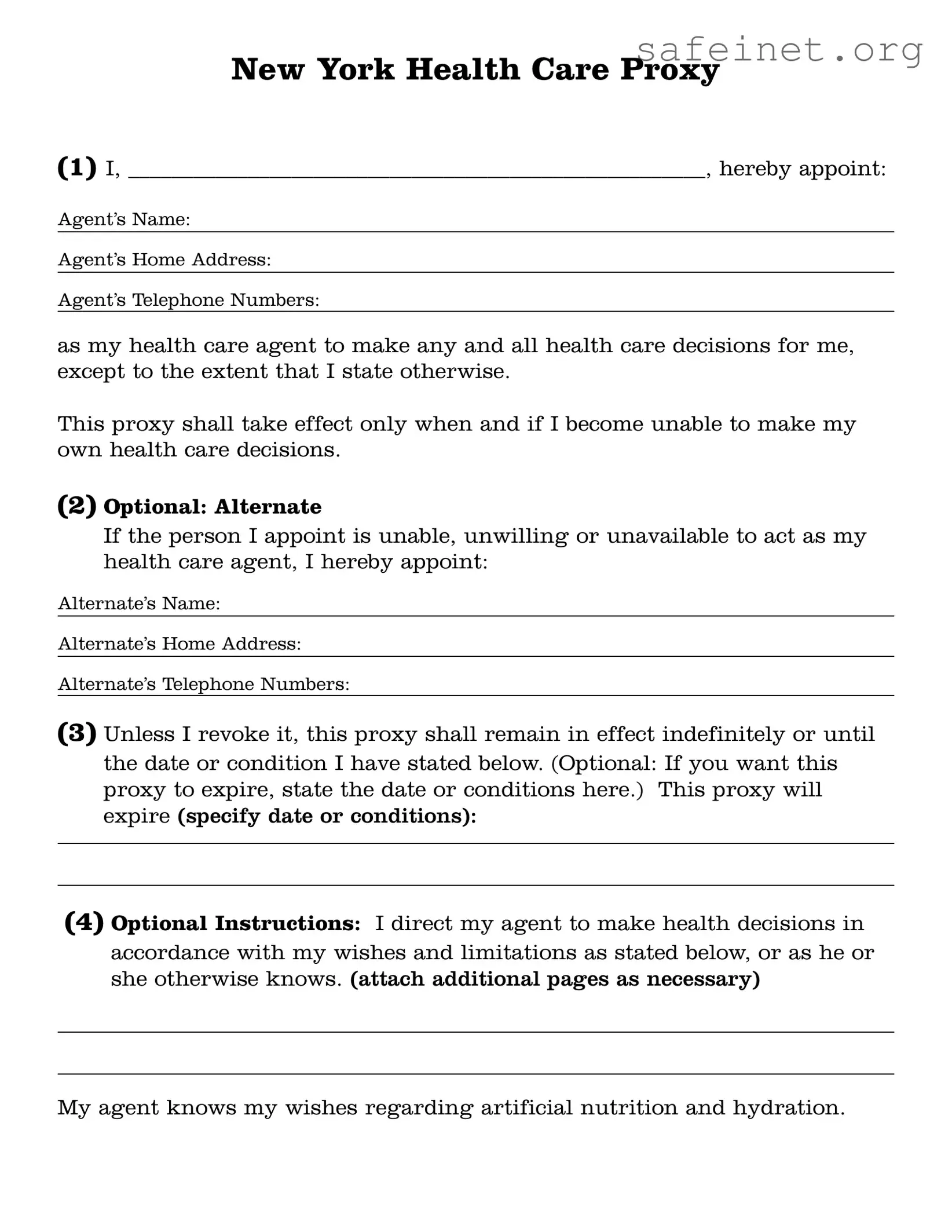
The New York Health Care Proxy form serves as a critical legal document that allows individuals to designate a trusted person to make health care decisions on their behalf when they are unable to do so. This form outlines the appointment of an agent, who is responsible for making decisions that align with the individual's preferences and values regarding medical treatment. In addition to the primary agent, individuals have the option to name an alternate agent should the primary agent be unable to fulfill their duties. The document remains valid indefinitely unless revoked or a specific expiration date or condition is stated. It also provides space for individuals to include any specific instructions regarding their health care preferences, including their wishes about artificial nutrition and hydration. Furthermore, the form includes a section for organ and tissue donation, allowing individuals to express their wishes regarding the donation of their body parts upon death. To ensure the validity of the proxy, the signatures of two witnesses are required, confirming that the individual executed the document willingly and in their presence. This comprehensive approach ensures that health care decisions reflect the individual's desires, even when they cannot communicate them directly.

New York Health Care Proxy
(1) I, _____________________________________________________, hereby appoint:
Agent’s Name:
Agent’s Home Address:
Agent’s Telephone Numbers:
as my health care agent to make any and all health care decisions for me, except to the extent that I state otherwise.
This proxy shall take effect only when and if I become unable to make my own health care decisions.
(2) Optional: Alternate
If the person I appoint is unable, unwilling or unavailable to act as my health care agent, I hereby appoint:
Alternate’s Name:
Alternate’s Home Address:
Alternate’s Telephone Numbers:
(3) Unless I revoke it, this proxy shall remain in effect indefinitely or until the date or condition I have stated below. (Optional: If you want this proxy to expire, state the date or conditions here.) This proxy will expire (specify date or conditions):
(4) Optional Instructions: I direct my agent to make health decisions in accordance with my wishes and limitations as stated below, or as he or she otherwise knows. (attach additional pages as necessary)
My agent knows my wishes regarding artificial nutrition and hydration.

(5) Your Identification (please print)
Your Name:
Your Signature: |
Date: |
|
|
Your Address:
(6) Optional: Organ and/or Tissue Donation
Upon my death, I wish to donate my organs, tissues or body parts: (check any that apply and note limitations)
Any needed organs and/or tissues
_____ Only the following organs and/or tissues:
My donation is for the following:
___transplant ___therapy ___research ___education ___any use
Your Signature: ______________________________________ Date:________________
(7) Statement by Witnesses (Witnesses must be 18 years of age or older and cannot be the health care agent or alternate.)
I declare that the person who signed this document is known to me and appears to execute this proxy willingly and of his or her own free will. He or she signed (or asked another to sign for him or her) this document in my presence.
Name of Witness 1 (please print): |
Date: |
|
|
Signature: |
|
|
|
Address: |
|
|
|
Name of Witness 2 (please print): |
Date: |
|
|
Signature: |
|
|
|
Address : |
|
|
|
| Fact Name | Description |
|---|---|
| Agent Appointment | The form allows individuals to appoint a health care agent who will make medical decisions on their behalf if they are unable to do so. |
| Effectiveness | This proxy takes effect only when the individual is deemed unable to make their own health care decisions. |
| Indefinite Duration | Unless revoked, the proxy remains valid indefinitely or until a specified expiration date or condition is met. |
| Optional Alternate Agent | The form provides an option to appoint an alternate agent if the primary agent is unavailable or unwilling to act. |
| Personal Wishes | Individuals can specify their health care preferences, including directives on artificial nutrition and hydration. |
| Organ Donation | There is an optional section where individuals can express their wishes regarding organ and tissue donation upon death. |
| Witness Requirement | The document must be signed in the presence of two witnesses who are at least 18 years old and not the appointed agents. |
| Governing Law | The New York Health Care Proxy form is governed by New York Public Health Law, Article 29-C. |
Completing the New York Health Care Proxy form is an important step in ensuring that your health care preferences are honored. After filling out this form, it will be crucial to share it with your appointed agent and keep copies in accessible locations. Below are the steps to fill out the form accurately.
What is a New York Health Care Proxy form?
The New York Health Care Proxy form is a legal document that allows an individual to appoint someone else, known as an agent, to make health care decisions on their behalf. This form is particularly important for situations where a person becomes unable to communicate their wishes regarding medical treatment. The appointed agent can make decisions based on the individual's preferences, which can be outlined in the document itself or communicated to the agent beforehand.
When does the Health Care Proxy take effect?
The Health Care Proxy takes effect only when the individual who created it becomes unable to make their own health care decisions. This incapacity can result from various circumstances, such as a serious illness or injury. Until that point, the individual retains the right to make their own health care choices, even if the proxy has been established.
Can I appoint an alternate agent in my Health Care Proxy?
Yes, the form allows you to designate an alternate agent. This is a wise decision in case your primary agent is unable, unwilling, or unavailable to fulfill their role. You can provide the name, address, and contact information for this alternate agent within the same form. This ensures that your health care decisions can still be managed according to your wishes, even if your first choice is not available.
How long does the Health Care Proxy remain in effect?
The Health Care Proxy remains in effect indefinitely unless you specify a date or condition for its expiration. If you wish for the proxy to end at a certain time or under specific circumstances, you can indicate that in the form. Otherwise, it will continue to be valid until you revoke it or until your death.
What if I have specific wishes regarding my health care decisions?
You have the option to include specific instructions for your agent in the Health Care Proxy form. This can include preferences about particular treatments, limitations on decisions, or any other health care wishes you want your agent to follow. If necessary, you can attach additional pages to provide more detailed information. It is essential that your agent understands your values and wishes, especially regarding critical issues like artificial nutrition and hydration.
Failing to provide complete information for the agent. Ensure that the agent’s name, address, and telephone number are filled out completely.
Not designating an alternate agent. If the primary agent is unavailable, having an alternate agent is crucial for ensuring your wishes are followed.
Overlooking the expiration date. If you wish for the proxy to expire, clearly state the date or conditions for expiration.
Neglecting to provide specific instructions. It is important to include any specific wishes or limitations regarding health care decisions.
Not signing and dating the form. Your signature and date are essential to validate the document.
Forgetting to include witness signatures. Witnesses must be at least 18 years old and cannot be the agent or alternate.
Leaving out identification details. Ensure that your name and address are printed clearly on the form.
Not reviewing the document after completion. Take the time to double-check for any errors or omissions before submitting.
Failing to communicate your wishes. It is important to discuss your health care preferences with your agent and loved ones.
Using outdated forms. Always ensure that you are using the most recent version of the New York Health Care Proxy form.
The New York Health Care Proxy form is an important document that allows individuals to designate someone to make health care decisions on their behalf if they become unable to do so. Alongside this form, several other documents are often used to ensure comprehensive health care planning. Below is a list of these related forms and documents.
Having these documents in place can provide peace of mind and ensure that your health care preferences are honored. It is advisable to discuss these options with family members and legal advisors to make informed decisions that reflect your values and wishes.
The Living Will is a document that outlines a person's wishes regarding medical treatment in situations where they cannot communicate their decisions. Like the New York Health Care Proxy, it focuses on end-of-life care and specifies what types of medical interventions a person does or does not want. However, while a health care proxy appoints someone to make decisions on behalf of the individual, a living will serves as a direct expression of the individual's own wishes. Both documents are crucial for ensuring that medical care aligns with personal values and preferences.
The Durable Power of Attorney for Health Care is similar to the New York Health Care Proxy in that it designates a person to make health care decisions when the individual is unable to do so. This document can cover a broader range of decisions, including financial matters, but it is often used specifically for health care decisions. Like the health care proxy, it requires the appointed agent to act in the best interest of the individual, following their known wishes and values.
The Do Not Resuscitate (DNR) order is a specific type of medical directive that indicates a person's wish not to receive CPR or other life-saving measures in the event of cardiac arrest. While the New York Health Care Proxy allows for broader health care decisions, a DNR focuses solely on resuscitation efforts. Both documents are essential for communicating personal health care preferences, especially in critical situations.
The Physician Orders for Life-Sustaining Treatment (POLST) form is designed for individuals with serious illnesses. It translates a person’s treatment preferences into actionable medical orders. Similar to the health care proxy, the POLST is intended to ensure that a person’s wishes are honored in medical emergencies. However, the POLST is often used in conjunction with the health care proxy, providing specific instructions for emergency personnel.
The Advance Directive is a general term that encompasses various documents, including living wills and health care proxies. It serves as a way for individuals to express their health care preferences ahead of time. Like the New York Health Care Proxy, advance directives ensure that a person's wishes are respected when they cannot communicate them. This document can include multiple types of instructions about medical care, making it comprehensive.
The Mental Health Care Proxy is a specific type of health care proxy that focuses on mental health decisions. It allows an individual to appoint someone to make decisions regarding their mental health treatment when they are unable to do so. Similar to the New York Health Care Proxy, it emphasizes the importance of having a trusted person to advocate for the individual's preferences in a sensitive area of health care.
The Organ Donation Consent form is a document that allows individuals to express their wishes regarding organ donation upon death. Like the organ donation section of the New York Health Care Proxy, this form ensures that a person's preferences are known and respected. Both documents serve to facilitate the donation process and relieve family members from making difficult decisions during a time of grief.
The Health Insurance Portability and Accountability Act (HIPAA) Authorization is a document that allows individuals to grant permission for others to access their medical records. While it does not directly make health care decisions, it complements the New York Health Care Proxy by ensuring that the appointed agent has the necessary information to make informed decisions. Both documents work together to protect an individual's health care rights and preferences.
The End-of-Life Care Plan is a comprehensive document that outlines an individual's wishes for their care during the final stages of life. It can include preferences about pain management, hospice care, and other treatments. Similar to the New York Health Care Proxy, it aims to ensure that health care providers and family members understand and respect the individual's desires, making it an important tool for end-of-life discussions.
The Family Health Care Decision Act allows family members to make health care decisions on behalf of a loved one who is unable to do so. This act provides a legal framework for decision-making in the absence of a health care proxy. While the New York Health Care Proxy allows for the appointment of an agent, this act ensures that family members can step in when no designated agent is available, highlighting the importance of having clear directives in place.
When filling out the New York Health Care Proxy form, there are important dos and don’ts to keep in mind. This will help ensure that your wishes are clearly communicated and legally valid.
Many people have misconceptions about the New York Health Care Proxy form. Here are ten common misunderstandings:
Understanding these points can help ensure that your health care preferences are honored when it matters most.
Filling out the New York Health Care Proxy form is an important step in ensuring your health care wishes are honored. Here are some key takeaways to keep in mind:
Completing this form can provide peace of mind, knowing your health care preferences will be respected when you cannot speak for yourself.