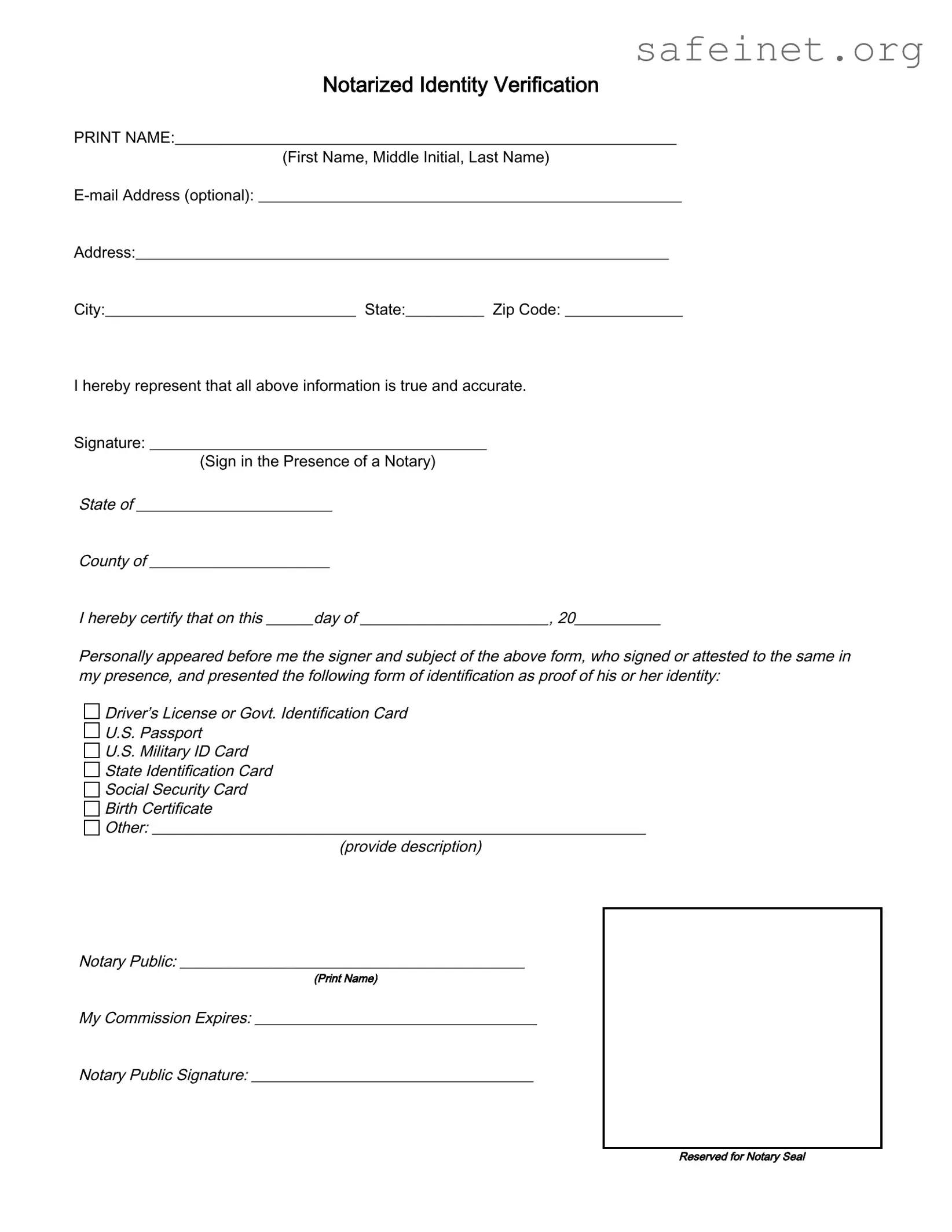
The Notarized Identity Verification form serves a critical role in confirming an individual's identity through a structured and reliable process. This document requires the individual to provide their full name, optional email address, and residential address, ensuring that all information submitted is accurate and truthful. A signature is required, which must be executed in the presence of a notary public, emphasizing the importance of verification in legal and official contexts. The notary public plays a pivotal role by certifying the identity of the signer, who must present an acceptable form of identification. Options for identification include a driver's license, passport, military ID, state ID, social security card, or birth certificate, among others. This multi-faceted approach not only enhances the credibility of the verification process but also protects against identity fraud. The notary's signature and seal further authenticate the document, providing an additional layer of security. Overall, the Notarized Identity Verification form is an essential tool for various transactions that require a high level of trust and verification.

Notarized Identity Verification
PRINT NAME:________________________________________________________________
(First Name, Middle Initial, Last Name)
Address:____________________________________________________________________
City:________________________________ State:__________ Zip Code: _______________
I hereby represent that all above information is true and accurate.
Signature: ___________________________________________
(Sign in the Presence of a Notary)
State of _________________________
County of _______________________
I hereby certify that on this ______day of ________________________, 20___________
Personally appeared before me the signer and subject of the above form, who signed or attested to the same in my presence, and presented the following form of identification as proof of his or her identity:
Driver’s License or Govt. Identification Card
U.S. Passport
U.S. Military ID Card
State Identification Card
Social Security Card
Birth Certificate
Other: _______________________________________________________________
(provide description)
Notary Public: ____________________________________________
(Print Name)
My Commission Expires: ____________________________________
Notary Public Signature: ____________________________________
Reserved for Notary Seal
| Fact Name | Description |
|---|---|
| Purpose | The Notarized Identity Verification form is used to confirm a person's identity through notarization, ensuring that the information provided is accurate and truthful. |
| Required Information | Individuals must provide their full name, email address (optional), address, city, state, and zip code to complete the form. |
| Signature Requirement | The signer must sign the form in the presence of a notary public, affirming that all provided information is correct. |
| Identification Types | Acceptable forms of identification include a driver’s license, U.S. passport, military ID, state ID, social security card, birth certificate, or other specified identification. |
| State-Specific Forms | Different states may have specific requirements or variations of the notarized identity verification form, governed by their respective laws. |
| Notary Public Role | A notary public is responsible for verifying the identity of the signer and witnessing the signing of the form. |
| Commission Expiration | The notary public must indicate the expiration date of their commission, which is essential for the validity of the notarization. |
Filling out the Notarized Identity Verification form is a straightforward process that requires attention to detail. Once completed, the form will need to be signed in the presence of a notary public, who will then verify your identity. Follow these steps to ensure that you fill out the form correctly.
What is the purpose of the Notarized Identity Verification form?
The Notarized Identity Verification form serves to confirm an individual's identity through notarization. It is often required in situations where legal documents need to be validated, such as for financial transactions, legal proceedings, or other official matters. The notarization process adds an extra layer of security, ensuring that the person presenting the document is indeed who they claim to be.
Who needs to complete this form?
This form is typically needed by anyone who is required to verify their identity for legal or official purposes. This can include individuals applying for loans, opening bank accounts, or engaging in other transactions that necessitate identity verification. If you are unsure whether you need to complete this form, it is advisable to check with the requesting institution or authority.
What information do I need to provide on the form?
You will need to provide your full name, email address (optional), and your complete address, including city, state, and zip code. Additionally, you must sign the form in the presence of a notary public. The notary will also require you to present a valid form of identification, which could be a driver’s license, passport, military ID, or other acceptable forms of ID.
How do I find a notary public?
Notaries can often be found in various locations, including banks, law offices, and public libraries. Additionally, many online platforms allow you to search for notaries in your area. It’s important to ensure that the notary you choose is authorized to perform notarizations in your state. You may also want to call ahead to confirm their availability.
What forms of identification are accepted?
Accepted forms of identification include a driver’s license, government-issued ID card, U.S. passport, U.S. military ID card, state identification card, social security card, and birth certificate. If you have another form of ID that you believe is valid, you can describe it in the space provided on the form. Always check with the notary beforehand to ensure your ID will be accepted.
Is my email address required on the form?
No, providing your email address is optional. However, including it may facilitate communication regarding the notarization process or any related matters. If you prefer not to share your email, you can leave that section blank without any issues.
What happens after I complete the form?
Once you have filled out the form and signed it in the presence of a notary, the notary will complete their section, certifying your identity and the authenticity of your signature. The notary will then affix their seal to the document. You should keep a copy of the notarized form for your records, while the original may be submitted to the requesting party.
How long is the notarization valid?
The validity of a notarization can vary depending on the specific requirements of the institution or authority requesting the form. Generally, notarizations do not expire, but some organizations may have their own policies regarding how recent the notarization must be. It is advisable to check with the requesting entity for their specific guidelines.
Can I complete the form without a notary?
No, the notarization process is a crucial part of the identity verification. The form must be signed in the presence of a notary public to be considered valid. The notary's role is to witness the signing and verify your identity, which is essential for the integrity of the process.
Incomplete Name Entry: Many individuals forget to include their middle initial or do not write their name clearly. This can lead to confusion and potential rejection of the form.
Missing Signature: It’s crucial to sign the form in the presence of a notary. Failing to do so or signing before arriving can invalidate the document.
Incorrect Identification: Providing the wrong type of identification can create issues. Ensure that the identification presented matches the acceptable forms listed on the form.
Omitting Address Details: Some people overlook filling out their complete address, including the city, state, and zip code. This information is essential for verification purposes.
Notary Information Errors: Errors in the notary section, such as incorrect dates or missing notary signatures, can render the form invalid. Double-check all notary details before submission.
The Notarized Identity Verification form is often used in various situations that require proof of identity. Several other documents complement this form, providing additional verification or serving related purposes. Below is a list of commonly associated forms and documents.
These documents, when used alongside the Notarized Identity Verification form, help ensure accurate identification and verification in various legal and administrative processes. Having the correct documentation is crucial for facilitating transactions and safeguarding against identity fraud.
The Affidavit of Identity is a document that serves a similar purpose to the Notarized Identity Verification form. It is a sworn statement made before a notary public, where an individual declares their identity and provides personal details. Like the Notarized Identity Verification form, it requires the signer to present valid identification. Both documents aim to confirm the identity of the individual, ensuring that the information provided is accurate and can be trusted.
A Power of Attorney (POA) document also shares similarities with the Notarized Identity Verification form. While a POA allows one person to act on behalf of another, it typically requires notarization to validate the identity of the person granting authority. Both forms necessitate the presence of a notary public, ensuring that the identity of the signers is verified and that the documents are legally binding.
The Certificate of Identity is another document that aligns closely with the Notarized Identity Verification form. This certificate is often used in legal proceedings to verify an individual's identity. Just like the Notarized Identity Verification form, it requires the individual to present identification and often involves a notary public to affirm that the identity has been accurately confirmed.
The Declaration of Identity is similar in function to the Notarized Identity Verification form. It is a formal statement made under oath, where an individual declares their identity and provides necessary details. Both documents are used to establish identity and require a notary public to ensure the information is truthful and verified, thus serving as a safeguard against identity fraud.
A notarized letter of consent also shares common ground with the Notarized Identity Verification form. This letter often requires the signer to verify their identity before granting permission for a specific action, such as medical treatment or travel. Both documents necessitate the presence of a notary public to authenticate the identity of the signer, ensuring that the consent provided is legitimate.
The Notarized Affidavit of Identity is another document that parallels the Notarized Identity Verification form. This affidavit is a sworn statement that confirms an individual's identity, often used in legal contexts. It requires the individual to present valid identification and be notarized, similar to the verification form, to ensure that the identity claimed is accurate and can be relied upon.
The Identity Theft Report is also akin to the Notarized Identity Verification form, particularly in its focus on confirming identity. This report is often filed when someone believes their identity has been stolen. Like the Notarized Identity Verification form, it may require the presentation of identification and can involve a notary public to verify the identity of the individual filing the report.
Lastly, the Notarized Statement of Identity is similar to the Notarized Identity Verification form in that it serves to affirm an individual's identity. This statement is often used in various legal and financial situations where identity verification is crucial. Both documents require a notary public to ensure that the identity is accurately represented and verified, providing an additional layer of security against identity fraud.
When filling out the Notarized Identity Verification form, it’s essential to ensure accuracy and completeness. Here’s a list of things to keep in mind:
Misconceptions about the Notarized Identity Verification form can lead to confusion and errors. Here are four common misunderstandings:
Filling out and using the Notarized Identity Verification form can seem daunting, but understanding its key components can make the process smoother. Here are some important takeaways to keep in mind:
By following these key points, you can navigate the Notarized Identity Verification form with confidence and ease.