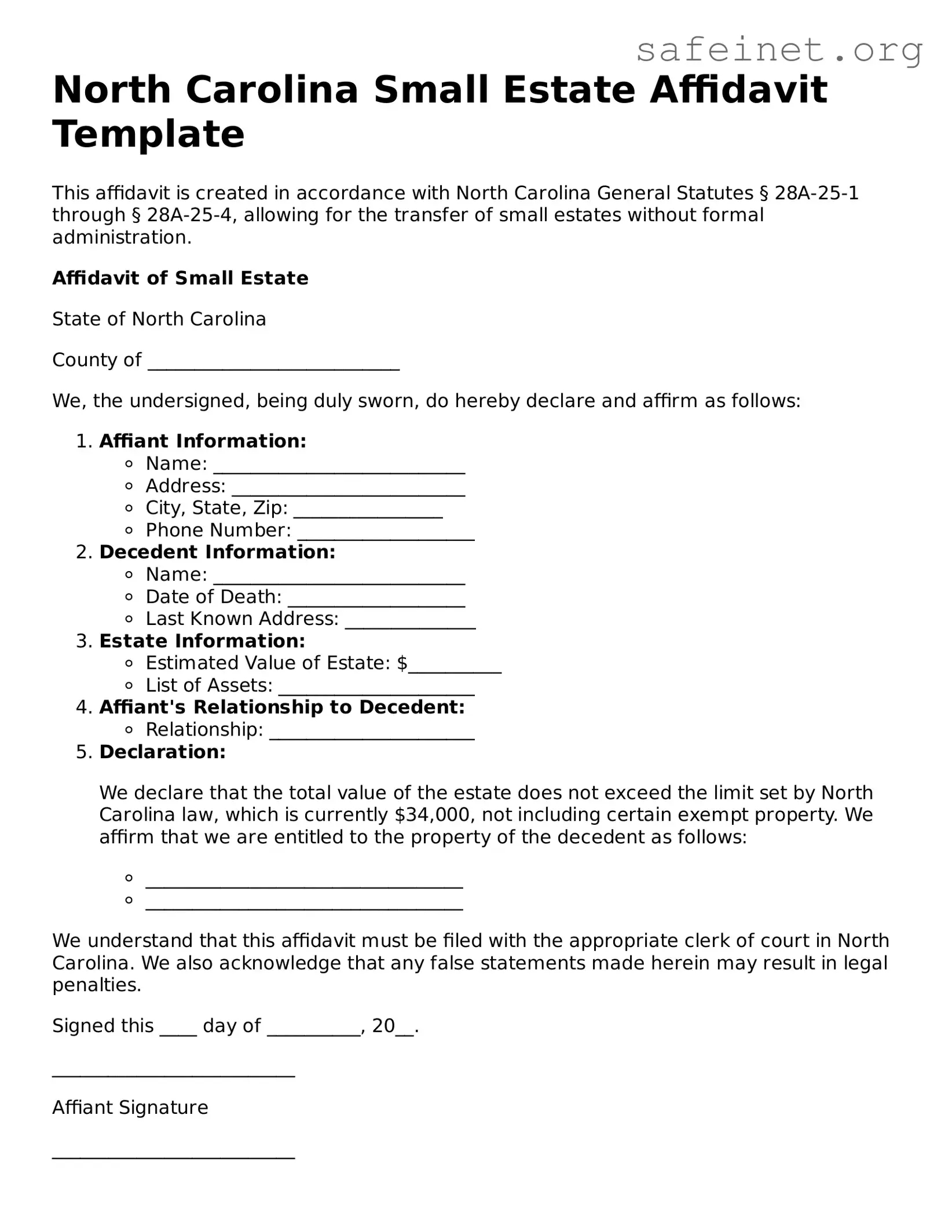
In North Carolina, navigating the process of settling a small estate can be streamlined through the use of the Small Estate Affidavit form. This form is designed for estates where the total value of personal property does not exceed $34,000, making it a practical option for families and individuals dealing with the loss of a loved one. By utilizing this affidavit, heirs can bypass the lengthy probate process, allowing them to claim assets more efficiently. The form requires information about the deceased, such as their name, date of death, and details about the assets involved. Additionally, it must be signed under oath, affirming the validity of the claims made within it. This straightforward approach not only eases the burden on grieving families but also provides a clear path to asset distribution without the need for court intervention. Understanding how to properly complete and file this form is essential for ensuring that the estate is settled in accordance with North Carolina law.
North Carolina Small Estate Affidavit Template
This affidavit is created in accordance with North Carolina General Statutes § 28A-25-1 through § 28A-25-4, allowing for the transfer of small estates without formal administration.
Affidavit of Small Estate
State of North Carolina
County of ___________________________
We, the undersigned, being duly sworn, do hereby declare and affirm as follows:
We declare that the total value of the estate does not exceed the limit set by North Carolina law, which is currently $34,000, not including certain exempt property. We affirm that we are entitled to the property of the decedent as follows:
We understand that this affidavit must be filed with the appropriate clerk of court in North Carolina. We also acknowledge that any false statements made herein may result in legal penalties.
Signed this ____ day of __________, 20__.
__________________________
Affiant Signature
__________________________
Printed Name
__________________________
Notary Public
| Fact Name | Description |
|---|---|
| Purpose | The North Carolina Small Estate Affidavit allows heirs to claim assets of a deceased person without going through full probate. |
| Eligibility | The estate must not exceed $20,000 in value, or $30,000 if the surviving spouse is the sole heir. |
| Governing Law | This form is governed by North Carolina General Statutes § 28A-24-1. |
| Who Can Use It | Only heirs or beneficiaries of the deceased can use the Small Estate Affidavit. |
| Filing Requirement | No court filing is required, but the affidavit must be presented to financial institutions or other entities holding the deceased's assets. |
| Required Information | The affidavit must include details about the deceased, the heirs, and a list of assets. |
| Signature Requirement | The affidavit must be signed under oath in front of a notary public. |
| Debts | Heirs are responsible for settling any debts of the deceased before claiming assets. |
| Time Limit | There is no specific time limit for using the Small Estate Affidavit, but acting promptly is advisable. |
| Additional Resources | Consulting with an attorney for guidance on the process is recommended, especially for complex estates. |
Filling out the North Carolina Small Estate Affidavit form is an important step in managing the affairs of a deceased loved one. This process allows you to claim assets without going through a lengthy probate procedure. By carefully following the steps below, you can ensure that the form is completed accurately and efficiently.
Once the form is filled out and notarized, you can submit it to the appropriate institutions to access the deceased's assets. Be sure to keep a copy for your records, as you may need it for future reference.
What is a Small Estate Affidavit in North Carolina?
A Small Estate Affidavit is a legal document that allows individuals to settle a deceased person's estate without going through formal probate. In North Carolina, this process is available for estates valued at $34,000 or less, excluding certain exempt property. It simplifies the distribution of assets to heirs or beneficiaries.
Who can use the Small Estate Affidavit?
The Small Estate Affidavit can be used by any individual who is entitled to receive property from the deceased. Typically, this includes immediate family members such as spouses, children, or parents. However, it can also be used by other heirs or beneficiaries named in a will.
What assets are included in the Small Estate Affidavit?
Assets that can be included in the Small Estate Affidavit are those owned solely by the deceased at the time of their death. This includes cash, bank accounts, personal property, and real estate. However, life insurance policies and retirement accounts with designated beneficiaries are not included in the total value of the estate.
What is the process for completing a Small Estate Affidavit?
To complete a Small Estate Affidavit, you must gather information about the deceased's assets and debts. Then, fill out the affidavit form, which requires details such as the deceased's name, date of death, and a list of assets. After completing the form, it must be signed in front of a notary public. Finally, present the affidavit to the institutions holding the deceased's assets, such as banks or property registries.
Is there a fee to file a Small Estate Affidavit?
There is no fee for filing a Small Estate Affidavit itself. However, some institutions may charge a fee for processing the affidavit or for transferring assets. It is advisable to check with each institution for any potential fees involved.
Do I need a lawyer to file a Small Estate Affidavit?
While hiring a lawyer is not required, it can be beneficial, especially if the estate is complex or if there are disputes among heirs. A legal professional can provide guidance and ensure that all necessary steps are followed correctly.
What happens if the estate exceeds $34,000?
If the estate exceeds the $34,000 limit, the Small Estate Affidavit cannot be used. In this case, the estate will need to go through the formal probate process. This involves filing a petition with the court and may require the appointment of an executor or administrator.
Can creditors make claims against the estate during this process?
Yes, creditors can make claims against the estate. The Small Estate Affidavit process does not prevent creditors from seeking payment for debts owed by the deceased. It is important to settle any outstanding debts before distributing assets to heirs or beneficiaries.
How long does the Small Estate Affidavit process take?
The time it takes to complete the Small Estate Affidavit process can vary. Generally, once the affidavit is signed and presented to financial institutions, they may process the request within a few weeks. However, the overall timeline can be influenced by factors such as the complexity of the estate and the responsiveness of the institutions involved.
What if there are disputes among heirs regarding the estate?
Disputes among heirs can complicate the Small Estate Affidavit process. If disagreements arise, it may be necessary to seek legal advice or mediation. In some cases, disputes may lead to formal probate proceedings, where a court will resolve the issues and determine how the estate should be distributed.
Incomplete Information: Many individuals fail to provide all necessary details. This includes missing names, addresses, or dates. Every section must be filled out completely to avoid delays.
Incorrect Value Estimates: Some people underestimate or overestimate the value of the estate. Accurate valuations are crucial for the affidavit to be accepted.
Failure to List All Assets: Omitting assets can lead to complications. Ensure that all property, bank accounts, and personal belongings are accounted for.
Not Including Debts: Neglecting to mention debts can skew the financial picture of the estate. List all outstanding debts to provide a clear overview.
Signature Issues: Some individuals forget to sign the affidavit or do not have the required witnesses. Signatures must be present and valid to authenticate the document.
Improper Notarization: A common mistake is failing to have the affidavit notarized correctly. This step is essential for legal validity.
Not Checking for Updates: Laws can change. Many people fill out the form without verifying if there have been any recent updates to the requirements.
The North Carolina Small Estate Affidavit is a useful tool for settling the estates of individuals who have passed away, particularly when the estate's value is below a certain threshold. However, several other documents are commonly used in conjunction with this affidavit to facilitate the estate settlement process.
Using these documents in conjunction with the North Carolina Small Estate Affidavit can streamline the process of settling an estate. Proper documentation ensures that all legal requirements are met and helps facilitate a smoother transition for the heirs involved.
The North Carolina Small Estate Affidavit is similar to the Affidavit of Heirship, a document often used in estate matters. The Affidavit of Heirship serves to establish the heirs of a deceased person when there is no will. Like the Small Estate Affidavit, it allows heirs to claim property without going through the lengthy probate process. Both documents require the signature of witnesses and aim to simplify the transfer of assets, providing a more accessible route for families during a challenging time.
Another document that bears resemblance is the Will. While a will outlines the deceased’s wishes regarding asset distribution, the Small Estate Affidavit is utilized when the estate is small enough to bypass formal probate. Both documents serve to distribute assets, but the will requires more formalities and is subject to court approval. In contrast, the Small Estate Affidavit facilitates a more immediate transfer of property to heirs, reflecting the need for efficiency in certain situations.
The Declaration of Trust is another document that shares similarities with the Small Estate Affidavit. A trust allows individuals to manage their assets during their lifetime and dictate how those assets will be distributed after death. While the Small Estate Affidavit is used posthumously to distribute assets without probate, both documents emphasize the importance of clear intentions regarding asset management and distribution. They provide a means for individuals to express their wishes and protect their loved ones.
The Transfer on Death Deed (TODD) is also comparable to the Small Estate Affidavit. A TODD allows property owners to designate beneficiaries who will receive the property upon the owner's death, avoiding probate. Similar to the Small Estate Affidavit, this deed streamlines the transfer process and provides a clear path for asset distribution. Both documents reflect a desire to minimize the administrative burden on families during a time of grief.
Lastly, the Affidavit of Collection of Personal Property is akin to the Small Estate Affidavit in that it enables heirs to collect personal property without going through probate. This affidavit is typically used for tangible personal property, such as furniture or vehicles. Both documents simplify the process for heirs, allowing them to access and manage their loved one's belongings more quickly. They serve as practical tools for families navigating the complexities of estate matters.
When filling out the North Carolina Small Estate Affidavit form, it is essential to follow certain guidelines to ensure accuracy and compliance. Below is a list of things you should and shouldn't do.
By adhering to these guidelines, individuals can navigate the process more smoothly and avoid potential complications.
The North Carolina Small Estate Affidavit form is often misunderstood. Here are five common misconceptions:
This is not true. The Small Estate Affidavit is designed for estates with a total value of $34,000 or less, making it accessible for many families, not just the wealthy.
While it is related to probate, the Small Estate Affidavit allows for the transfer of property without going through the full probate process. This can simplify matters for smaller estates.
This is a misconception. While it is important to address debts, the affidavit can still be used to transfer assets even if some debts remain unpaid.
Many people find the Small Estate Affidavit straightforward. It is designed for individuals to complete without needing a lawyer, although seeking help is always an option if needed.
In most cases, processing the affidavit is relatively quick. Once submitted, the transfer of assets can often happen in a timely manner, allowing families to settle affairs efficiently.
Filling out and using the North Carolina Small Estate Affidavit can be a straightforward process if you keep a few key points in mind. Here are some important takeaways to consider:
By keeping these points in mind, you can navigate the Small Estate Affidavit process with greater confidence and ease.