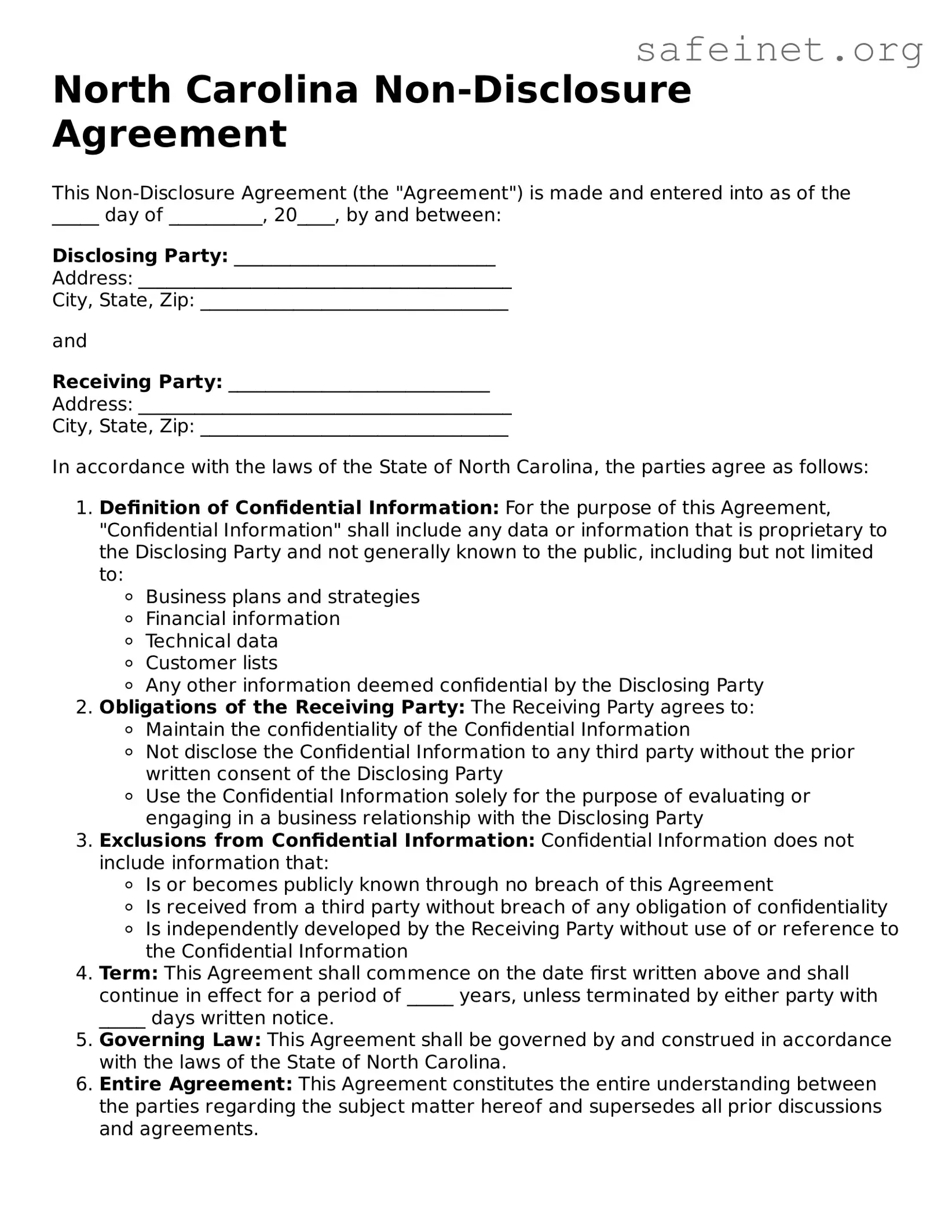
In the realm of business and professional relationships, confidentiality is paramount. The North Carolina Non-disclosure Agreement (NDA) serves as a vital tool for protecting sensitive information shared between parties. This legally binding document outlines the obligations of the receiving party to maintain the confidentiality of proprietary information, trade secrets, and other sensitive data. By clearly defining what constitutes confidential information, the NDA helps prevent unauthorized disclosure and misuse. It includes essential elements such as the duration of confidentiality, the scope of information covered, and the consequences of breach. Whether you are a business owner, an employee, or a contractor, understanding the North Carolina NDA is crucial for safeguarding your interests and ensuring that trust remains intact in professional dealings. This form not only establishes a framework for confidentiality but also fosters a secure environment for innovation and collaboration.
North Carolina Non-Disclosure Agreement
This Non-Disclosure Agreement (the "Agreement") is made and entered into as of the _____ day of __________, 20____, by and between:
Disclosing Party: ____________________________
Address: ________________________________________
City, State, Zip: _________________________________
and
Receiving Party: ____________________________
Address: ________________________________________
City, State, Zip: _________________________________
In accordance with the laws of the State of North Carolina, the parties agree as follows:
IN WITNESS WHEREOF, the parties hereto have executed this Non-Disclosure Agreement as of the date first above written.
Disclosing Party Signature: ____________________________
Date: ______________________
Receiving Party Signature: ____________________________
Date: ______________________
| Fact Name | Description |
|---|---|
| Purpose | The North Carolina Non-disclosure Agreement (NDA) is designed to protect confidential information shared between parties. |
| Governing Law | This NDA is governed by the laws of North Carolina, ensuring that any disputes are resolved under state regulations. |
| Parties Involved | Typically, the NDA involves at least two parties: the disclosing party and the receiving party. |
| Duration of Confidentiality | The agreement specifies how long the confidentiality obligations last, which can vary based on the agreement. |
| Enforcement | If a party breaches the NDA, the other party may seek legal remedies, including injunctions or damages. |
Filling out the North Carolina Non-disclosure Agreement form is a straightforward process that requires attention to detail. Once completed, this form will help protect sensitive information as you engage in business discussions or collaborations.
What is a Non-disclosure Agreement (NDA) in North Carolina?
A Non-disclosure Agreement, commonly referred to as an NDA, is a legal contract that protects confidential information shared between parties. In North Carolina, this agreement ensures that sensitive information remains private and is not disclosed to unauthorized individuals or entities.
Why should I use a Non-disclosure Agreement?
Using an NDA is crucial for safeguarding your intellectual property, trade secrets, or any proprietary information. By having a formal agreement in place, you can establish clear expectations about confidentiality and provide legal recourse in case of a breach.
Who can enter into a Non-disclosure Agreement?
Any individual or business can enter into an NDA. This includes employees, contractors, partners, and vendors. It is essential that all parties involved understand the terms and implications of the agreement before signing.
What types of information are typically covered in an NDA?
NDAs usually cover a wide range of information, including business plans, customer lists, financial data, marketing strategies, and any other information deemed confidential. Specificity in the agreement helps to ensure that all parties are aware of what is considered confidential.
How long does the confidentiality obligation last?
The duration of confidentiality obligations can vary. Many NDAs specify a time frame, which could be a few years or indefinite, depending on the nature of the information. It is essential to clearly outline this duration in the agreement to avoid misunderstandings.
What happens if someone breaches the Non-disclosure Agreement?
If a party breaches the NDA, the injured party may seek legal remedies. This can include monetary damages or injunctive relief to prevent further disclosure. The specific consequences should be outlined in the NDA to provide clarity for all parties involved.
Do I need a lawyer to create a Non-disclosure Agreement?
While it is not mandatory to have a lawyer draft an NDA, consulting with one can be beneficial. A legal professional can help ensure that the agreement is comprehensive and tailored to your specific needs, reducing the risk of potential issues in the future.
Can a Non-disclosure Agreement be modified after it is signed?
Yes, an NDA can be modified after it is signed, but both parties must agree to the changes. It is best practice to document any amendments in writing and have both parties sign the updated agreement to ensure clarity and enforceability.
Is a Non-disclosure Agreement enforceable in North Carolina?
Yes, NDAs are enforceable in North Carolina as long as they meet the legal requirements. The agreement must be reasonable in scope and duration, and it should protect legitimate business interests. Courts generally uphold NDAs that are clear and specific.
Failing to provide complete contact information. It is essential to include full names, addresses, and phone numbers for all parties involved.
Not clearly defining the confidential information. Specificity helps avoid misunderstandings about what is considered confidential.
Omitting the purpose of the agreement. Clearly stating the reason for sharing confidential information ensures all parties understand the context.
Using vague language. Ambiguous terms can lead to confusion and may result in disputes later on.
Failing to specify the duration of confidentiality. Indicating how long the information should remain confidential is critical for clarity.
Not including signatures. All parties must sign the agreement for it to be legally binding.
Neglecting to consult legal advice. Seeking guidance can help ensure the agreement meets all necessary legal requirements.
When entering into a Non-disclosure Agreement (NDA) in North Carolina, several other forms and documents may be necessary to ensure that all parties are protected and informed. Here are some common documents that often accompany an NDA.
These documents play a vital role in safeguarding sensitive information and establishing clear expectations between parties. Always consider consulting with a legal professional to ensure that all necessary forms are properly executed and tailored to your specific needs.
A Confidentiality Agreement is often similar to a Non-disclosure Agreement (NDA) in its purpose and function. Both documents aim to protect sensitive information shared between parties. A Confidentiality Agreement outlines the specific information that must remain private and establishes the obligations of the parties involved. Like an NDA, it is commonly used in business relationships, ensuring that trade secrets, proprietary information, and other confidential data are not disclosed to unauthorized individuals.
A Mutual Non-disclosure Agreement is another document that shares similarities with a standard NDA. This type of agreement is entered into by two parties who both wish to protect their confidential information. Each party agrees not to disclose the other’s sensitive information. This mutuality can foster trust and collaboration, especially in joint ventures or partnerships where both sides need to share proprietary information to move forward.
An Employment Non-disclosure Agreement is specifically tailored for employer-employee relationships. This document protects a company’s confidential information from being shared by employees during and after their employment. It often includes clauses that address the handling of sensitive data, trade secrets, and company practices, ensuring that employees understand their responsibilities regarding confidentiality.
A Non-circumvention Agreement is similar to an NDA but focuses on preventing one party from bypassing the other in business dealings. This document is often used in situations where one party introduces another to potential clients or business opportunities. By signing a Non-circumvention Agreement, parties agree not to engage directly with each other’s contacts without permission, thereby protecting business interests.
A Proprietary Information Agreement is closely related to NDAs and emphasizes the ownership of specific information. This document is designed to protect proprietary data, trade secrets, and intellectual property. It typically outlines what constitutes proprietary information and the obligations of the receiving party to safeguard that information. This agreement is essential in industries where innovation and unique processes are key to competitive advantage.
A License Agreement may also share characteristics with a Non-disclosure Agreement, especially when it involves the sharing of proprietary technology or information. In a License Agreement, one party grants another the right to use certain intellectual property while imposing restrictions on the disclosure of that information. This ensures that the original owner retains control over their intellectual property while allowing the licensee to benefit from it.
A Non-solicitation Agreement is another document that often complements NDAs. While it primarily focuses on preventing one party from soliciting the employees or clients of another party, it can include confidentiality provisions. This agreement helps protect business relationships and sensitive information by restricting certain actions that could harm the original party’s interests.
Lastly, a Service Agreement may contain confidentiality clauses similar to those found in NDAs. While this document primarily outlines the terms of service between two parties, it often includes provisions to protect confidential information shared during the service relationship. This ensures that sensitive data remains secure while the parties engage in their contractual obligations.
When filling out the North Carolina Non-disclosure Agreement form, it is important to follow certain guidelines to ensure the document is completed correctly. Below are nine things to do and not to do during this process.
Things You Should Do:
Things You Shouldn't Do:
Non-disclosure agreements (NDAs) are often misunderstood. Here are six common misconceptions about the North Carolina Non-disclosure Agreement form:
Understanding these misconceptions can help individuals and businesses make informed decisions when considering a Non-disclosure Agreement in North Carolina.
When dealing with sensitive information in North Carolina, using a Non-disclosure Agreement (NDA) can be essential. Here are some key takeaways to keep in mind when filling out and utilizing the North Carolina NDA form:
Taking these steps can help you effectively use the North Carolina Non-disclosure Agreement form to protect your interests.