Creating a comprehensive employee handbook is essential for any business operating in North Carolina. This document serves as a foundational resource that outlines company policies, employee rights, and workplace expectations. It typically includes critical sections such as an introduction to the organization, an overview of employment policies, and guidelines on workplace behavior. Additionally, the handbook addresses topics like anti-discrimination policies, leave policies, benefits information, and procedures for reporting grievances. By providing clear and accessible information, the employee handbook helps foster a positive work environment, ensuring that employees understand their roles and responsibilities while also protecting the employer's interests. Furthermore, adhering to state and federal regulations is vital, as it can mitigate potential legal disputes and promote compliance within the workplace. Crafting an effective employee handbook not only enhances communication but also establishes a culture of transparency and accountability, making it a crucial component of human resource management in North Carolina.
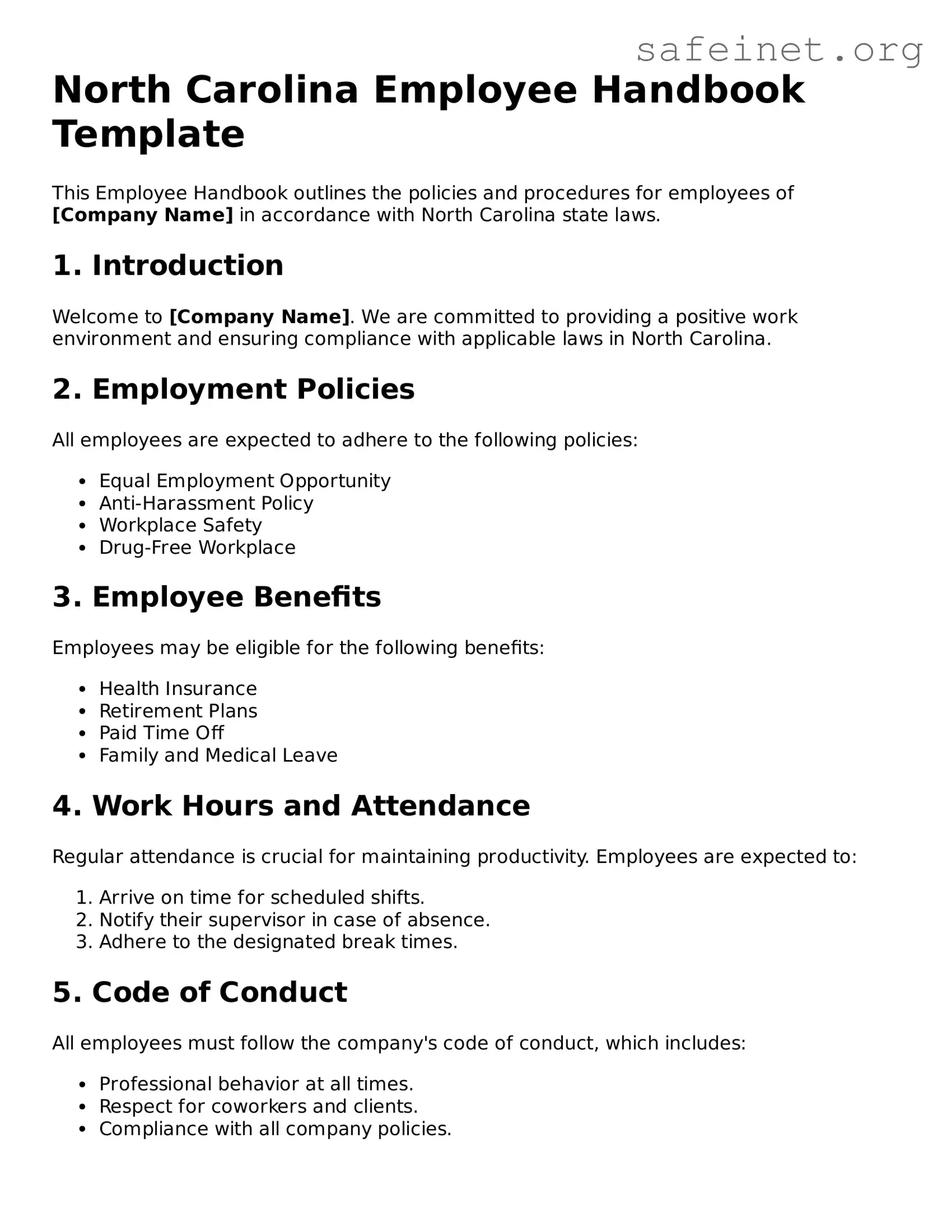
North Carolina Employee Handbook Template
This Employee Handbook outlines the policies and procedures for employees of [Company Name] in accordance with North Carolina state laws.
1. Introduction
Welcome to [Company Name]. We are committed to providing a positive work environment and ensuring compliance with applicable laws in North Carolina.
2. Employment Policies
All employees are expected to adhere to the following policies:
3. Employee Benefits
Employees may be eligible for the following benefits:
4. Work Hours and Attendance
Regular attendance is crucial for maintaining productivity. Employees are expected to:
5. Code of Conduct
All employees must follow the company's code of conduct, which includes:
6. Disciplinary Procedures
Failure to comply with company policies may result in disciplinary action, which can include:
7. Acknowledgment of Receipt
By signing below, you acknowledge that you have received and understood the Employee Handbook.
Employee Name: [Employee Name]
Employee Signature: _______________________ Date: ________________
For any questions regarding this handbook, please contact [HR Contact Name] at [HR Contact Information].
| Fact Name | Description |
|---|---|
| Purpose | The North Carolina Employee Handbook form serves as a guide for employees regarding company policies, procedures, and expectations. |
| Governing Laws | The form is governed by North Carolina General Statutes and relevant federal employment laws. |
| Content Requirements | Employers must include information on workplace conduct, benefits, and employee rights. |
| Distribution | The handbook should be provided to all employees upon hiring and updated regularly. |
| Legal Compliance | Employers must ensure that the handbook complies with state and federal labor laws to avoid legal issues. |
| Review Process | The handbook should be reviewed by legal counsel to ensure accuracy and compliance. |
| Signature Acknowledgment | Employees are often required to sign an acknowledgment form indicating they have received and understood the handbook. |
| Updates | Employers should regularly update the handbook to reflect changes in laws or company policies. |
Filling out the North Carolina Employee Handbook form is an important step in ensuring that you understand your rights and responsibilities as an employee. This process will guide you through the necessary sections to complete the form accurately.
Once completed, submit the form to ensure that your acknowledgment of the employee handbook is recorded. This step is crucial for both you and your employer to maintain clear communication regarding workplace expectations.
What is the North Carolina Employee Handbook form?
The North Carolina Employee Handbook form serves as a guideline for employees and employers. It outlines company policies, procedures, and expectations. This document helps ensure that everyone is on the same page regarding workplace rules, benefits, and employee rights.
Why is it important to have an Employee Handbook?
An Employee Handbook is crucial for fostering a positive workplace culture. It provides clarity on various topics, such as attendance, dress code, and disciplinary actions. By having a well-defined handbook, employers can reduce misunderstandings and promote fairness among employees.
Who should receive a copy of the Employee Handbook?
Every employee should receive a copy of the Employee Handbook upon hiring. This ensures that new hires understand the company's policies from the start. Additionally, existing employees should be informed of any updates or changes to the handbook to keep everyone informed and compliant.
How often should the Employee Handbook be updated?
The Employee Handbook should be reviewed and updated regularly, ideally at least once a year. Changes in laws, company policies, or workplace practices may necessitate updates. Regular reviews ensure that the handbook remains relevant and compliant with current regulations.
What should be included in the Employee Handbook?
Key elements of an Employee Handbook typically include company mission and values, employment policies, benefits information, workplace conduct guidelines, and procedures for reporting issues. Including these components helps employees understand their rights and responsibilities within the organization.
How can employees provide feedback on the Employee Handbook?
Employees are encouraged to provide feedback on the Employee Handbook through designated channels, such as HR meetings or suggestion boxes. This feedback can help identify areas for improvement and ensure that the handbook meets the needs of all employees.
What should an employee do if they have questions about the handbook?
If an employee has questions about the Employee Handbook, they should reach out to their supervisor or the Human Resources department. These resources are available to clarify any policies or procedures that may be unclear, ensuring that employees feel supported and informed.
Inaccurate Personal Information: One common mistake is providing incorrect or outdated personal details. Always double-check your name, address, and contact information to ensure accuracy.
Neglecting to Read Policies: Many individuals skip over the handbook's policies. This can lead to misunderstandings about company rules and expectations. Take the time to read through each section thoroughly.
Failing to Sign and Date: Omitting your signature or the date can render the form incomplete. Ensure you sign and date the document before submitting it.
Ignoring Acknowledgment of Receipt: Some employees overlook the acknowledgment section. This part confirms that you have received and understood the handbook. Be sure to acknowledge receipt to avoid future issues.
Not Asking Questions: If anything is unclear, many people hesitate to ask for clarification. Don’t be afraid to reach out to HR or a supervisor for help. Understanding the policies is crucial.
Submitting the Form Late: Timeliness matters. Some individuals submit their forms after the deadline. Make sure to adhere to any deadlines set by your employer to avoid complications.
In addition to the North Carolina Employee Handbook, several other forms and documents are commonly used in the workplace to ensure compliance with state and federal regulations, as well as to establish clear communication between employers and employees. Each document serves a specific purpose and helps facilitate a well-organized work environment.
These documents, along with the Employee Handbook, play a crucial role in establishing a transparent and structured work environment. They help protect both the employer's interests and the rights of employees, fostering a culture of communication and compliance.
The North Carolina Employee Handbook form shares similarities with the Employee Manual. Both documents outline company policies, procedures, and expectations for employees. The Employee Manual often serves as a more detailed version of the handbook, providing specific guidelines on workplace behavior, dress code, and attendance policies. While the handbook may summarize these points, the manual dives deeper into each topic, offering examples and scenarios to clarify expectations.
Another document that resembles the Employee Handbook is the Company Policy Document. This document typically contains specific rules and regulations that govern employee behavior and workplace operations. Like the Employee Handbook, the Company Policy Document addresses issues such as harassment, discrimination, and workplace safety. However, it often focuses more on compliance with laws and regulations, providing a framework for disciplinary actions if policies are violated.
The Orientation Guide is another document similar to the Employee Handbook. This guide is usually provided to new hires during their onboarding process. It introduces employees to the company culture, mission, and values. While the Employee Handbook serves as a long-term reference for all employees, the Orientation Guide is more focused on initial integration into the company, offering a snapshot of what to expect in the early days of employment.
The Job Description Document also bears resemblance to the Employee Handbook. Each job description outlines the responsibilities and qualifications required for specific positions within the company. While the Employee Handbook addresses broader company policies, the Job Description Document focuses on individual roles. Both documents help clarify expectations, but the job description is more targeted towards specific positions rather than overall company conduct.
Similar to the Employee Handbook is the Code of Conduct. This document outlines the ethical standards and behaviors expected from employees. It often includes guidelines on integrity, respect, and professionalism. While the Employee Handbook provides a broader overview of company policies, the Code of Conduct hones in on ethical behavior, emphasizing the importance of maintaining a positive workplace environment.
The Benefits Summary Document is another related document. It details the various benefits offered to employees, such as health insurance, retirement plans, and paid time off. The Employee Handbook may briefly mention these benefits, but the Benefits Summary provides a comprehensive overview. It serves as a valuable resource for employees seeking to understand their entitlements and how to access them.
The Performance Review Policy Document is also similar to the Employee Handbook. This document outlines the process for evaluating employee performance, including criteria for assessments and frequency of reviews. While the Employee Handbook may touch on performance expectations, the Performance Review Policy provides specific guidelines on how performance is measured and the consequences of performance evaluations.
Lastly, the Training and Development Policy Document shares characteristics with the Employee Handbook. This document outlines opportunities for employee growth, including training programs, workshops, and continuing education. While the Employee Handbook may encourage professional development, the Training and Development Policy focuses on the specific resources available to employees to enhance their skills and advance their careers.
When filling out the North Carolina Employee Handbook form, it's important to approach the task carefully. Here are some key points to consider:
By following these guidelines, you can ensure that your completion of the Employee Handbook form is both accurate and effective.
Understanding the North Carolina Employee Handbook form is essential for both employers and employees. However, several misconceptions can lead to confusion. Here are seven common misconceptions explained:
This is not true. While there is no law requiring an employee handbook, having one is highly recommended. It provides clarity on company policies and can protect employers in legal disputes.
Each employee handbook should be tailored to the specific needs and policies of the company. There is no one-size-fits-all handbook.
Policies and laws change. Regularly reviewing and updating the handbook ensures that it remains relevant and compliant with current regulations.
Small businesses can benefit from handbooks just as much as larger organizations. They help establish clear expectations and protect the business.
While it is beneficial to have employees acknowledge receipt of the handbook, a signature is not legally required. However, documenting this acknowledgment can be helpful.
Typically, an employee handbook is not considered a contract unless explicitly stated. It serves as a guideline for policies and procedures.
Not every policy needs to be in the handbook. Employers can choose to include essential policies and refer to other documents for detailed procedures.
Addressing these misconceptions can help both employers and employees better understand the purpose and importance of the North Carolina Employee Handbook form.
Filling out and utilizing the North Carolina Employee Handbook form is a vital process for both employers and employees. Here are some key takeaways to keep in mind: