In today's fast-paced business environment, protecting sensitive information is crucial for maintaining a competitive edge. One effective tool that individuals and companies use to safeguard their proprietary information is the Non-disclosure Agreement (NDA). This legally binding contract establishes a confidential relationship between parties, ensuring that shared information remains protected from unauthorized disclosure. Typically, an NDA outlines the specific information considered confidential, the obligations of the parties involved, and the duration of the confidentiality agreement. It can cover various situations, from employee agreements to partnerships and vendor relationships. By clearly defining what constitutes confidential information and the consequences of breaches, an NDA serves as a vital instrument in fostering trust and collaboration while mitigating the risks associated with information sharing.
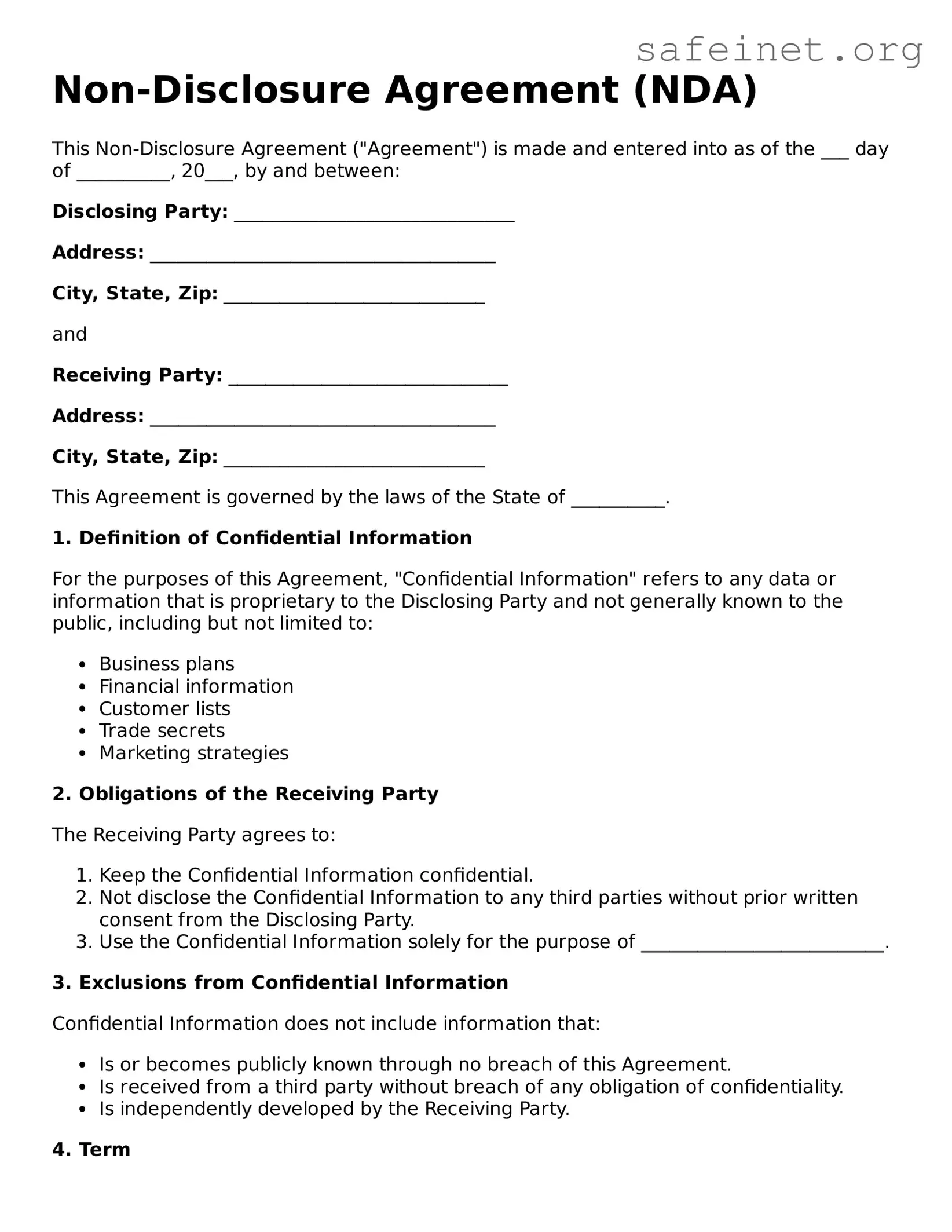
Non-Disclosure Agreement (NDA)
This Non-Disclosure Agreement ("Agreement") is made and entered into as of the ___ day of __________, 20___, by and between:
Disclosing Party: ______________________________
Address: _____________________________________
City, State, Zip: ____________________________
and
Receiving Party: ______________________________
Address: _____________________________________
City, State, Zip: ____________________________
This Agreement is governed by the laws of the State of __________.
1. Definition of Confidential Information
For the purposes of this Agreement, "Confidential Information" refers to any data or information that is proprietary to the Disclosing Party and not generally known to the public, including but not limited to:
2. Obligations of the Receiving Party
The Receiving Party agrees to:
3. Exclusions from Confidential Information
Confidential Information does not include information that:
4. Term
This Agreement shall remain in effect for a period of ___ years from the date of signing.
5. Miscellaneous
This Agreement constitutes the entire understanding between the parties regarding the subject matter hereof and supersedes all prior discussions or agreements. Any amendments must be in writing and signed by both parties.
IN WITNESS WHEREOF, the parties hereto have executed this Non-Disclosure Agreement as of the date first above written.
Disclosing Party Signature: ________________________
Date: ________________________
Receiving Party Signature: ________________________
Date: ________________________
| Fact Name | Details |
|---|---|
| Definition | A Non-disclosure Agreement (NDA) is a legally binding contract that establishes a confidential relationship between parties. |
| Purpose | NDAs protect sensitive information from being disclosed to unauthorized third parties. |
| Types | There are unilateral, bilateral, and multilateral NDAs, depending on the number of parties involved. |
| Duration | The confidentiality obligations in an NDA typically last for a specified period, often ranging from 1 to 5 years. |
| Enforceability | NDAs are enforceable in court, provided they are reasonable in scope and duration. |
| Governing Law | For California, the governing law is California Civil Code Section 3426. For New York, it is governed by New York General Obligations Law Section 5-701. |
| Exclusions | Information that is public knowledge or independently developed is usually excluded from NDA protections. |
| Consequences of Breach | Breaching an NDA can result in legal action, including monetary damages and injunctions to prevent further disclosures. |
Filling out a Non-disclosure Agreement (NDA) is an important step in protecting sensitive information. Once the form is completed, it should be reviewed carefully to ensure that all necessary details are accurate before signing. Here’s how to fill out the form step by step.
After completing these steps, review the NDA once more for accuracy and completeness. Once everything looks good, both parties can keep a signed copy for their records.
What is a Non-disclosure Agreement (NDA)?
A Non-disclosure Agreement, often called an NDA, is a legal contract that protects confidential information. It ensures that parties involved do not share sensitive information with others. NDAs are commonly used in business settings to safeguard trade secrets, proprietary information, and other confidential data. When signed, the parties agree to keep certain information private and to use it only for the purposes outlined in the agreement.
When should I use an NDA?
You should consider using an NDA when you plan to share sensitive information with another party. This could be during business negotiations, partnerships, or when discussing potential projects. If you have proprietary information, such as a unique product idea or confidential business strategies, an NDA can help protect that information from being disclosed to competitors or the public.
What are the key components of an NDA?
An NDA typically includes several important components. These include a definition of what constitutes confidential information, the obligations of the parties involved, the duration of the confidentiality obligation, and any exclusions from confidentiality. It may also outline the consequences of breaching the agreement. Each of these components is crucial in ensuring that the NDA serves its purpose effectively.
How long does an NDA last?
The duration of an NDA can vary based on the agreement between the parties. Some NDAs specify a fixed term, such as one or two years, while others may remain in effect indefinitely. It’s important to clearly define this duration in the agreement to avoid any confusion in the future. The length should reflect the nature of the information being protected and the potential risks involved.
What happens if someone breaches an NDA?
If someone breaches an NDA, the injured party may have several options. They can seek damages for any losses incurred due to the breach. Legal action may also be taken to enforce the agreement and prevent further disclosures. Additionally, the NDA may specify certain remedies, such as injunctive relief, which can help stop the breach from continuing. It’s essential to understand that the consequences can vary based on the terms of the agreement and the specific circumstances surrounding the breach.
Not reading the entire agreement. Many people skip over sections, missing important details that could affect their rights.
Failing to define confidential information clearly. It's essential to specify what information is considered confidential to avoid misunderstandings.
Leaving out the duration of the agreement. Without a specified time frame, it can be unclear how long the confidentiality obligations last.
Not including the purpose of the disclosure. Clearly stating why the information is being shared helps clarify the context and limits of the agreement.
Neglecting to identify all parties involved. It's important to list everyone who will have access to the confidential information to ensure accountability.
Overlooking the consequences of a breach. Understanding the potential penalties for violating the agreement is crucial for all parties.
Using vague language. Clear and precise wording helps prevent confusion and misinterpretation of the terms.
Not seeking legal advice when necessary. Consulting with a legal professional can provide clarity and ensure that the agreement is enforceable.
A Non-disclosure Agreement (NDA) is a crucial document for protecting sensitive information. However, it is often accompanied by other forms and documents that enhance its effectiveness or provide additional legal clarity. Here is a list of common documents that may be used alongside an NDA:
Understanding these related documents can significantly enhance the protection of sensitive information and establish clear expectations between parties. Each document serves a unique purpose, yet they collectively contribute to a robust legal framework for confidentiality and protection of proprietary information.
A Confidentiality Agreement serves a similar purpose to a Non-disclosure Agreement (NDA). Both documents are designed to protect sensitive information shared between parties. A Confidentiality Agreement typically outlines the specific information that must remain confidential and the obligations of each party regarding that information. While NDAs are often used in a business context, Confidentiality Agreements can also apply to personal matters, such as private discussions between friends or family members.
A Non-compete Agreement restricts an individual from engaging in similar business activities within a certain geographical area and timeframe after leaving a company. Like an NDA, this document aims to protect a company’s proprietary information. Both agreements seek to prevent the sharing of valuable knowledge that could benefit competitors. However, a Non-compete Agreement focuses more on limiting future employment opportunities rather than just protecting information during a business relationship.
A Non-solicitation Agreement prevents one party from soliciting clients, customers, or employees from another party. This document is similar to an NDA in that it aims to protect business interests and relationships. By prohibiting solicitation, the agreement ensures that sensitive relationships and trade secrets are not exploited by former employees or partners, thus maintaining the integrity of the business.
An Employment Agreement often includes confidentiality clauses similar to those found in NDAs. This document outlines the terms of employment, including job responsibilities, salary, and benefits. The confidentiality clauses within an Employment Agreement protect the employer's proprietary information and trade secrets, ensuring that employees do not disclose sensitive information during or after their employment.
A Partnership Agreement may also contain confidentiality provisions akin to those in an NDA. This document governs the relationship between partners in a business venture. By including confidentiality clauses, partners agree to keep certain information private, ensuring that sensitive business strategies and financial information remain within the partnership.
A Licensing Agreement allows one party to use the intellectual property of another under specific conditions. Similar to an NDA, it often includes confidentiality terms to protect proprietary information shared during the licensing process. This ensures that trade secrets and sensitive information are not disclosed to unauthorized parties, safeguarding the interests of the intellectual property holder.
An Intellectual Property Assignment Agreement transfers ownership of intellectual property from one party to another. This document often includes confidentiality clauses to protect sensitive information during the transfer process. Both agreements aim to secure proprietary information and ensure that it is not misused or disclosed to third parties.
A Service Agreement, like a Non-disclosure Agreement, can include confidentiality terms. This document outlines the services to be provided and the obligations of both parties. By incorporating confidentiality provisions, the Service Agreement protects any sensitive information exchanged during the course of the service, ensuring that both parties maintain the confidentiality of proprietary information.
A Settlement Agreement may include confidentiality clauses to protect the terms of a settlement reached between parties. Similar to an NDA, this document prevents either party from disclosing the details of the settlement to outsiders. This ensures that sensitive information regarding the dispute and its resolution remains private, protecting the interests of both parties.
A Memorandum of Understanding (MOU) often contains confidentiality provisions similar to those found in NDAs. An MOU outlines the intentions and agreements between parties before formalizing a contract. By including confidentiality terms, the parties agree to keep discussions and preliminary agreements private, fostering trust and encouraging open communication.
When filling out a Non-disclosure Agreement (NDA) form, it is important to approach the task with care and attention to detail. Here are some essential dos and don'ts to keep in mind:
By following these guidelines, individuals can better protect their sensitive information and ensure a smoother agreement process.
Non-disclosure agreements (NDAs) are often misunderstood. Here are six common misconceptions that can lead to confusion.
All NDAs are the same. Many people believe that all NDAs have a standard format and language. In reality, each NDA can be tailored to fit the specific needs of the parties involved. The details, such as the definition of confidential information and the duration of the agreement, can vary significantly.
NDAs are only for businesses. While it’s true that businesses frequently use NDAs to protect sensitive information, individuals can also benefit from them. Freelancers, consultants, and even employees may need to sign NDAs to safeguard personal or proprietary information.
Signing an NDA means you can never talk about your work. This is a common fear. However, NDAs typically allow for certain disclosures, such as sharing information with legal representatives or in situations where disclosure is required by law. It’s important to read the NDA carefully to understand what is and isn’t allowed.
NDAs are only enforceable in court. While it’s true that breaches of NDAs can lead to legal action, enforcement can also occur through negotiation or mediation. Many parties prefer to resolve disputes amicably rather than resorting to litigation.
Once signed, an NDA lasts forever. Many people assume that NDAs are indefinite. In fact, most NDAs specify a time frame during which the information must remain confidential. After this period, the obligation to keep the information secret may no longer apply.
NDAs are unnecessary if the information is not shared in writing. Some individuals think that verbal agreements do not require an NDA. However, confidential discussions can still warrant an NDA. Protecting sensitive information is crucial, regardless of the format in which it is shared.
Understanding these misconceptions can help you navigate the complexities of NDAs more effectively. Always consider seeking professional advice when dealing with such agreements.
When it comes to protecting sensitive information, a Non-disclosure Agreement (NDA) is a crucial tool. Here are some key takeaways to consider when filling out and using an NDA:
Using an NDA effectively requires attention to detail and a clear understanding of the terms involved. By following these key takeaways, parties can better safeguard their valuable information.