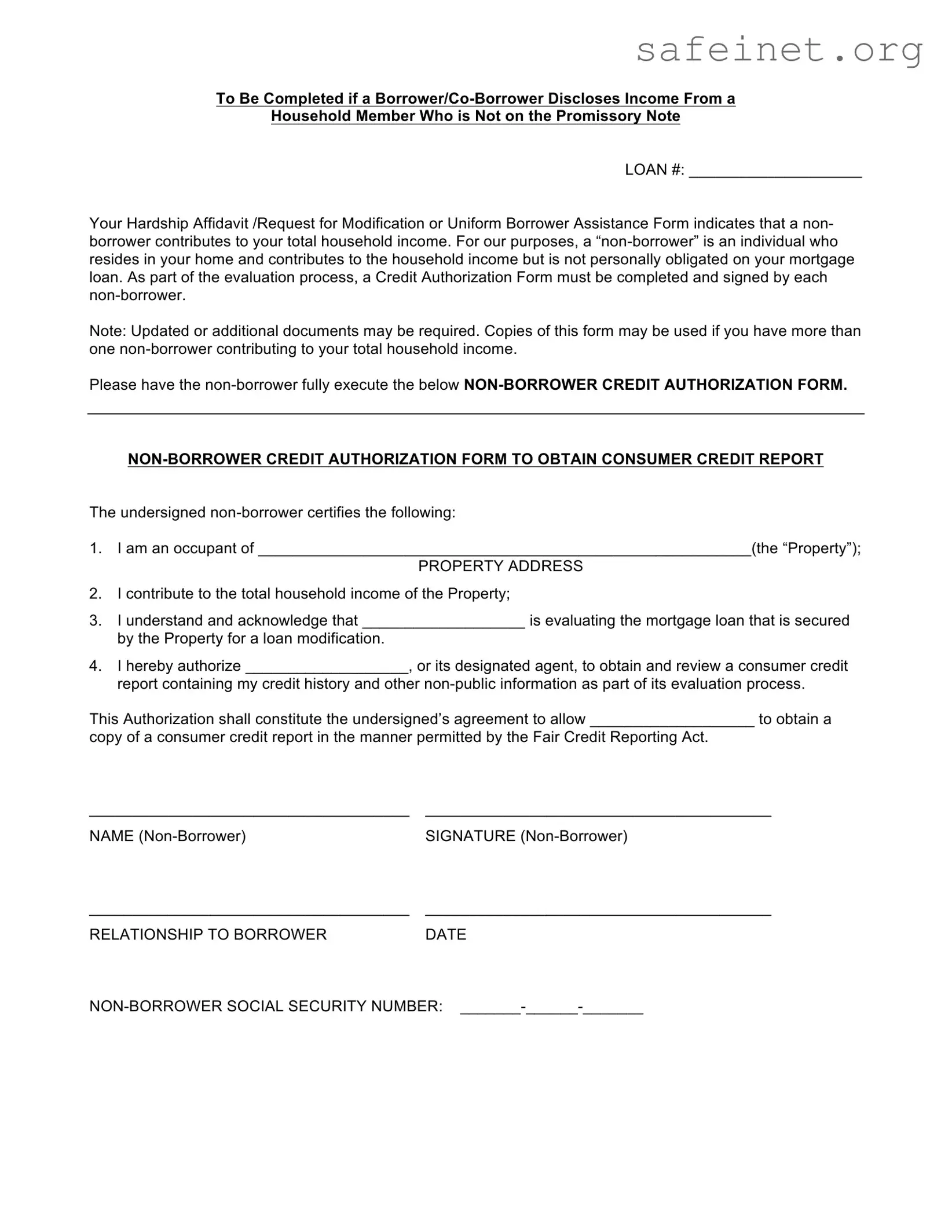
The Non Borrower Credit Authorization form plays a crucial role in the mortgage modification process for borrowers who rely on additional household income from individuals not listed on the promissory note. When a borrower or co-borrower discloses that a non-borrower contributes to their total household income, this form must be completed. A non-borrower is someone who lives in the home and supports the household financially but does not have any legal obligation on the mortgage loan. Each non-borrower must fill out and sign this form as part of the evaluation process for loan modifications. This ensures that all relevant income sources are considered when assessing eligibility for assistance. If there are multiple non-borrowers, copies of the form can be used to gather the necessary information. The form requires the non-borrower to certify their occupancy, acknowledge the purpose of the evaluation, and authorize the lender to access their credit report. This step is essential for a thorough review and helps streamline the process for those seeking modifications.

To Be Completed if a
Household Member Who is Not on the Promissory Note
LOAN #: ____________________
Your Hardship Affidavit /Request for Modification or Uniform Borrower Assistance Form indicates that a non- borrower contributes to your total household income. For our purposes, a
Note: Updated or additional documents may be required. Copies of this form may be used if you have more than one
Please have the
The undersigned
1.I am an occupant of _________________________________________________________(the “Property”);
PROPERTY ADDRESS
2.I contribute to the total household income of the Property;
3.I understand and acknowledge that ___________________ is evaluating the mortgage loan that is secured by the Property for a loan modification.
4.I hereby authorize ___________________, or its designated agent, to obtain and review a consumer credit report containing my credit history and other
This Authorization shall constitute the undersigned’s agreement to allow ___________________ to obtain a
copy of a consumer credit report in the manner permitted by the Fair Credit Reporting Act.
_____________________________________ |
________________________________________ |
NAME |
SIGNATURE |
_____________________________________ |
________________________________________ |
RELATIONSHIP TO BORROWER |
DATE |
| Fact Name | Description |
|---|---|
| Purpose | The Non-Borrower Credit Authorization form is used to evaluate the creditworthiness of a non-borrower who contributes to the household income but is not on the mortgage loan. |
| Required Signatures | Each non-borrower must sign the form to authorize the lender to obtain their consumer credit report. |
| Multiple Non-Borrowers | If there are multiple non-borrowers, copies of the form can be used for each individual contributing to the household income. |
| Governing Law | The form is subject to the Fair Credit Reporting Act, which governs the acquisition and use of consumer credit information. |
| Property Address | The form requires the specific address of the property where the non-borrower resides and contributes to the household income. |
Filling out the Non Borrower Credit Authorization form is an important step in the loan modification process. Once completed, this form will help facilitate the evaluation of your mortgage loan. Follow the steps below to ensure the form is filled out correctly.
Once the form is filled out, it should be submitted as part of the loan modification evaluation process. Ensure that all information is accurate and complete to avoid any delays.
What is the purpose of the Non Borrower Credit Authorization form?
The Non Borrower Credit Authorization form is designed to collect consent from individuals who contribute to a household's income but are not listed on the mortgage loan. This form allows the lender to obtain a consumer credit report for these non-borrowers. It is a crucial step in the evaluation process for loan modifications, ensuring that all relevant income sources are considered.
Who qualifies as a non-borrower?
A non-borrower is defined as an individual who resides in the same home as the borrower and contributes to the household income but is not legally obligated on the mortgage loan. This could include family members, roommates, or others living in the household who help with financial responsibilities.
What information is required from the non-borrower on the form?
The form requires the non-borrower to provide their name, signature, relationship to the borrower, and Social Security number. Additionally, the non-borrower must acknowledge their contribution to the household income and authorize the lender to access their credit report as part of the loan modification evaluation.
Can the Non Borrower Credit Authorization form be used for multiple non-borrowers?
Yes, if there are multiple non-borrowers contributing to the household income, copies of the Non Borrower Credit Authorization form can be utilized. Each non-borrower must complete and sign their own form to provide the necessary authorization for the lender to obtain their credit information.
What happens after the Non Borrower Credit Authorization form is submitted?
Once the form is completed and submitted, the lender will review the information provided. They will obtain the consumer credit reports for the non-borrowers to assess the overall financial situation of the household. This evaluation is part of the process for determining eligibility for a loan modification.
Are there any additional documents required along with the Non Borrower Credit Authorization form?
In some cases, updated or additional documents may be necessary to complete the evaluation process. The lender may request further documentation to support the income claims made by the non-borrowers or to verify other financial information relevant to the loan modification request.
Incomplete Property Address: Failing to provide the full address of the property can delay the processing of the application.
Missing Signatures: Both the non-borrower and the borrower must sign the form. Omitting one can render the form invalid.
Incorrect Social Security Number: Providing an incorrect Social Security number can lead to issues when obtaining the credit report.
Not Specifying the Relationship: It’s important to clearly state the relationship to the borrower. Leaving this blank can cause confusion.
Not Understanding the Authorization: Non-borrowers should read and understand what they are authorizing before signing. Ignorance can lead to unexpected consequences.
Using an Outdated Form: Always ensure that you are using the most current version of the form. Using an outdated version can lead to compliance issues.
Providing Inaccurate Income Information: Misrepresenting income contributions can affect the evaluation process and may result in denial.
Not Including Additional Non-Borrowers: If there are multiple non-borrowers, each must fill out a separate form. Neglecting this can complicate the application.
Failing to Follow Up: After submitting the form, it’s crucial to follow up to ensure it has been received and processed correctly.
The Non Borrower Credit Authorization form is an essential document used when a household member, who is not a borrower on the mortgage, contributes to the total household income. This form allows lenders to obtain the necessary credit information from non-borrowers, which is crucial for evaluating loan modifications. Alongside this form, several other documents are often required to complete the loan modification process.
Each of these documents plays a significant role in the loan modification process. Collectively, they provide a comprehensive view of the financial situation, helping lenders make informed decisions regarding modifications. Ensuring that all required forms are completed accurately can facilitate a smoother evaluation process.
The Non-Borrower Credit Authorization form shares similarities with the Authorization to Release Information form. Both documents require the signature of an individual who is not financially obligated on a loan but whose financial information may be relevant to the loan application process. The Authorization to Release Information form allows a lender to obtain necessary data from third parties, such as employers or financial institutions, to assess the borrower's financial situation. Like the Non-Borrower Credit Authorization, it emphasizes the importance of consent and confidentiality in handling personal information.
Another related document is the Borrower’s Authorization for Credit Report form. This form is used by borrowers to give permission for lenders to access their credit reports. It includes similar elements, such as the borrower's acknowledgment of the evaluation process and the implications of granting access to their credit history. Both forms serve the purpose of ensuring that the lender can make informed decisions based on the financial standing of all individuals involved in the household.
The Non-Borrower Credit Authorization is also comparable to the Co-Borrower Credit Authorization form. This document is specifically designed for individuals who are co-borrowers on a mortgage loan. It requires the co-borrower to authorize the lender to access their credit report, just as the Non-Borrower Credit Authorization does for non-borrowers. The key distinction lies in the financial obligation; co-borrowers are legally responsible for the loan, while non-borrowers are not.
Additionally, the Non-Borrower Credit Authorization form resembles the Household Income Verification form. This document is used to verify the total income of all household members, including non-borrowers. It requires individuals to disclose their income sources and amounts, similar to how the Non-Borrower Credit Authorization collects information about the non-borrower’s contribution to household income. Both forms are essential for lenders to evaluate the financial stability of the household.
Lastly, the Employment Verification form is another document that aligns with the Non-Borrower Credit Authorization. This form is used to confirm an individual's employment status and income, which may be necessary for assessing the financial qualifications of all household members. While the Non-Borrower Credit Authorization focuses on credit history, the Employment Verification form provides a snapshot of current employment and income, both of which are vital for the loan evaluation process.
When filling out the Non Borrower Credit Authorization form, it is essential to follow specific guidelines to ensure accuracy and compliance. Here are five things you should and shouldn't do:
Here are seven common misconceptions about the Non Borrower Credit Authorization form:
Here are some key takeaways about filling out and using the Non Borrower Credit Authorization form: