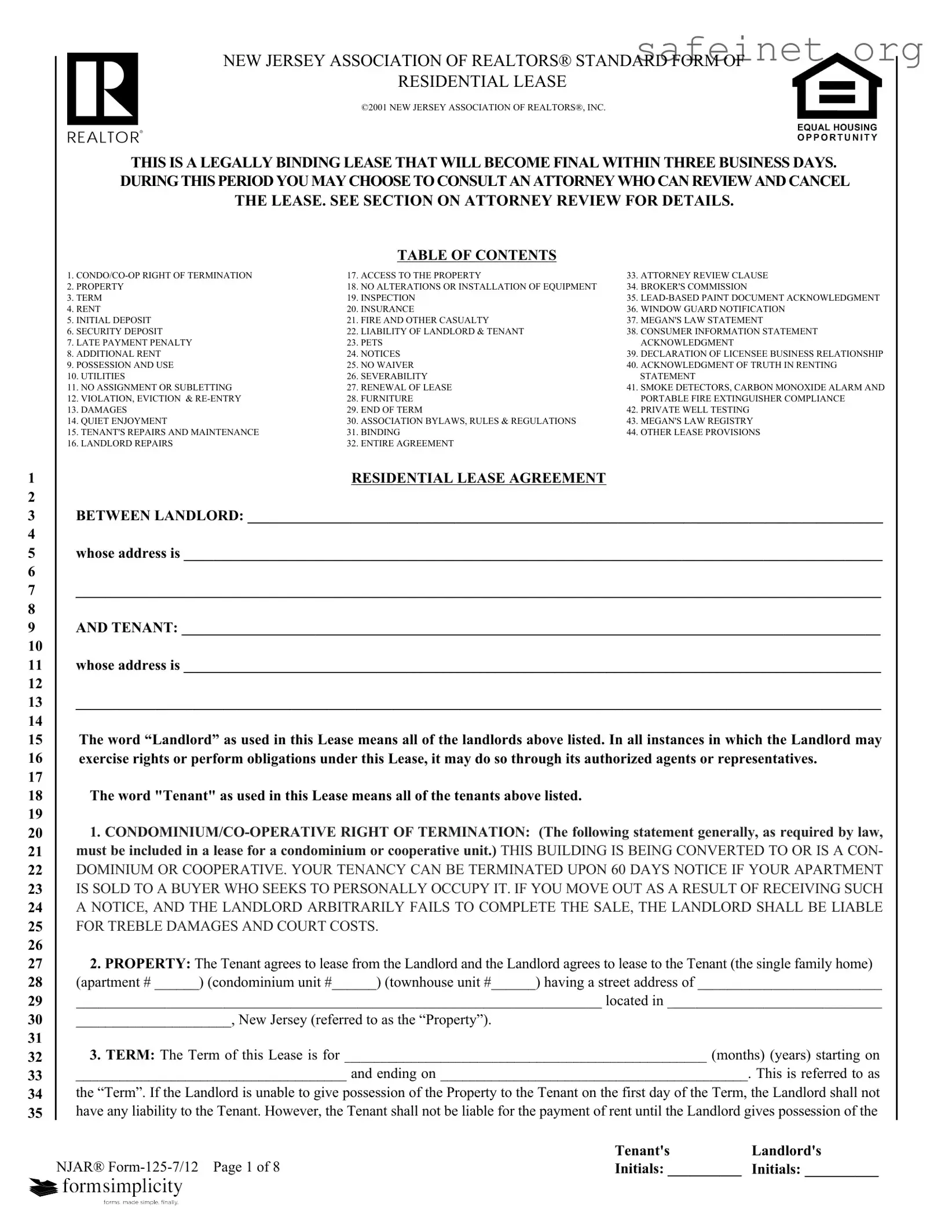
The NJAR 125 7 12 form serves as a comprehensive framework for residential leases in New Jersey, outlining the rights and responsibilities of both landlords and tenants. This legally binding document becomes effective within three business days unless an attorney reviews and disapproves it. The form includes essential sections that address various aspects of the leasing arrangement, such as the property being leased, the duration of the lease term, and the agreed-upon rent. It also details important financial components, including initial deposits and security deposits, which are designed to protect both parties' interests. Furthermore, the form encompasses stipulations regarding utilities, maintenance responsibilities, and conditions for alterations to the property. Notably, it includes provisions for attorney review, ensuring that both parties have the opportunity to seek legal counsel before finalizing the agreement. Additionally, the form outlines protocols for handling issues such as late payments, eviction processes, and the renewal of the lease, thereby providing a clear guide for navigating potential disputes. By addressing these critical elements, the NJAR 125 7 12 form not only facilitates a smoother leasing experience but also promotes transparency and understanding between landlords and tenants.
1
2
3
4
5
6
7
8
9
10
11
12
13
14
15
16
17
18
19
20
21
22
23
24
25
26
27
28
29
30
31
32
33
34
35
NEW JERSEY ASSOCIATION OF REALTORS® STANDARD FORM OF
RESIDENTIAL LEASE
©2001 NEW JERSEY ASSOCIATION OF REALTORS®, INC.
THIS IS A LEGALLY BINDING LEASE THAT WILL BECOME FINAL WITHIN THREE BUSINESS DAYS. DURING THIS PERIOD YOU MAY CHOOSE TO CONSULT AN ATTORNEY WHO CAN REVIEW AND CANCEL THE LEASE. SEE SECTION ON ATTORNEY REVIEW FOR DETAILS.
TABLE OF CONTENTS
1. |
17. ACCESS TO THE PROPERTY |
33. ATTORNEY REVIEW CLAUSE |
2. PROPERTY |
18. NO ALTERATIONS OR INSTALLATION OF EQUIPMENT |
34. BROKER'S COMMISSION |
3. TERM |
19. INSPECTION |
35. |
4. RENT |
20. INSURANCE |
36. WINDOW GUARD NOTIFICATION |
5. INITIAL DEPOSIT |
21. FIRE AND OTHER CASUALTY |
37. MEGAN'S LAW STATEMENT |
6. SECURITY DEPOSIT |
22. LIABILITY OF LANDLORD & TENANT |
38. CONSUMER INFORMATION STATEMENT |
7. LATE PAYMENT PENALTY |
23. PETS |
ACKNOWLEDGMENT |
8. ADDITIONAL RENT |
24. NOTICES |
39. DECLARATION OF LICENSEE BUSINESS RELATIONSHIP |
9. POSSESSION AND USE |
25. NO WAIVER |
40. ACKNOWLEDGMENT OF TRUTH IN RENTING |
10. UTILITIES |
26. SEVERABILITY |
STATEMENT |
11. NO ASSIGNMENT OR SUBLETTING |
27. RENEWAL OF LEASE |
41. SMOKE DETECTORS, CARBON MONOXIDE ALARM AND |
12. VIOLATION, EVICTION & |
28. FURNITURE |
PORTABLE FIRE EXTINGUISHER COMPLIANCE |
13. DAMAGES |
29. END OF TERM |
42. PRIVATE WELL TESTING |
14. QUIET ENJOYMENT |
30. ASSOCIATION BYLAWS, RULES & REGULATIONS |
43. MEGAN'S LAW REGISTRY |
15. TENANT'S REPAIRS AND MAINTENANCE |
31. BINDING |
44. OTHER LEASE PROVISIONS |
16. LANDLORD REPAIRS |
32. ENTIRE AGREEMENT |
|
|
RESIDENTIAL LEASE AGREEMENT |
|
BETWEEN LANDLORD: ______________________________________________________________________________________
whose address is ______________________________________________________________________________________________
_____________________________________________________________________________________________________________
AND TENANT: ______________________________________________________________________________________________
whose address is ______________________________________________________________________________________________
_____________________________________________________________________________________________________________
The word “Landlord” as used in this Lease means all of the landlords above listed. In all instances in which the Landlord may exercise rights or perform obligations under this Lease, it may do so through its authorized agents or representatives.
The word "Tenant" as used in this Lease means all of the tenants above listed.
1.
DOMINIUM OR COOPERATIVE. YOUR TENANCY CAN BE TERMINATED UPON 60 DAYS NOTICE IF YOUR APARTMENT IS SOLD TO A BUYER WHO SEEKS TO PERSONALLY OCCUPY IT. IF YOU MOVE OUT AS A RESULT OF RECEIVING SUCH A NOTICE, AND THE LANDLORD ARBITRARILY FAILS TO COMPLETE THE SALE, THE LANDLORD SHALL BE LIABLE FOR TREBLE DAMAGES AND COURT COSTS.
2.PROPERTY: The Tenant agrees to lease from the Landlord and the Landlord agrees to lease to the Tenant (the single family home) (apartment # ______) (condominium unit #______) (townhouse unit #______) having a street address of _________________________
_______________________________________________________________________ located in _____________________________
_____________________, New Jersey (referred to as the “Property”).
3.TERM: The Term of this Lease is for _________________________________________________ (months) (years) starting on
_____________________________________ and ending on __________________________________________. This is referred to as the “Term”. If the Landlord is unable to give possession of the Property to the Tenant on the first day of the Term, the Landlord shall not have any liability to the Tenant. However, the Tenant shall not be liable for the payment of rent until the Landlord gives possession of the
|
Tenant's |
Landlord's |
NJAR® |
Initials: __________ |
Initials: __________ |

36
37
38
39
40
41
42
43
44
45
46
47
48
49
50
51
52
53
54
55
56
57
58
59
60
61
62
63
64
65
66
67
68
69
70
71
72
73
74
75
76
77
78
79
80
81
82
83
84
85
86
87
88
89
90
91
92
Property to the Tenant. If the Landlord fails to give possession of the Property within 30 days of the start date set forth above, then the Tenant may terminate this Lease by giving notice to Landlord. If the first day of the Term is delayed, then the last day of the Term shall be adjusted accordingly, so that the Term remains for the number of months or years above stated.
4.RENT: The rent for the Term of this Lease is $ ________________, to be paid as follows: $______________ per month, which is due on the ___________________________ day of each month. Rent shall be payable to: ____________________________________
____________________________________________________________________________________________________________.
(NAME AND ADDRESS)
5. INITIAL DEPOSIT: Tenant has paid an initial deposit of $ ________________ received on ____________________ that will
be credited towards ____________ the first month's rent or ____________ the Security Deposit. The balance shall be paid as fol-
lows: First month's rent $__________________ Due on _______________________________________________, Security Deposit
$_______________________ Due on ________________________________________________________.
6. SECURITY DEPOSIT: Tenant shall pay to the Landlord the sum of $ _____________ (the “Security Deposit” which cannot
exceed one and
The Landlord may deduct from the Security Deposit any costs resulting from the Tenant's failure to comply with any of the terms of this Lease. If the Landlord makes any such deductions, then upon demand, the Tenant shall promptly restore the Security Deposit to its original amount. The Security Deposit may not be used by the Tenant for the payment of rent without the written consent of the Landlord.
The Landlord shall inspect the Property after the Tenant vacates at the end of the Term. Within 30 days of the termination of this Lease, the Landlord shall return the Security Deposit plus the undistributed interest to the Tenant, less any charges expended by the Landlord for damages to the Property resulting from the Tenant's occupancy. The interest and deductions shall be itemized in a statement by the Landlord, and shall be forwarded to the Tenant with the balance of the Security Deposit by personal delivery, registered or certified mail.
If the Landlord sells or transfers the Property during the Term of this Lease, the Landlord will transfer the Security Deposit plus the undistributed interest to the new owner. Landlord shall notify the Tenant of the sale and transfer, as well as the name and address of the new owner. The notice shall be given by registered or certified mail within five days after conveyance of title. After acquisition of the Property, the new owner shall have all responsibility regarding the Security Deposit, and the Landlord shall have no further responsibility.
7. LATE PAYMENT PENALTY: If the Tenant does not pay the rent by the ___________ day of the month, the Tenant shall pay a
late charge of _____________ until the rent is received by Landlord. The late charge shall be added to the rent, and shall be considered as
additional rent, which is defined in Section 8. In the event any rent check is returned unpaid due to insufficient funds, the Tenant agrees to pay the Landlord a $__________________ processing charge. In such event, the Landlord reserves the right to demand that future rent
payments be made in cash, bank or certified check.
8. ADDITIONAL RENT: Landlord may perform any obligations under this Lease which are Tenant's responsibility and which Tenant fails to perform. The cost to Landlord for such performance may be charged to TENANT as "additional rent" which shall be due and payable with the next installment of monthly rent. The additional rent may include reasonable attorney's fees incurred by Landlord because of Tenant's failure to perform under this Lease. Landlord has the same rights against Tenant for failure to pay additional rent as Landlord has for Tenant's failure to pay monthly rent. This means that the Landlord may evict Tenant for failure to pay additional rent.
9. POSSESSION AND USE: The Landlord shall give possession of the Property to the Tenant for the Term of this Lease except as otherwise provided in this Lease. The Tenant shall occupy the Property only as a private residence, and will not use the Property for any business, trade or profession. The Tenant shall not store any flammable, dangerous or hazardous materials at the Property, other than ordinary household cleaning materials. The Property shall not be allowed to be vacant for any extended period of time.
10. UTILITIES: The Tenant shall arrange to have the utilities transferred into Tenant's name prior to occupancy, and shall be respon-
sible for paying the following utility services: |
Gas |
Electric |
Water |
Heat |
Sewer |
General Trash Disposal |
|||
(Other) ___________________________________________________________________. |
|
|
|
||||||
The Landlord shall provide and pay for the following utility services: |
Gas |
Electric |
Water |
Heat |
Sewer |
||||
|
|
|
|
|
|
Tenant's |
|
Landlord's |
|
NJAR® |
|
|
|
|
|
Initials: __________ |
Initials: __________ |
||

93
94
95
96
97
98
99
100
101
102
103
104
105
106
107
108
109
110
111
112
113
114
115
116
117
118
119
120
121
122
123
124
125
126
127
128
129
130
131
132
133
134
135
136
137
138
139
140
141
142
143
144
145
146
147
148
149
150
General Trash Disposal |
(Other) ______________________________________________________________. The Tenant agrees |
not to waste or unreasonably use any utility or appliance that is provided by the Landlord. Landlord shall not be responsible for any dam- age or loss caused to Tenant or Tenant's property because of an interruption in utility services over which Landlord has no reasonable means of control. Any such interruption shall not be grounds for Tenant to reduce or stop paying rent.
11.NO ASSIGNMENT OR SUBLETTING: The Tenant may not assign this Lease, sublet all or any part of the Property, or permit any other person to use the Property without the prior written permission of the Landlord. The Landlord may withhold such permission in Landlord's sole and absolute discretion.
12.VIOLATION, EVICTION AND
13.DAMAGES: The Tenant is liable for all Landlord's damages caused by Tenant's breach of this Lease. Such damages may include loss of rent, the cost of preparing the Property for
14.QUIET ENJOYMENT: The Tenant may occupy the Property without interference, subject to Tenant's compliance with the Terms of this Lease.
15.TENANT'S REPAIRS AND MAINTENANCE: The Tenant shall:
(a)Pay for all repairs, replacements and damages caused by the act or neglect of the Tenant, the Tenant's family, domestic employees, guests or visitors, which includes but is not limited to sewer and plumbing drainage problems caused by the Tenant.
(b)Keep and maintain the Property in a neat, clean, safe and sanitary condition.
(c)Cut the grass and maintain the shrubbery.
(d)Drive and park vehicles only in designated areas, if any.
(e)Take good care of the Property and all equipment, fixtures, carpeting and appliances located in it.
(f)Keep the furnace clean, and regularly change the furnace filters, if applicable.
(g)Keep nothing in the Property which is flammable, dangerous or which might increase the danger of fire or other casualty.
(h)Promptly notify the Landlord of any condition which requires repairs to be done.
(i)Use the electric, plumbing and other systems and facilities in a safe manner.
(j)Promptly remove all garbage and recyclables from the Property and place it at the curb (or other designated area) in the proper containers in accordance with the prescribed
(k)Not engage in any activity which may cause a cancellation or an increase in the cost of the Landlord's insurance coverages.
(l)Use no more electricity than the receptacles, wiring or feeders to the Property can safely carry.
(m)Obey all instructions, written or otherwise, of the Landlord for the care and use of appliances, equipment and other personal prop- erty.
(n)Do nothing to destroy, deface or damage any part of the Property.
(o)Promptly comply with all orders and rules of the Board of Health or any other governmental authority which are directed to the Tenant.
(p)Do nothing which interferes with the use and enjoyment of neighboring properties.
(q)Do nothing to cause any damage to any trees or landscaping on the Property.
(r)Keep the walks and driveway free from dirt, debris, snow, ice and any hazardous objects.
(s)Comply with such rules and regulations that may be published from time to time by the Landlord.
16.LANDLORD REPAIRS: The Landlord shall make any necessary repairs and replacements to the vital facilities serving the Property, such as the heating, plumbing and electrical systems, within a reasonable time after notice by the Tenant. The Tenant may be liable for the cost of such repairs and replacements pursuant to Section 15. The Landlord shall not be liable for interruption of services or inconvenience resulting from delays in making repairs or replacements if due to circumstances beyond Landlord's reasonable control.
17.ACCESS TO THE PROPERTY: The Landlord shall have access to the Property on reasonable notice to the Tenant in order to
(a)inspect the interior and exterior of the Property, (b) make necessary repairs, alterations, or improvements, (c) supply services, and (d) show it to prospective buyers, appraisers, contractors or insurers. The Landlord may enter the Property without prior notice in the event of an emergency or if the Tenant is not home for more than seven consecutive days. If this Lease is not renewed as per Section 27 of this Lease Agreement, Landlord shall then be allowed access to the Property at any time prior to the end of the Term for showing of Property to prospective tenants.
NJAR® |
Tenant's |
Landlord's |
|
|
|
|
Initials: __________ |
Initials: __________ |

151
152
153
154
155
156
157
158
159
160
161
162
163
164
165
166
167
168
169
170
171
172
173
174
175
176
177
178
179
180
181
182
183
184
185
186
187
188
189
190
191
192
193
194
195
196
197
198
199
200
201
202
203
204
205
206
18.NO ALTERATIONS OR INSTALLATION OF EQUIPMENT: The Tenant may not alter or change the Property without first obtaining Landlord's written consent. By way of example, the Tenant may not:
(a)Install any improvement such as carpeting, paneling, floor tiles, or any other improvement which is nailed or tacked down, cemented or glued in;
(b)Install any locks or chain guards;
(c)Wallpaper, affix wall coverings or other permanent type decorations;
(d)Install or change the electrical, plumbing, heating or air cooling system.
When painting (whether interior or exterior), the Tenant must have the Landlord's permission regarding paint colors. All painting must be done in a professional and workmanlike manner. The Tenant shall repair all walls and ceilings which had pictures or fixtures attached, prior to vacating. Any and all changes, additions or improvements made without the Landlord's written consent shall be removed by the Tenant on demand by the Landlord. The Property shall be in substantially the same condition at the end of the Term as it was at the begin- ning of the Term, reasonable wear and tear excepted.
All permitted changes, additions and improvements shall become the property of the Landlord when completed, shall be fully paid for by the Tenant, and shall remain as part of the Property at the end of the Term of this Lease, unless the Landlord demands that the Tenant remove them. The Tenant shall not allow any construction lien or other claim to be filed against the Property. If any such lien or claim is filed against the Property, the Tenant shall have it promptly removed.
19.INSPECTION: If the municipality requires a continued use inspection or certificate of occupancy prior to occupancy, the Land- lord shall be responsible for obtaining such inspections and certificates as well as making the necessary repairs.
20.INSURANCE: The Tenant shall be responsible for obtaining, at Tenant's own cost and expense, a tenant's insurance policy for the Tenant's furniture, furnishings, clothing and other personal property. The Tenant's personal property shall not be the responsibility of the Landlord, and will not be insured by the Landlord. The Tenant's insurance policy must also include liability coverage. Upon request, the Tenant shall periodically furnish Landlord with evidence of Tenant's insurance policy.
21.FIRE AND OTHER CASUALTY: Immediate notice shall be given by the Tenant to Landlord of any fire or other casualty which occurs at the Property. If the Property is uninhabitable, Tenant's obligation to pay rent shall cease until the time that the Property is re- stored by the Landlord. If only a part of the Property is uninhabitable, then the rent shall be adjusted proportionately.
If only part of the Property is damaged, the Landlord shall repair the Property within a reasonable period of time. Landlord shall not be obligated to repair or restore any improvements that Tenant has made to the Property.
Either party may cancel this Lease if the Property is so damaged by fire or other casualty that the property cannot be repaired within 90 days. The Landlord's determination in such regard shall be final, conclusive and binding on both parties.
The Lease shall end if the Property is totally destroyed. The Tenant shall pay rent to the date of destruction.
If the fire or other casualty is caused by the act or neglect of the Tenant, the Tenant's family, domestic employees, guests or visitors, the Tenant shall pay for all repairs and other damages.
22.LIABILITY OF LANDLORD AND TENANT: The Landlord is not legally responsible for any loss, injury or damage to any person or property unless such loss, injury or damage is directly caused by the Landlord's negligence. The Tenant is legally responsible for loss, injury or damage to any person or property caused by the negligence of the Tenant, the Tenant's family members, domestic em- ployees, guests or visitors.
23.PETS: No dogs, cats or other pets shall be permitted on the Property without the prior written consent of the Landlord, which the Landlord may withhold in the Landlord's sole and absolute discretion.
24.NOTICES: All notices given under this Lease must be in writing in order to be effective. Delivery of notices may not be refused. If any notice is refused, it shall be considered to have been effectively given. Notices shall be given by (a) personal delivery, or (b) certified mail, return receipt requested, unless applicable law requires a different means of notice. Notices to the Landlord shall be at the address on the first page of this Lease, and to the Tenant at the Property.
25.NO WAIVER: The Landlord's failure to enforce any obligation of the Tenant contained in this Lease in any one instance shall not prevent the Landlord from enforcing the obligation at a later time.
26.SEVERABILITY: If any term or condition of this Lease is contrary to law, the remainder of the Lease shall be unaffected and shall continue to be binding upon the parties.
NJAR® |
Tenant's |
Landlord's |
|
|
|
|
Initials: __________ |
Initials: __________ |

207
208
209
210
211
212
213
214
215
216
217
218
219
220
221
222
223
224
225
226
227
228
229
230
231
232
233
234
235
236
237
238
239
240
241
242
243
244
245
246
247
248
249
250
251
252
253
254
255
256
257
258
259
260
261
262
27.RENEWAL OF LEASE: The Tenant must be offered a renewal of this Lease by the Landlord, unless the Landlord has good cause not to do so under applicable law. Reasonable changes may be included in the renewal Lease. Not less than ___________ days before the expiration of the Term of this Lease, the Landlord shall notify the Tenant of the proposed terms for the renewal Lease. Within
___________ days after the Tenant receives the Landlord's renewal notice, Tenant shall notify Landlord whether Tenant accepts or rejects the proposed renewal Lease. If the Tenant does not notify the Landlord of Tenant's acceptance, then the Landlord's proposal shall be con- sidered to have been rejected. If the Tenant does not accept the renewal Lease, the Tenant must vacate the Property at the end of the Term.
28.FURNITURE: If the Property is leased in furnished condition, or if the Landlord leaves personal property to be used by the Ten- ant, the Tenant shall maintain the furniture and furnishings in good condition and repair. A list of such items shall be attached to this Lease and signed by the Landlord and the Tenant.
29.END OF TERM: At the end of the Term, the Tenant shall (a) leave the Property clean, (b) remove all of the Tenant's property,
(c)repair any damage including that caused by moving, (d) make arrangements for final utility readings and pay all final utility bills and
(e)vacate the Property and return it with all keys to the Landlord in the same condition as it was at the beginning of the Term, except for normal wear and tear.
30.ASSOCIATION BYLAWS, RULES AND REGULATIONS: If Property is subject to any Association Bylaws
and Rules and Regulations, Tenant agrees to comply with such Association Bylaws and Rules and Regulations including any amendments.
31.BINDING: This Lease is binding on the Landlord and the Tenant and all parties who lawfully succeed to their rights and respon- sibilities.
32.ENTIRE AGREEMENT: This Lease contains the entire agreement of the Landlord and Tenant. No representations have been made by the Landlord or its real estate broker or agents except as set forth in this Lease. This Lease can only be changed in writing by an agreement signed by both the Landlord and the Tenant.
33.ATTORNEY REVIEW CLAUSE:
(1) Study by Attorney.
The Tenant or the Landlord may choose to have an attorney study this Lease. If an attorney is consulted, the attorney must complete his or her review of the Lease within a
(2) Counting the Time.
You count the three days from the date of delivery of the signed Lease to the Tenant and the Landlord. You do not count Saturdays, Sundays or legal holidays. The Tenant and the Landlord may agree in writing to extend the
(3) Notice of Disapproval.
If an attorney for the Tenant or the Landlord reviews and disapproves of this Lease, the attorney must notify the Broker(s) and the other party named in this Lease within the
34.BROKER'S COMMISSION: The Broker's Commission is earned, due and payable upon signing of a fully executed Lease Agreement and satisfaction of the Attorney Review Period set forth in Section 33 of this Lease. The Commission shall be paid by the
Landlord in accord with previously executed Listing Agreement.
Tenant and shall be payable as follows: ________________________________________________________________________
___________________________________________________________________________________________________________
__________________________________________________________________________________________________________
Listing Broker
_______________________________________________________________ |
______________________________________ |
Address |
Telephone # |
NJAR® |
Tenant's |
Landlord's |
|
|
|
|
Initials: __________ |
Initials: __________ |
263
264
265
266
267
268
269
270
271
272
273
274
275
276
277
278
279
280
281
282
283
284
285
286
287
288
289
290
291
292
293
294
295
296
297
298
299
300
301
302
303
304
305
306
307
308
309
310
311
312
313
314
315
316
317
318
319
320
_______________________________________________________________ |
______________________________________ |
Participating Broker |
Commission |
_______________________________________________________________ |
______________________________________ |
Address |
Telephone # |
35.
The Tenant acknowledges receipt of the EPA pamphlet, “Protect Your Family From Lead In Your Home”. Moreover, a copy of the document entitled, “Disclosure of Information on
36. WINDOW GUARD NOTIFICATION:
THE OWNER (LANDLORD) IS REQUIRED BY LAW TO PROVIDE, INSTALL AND MAINTAIN WINDOW GUARDS IN THE APARTMENT IF A CHILD OR CHILDREN 10 YEARS OF AGE OR YOUNGER IS, OR WILL BE, LIVING IN THE APARTMENT OR IS, OR WILL BE, REGULARLY PRESENT THERE FOR A SUBSTANTIAL PERIOD OF TIME IF THE TENANT GIVES THE OWNER (LANDLORD) A WRITTEN REQUEST THAT THE WINDOW GUARDS BE INSTALLED. THE OWNER (LANDLORD) IS ALSO REQUIRED, UPON THE WRITTEN REQUEST OF THE TENANT, TO PROVIDE, INSTALL AND MAINTAIN WINDOW GUARDS IN THE HALLWAYS TO WHICH PERSONS IN THE TENANT'S UNIT HAVE ACCESS WITHOUT HAVING TO GO OUT OF THE BUILDING. IF THE BUILDING IS A CONDOMINIUM, COOP- ERATIVE OR MUTUAL HOUSING BUILDING, THE OWNER (LANDLORD) OF THE APARTMENT IS RESPONSIBLE FOR INSTALLING AND MAINTAINING WINDOW GUARDS IN THE APARTMENT AND THE ASSOCIATION IS RE- SPONSIBLE FOR INSTALLING AND MAINTAINING WINDOW GUARDS IN HALLWAY WINDOWS. WINDOW GUARDS ARE ONLY REQUIRED TO BE PROVIDED IN FIRST FLOOR WINDOWS WHERE THE WINDOW SILL IS MORE THAN SIX FEET ABOVE GRADE OR THERE ARE OTHER HAZARDOUS CONDITIONS THAT MAKE INSTALLATION OF WINDOW GUARDS NECESSARY TO PROTECT THE SAFETY OF CHILDREN.
37. MEGAN'S LAW STATEMENT:
UNDER NEW JERSEY LAW, THE COUNTY PROSECUTOR DETERMINES WHETHER AND HOW TO PROVIDE NO- TICE OF THE PRESENCE OF CONVICTED SEX OFFENDERS IN AN AREA. IN THEIR PROFESSIONAL CAPACITY, REAL ESTATE LICENSEES ARE NOT ENTITLED TO NOTIFICATION BY THE COUNTY PROSECUTOR UNDER ME- GAN'S LAW AND ARE UNABLE TO OBTAIN SUCH INFORMATION FOR YOU. UPON CLOSING, THE COUNTY PROS- ECUTOR MAY BE CONTACTED FOR SUCH FURTHER INFORMATION AS MAY BE DISCLOSABLE TO YOU.
38.CONSUMER INFORMATION STATEMENT ACKNOWLEDGMENT: By signing below, the Landlord and Tenant acknowl- edge they received the Consumer Information Statement on New Jersey Real Estate Relationships from the brokerage firms involved in this transaction prior to the first showing of the Property.
39.DECLARATION OF LICENSEE BUSINESS RELATIONSHIP(S):
A. ________________________________________________________________________________________, (name of firm)
AND _________________________________________________________________________________ (name(s) of licensee(s))
AS ITS AUTHORIZED REPRESENTATIVE(S) ARE WORKING IN THIS TRANSACTION AS (choose one)
LANDLORD'S AGENTS TENANT'S AGENTS DISCLOSED DUAL AGENTS TRANSACTION BROKERS.
B. INFORMATION SUPPLIED BY _________________________________________________________(name of other firm)
HAS INDICATED THAT IT IS OPERATING IN THIS TRANSACTION AS A (choose one)
LANDLORD'S AGENT ONLY TENANT'S AGENT ONLY DISCLOSED DUAL AGENT TRANSACTION BROKER.
40.ACKNOWLEDGMENT OF TRUTH IN RENTING STATEMENT: (Applies to all Tenants with a rental term of at least one month living in residences with more than two dwelling units or more than three if the Landlord occupies one.) By signing below, Tenant acknowledges receipt of the booklet, “Truth In Renting - A guide to the rights and responsibilities of residential tenants and landlords in New Jersey”.
41.SMOKE DETECTORS, CARBON MONOXIDE ALARM AND PORTABLE FIRE EXTINGUISHER COMPLIANCE: The Certificate of smoke detectors, carbon monoxide alarm and portable fire extinguisher compliance (CSDCMAPFEC), as required by law, shall be the responsibility of the Landlord. If such alarms are battery operated, the Tenant shall be responsible for their maintenance.
42.PRIVATE WELL TESTING: (This section is applicable if the Property's potable water supply is provided by a private well for which testing of the water is not required by any State law other than the Private Well Testing Act (the “Act” - N.J.S.A.
NJAR® |
Tenant's |
Landlord's |
|
|
|
|
Initials: __________ |
Initials: __________ |

321
322
323
324
325
326
327
328
329
330
331
332
333
334
335
336
337
338
339
340
341
342
343
344
345
346
347
348
349
350
351
352
353
354
355
356
357
358
359
360
361
362
363
364
365
366
367
368
369
370
371
372
373
374
375
376
377
supply for the Property in accordance with the Act. Within thirty (30) days after receiving the test results, the Landlord shall provide a written copy thereof to the Tenant. Also, the Landlord is required to provide a written copy of the most recent test results to any new tenant at the Property. If the Property is for “seasonal use or rental,” the Landlord shall either post the tests results in a readily visible location inside of the Property or provide a written copy thereof to the tenant. A “seasonal use or rental” means use or rental for a term of not more than 125 consecutive days for residential purposes by a person having a permanent place of residence elsewhere. By signing below, Tenant acknowledges receipt of a written copy of the test results, or in the case of a seasonal rental, if it has not received the test results, acknowledges the posting thereof inside of the Property in accordance with the Act.
43.MEGAN'S LAW REGISTRY: Buyer is notified that New Jersey law establishes an Internet Registry of Sex Offenders that may be accessed at www.njsp.org.
44.OTHER LEASE PROVISIONS, IF ANY:
NJAR® |
Tenant's |
Landlord's |
|
Initials: __________ |
Initials: __________ |

378
379
380
381
382
383
384
385
386
387
388
389
390
391
392
393
394
395
396
397
398
WITNESS: |
|
|
_____________________________________________ |
_____________________________________________ |
________________ |
|
Landlord |
Date |
_____________________________________________ |
_____________________________________________ |
________________ |
|
Landlord |
Date |
|
_____________________________________________ |
________________ |
|
Tenant |
Date |
|
_____________________________________________ |
________________ |
|
Tenant |
Date |
NJAR® |
Tenant's |
Landlord's |
|
Initials: __________ |
Initials: __________ |

THIS PAGE SHOULD BE KEPT SEPARATE FROM THE LEASE
VERIFICATION OF VERBAL WINDOW GUARD NOTIFICATION
This will verify that the below window guard notification was provided verbally at the time of lease signing to the undersigned tenant by the owner, lessor, agent, or other person who manages or controls the unit (“owner/representative”) and that the tenant was made aware of his/her right to request installation of window guards and understands this notification.
WINDOW GUARD NOTIFICATION:
THE OWNER (LANDLORD) IS REQUIRED BY LAW TO PROVIDE, INSTALL AND MAINTAIN WINDOW GUARDS IN THE APARTMENT IF A CHILD OR CHILDREN 10 YEARS OF AGE OR YOUNGER IS, OR WILL BE, LIVING IN THE APARTMENT OR IS, OR WILL BE, REGULARLY PRESENT THERE FOR A SUBSTANTIAL PERIOD OF TIME IF THE TENANT GIVES THE OWNER (LANDLORD) A WRITTEN REQUEST THAT THE WINDOW GUARDS BE INSTALLED. THE OWNER (LANDLORD) IS ALSO REQUIRED, UPON THE WRITTEN REQUEST OF THE TENANT, TO PROVIDE, INSTALL AND MAINTAIN WINDOW GUARDS IN THE HALLWAYS TO WHICH PERSONS IN THE TENANT'S UNIT HAVE ACCESS WITHOUT HAVING TO GO OUT OF THE BUILDING. IF THE BUILDING IS A CONDOMINIUM, COOPERATIVE OR MUTUAL HOUSING BUILDING, THE OWNER (LANDLORD) OF THE APARTMENT IS RESPONSIBLE FOR INSTALLING AND MAINTAINING WINDOW GUARDS IN THE APARTMENT AND THE ASSOCIATION IS RESPONSIBLE FOR INSTALLING AND MAINTAINING WINDOW GUARDS IN HALLWAY WINDOWS. WINDOW GUARDS ARE ONLY REQUIRED TO BE PROVIDED IN FIRST FLOOR WINDOWS WHERE THE WINDOW SILL IS MORE THAN SIX FEET ABOVE GRADE OR THERE ARE OTHER HAZARDOUS CONDITIONS THAT MAKE INSTALLATION OF WINDOW GUARDS NECESSARY TO PROTECT THE SAFETY OF CHILDREN.
DATED : ______________ |
___________________________________________________________________ |
|
TENANT (SIGNATURE) |
|
___________________________________________________________________ |
|
TENANT (PRINT NAME) |
DATED : ______________ |
___________________________________________________________________ |
|
TENANT (SIGNATURE) |
|
___________________________________________________________________ |
|
TENANT (PRINT NAME) |
DATED : ______________ |
___________________________________________________________________ |
|
OWNER/REPRESENTATIVE (SIGNATURE) |
|
___________________________________________________________________ |
|
OWNER/REPRESENTATIVE (PRINT NAME ) |
NJAR® Veification Verbal- 7/12 copyright ©2012, New Jersey Association of REALTORS®, INC.
| Fact Name | Details |
|---|---|
| Form Title | New Jersey Association of REALTORS® Standard Form of Residential Lease |
| Binding Nature | This lease becomes legally binding within three business days unless reviewed and canceled by an attorney. |
| Initial Deposit | The tenant must pay an initial deposit that will be credited toward the first month's rent or security deposit. |
| Security Deposit Regulations | The security deposit cannot exceed one and one-half months' rent and must comply with the Rent Security Deposit Act (N.J.S.A. 46:8-19 et seq.). |
| Late Payment Penalty | A late charge will apply if the tenant does not pay rent by a specified date each month. |
| Tenant's Responsibilities | The tenant is responsible for maintaining the property and covering repair costs due to their actions. |
| Landlord's Access | The landlord can access the property with reasonable notice for inspections, repairs, and other specified reasons. |
| Governing Law | This lease is governed by the laws of the State of New Jersey. |
Filling out the NJAR 125 7 12 form is a crucial step in establishing a legally binding lease agreement. By carefully completing this form, both landlords and tenants can ensure that their rights and responsibilities are clearly defined. Below are the steps to guide you through the process of filling out the form.
What is the Njar 125 7 12 form?
The Njar 125 7 12 form is a standard residential lease agreement used in New Jersey. This legally binding document outlines the terms and conditions under which a landlord rents a property to a tenant. It includes essential details such as the rental amount, duration of the lease, security deposit requirements, and responsibilities of both the landlord and tenant. It’s important to understand that once signed, the lease becomes effective, and both parties are expected to adhere to its terms.
What should I know about the attorney review clause?
The attorney review clause is a critical part of the Njar 125 7 12 form. It allows both the landlord and tenant to have their attorneys review the lease within three business days after signing. During this period, either party can cancel the lease if their attorney disapproves of it. This clause ensures that both parties have the opportunity to seek legal advice before the lease becomes binding. It’s important to note that weekends and holidays do not count in this three-day period.
What are my responsibilities regarding the security deposit?
Can I make changes to the property I am renting?
Making changes to the property, such as painting walls or installing new fixtures, is generally not allowed without the landlord's written consent. This rule ensures that the property remains in good condition and that any alterations are approved. If a tenant makes changes without permission, they may be required to remove those changes and restore the property to its original state before moving out. Always check with the landlord before making any modifications to avoid potential disputes.
Incomplete Information: One common mistake is failing to fill in all required fields. Each section of the form must be completed accurately, including names, addresses, and specific details about the property.
Incorrect Dates: Entering incorrect dates for the lease term can lead to confusion. It's essential to ensure that the start and end dates reflect the actual agreement between the landlord and tenant.
Misunderstanding the Security Deposit: Many tenants mistakenly believe they can use the security deposit for their last month’s rent. This is not allowed unless the landlord provides written consent.
Ignoring the Attorney Review Clause: Some individuals overlook the attorney review period. It is crucial to understand that the lease becomes binding after three business days unless reviewed by an attorney.
Failure to Specify Rent Payment Details: Not clearly stating how much rent is due and when it is payable can lead to disputes. Specify the amount and due date to avoid confusion.
Not Notifying of Changes: If there are any changes to the lease terms, such as alterations to the property, these must be documented. Failing to do so can result in misunderstandings later.
Overlooking Utility Responsibilities: Tenants often forget to clarify who is responsible for which utilities. Clearly outline which utilities the tenant must pay and which ones the landlord covers.
Neglecting to Review the Entire Lease: Some individuals do not read the entire lease thoroughly. Each section contains important information that could affect the tenant's rights and responsibilities.
The NJAR 125 7 12 form is a standard residential lease agreement used in New Jersey. Along with this form, several other documents and forms may be required or beneficial for both landlords and tenants. Below is a list of these documents, each briefly described to provide clarity on their purpose and importance.
These documents play a crucial role in maintaining clear communication and understanding between landlords and tenants. By ensuring that all necessary forms are completed and properly managed, both parties can protect their rights and responsibilities throughout the rental period.
The NJAR 125 7 12 form, a standard residential lease agreement, shares similarities with the HUD-92541 form, also known as the Residential Lease. Both documents outline the terms of tenancy, including rent, security deposits, and responsibilities of both landlords and tenants. They emphasize the importance of understanding lease terms and provide a framework for resolving disputes. Furthermore, both forms often include clauses about maintenance and repairs, ensuring that tenants understand their obligations to maintain the property.
Another document similar to the NJAR 125 7 12 is the California Residential Lease Agreement. This lease form is designed to protect both parties' rights and responsibilities in a rental situation. It includes sections on rent payment, security deposits, and termination of the lease, mirroring the structure found in the NJAR form. Additionally, both agreements typically contain provisions regarding the use of the property, ensuring tenants are aware of restrictions on business activities or alterations to the premises.
The Texas Residential Lease Agreement is another document that parallels the NJAR 125 7 12 form. It covers essential elements such as the duration of the lease, rental amount, and maintenance responsibilities. Both forms include clauses that address tenant rights, such as the right to quiet enjoyment and the landlord's obligation to maintain the property. This ensures that tenants are informed of their rights while also outlining their responsibilities during the lease term.
Similarly, the Florida Residential Lease Agreement serves a comparable purpose. It includes detailed sections on rent, security deposits, and maintenance obligations, just like the NJAR form. Both documents emphasize the need for clear communication between landlords and tenants, particularly regarding notices and the process for addressing lease violations. This helps to establish a mutual understanding of the expectations for both parties.
The Massachusetts Lease Agreement also shares key features with the NJAR 125 7 12 form. It outlines the terms of the lease, including rent, duration, and security deposits. Both agreements typically contain provisions about tenant obligations, such as maintaining the property and notifying the landlord of necessary repairs. This ensures that both parties have a clear understanding of their responsibilities and rights throughout the lease period.
Another similar document is the New York City Lease Agreement, which addresses many of the same issues found in the NJAR form. It includes sections on rent payment, security deposits, and the landlord's responsibilities for repairs. Both forms highlight the importance of written notices for any changes or violations, ensuring that tenants are aware of the processes involved in addressing issues during their tenancy.
The Virginia Residential Lease Agreement also aligns closely with the NJAR 125 7 12 form. It includes essential elements such as rent, security deposits, and maintenance obligations. Both documents emphasize the importance of tenant rights, including the right to a habitable living environment and the process for addressing grievances. This helps to create a framework for fair treatment of tenants while ensuring landlords can enforce their rights as well.
The Illinois Residential Lease Agreement is another document that mirrors the NJAR 125 7 12 form. It provides a comprehensive overview of the lease terms, including rent, duration, and security deposits. Both agreements include provisions for handling disputes and ensuring that both parties adhere to their responsibilities. This fosters a clear understanding of the expectations for both landlords and tenants throughout the lease term.
Finally, the Washington State Residential Lease Agreement shares many similarities with the NJAR 125 7 12 form. It covers essential topics such as rent, security deposits, and maintenance responsibilities. Both documents emphasize the importance of clear communication and written notices, ensuring that tenants are informed about their rights and obligations. This helps to create a transparent relationship between landlords and tenants, reducing the likelihood of disputes.
When filling out the NJAR 125 7 12 form, there are several important considerations to keep in mind. Here are five things to do and five things to avoid:
When dealing with the Njar 125 7 12 form, several misconceptions can lead to confusion for both landlords and tenants. Here are seven common misunderstandings explained:
Understanding these misconceptions can help both landlords and tenants navigate their lease agreements more effectively and avoid potential disputes.
When filling out and using the NJAR 125 7 12 form, there are several important points to keep in mind: