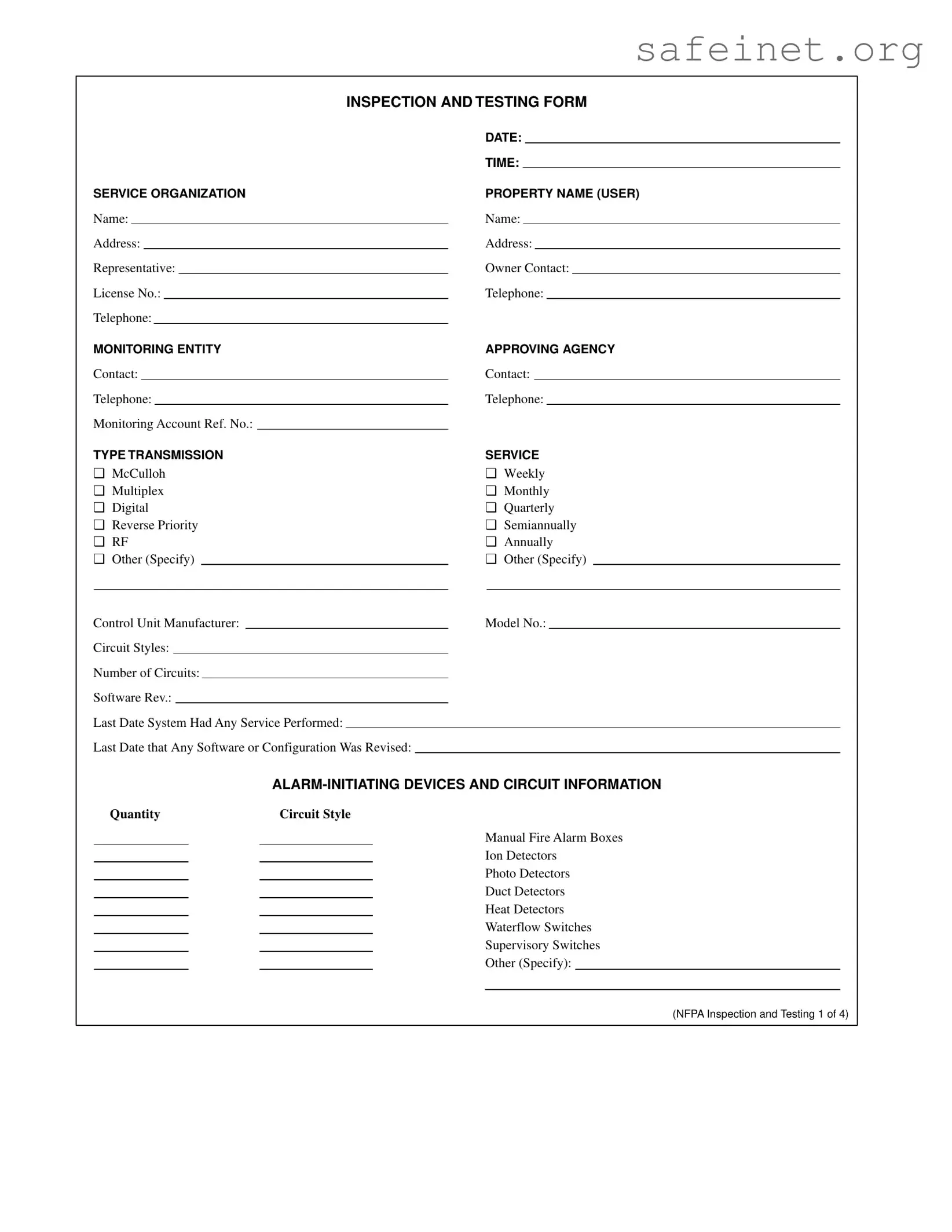
The NFPA Testing Form is an essential tool for ensuring that fire alarm systems are functioning correctly and in compliance with safety standards. This comprehensive document captures critical information about the inspection and testing of various components, including alarm-initiating devices, notification appliances, and supervisory signal devices. Each section of the form is designed to gather details about the system's configuration, including the type of transmission service and the specifications of power supplies. It also records the last maintenance performed, ensuring that the system remains up to date. The form requires input from multiple stakeholders, including service organizations, monitoring entities, and building management, highlighting the collaborative effort needed to maintain safety. Furthermore, it includes sections for documenting tests and inspections, as well as any notifications made prior to testing. By meticulously filling out this form, professionals can ensure that all necessary checks are performed, and any issues are promptly addressed, reinforcing the integrity of fire safety measures in any property.

|
|
|
|
|
|
|
|
|
|
|
|
INSPECTION AND TESTING FORM |
|||||||||
|
|
|
|
|
|
|
|
|
|
|
|
|
DATE: |
|
|||||||
|
|
|
|
|
|
|
|
|
|
|
|
|
TIME: |
|
|||||||
SERVICE ORGANIZATION |
|
PROPERTY NAME (USER) |
|||||||||||||||||||
Name: |
|
|
Name: |
|
|||||||||||||||||
Address: |
|
|
Address: |
|
|||||||||||||||||
Representative: |
|
|
Owner Contact: |
|
|||||||||||||||||
License No.: |
|
|
Telephone: |
|
|||||||||||||||||
Telephone: |
|
|
|
|
|
|
|
|
|
|
|
||||||||||
MONITORING ENTITY |
|
APPROVING AGENCY |
|||||||||||||||||||
Contact: |
|
|
Contact: |
|
|||||||||||||||||
Telephone: |
|
|
Telephone: |
|
|||||||||||||||||
Monitoring Account Ref. No.: |
|
|
|
|
|
|
|
|
|
|
|||||||||||
TYPE TRANSMISSION |
|
SERVICE |
|||||||||||||||||||
❏ McCulloh |
|
❏ Weekly |
|||||||||||||||||||
❏ Multiplex |
|
❏ Monthly |
|||||||||||||||||||
❏ Digital |
|
❏ Quarterly |
|||||||||||||||||||
❏ Reverse Priority |
|
❏ Semiannually |
|||||||||||||||||||
❏ RF |
|
❏ Annually |
|||||||||||||||||||
❏ Other (Specify) |
|
❏ Other (Specify) |
|||||||||||||||||||
|
|
|
|
|
|
|
|
|
|
|
|
|
|
|
|
|
|
|
|
|
|
Control Unit Manufacturer: |
|
|
Model No.: |
|
|||||||||||||||||
Circuit Styles: |
|
|
|
|
|
|
|
|
|
|
|
||||||||||
Number of Circuits: |
|
|
|
|
|
|
|
|
|
|
|
||||||||||
Software Rev.: |
|
|
|
|
|
|
|
|
|
|
|
||||||||||
Last Date System Had Any Service Performed:
Last Date that Any Software or Configuration Was Revised:
Quantity |
Circuit Style |
Manual Fire Alarm Boxes
Ion Detectors
Photo Detectors
Duct Detectors
Heat Detectors
Waterflow Switches
Supervisory Switches
Other (Specify):
(NFPA Inspection and Testing 1 of 4)

ALARM NOTIFICATION APPLIANCES AND CIRCUIT INFORMATION
Quantity |
Circuit Style |
Bells
Horns
Chimes
Strobes
Speakers
Other (Specify):
No. of alarm notification appliance circuits:
Are circuits monitored for integrity? ❏ Yes ❏ No
SUPERVISORY
Quantity |
Circuit Style |
Building Temp.
Site Water Temp.
Site Water Level
Fire Pump Power
Fire Pump Running
Fire Pump Auto Position
Fire Pump or Pump Controller Trouble
Fire Pump Running
Generator In Auto Position
Generator or Controller Trouble
Switch Transfer
Generator Engine Running
Other:
SIGNALING LINE CIRCUITS |
|
|
|
|
|
|
|
|
|
|
|||||||||
Quantity and style (See NFPA 72, Table |
|
|
|
||||||||||||||||
Quantity |
|
|
Style(s) |
|
|
|
|
||||||||||||
SYSTEM POWER SUPPLIES |
|
|
|
|
|
|
|
|
|
|
|||||||||
a. |
Primary (Main): Nominal Voltage |
|
|
|
, Amps |
|
|
|
|
||||||||||
|
Overcurrent Protection: Type |
|
|
|
, Amps |
|
|
|
|
||||||||||
|
Location (of Primary Supply Panelboard): |
|
|
|
|
|
|
|
|
|
|
|
|||||||
|
Disconnecting Means Location: |
|
|
|
|
|
|
|
|
|
|
|
|||||||
b. |
Secondary (Standby): |
|
|
|
|
|
|
|
|
|
|
||||||||
|
|
|
|
|
|
|
|
|
Storage Battery: |
|
|
|
|||||||
|
Calculated capacity to operate system, in hours: |
|
24 |
|
|
|
60 |
|
|
||||||||||
|
|
|
|
|
|
|
|
|
|||||||||||
|
Location of fuel storage: |
|
|
|
|
|
|
|
|
|
|
|
|||||||
TYPE BATTERY
❏Dry Cell
❏
❏Sealed
❏
❏Other (Specify):
c.Emergency or standby system used as a backup to primary power supply, instead of using a secondary power supply: Emergency system described in NFPA 70, Article 700
Legally required standby described in NFPA 70, Article 701
Optional standby system described in NFPA 70, Article 702, which also meets the performance requirements of Article 700 or 701.
(NFPA Inspection and Testing 2 of 4)

PRIOR TO ANY TESTING
NOTIFICATIONS ARE MADE |
Yes |
No |
Who |
|
Time |
Monitoring Entity |
❏ |
❏ |
|
|
|
Building Occupants |
❏ |
❏ |
|
|
|
Building Management |
❏ |
❏ |
|
|
|
Other (Specify) |
❏ |
❏ |
|
|
|
AHJ (Notified) of Any Impairments |
❏ |
❏ |
|
|
|
SYSTEM TESTS AND INSPECTIONS
TYPE |
Visible |
Functional |
Comments |
Control Unit |
❏ |
❏ |
|
Interface Eq. |
❏ |
❏ |
|
Lamps/LEDS |
❏ |
❏ |
|
Fuses |
❏ |
❏ |
|
Primary Power Supply |
❏ |
❏ |
|
Trouble Signals |
❏ |
❏ |
|
Disconnect Switches |
❏ |
❏ |
|
❏ |
❏ |
|
|
SECONDARY POWER |
|
|
|
TYPE |
Visible |
Functional |
Comments |
Battery Condition |
❏ |
|
|
Load Voltage |
|
❏ |
|
Discharge Test |
|
❏ |
|
Charger Test |
|
❏ |
|
Specific Gravity |
|
❏ |
|
TRANSIENT SUPPRESSORS |
❏ |
|
|
REMOTE ANNUNCIATORS |
❏ |
❏ |
|
NOTIFICATION APPLIANCES |
|
|
|
Audible |
❏ |
❏ |
|
Visual |
❏ |
❏ |
|
Speakers |
❏ |
❏ |
|
Voice Clarity |
|
❏ |
|
INITIATING AND SUPERVISORY DEVICE TESTS AND INSPECTIONS
|
|
|
Device |
Visual |
Functional |
Factory |
|
Meas. |
|
|
Loc. & S/N |
|
Type |
Check |
Test |
Setting |
|
Setting |
Pass |
Fail |
|
|
|
|
|
❏ |
❏ |
|
|
|
❏ |
❏ |
|
|
|
|
❏ |
❏ |
|
|
|
❏ |
❏ |
|
|
|
|
❏ |
❏ |
|
|
|
❏ |
❏ |
|
|
|
|
❏ |
❏ |
|
|
|
❏ |
❏ |
|
|
|
|
❏ |
❏ |
|
|
|
❏ |
❏ |
|
|
|
|
❏ |
❏ |
|
|
|
❏ |
❏ |
Comments: |
|
|
|
|
|
|
|
|
|
|
|
|
|
|
|
|
|
|
|
|
|
|
|
|
|
|
|
|
|
|
|
|
|
|
|
|
|
|
|
|
|
|
|
(NFPA Inspection and Testing 3 of 4)

EMERGENCY COMMUNICATIONS EQUIPMENT |
Visual |
Functional |
Comments |
Phone Set |
❏ |
❏ |
|
Phone Jacks |
❏ |
❏ |
|
❏ |
❏ |
|
|
Amplifier(s) |
❏ |
❏ |
|
Tone Generator(s) |
❏ |
❏ |
|
❏ |
❏ |
|
|
System Performance |
❏ |
❏ |
|
|
|
|
Device |
Simulated |
|
|
Visual |
Operation |
Operation |
INTERFACE EQUIPMENT |
|
|
|
|
(Specify) |
|
❏ |
❏ |
❏ |
(Specify) |
|
❏ |
❏ |
❏ |
(Specify) |
|
❏ |
❏ |
❏ |
SPECIAL HAZARD SYSTEMS |
|
|
|
|
(Specify) |
|
❏ |
❏ |
❏ |
(Specify) |
|
❏ |
❏ |
❏ |
(Specify) |
|
❏ |
❏ |
❏ |
Special Procedures:
Comments:
SUPERVISING STATION MONITORING |
Yes |
No |
Time |
Comments |
|
Alarm Signal |
❏ |
❏ |
|
|
|
Alarm Restoration |
❏ |
❏ |
|
|
|
Trouble Signal |
❏ |
❏ |
|
|
|
Supervisory Signal |
❏ |
❏ |
|
|
|
Supervisory Restoration |
❏ |
❏ |
|
|
|
NOTIFICATIONS THAT TESTING IS COMPLETE |
Yes |
|
No |
|
|
Who |
|
|
Time |
||||||||||
Building Management |
❏ |
|
|
❏ |
|
|
|
|
|
|
|
|
|||||||
Monitoring Agency |
❏ |
|
|
❏ |
|
|
|
|
|
|
|
|
|||||||
Building Occupants |
❏ |
|
|
❏ |
|
|
|
|
|
|
|
|
|||||||
Other (Specify) |
❏ |
|
|
❏ |
|
|
|
|
|
|
|
|
|||||||
The following did not operate correctly: |
|
|
|
|
|
|
|
|
|
|
|
|
|
||||||
|
|
|
|
|
|
|
|
|
|
|
|
|
|
|
|
|
|
|
|
|
|
|
|
|
|
|
|
|
|
|
|
|
|
|
|
|
|
|
|
System restored to normal operation: Date: |
|
|
|
Time: |
|
|
|
|
|
|
|
|
|
||||||
THIS TESTING WAS PERFORMED IN ACCORDANCE WITH APPLICABLE NFPA STANDARDS. |
|
|
|
||||||||||||||||
Name of Inspector: |
|
|
|
|
|
|
Date: |
|
|
Time: |
|
||||||||
Signature: |
|
|
|
|
|
|
|
|
|
|
|
|
|
|
|||||
Name of Owner or Representative: |
|
|
|
|
|
|
|
|
|
|
|
|
|
|
|||||
Date: |
|
Time: |
|
|
|
|
|
|
|
|
|
|
|
||||||
Signature: |
|
|
|
|
|
|
|
|
|
|
|
|
|
|
|||||
(NFPA Inspection and Testing 4 of 4)
| Fact Name | Details |
|---|---|
| Form Purpose | The NFPA Testing Form is used to document inspections and tests of fire alarm systems. |
| Governing Standards | The form adheres to the National Fire Protection Association (NFPA) standards, specifically NFPA 72. |
| Inspection Frequency | Inspections can occur at various intervals, including weekly, monthly, quarterly, semiannually, and annually. |
| Notification Requirement | Before testing, notifications must be made to relevant parties, including monitoring entities and building occupants. |
| Device Testing | The form requires visual and functional testing of various devices, including alarm-initiating devices and notification appliances. |
| Power Supply Documentation | Details regarding primary and secondary power supplies must be documented, including type, voltage, and location. |
| Completion Acknowledgment | Notifications that testing is complete must be recorded, along with signatures from the inspector and owner or representative. |
Completing the NFPA Testing form requires careful attention to detail. Each section must be filled out accurately to ensure compliance with safety standards. Follow these steps to complete the form effectively.
What is the purpose of the NFPA Testing Form?
The NFPA Testing Form is designed to document the inspection and testing of fire alarm systems. This form ensures that all components of the system are functioning correctly and comply with National Fire Protection Association standards. It serves as a record for service organizations, property owners, and regulatory agencies, helping to maintain safety and reliability in fire protection systems.
Who needs to fill out the NFPA Testing Form?
The form should be completed by a qualified inspector or technician from a licensed service organization. This individual is responsible for ensuring that all necessary tests and inspections are conducted according to NFPA guidelines. Additionally, property owners or representatives may also need to provide information regarding the property and its fire alarm system.
What information is required on the NFPA Testing Form?
The form collects a variety of information, including the date and time of the inspection, details about the service organization, property name, and contact information for key representatives. It also includes specifics about the fire alarm system, such as the type of transmission service, alarm-initiating devices, notification appliances, and power supplies.
How often should the NFPA Testing Form be completed?
The frequency of completing the NFPA Testing Form depends on the type of service specified. Common intervals include weekly, monthly, quarterly, semiannually, or annually. Regular testing is crucial to ensure that the fire alarm system remains operational and effective in case of an emergency.
What types of tests are documented on the NFPA Testing Form?
The form documents various tests, including visual inspections and functional tests of the control unit, alarm notification appliances, initiating devices, and supervisory signals. It also covers secondary power supply tests, such as battery condition and load voltage, ensuring all components are in working order.
What should be done if a component does not operate correctly during testing?
If any component fails to operate correctly, it is essential to document this on the NFPA Testing Form. The inspector should note the specific issue and take steps to restore the system to normal operation. This ensures that all parties are aware of any deficiencies and can address them promptly.
Who should be notified after testing is complete?
Once testing is complete, notifications should be made to building management, the monitoring agency, and building occupants. This communication is vital to inform everyone about the status of the fire alarm system and any issues that may have been identified during testing.
What happens if there are impairments during the testing process?
If impairments are identified during testing, the inspector must notify the Authority Having Jurisdiction (AHJ) and other relevant parties. Documenting these impairments ensures that corrective actions can be taken and that all stakeholders are aware of the system's status.
How is compliance with NFPA standards verified?
Compliance with NFPA standards is verified through the completion of the NFPA Testing Form, which includes the inspector's name, date, and signature. This documentation serves as proof that the inspection and testing were conducted according to the applicable standards, ensuring that the fire alarm system is safe and reliable.
Missing Information: Many people forget to fill in all required fields, such as the property name or contact details. This can delay processing and create confusion.
Incorrect Dates: Entering the wrong date for the last service performed or software revision can lead to misunderstandings about system maintenance.
Improper Selection of Services: Users often select the wrong type of transmission service. Double-checking the options can prevent errors.
Omitting Signatures: Not signing the form is a common mistake. Both the inspector and the owner or representative need to sign for the document to be valid.
Inaccurate Quantity Reporting: When listing quantities of devices, it's easy to miscount. Ensure all devices are accounted for accurately.
Neglecting to Notify: Failing to indicate who was notified before testing can lead to compliance issues. Always document notifications clearly.
Ignoring Comments Section: Some users skip the comments section, which can provide important context or details about any issues encountered during testing.
The NFPA Testing form is an essential document for conducting inspections and tests of fire alarm systems. Several other forms and documents complement this form to ensure comprehensive compliance and safety. Below is a list of commonly used documents alongside the NFPA Testing form.
Utilizing these forms and documents alongside the NFPA Testing form enhances the effectiveness of fire alarm system management. Proper documentation supports compliance, safety, and efficient operation.
The NFPA Testing form shares similarities with the Fire Alarm Inspection Report. Both documents serve to document the inspection and testing of fire alarm systems. They detail critical information such as the service organization, property name, and contact details. Each report includes sections for listing various alarm-initiating devices and their operational status, ensuring that all components are functioning as intended. The Fire Alarm Inspection Report often includes recommendations for maintenance or upgrades, similar to the NFPA Testing form's focus on system performance and compliance with safety standards.
Another related document is the Emergency Lighting Inspection Report. This report focuses specifically on the functionality of emergency lighting systems within a facility. Like the NFPA Testing form, it requires detailed information about the equipment, including the type, location, and operational status. Both documents emphasize the importance of notifying relevant parties prior to testing, ensuring that building occupants are aware of any potential disruptions. The Emergency Lighting Inspection Report also includes comments on performance, paralleling the NFPA form's sections for observations and recommendations.
The Fire Protection System Test Report is also comparable. This document outlines the testing procedures for various fire protection systems, including sprinklers and alarms. Similar to the NFPA Testing form, it requires details about the service organization and the property being tested. Both forms highlight the importance of documenting the operational status of each component and any issues that arise during testing. The Fire Protection System Test Report often includes a summary of compliance with local codes, akin to the NFPA form's focus on adherence to NFPA standards.
The Building Safety Inspection Report is another relevant document. This report encompasses a broader range of safety inspections, including fire alarms, emergency exits, and general safety compliance. Like the NFPA Testing form, it requires a thorough inspection of various systems and components, documenting any deficiencies. Both documents serve as a record for building management and regulatory agencies, ensuring that safety standards are met and maintained. The Building Safety Inspection Report may also include recommendations for corrective actions, similar to the NFPA form's focus on system performance.
The Life Safety System Inspection Report shares similarities as well. This document focuses on the inspection of life safety systems, including alarms and emergency communication devices. Both reports require detailed information about the systems being tested, including their operational status and any observed deficiencies. The Life Safety System Inspection Report emphasizes the importance of compliance with safety regulations, paralleling the NFPA Testing form's adherence to NFPA standards. Each document serves to ensure that safety measures are effectively implemented and maintained.
The Alarm Monitoring Service Report is comparable in its focus on the monitoring aspects of fire alarm systems. This report details the performance of monitoring services and any issues encountered during testing. Like the NFPA Testing form, it includes sections for documenting notifications to relevant parties and the operational status of alarm systems. Both documents emphasize the importance of maintaining effective communication with monitoring agencies to ensure prompt responses to alarms and emergencies.
The Fire Drill Report also bears similarities to the NFPA Testing form. This document records the outcomes of fire drills conducted within a facility, including observations about the effectiveness of alarm systems and occupant responses. Like the NFPA Testing form, it requires detailed information about the testing process and any identified issues. Both reports serve as essential tools for improving safety protocols and ensuring that systems are functioning as intended during emergencies.
Lastly, the Maintenance Service Report is relevant in this context. This document outlines the maintenance performed on fire alarm systems and other safety equipment. Similar to the NFPA Testing form, it includes details about the service organization, equipment status, and any repairs made. Both reports emphasize the importance of regular maintenance to ensure system reliability and compliance with safety standards. The Maintenance Service Report may also include recommendations for future maintenance, aligning with the NFPA form's focus on ongoing system performance and safety compliance.
When filling out the NFPA Testing form, attention to detail is crucial. Here are seven important do's and don'ts to keep in mind:
Misconceptions about the NFPA Testing form can lead to confusion and improper use. Here are nine common misconceptions clarified:
Understanding these misconceptions can help ensure proper use of the NFPA Testing form and enhance safety protocols.
When filling out the NFPA Testing form, consider these key takeaways: