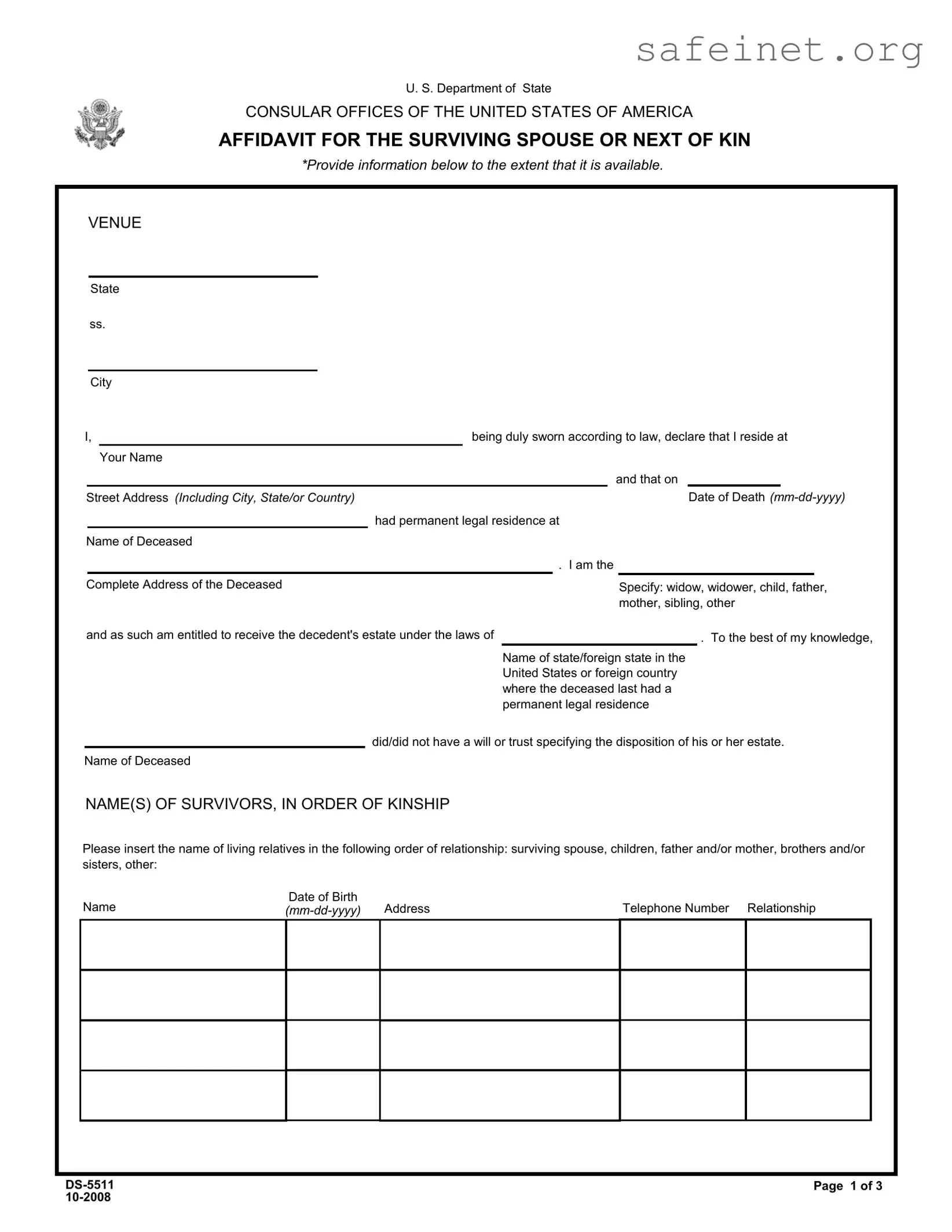
The Next Of Kin form is an essential document for individuals seeking to establish their relationship to a deceased person, particularly in cases where the death occurs abroad. This form is utilized by U.S. Consular Officers to determine the rightful next of kin of an American citizen who has passed away outside the United States. It requires the affiant to provide personal information, including their name, address, and relationship to the deceased. The form also asks for details about the deceased, such as their name, date of death, and whether they had a will or trust in place. Additionally, the form outlines the order of kinship for living relatives, ensuring that the appropriate individuals are recognized. While completing the form is voluntary, failure to do so may necessitate the submission of alternative legal documents to prove the relationship to the deceased. The information collected may be shared with various government entities for administrative or legal purposes, highlighting the importance of accurate and complete submissions.
U. S. Department of State
CONSULAR OFFICES OF THE UNITED STATES OF AMERICA
AFFIDAVIT FOR THE SURVIVING SPOUSE OR NEXT OF KIN
*Provide information below to the extent that it is available.
VENUE
State
ss.
|
|
City |
|
|
|
|
|
|
|
|
|
|
|
I, |
|
being duly sworn according to law, declare that I reside at |
|||||||||||
|
|
|
Your Name |
|
|
|
|
|
|
|
|
|
|
|
|
|
|
|
|
|
|
and that on |
|
|
|||
Street Address (Including City, State/or Country) |
|
|
|
|
|
|
Date of Death |
||||||
|
|
|
|
had permanent legal residence at |
|||||||||
Name of Deceased |
|
|
|
|
|
|
|
|
|
|
|||
|
|
|
|
|
|
|
. I am the |
|
|
||||
Complete Address of the Deceased |
|
|
|
|
|
Specify: widow, widower, child, father, |
|||||||
|
|
|
|
|
|
|
|
|
mother, sibling, other |
||||
and as such am entitled to receive the decedent's estate under the laws of |
|
|
|
|
|
. To the best of my knowledge, |
|||||||
|
|
|
|
|
|
Name of state/foreign state in the |
|||||||
United States or foreign country where the deceased last had a permanent legal residence
did/did not have a will or trust specifying the disposition of his or her estate.
Name of Deceased
NAME(S) OF SURVIVORS, IN ORDER OF KINSHIP
Please insert the name of living relatives in the following order of relationship: surviving spouse, children, father and/or mother, brothers and/or sisters, other:
Name |
Date of Birth |
Telephone Number Relationship |
Page 1 of 3 |
|
|

Name |
Date of Birth |
Address |
Telephone Number Relationship |
|
|
|
|
|
|
|
|
|
|
|
|
|
|
|
|
|
|
|
|
|
|
|
|
|
|
|
|
|
|
|
|
|
|
|
|
|
|
|
|
|
Subscribed and sworn to before me by
|
Signature of Affiant |
|
||||
|
|
|
|
|
|
|
Type Name of Affiant |
|
|
|
Date |
|
|
|
|
|
|
|
|
|
Address of Notary Public |
|
|
|
|
|
|
|
|
|
|
|
|
|
Signature of Notary Public |
|
|
|
Type Name of Notary Public |
|
|
Page 2 of 3 |

PRIVACY ACT STATEMENT
The information on this form is requested to assist U.S. Consular Officers to fulfill the requirements of 22 U.S.C. 2715c and determine the
Providing the information in the affidavit is voluntary, but, failure to complete this form will require the person claiming to be
ROUTINE USES: The information solicited on this form may be made available to federal, state, local, or foreign government entities for administrative or law enforcement purpose, including for the notification of kin or judicial matters involving contested estates and related issues.
Page 3 of 3 |
| Fact Name | Description | Governing Law |
|---|---|---|
| Purpose of the Form | The Next of Kin form assists U.S. Consular Officers in identifying the next of kin of an American citizen who dies abroad. | 22 U.S.C. 2715c |
| Affidavit Requirement | The form requires an affidavit from the surviving spouse or next of kin, confirming their relationship to the deceased. | State probate laws |
| Voluntary Information | Providing information on the form is voluntary; however, failure to do so may necessitate alternative documentation. | State probate laws |
| Privacy Act Statement | The form includes a Privacy Act Statement, outlining how the information may be used and shared with various government entities. | Privacy Act of 1974 |
Filling out the Next Of Kin form is an important step in managing the affairs of a deceased individual. This form assists U.S. Consular Officers in determining the rightful next of kin and ensuring that the decedent's estate is handled according to legal requirements. Below are the steps to complete this form accurately.
What is the purpose of the Next of Kin form?
The Next of Kin form is used to identify the closest living relatives of an individual who has passed away, particularly when that individual was a U.S. citizen who died abroad. This form helps U.S. Consular Officers fulfill their responsibilities regarding the decedent's personal effects and estate. It provides essential information to ensure that the rightful heirs can claim the deceased's belongings and manage any estate matters.
Who should complete the Next of Kin form?
The form should be completed by a person who is considered the next of kin of the deceased. This could be a surviving spouse, child, parent, sibling, or other relative. It is crucial that the individual filling out the form is legally recognized as having a claim to the decedent's estate under the laws of the state or country where the deceased had their permanent residence.
What information is required on the Next of Kin form?
The form requires specific details, including the name and address of the deceased, the date of death, and the relationship of the affiant (the person completing the form) to the deceased. Additionally, it asks for the names and contact information of other living relatives in order of kinship, as well as information about whether the deceased had a will or trust.
What happens if the deceased had a will or trust?
If the deceased had a will or trust that specifies how their estate should be distributed, this information should be included on the form. The presence of a will or trust may affect the distribution of the estate and the responsibilities of the next of kin. If there is a will, the executor named in the document typically handles the estate, and the Next of Kin form may not be necessary for claiming personal effects.
Is it mandatory to complete the Next of Kin form?
While it is not legally mandatory to complete the form, doing so is highly recommended. If the form is not completed, the person claiming to be the next of kin may need to provide alternative legal documents, such as Letters Testamentary or Letters of Administration, to prove their right to manage the decedent's estate. Completing the form simplifies the process of claiming personal effects and ensures that the appropriate individuals are recognized.
How is the information on the Next of Kin form used?
The information collected on the form is used by U.S. Consular Officers to identify the next of kin and facilitate the release of the decedent's personal effects. Additionally, the data may be shared with federal, state, local, or foreign government entities for administrative or legal purposes, such as notifying relatives or handling contested estate matters.
What should I do if I am unsure about my relationship to the deceased?
If there is uncertainty regarding your relationship to the deceased, it is advisable to seek guidance. You may consult with legal professionals who specialize in estate matters. They can help clarify your standing and provide advice on how to proceed with the Next of Kin form or any necessary documentation.
Can the Next of Kin form be submitted electronically?
Submission methods for the Next of Kin form may vary depending on the specific consular office's policies. Some offices may allow electronic submission, while others might require a physical copy. It is essential to check with the relevant consular office for their specific submission guidelines to ensure compliance and avoid delays.
Incomplete Information: Failing to provide all required details can lead to delays. Ensure that every section is filled out completely, especially names, addresses, and relationships.
Incorrect Dates: Entering the wrong date of death or birth can cause confusion. Double-check these dates for accuracy.
Wrong Relationship Order: Listing survivors out of the specified order can complicate the process. Follow the order of kinship as instructed.
Missing Signatures: Not signing the form can render it invalid. Make sure to sign and date where required.
Notary Issues: Forgetting to have the affidavit notarized can lead to rejection. Ensure a notary public signs the document.
Using Incorrect Titles: Mislabeling your relationship to the deceased can create misunderstandings. Use the correct terms like widow, sibling, or child.
Neglecting to Review: Skipping a final review of the form may allow errors to go unnoticed. Take a moment to check everything before submission.
Ignoring Privacy Statements: Not understanding the privacy implications can lead to concerns later. Read the privacy statement carefully to know how your information will be used.
The Next Of Kin form is an important document often used in situations involving the death of a loved one. To support this process, several other forms and documents may also be required. Here’s a list of commonly used documents that accompany the Next Of Kin form, along with brief descriptions of each.
Each of these documents plays a crucial role in managing the affairs of a deceased person. Having them prepared can simplify the process for the next of kin during a challenging time.
The Affidavit for the Surviving Spouse or Next of Kin form shares similarities with a Last Will and Testament. Both documents address the distribution of a deceased person's estate. A Last Will outlines the wishes of the deceased regarding asset distribution, naming beneficiaries and appointing an executor. In contrast, the Next of Kin form identifies the individuals entitled to inherit when no will exists. Both documents serve to clarify the intentions of the deceased and ensure that their wishes are honored, although they operate in different contexts.
Another related document is the Letters Testamentary. These are issued by a probate court and grant the executor the authority to manage the deceased's estate. Like the Next of Kin form, Letters Testamentary establish a legal relationship between the executor and the estate. The Next of Kin form can be crucial when there is no will, as it helps determine who has the right to inherit. Both documents play important roles in the estate administration process, ensuring that the rightful heirs are recognized.
The Letters of Administration also bear resemblance to the Next of Kin form. When a person dies without a will, a court may issue Letters of Administration to appoint an administrator for the estate. This document allows the administrator to handle the deceased's affairs, similar to how the Next of Kin form identifies those who may inherit. Both documents aim to provide clarity in situations where the deceased did not leave explicit instructions regarding their estate.
Finally, the Affidavit of Heirship is another document that aligns with the Next of Kin form. This affidavit is often used when there is no will to establish who the legal heirs are. It provides a sworn statement identifying the heirs based on their relationship to the deceased. Like the Next of Kin form, the Affidavit of Heirship seeks to clarify the lineage and rights of individuals entitled to inherit from the estate. Both documents serve to facilitate the transfer of assets in the absence of a formal will.
Filling out the Next of Kin form is a crucial task that requires attention to detail. Here are some important do's and don'ts to keep in mind:
Completing this form accurately can significantly impact the handling of the decedent's estate. Take the time to follow these guidelines carefully.
This form is designed for various relatives, not just spouses. Children, parents, siblings, and others can also be recognized as next of kin.
A will is not a requirement for completing this form. It is used to identify next of kin, regardless of whether the deceased had a will or not.
This form is applicable for U.S. citizens who die abroad. It helps consular officers manage the deceased's personal effects and estate.
Filling out the form does not automatically grant access to the estate. Legal qualifications must still be met.
Multiple relatives can be listed in order of kinship. This helps clarify relationships and claims to the estate.
The information provided is protected under privacy laws and is only shared with authorized entities for specific purposes.
Filling out the Next Of Kin form is an important process for individuals dealing with the estate of a deceased loved one. Understanding the key aspects of this form can help ensure that the process is smooth and efficient. Here are some essential takeaways:
By keeping these key points in mind, individuals can navigate the Next Of Kin form more effectively, ensuring that they meet the necessary legal requirements and facilitate the management of the deceased’s estate.