The New York Transfer-on-Death Deed form represents a significant advancement in estate planning, allowing property owners to transfer their real estate to designated beneficiaries upon their death without the need for probate. This form simplifies the process of passing on property, ensuring that loved ones can inherit without the complications often associated with traditional wills. By completing and recording this deed, individuals can maintain full control over their property during their lifetime while providing a clear and direct path for the transfer of ownership after they pass. The form requires careful attention to detail, including the identification of the property, the names of beneficiaries, and the signatures of the property owner. Importantly, this deed must be executed in accordance with specific legal requirements to ensure its validity. Understanding the nuances of this form can empower property owners to make informed decisions about their estate, providing peace of mind for both themselves and their heirs.
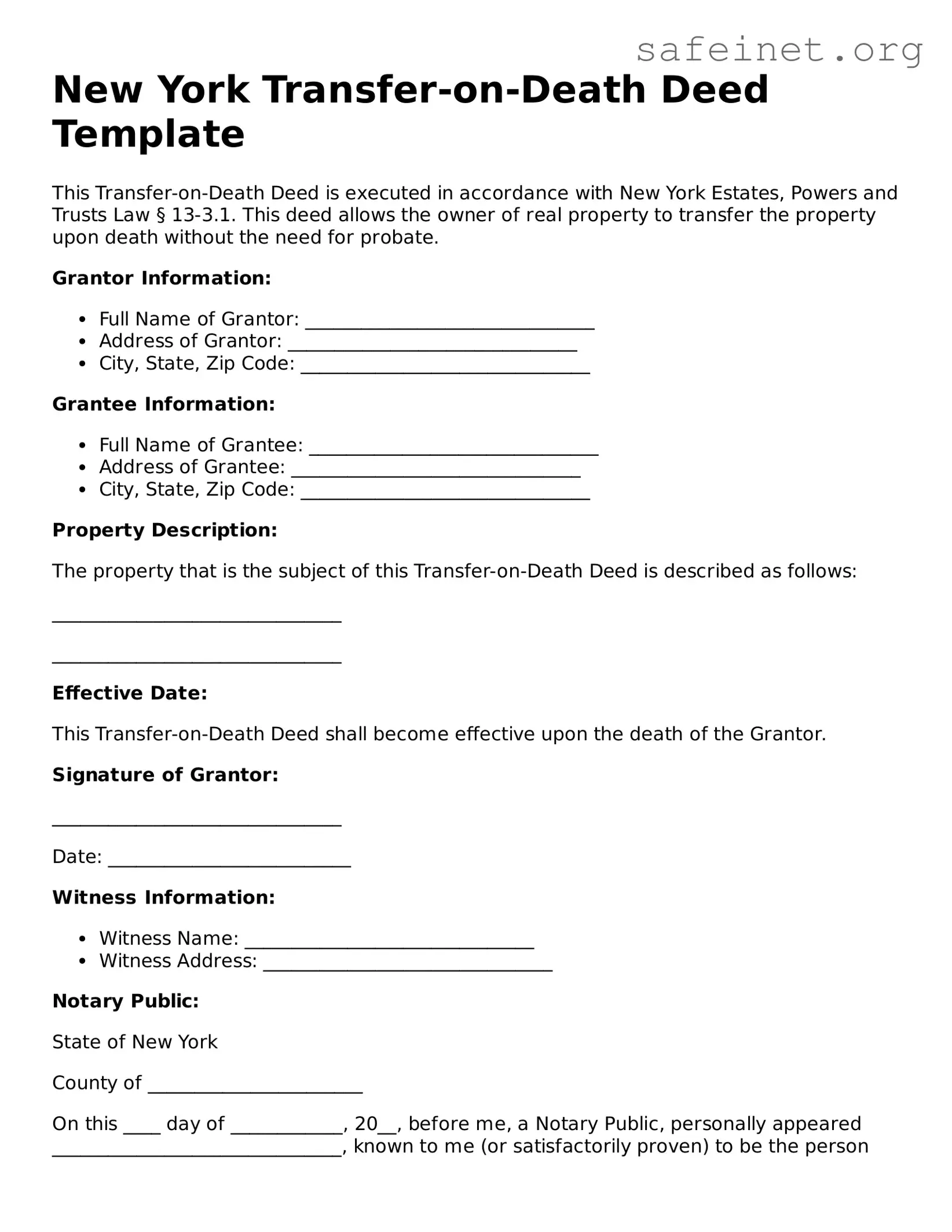
New York Transfer-on-Death Deed Template
This Transfer-on-Death Deed is executed in accordance with New York Estates, Powers and Trusts Law § 13-3.1. This deed allows the owner of real property to transfer the property upon death without the need for probate.
Grantor Information:
Grantee Information:
Property Description:
The property that is the subject of this Transfer-on-Death Deed is described as follows:
_______________________________
_______________________________
Effective Date:
This Transfer-on-Death Deed shall become effective upon the death of the Grantor.
Signature of Grantor:
_______________________________
Date: __________________________
Witness Information:
Notary Public:
State of New York
County of _______________________
On this ____ day of ____________, 20__, before me, a Notary Public, personally appeared _______________________________, known to me (or satisfactorily proven) to be the person whose name is subscribed to the within instrument and acknowledged that he/she executed the same for the purposes therein contained.
Notary Public Signature: _______________________________
My Commission Expires: _______________________________
| Fact Name | Description |
|---|---|
| Definition | A Transfer-on-Death Deed allows an individual to transfer real estate to a beneficiary upon their death without going through probate. |
| Governing Law | The Transfer-on-Death Deed is governed by New York Estates, Powers and Trusts Law (EPTL) § 2-1.11. |
| Eligibility | Any individual who owns real property in New York can create a Transfer-on-Death Deed. |
| Revocation | The deed can be revoked at any time by the grantor through a written document that is properly executed. |
| Beneficiary Rights | Beneficiaries do not have any rights to the property until the grantor's death. |
| Filing Requirements | The deed must be recorded in the county where the property is located to be effective. |
After obtaining the New York Transfer-on-Death Deed form, you will need to complete it carefully. Each section requires specific information to ensure accuracy. Once filled out, the form must be signed and filed with the appropriate county office.
What is a Transfer-on-Death Deed in New York?
A Transfer-on-Death Deed (TOD) is a legal document that allows a property owner in New York to designate one or more beneficiaries to receive their real estate upon their death. This deed enables the property to transfer outside of probate, simplifying the process for heirs and ensuring a smoother transition of ownership. It is a valuable tool for estate planning, as it allows property owners to maintain control of their assets during their lifetime while specifying who will inherit them after they pass away.
How does a Transfer-on-Death Deed work?
When a property owner executes a Transfer-on-Death Deed, they retain full ownership and control of the property during their lifetime. The designated beneficiaries do not have any rights to the property until the owner dies. At that point, the property automatically transfers to the beneficiaries named in the deed without going through probate. This means that the heirs can avoid the lengthy and often costly probate process, making it a practical option for many individuals.
Who can be named as beneficiaries in a Transfer-on-Death Deed?
In New York, any individual or entity can be named as a beneficiary in a Transfer-on-Death Deed. This includes family members, friends, or even organizations. However, it is essential to consider the relationship with the beneficiaries and how the transfer aligns with your overall estate plan. Naming multiple beneficiaries is also possible, allowing for shared ownership among them if desired.
Are there any limitations to using a Transfer-on-Death Deed?
While a Transfer-on-Death Deed can be an effective estate planning tool, it does come with certain limitations. For instance, it cannot be used for all types of property. Real estate is the primary focus, and personal property, such as vehicles or bank accounts, cannot be transferred using this deed. Additionally, if the property owner has outstanding debts or liens, those obligations may still affect the property after the transfer, potentially complicating matters for the beneficiaries.
How do I create a valid Transfer-on-Death Deed?
To create a valid Transfer-on-Death Deed in New York, the property owner must complete the appropriate form, which includes information about the property and the designated beneficiaries. The deed must be signed by the owner and acknowledged before a notary public. After completing the deed, it must be recorded with the county clerk's office where the property is located. This recording is crucial, as it makes the deed legally effective and informs the public of the intended transfer.
Can I revoke or change a Transfer-on-Death Deed?
Yes, a Transfer-on-Death Deed can be revoked or changed at any time during the property owner's lifetime. To do this, the owner must create a new deed that explicitly revokes the previous one or file a formal revocation document with the county clerk's office. It's important to ensure that any changes are properly documented to avoid confusion or disputes among beneficiaries later on.
What happens if the beneficiary dies before the property owner?
If a designated beneficiary dies before the property owner, the transfer of the property will depend on how the deed is structured. If the deed names multiple beneficiaries, the remaining beneficiaries will still receive their share of the property. However, if the deed specifies that the property should go to a single beneficiary who has predeceased the owner, the property will typically pass according to the owner's will or, if there is no will, according to state intestacy laws.
Is it advisable to consult a lawyer when creating a Transfer-on-Death Deed?
While it is possible to create a Transfer-on-Death Deed without legal assistance, consulting a lawyer is highly recommended. An attorney can provide valuable guidance on how the deed fits into your overall estate plan, help ensure that the deed complies with New York laws, and address any specific concerns you may have. This professional support can help prevent potential issues down the line, ensuring that your wishes are carried out as intended.
Failing to properly identify the property. It is crucial to provide the correct legal description of the property being transferred. This includes the street address, county, and tax identification number. Without this information, the deed may be deemed invalid.
Not including all required signatures. The deed must be signed by the property owner. If there are multiple owners, all must sign the document. Missing signatures can lead to complications in the transfer process.
Neglecting to have the deed notarized. A Transfer-on-Death Deed must be notarized to be legally binding. Skipping this step can result in the deed not being recognized by the court.
Overlooking the need to record the deed. After completing the deed, it must be filed with the appropriate county clerk's office. Failing to record the deed means that the transfer may not take effect upon the owner's death.
Using outdated forms. Laws and requirements can change, so it’s important to use the most current version of the Transfer-on-Death Deed form. Using an outdated form may lead to errors or rejection of the deed.
The New York Transfer-on-Death Deed form allows individuals to transfer real property to designated beneficiaries upon their death. This document serves as a critical part of estate planning. Along with the Transfer-on-Death Deed, several other forms and documents may be necessary to ensure a comprehensive approach to property transfer and estate management. Below is a list of such documents.
Each of these documents plays a vital role in the estate planning process. Together, they help ensure that an individual's wishes are honored and that their assets are managed and distributed according to their preferences.
The New York Transfer-on-Death Deed (TOD) is a unique document that allows individuals to transfer real estate to beneficiaries upon their death without going through probate. It shares similarities with several other estate planning documents, each serving a specific purpose in the realm of asset transfer and inheritance. Understanding these documents can help individuals make informed decisions about their estate planning needs.
One document similar to the TOD is the Last Will and Testament. A will outlines how a person's assets should be distributed after their death. Like the TOD, a will can name beneficiaries, but it requires probate, which can be a lengthy and costly process. In contrast, the TOD allows for a more straightforward transfer of property directly to the named beneficiaries, bypassing probate entirely.
The Living Trust is another document that resembles the Transfer-on-Death Deed. A living trust allows individuals to place their assets into a trust during their lifetime, which can then be managed by a trustee. Upon the individual's death, the assets in the trust are distributed to beneficiaries without going through probate. While both the TOD and living trust facilitate direct transfers to beneficiaries, a living trust often provides more comprehensive management options during the individual's lifetime.
Beneficiary Designations on accounts such as life insurance policies and retirement accounts also share similarities with the TOD. These designations allow individuals to name beneficiaries who will receive the assets directly upon their death. Like the TOD, these designations avoid probate. However, they are limited to specific types of accounts and do not apply to real estate, making the TOD a valuable option for property transfers.
The Joint Tenancy with Right of Survivorship is another estate planning tool that bears resemblance to the Transfer-on-Death Deed. In a joint tenancy, two or more individuals hold title to property together, and upon the death of one owner, the surviving owner(s) automatically inherit the deceased's share. While both methods facilitate the transfer of property outside of probate, joint tenancy requires the co-ownership of the property during the owner's lifetime.
Another related document is the Community Property Agreement, which is specific to certain states that recognize community property laws. This agreement allows spouses to designate their property as community property, meaning that it will be automatically transferred to the surviving spouse upon death. Similar to the TOD, this agreement simplifies the transfer process, but it is limited to married couples and may not apply to all types of property.
The Transfer-on-Death Instrument (TODI) is a document used in some states that functions similarly to the New York TOD. It allows property owners to designate beneficiaries for their real estate, enabling a transfer upon death without probate. While the terminology and specific requirements may differ, the underlying purpose of both documents is to simplify the transfer of property to beneficiaries.
The Payable-on-Death (POD) designation is also akin to the Transfer-on-Death Deed. This designation is commonly used for bank accounts and allows account holders to name beneficiaries who will receive the funds directly upon their death. Like the TOD, a POD avoids probate, providing a quick and efficient means of asset transfer, although it is limited to financial accounts rather than real estate.
The Durable Power of Attorney is another document that, while serving a different function, shares a connection with the TOD. A durable power of attorney allows individuals to designate someone to make financial or medical decisions on their behalf if they become incapacitated. While the TOD focuses on transferring property after death, the durable power of attorney ensures that an individual's wishes are honored during their lifetime, demonstrating the importance of having a comprehensive estate plan.
Lastly, the Health Care Proxy is similar in that it allows individuals to designate someone to make medical decisions on their behalf if they are unable to do so. While not directly related to property transfer, it emphasizes the importance of having designated individuals in place to manage one’s affairs, much like the TOD allows for the designation of beneficiaries for real estate. Both documents reflect the broader goal of ensuring that individuals' wishes are respected and upheld, whether during their lifetime or after their passing.
When filling out the New York Transfer-on-Death Deed form, it is important to follow specific guidelines to ensure the document is completed correctly. Here are some dos and don'ts to consider:
Understanding the New York Transfer-on-Death Deed can be challenging. Here are nine common misconceptions about this legal form:
Many people believe that only those with significant assets can benefit from a Transfer-on-Death Deed. In reality, it can be a useful tool for anyone wanting to simplify the transfer of property to their heirs.
Some think that using a Transfer-on-Death Deed means avoiding all taxes related to property transfer. While it may help avoid probate, it does not eliminate potential estate or inheritance taxes.
Although a Transfer-on-Death Deed can be revoked, it must be done through a formal process. Simply changing your mind does not automatically invalidate the deed.
This deed can apply to various types of real estate, not just residential properties. Commercial and vacant land can also be transferred using this method.
Many believe that all potential heirs must agree to the Transfer-on-Death Deed. In fact, the owner can designate beneficiaries without needing consent from others.
While both serve to transfer property, a Transfer-on-Death Deed operates outside of probate, whereas a will must go through the probate process.
Some people think that once a Transfer-on-Death Deed is executed, it cannot be changed. However, the owner retains the right to modify or revoke the deed at any time before their death.
Each state has its own laws regarding Transfer-on-Death Deeds. New York has specific requirements that may differ from those in other states.
While a Transfer-on-Death Deed can simplify the process, complications can still arise, such as disputes among heirs or issues with the property title.
Understanding the New York Transfer-on-Death Deed form is essential for effective estate planning. Here are some key takeaways to consider:
By keeping these points in mind, individuals can utilize the Transfer-on-Death Deed effectively to ensure their property is passed on according to their wishes.