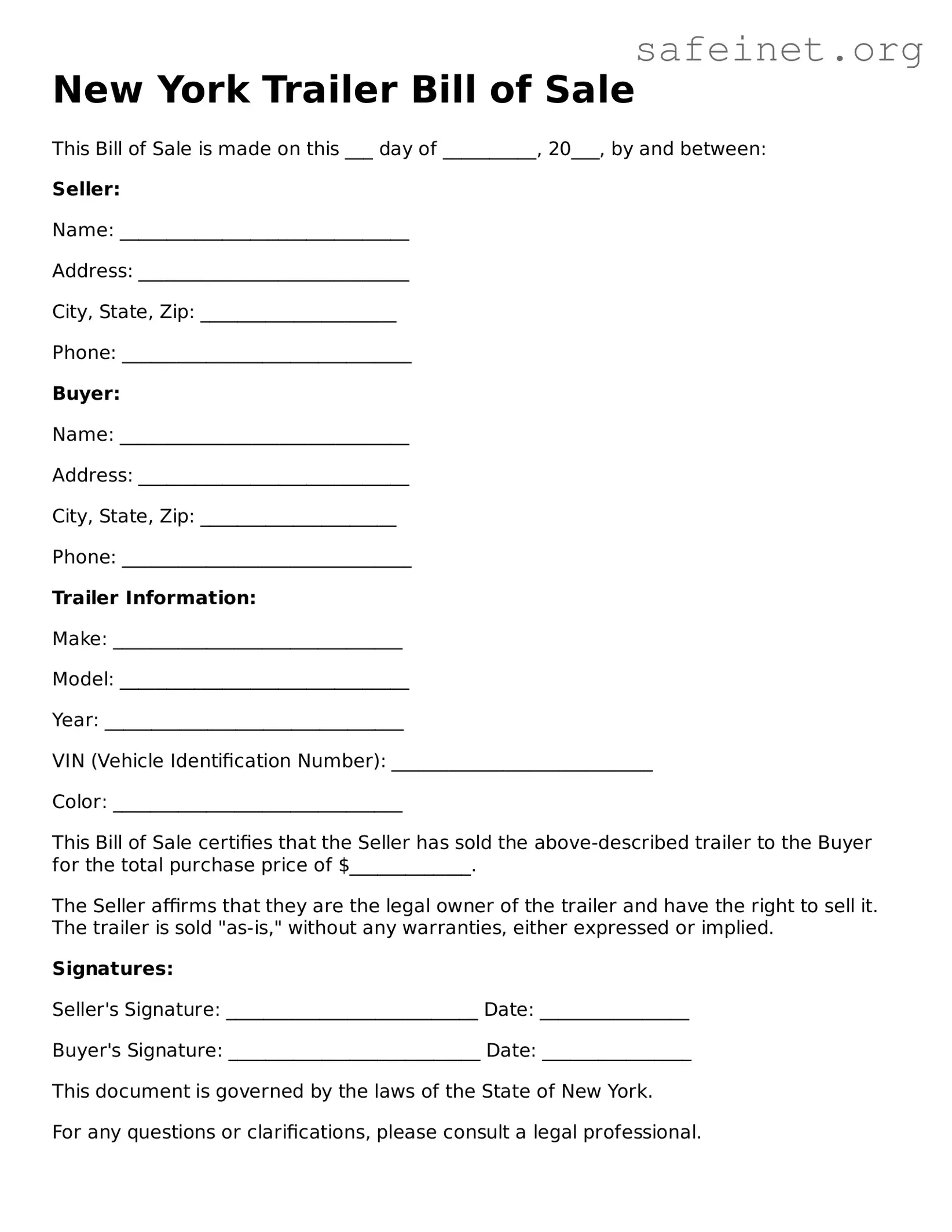
The New York Trailer Bill of Sale form serves as a crucial document for individuals and businesses involved in the buying and selling of trailers within the state. This form not only provides a record of the transaction but also ensures that both parties are protected under New York law. It typically includes essential details such as the names and addresses of the buyer and seller, a description of the trailer being sold—including its make, model, year, and Vehicle Identification Number (VIN)—and the sale price. Additionally, it may contain information regarding any liens on the trailer, which is vital for establishing clear ownership. By using this form, sellers can confirm that they have legally transferred ownership, while buyers can secure proof of their new purchase. The Trailer Bill of Sale is an important tool in facilitating a smooth transaction, preventing disputes, and ensuring compliance with state regulations.
New York Trailer Bill of Sale
This Bill of Sale is made on this ___ day of __________, 20___, by and between:
Seller:
Name: _______________________________
Address: _____________________________
City, State, Zip: _____________________
Phone: _______________________________
Buyer:
Name: _______________________________
Address: _____________________________
City, State, Zip: _____________________
Phone: _______________________________
Trailer Information:
Make: _______________________________
Model: _______________________________
Year: ________________________________
VIN (Vehicle Identification Number): ____________________________
Color: _______________________________
This Bill of Sale certifies that the Seller has sold the above-described trailer to the Buyer for the total purchase price of $_____________.
The Seller affirms that they are the legal owner of the trailer and have the right to sell it. The trailer is sold "as-is," without any warranties, either expressed or implied.
Signatures:
Seller's Signature: ___________________________ Date: ________________
Buyer's Signature: ___________________________ Date: ________________
This document is governed by the laws of the State of New York.
For any questions or clarifications, please consult a legal professional.
| Fact Name | Description |
|---|---|
| Purpose | The New York Trailer Bill of Sale form is used to document the sale of a trailer, providing proof of ownership transfer between the seller and buyer. |
| Governing Law | This form is governed by the laws of New York State, specifically under the Vehicle and Traffic Law. |
| Required Information | The form must include details such as the trailer's make, model, year, Vehicle Identification Number (VIN), and the sale price. |
| Signatures | Both the seller and buyer must sign the form to validate the transaction and confirm the agreement. |
| Notarization | While notarization is not always required, it is recommended for added security and to prevent disputes. |
| Filing | After the sale, the buyer should keep the form for their records and may need it for registration with the Department of Motor Vehicles (DMV). |
Once you have obtained the New York Trailer Bill of Sale form, you will need to fill it out carefully to ensure all necessary information is provided. This document will help facilitate the transfer of ownership of a trailer from one party to another. Follow these steps to complete the form accurately.
After completing the form, ensure that both parties retain a copy for their records. This will serve as proof of the transaction and can be useful for future reference, such as registration or titling purposes.
What is a New York Trailer Bill of Sale form?
The New York Trailer Bill of Sale form is a legal document used to transfer ownership of a trailer from one party to another within the state of New York. This form serves as proof of the transaction and includes important details such as the buyer's and seller's information, the trailer's description, and the sale price. Having this document helps ensure that both parties are protected during the sale and provides a record for future reference.
Why do I need a Bill of Sale for my trailer?
A Bill of Sale is essential for several reasons. Firstly, it provides legal evidence of the transaction, which can be important if disputes arise later. Secondly, it helps establish the new owner's rights to the trailer, especially when it comes to registration and title transfer. Lastly, having a Bill of Sale can facilitate the process of obtaining insurance for the trailer, as it serves as proof of ownership.
What information should be included in the Bill of Sale?
The Bill of Sale should include specific details to be considered valid. Essential information includes the names and addresses of both the buyer and seller, the trailer's make, model, year, and Vehicle Identification Number (VIN). Additionally, the sale price and the date of the transaction should be clearly stated. Both parties should sign the document to acknowledge their agreement to the sale.
Is the Bill of Sale required for trailer registration in New York?
Yes, a Bill of Sale is typically required when registering a trailer in New York. The Department of Motor Vehicles (DMV) will ask for this document to verify the ownership transfer. Along with the Bill of Sale, you may also need to provide other documents, such as proof of identity and any previous title or registration documents related to the trailer.
Can I create my own Bill of Sale for a trailer?
Yes, you can create your own Bill of Sale for a trailer, as long as it includes all the necessary information. However, using a standardized form can help ensure that you do not miss any critical details. Many resources are available online, including templates specifically designed for New York trailers, which can simplify the process and ensure compliance with state requirements.
What should I do after completing the Bill of Sale?
After completing the Bill of Sale, both the buyer and seller should keep a copy for their records. The buyer will need to take the original document to the DMV when registering the trailer. It is also advisable for the seller to notify their insurance company about the sale and to remove the trailer from their policy, ensuring that they are no longer liable for it.
Incomplete Information: Many individuals forget to fill in all required fields. Each section of the form is important, and leaving any part blank can lead to issues later.
Incorrect Vehicle Identification Number (VIN): The VIN must be accurate. A single digit off can cause significant problems when registering the trailer.
Not Signing the Document: Both the seller and buyer must sign the bill of sale. Without signatures, the document may not be considered valid.
Failure to Date the Form: It’s essential to include the date of the sale. This date is crucial for legal records and future reference.
Missing Payment Details: Clearly stating the payment method and amount helps avoid disputes. Omitting this information can lead to misunderstandings.
Not Including a Description of the Trailer: A thorough description, including make, model, and year, helps identify the trailer. Vague descriptions can create confusion.
Ignoring State Requirements: Each state may have specific requirements for a bill of sale. Not checking these can result in an invalid document.
Not Keeping a Copy: After completing the form, it’s wise to keep a copy for personal records. This can be helpful if questions arise in the future.
Rushing the Process: Filling out the form in haste can lead to mistakes. Take your time to ensure everything is accurate and complete.
When completing a transaction involving a trailer in New York, several additional documents may be required alongside the Trailer Bill of Sale. Each document serves a specific purpose and helps ensure a smooth transfer of ownership. Below is a list of commonly used forms and documents.
Having these documents prepared and organized can facilitate a seamless transaction. Ensure that all parties understand their roles and responsibilities in the process to avoid potential complications.
The New York Vehicle Bill of Sale is quite similar to the Trailer Bill of Sale. Both documents serve as proof of the transfer of ownership from one party to another. They include essential details such as the buyer's and seller's names, addresses, and signatures. Additionally, both forms typically require a description of the vehicle or trailer, including its make, model, year, and Vehicle Identification Number (VIN). This ensures that there is a clear record of the transaction for both parties and for future reference.
The New York Boat Bill of Sale also shares similarities with the Trailer Bill of Sale. Like the trailer form, the boat bill of sale is used to document the transfer of ownership. It captures important information about the boat, such as its make, model, and hull identification number. Both documents protect the interests of the buyer and seller by providing a legal record of the transaction. This helps in establishing ownership and can be useful for registration purposes.
An Equipment Bill of Sale is another document that resembles the Trailer Bill of Sale. This form is utilized for the sale of various types of equipment, including construction machinery or farm tools. Similar to the trailer form, it includes information about the seller and buyer, as well as a detailed description of the equipment being sold. The purpose remains the same: to create a legal record of the sale and transfer of ownership.
The Motorcycle Bill of Sale is also comparable to the Trailer Bill of Sale. Both documents serve to document the sale of a vehicle, and they contain similar essential details such as the identification of the buyer and seller, along with a description of the motorcycle. This helps to ensure that both parties are protected in the transaction, as the bill of sale acts as proof of ownership transfer.
A Mobile Home Bill of Sale bears resemblance to the Trailer Bill of Sale as well. Both documents are used to transfer ownership of a movable property. They include information about the seller and buyer, as well as specific details about the mobile home or trailer. This ensures clarity in the transaction and provides a legal record that can be referred to in the future.
Lastly, the New York Snowmobile Bill of Sale is akin to the Trailer Bill of Sale. Both documents are designed to facilitate the transfer of ownership of recreational vehicles. They include similar components, such as the names and addresses of the buyer and seller, along with a description of the snowmobile. This serves to protect both parties by providing a legal framework for the transaction.
When filling out the New York Trailer Bill of Sale form, it is important to follow certain guidelines to ensure the process goes smoothly. Below is a list of things to do and things to avoid.
Things to Do:
Things to Avoid:
The New York Trailer Bill of Sale form is often misunderstood. Here are six common misconceptions about this important document:
This is not true. The Bill of Sale is required for both new and used trailers. Any transfer of ownership necessitates this documentation.
While verbal agreements may hold some weight, a written Bill of Sale is essential for legal protection and clarity in the transaction.
Both the buyer and the seller must sign the Bill of Sale. This ensures that both parties agree to the terms of the sale.
A title alone does not suffice. The Bill of Sale serves as proof of the transaction and may be required for registration purposes.
While the Bill of Sale is a binding document, if both parties agree, they can amend the terms and create a new Bill of Sale.
This form is also applicable for transactions involving dealers. Any sale, regardless of the seller type, requires a Bill of Sale.
Understanding these misconceptions can help ensure a smoother transaction when buying or selling a trailer in New York.
When filling out and using the New York Trailer Bill of Sale form, several important points should be considered. Below are key takeaways to ensure a smooth transaction.
By following these guidelines, both the seller and buyer can facilitate a successful and transparent transaction.