In New York, when a loved one passes away, handling their estate can often feel overwhelming, especially during such an emotional time. For estates valued at $50,000 or less, the New York Small Estate Affidavit provides a streamlined process for heirs to claim the deceased’s assets without the need for formal probate proceedings. This form allows individuals to affirm their right to inherit property, simplifying the transfer of assets like bank accounts, personal belongings, and real estate. By completing the Small Estate Affidavit, heirs can avoid lengthy court processes, saving both time and money. The affidavit must be signed in front of a notary public and submitted to the appropriate financial institutions or agencies to facilitate the transfer. It’s essential to understand the requirements and limitations of this form to ensure a smooth transition of assets and to honor the wishes of the deceased. Knowing how to properly fill out and file the Small Estate Affidavit can make a significant difference during a challenging time.
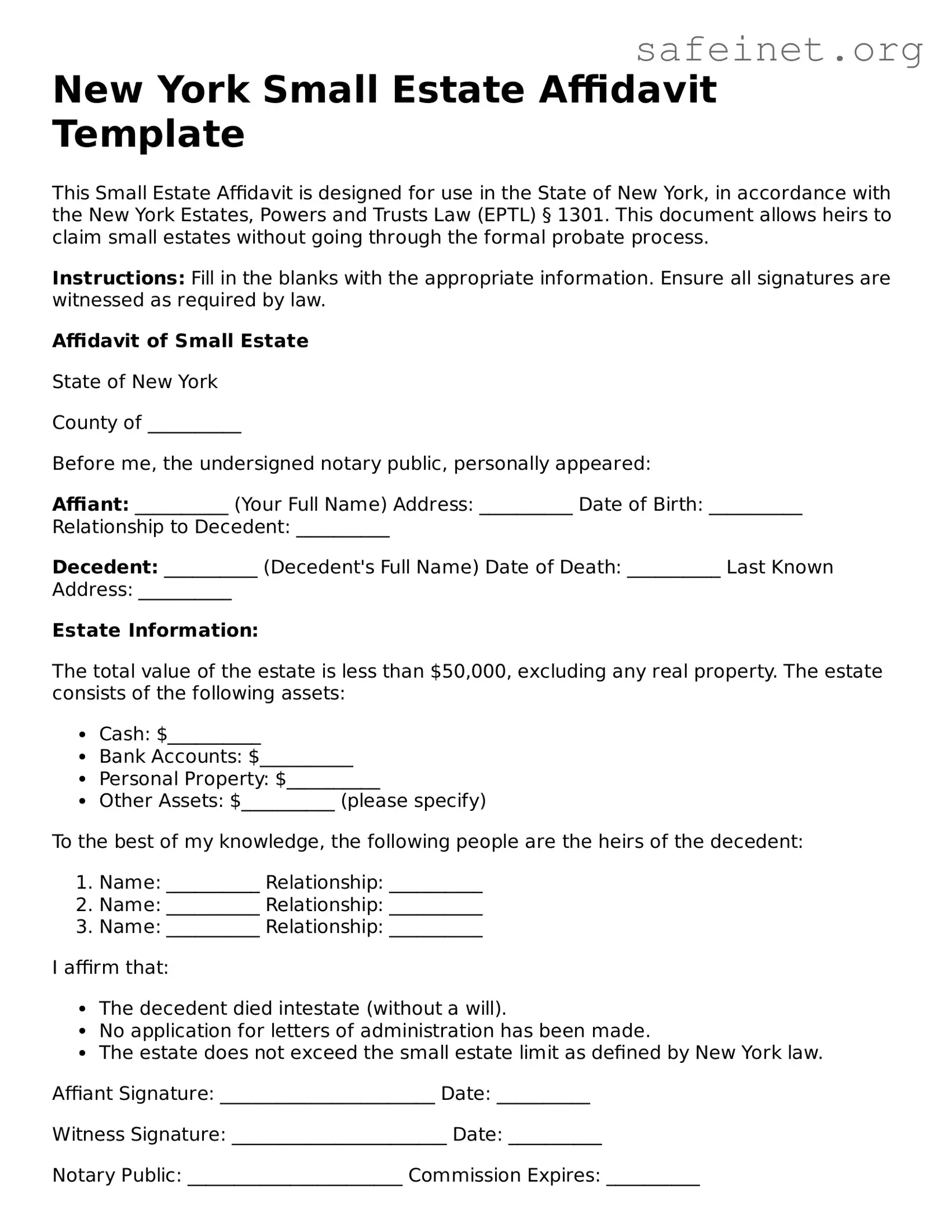
New York Small Estate Affidavit Template
This Small Estate Affidavit is designed for use in the State of New York, in accordance with the New York Estates, Powers and Trusts Law (EPTL) § 1301. This document allows heirs to claim small estates without going through the formal probate process.
Instructions: Fill in the blanks with the appropriate information. Ensure all signatures are witnessed as required by law.
Affidavit of Small Estate
State of New York
County of __________
Before me, the undersigned notary public, personally appeared:
Affiant: __________ (Your Full Name) Address: __________ Date of Birth: __________ Relationship to Decedent: __________
Decedent: __________ (Decedent's Full Name) Date of Death: __________ Last Known Address: __________
Estate Information:
The total value of the estate is less than $50,000, excluding any real property. The estate consists of the following assets:
To the best of my knowledge, the following people are the heirs of the decedent:
I affirm that:
Affiant Signature: _______________________ Date: __________
Witness Signature: _______________________ Date: __________
Notary Public: _______________________ Commission Expires: __________
This affidavit is executed under penalty of perjury. False statements may lead to legal consequences.
| Fact Name | Description |
|---|---|
| Purpose | The New York Small Estate Affidavit allows heirs to claim assets without going through probate if the estate is valued at $50,000 or less. |
| Eligibility | Only individuals who are entitled to inherit under New York law can use this form. |
| Governing Law | The Small Estate Affidavit is governed by New York Estates, Powers and Trusts Law (EPTL) § 1301. |
| Assets Included | Real estate, bank accounts, and personal property can be claimed using this affidavit, provided they meet the value limit. |
| Filing Requirements | The affidavit must be signed in front of a notary public and submitted to the institution holding the deceased's assets. |
| Affidavit Contents | The form must include information about the deceased, the heirs, and a list of assets. |
| Time Limit | There is no specific time limit for filing the affidavit, but it is advisable to do so promptly after death. |
| Multiple Heirs | If there are multiple heirs, all must sign the affidavit, indicating their agreement to the distribution of assets. |
| Not a Will | The Small Estate Affidavit does not replace a will; it is a simplified process for small estates. |
| Legal Advice | While the form is designed for ease of use, consulting with a legal professional is recommended for complex situations. |
After gathering the necessary information and documents, you are ready to fill out the New York Small Estate Affidavit form. This form allows individuals to claim assets of a deceased person without going through the lengthy probate process. Follow the steps below to ensure the form is completed accurately.
What is a New York Small Estate Affidavit?
The New York Small Estate Affidavit is a legal document that allows individuals to claim assets of a deceased person without going through the formal probate process. This is typically used when the value of the estate is below a certain threshold, making it simpler and faster to settle the estate. The affidavit serves as a sworn statement that provides information about the deceased, their assets, and the heirs entitled to inherit those assets.
Who can use the Small Estate Affidavit in New York?
Generally, any person who is an heir or a beneficiary of the deceased can use the Small Estate Affidavit. This includes spouses, children, parents, siblings, or other relatives who are legally recognized as heirs. However, the total value of the estate must not exceed $50,000 for individuals or $100,000 for married couples in order to qualify for this process.
What assets can be claimed using the Small Estate Affidavit?
The affidavit can be used to claim various types of assets, including bank accounts, personal property, and other tangible assets owned by the deceased. It is important to note that real estate cannot be transferred using this affidavit. If the deceased owned real estate, a different legal process would need to be followed.
How do I complete the Small Estate Affidavit?
To complete the Small Estate Affidavit, you must provide specific information about the deceased, such as their name, date of death, and the location of their assets. You will also need to list the names and addresses of all heirs and beneficiaries. It is crucial to ensure that all information is accurate and truthful, as this document is a sworn statement.
Is there a fee associated with filing the Small Estate Affidavit?
There is no fee to file a Small Estate Affidavit in New York. However, if you need to obtain certified copies of the affidavit for financial institutions or other entities, there may be a small fee for those copies. Always check with the specific institution for their requirements.
Do I need to file the Small Estate Affidavit with the court?
No, the Small Estate Affidavit does not need to be filed with the court. Instead, you present the affidavit directly to the institutions holding the deceased's assets. They will review the affidavit and, if everything is in order, release the assets to you.
What happens if there are disputes among heirs regarding the Small Estate Affidavit?
If there are disputes among heirs about the validity of the Small Estate Affidavit or the distribution of assets, the matter may need to be resolved through negotiation or, in some cases, legal proceedings. It is advisable to seek legal assistance in such situations to ensure that the rights of all parties are respected and the estate is settled fairly.
Can I use the Small Estate Affidavit if the deceased had a will?
Yes, you can still use the Small Estate Affidavit if the deceased had a will, provided that the estate meets the eligibility requirements. However, if the will names an executor, that person may need to go through the probate process instead. If the will is not contested and the estate is small, the Small Estate Affidavit can be an efficient option.
Incorrect Value of the Estate: Many people underestimate or overestimate the total value of the estate. Ensure that you accurately calculate the value of all assets, including real estate, bank accounts, and personal property.
Missing Signatures: Failing to obtain the required signatures can lead to delays. Make sure all necessary parties sign the affidavit before submission.
Not Including All Assets: Some individuals forget to list all assets owned by the deceased. Review carefully to ensure that nothing is omitted.
Incorrectly Identifying Heirs: Mistakes can occur when identifying heirs. Double-check names and relationships to avoid complications.
Inaccurate Dates: Entering incorrect dates, such as the date of death or the date of signing, can cause issues. Verify all dates before finalizing the form.
Not Following the Required Format: Each section of the affidavit must be completed in the specified format. Pay attention to details to ensure compliance.
Failing to Provide Supporting Documents: Some applicants neglect to include necessary documents, such as death certificates or proof of relationship. Gather all required documentation to support your affidavit.
The New York Small Estate Affidavit is a valuable tool for settling the estates of individuals who have passed away with limited assets. In addition to this affidavit, there are several other forms and documents that are often used in the process of estate administration. Each of these documents serves a specific purpose in ensuring a smooth transition of assets to heirs or beneficiaries.
Each of these documents plays a crucial role in the estate administration process. Understanding their purposes can help individuals navigate the complexities of settling an estate in New York more effectively.
The New York Small Estate Affidavit is somewhat similar to a Will. A Will outlines a person's wishes regarding the distribution of their assets after death. Both documents serve to transfer property, but a Will requires a more formal process, including probate court involvement. In contrast, the Small Estate Affidavit allows for a simpler procedure when the estate falls below a certain value, enabling heirs to claim assets without lengthy court proceedings.
Another document that shares similarities with the Small Estate Affidavit is the Affidavit of Heirship. This affidavit is used to establish the rightful heirs of a deceased person's estate. Like the Small Estate Affidavit, it is a sworn statement that helps in the transfer of property. However, the Affidavit of Heirship is typically used in situations where there is no Will, while the Small Estate Affidavit can be utilized when the estate is small and the deceased left behind a valid Will.
The Power of Attorney (POA) is also comparable to the Small Estate Affidavit in that both documents empower individuals to manage financial matters. A POA allows someone to act on behalf of another person while they are alive, whereas the Small Estate Affidavit is used after a person has passed away. Both documents require careful consideration and trust, as they involve significant authority over assets.
The Executor's Deed is another document that bears resemblance to the Small Estate Affidavit. This deed is used to transfer real property from an estate to the beneficiaries after the probate process. While the Small Estate Affidavit facilitates the transfer of assets without going through probate, the Executor's Deed is a formal document that comes into play once the estate has been settled, ensuring that the property is legally transferred to the heirs.
Lastly, the Letters of Administration share similarities with the Small Estate Affidavit. Letters of Administration are issued by the court to appoint an administrator for an estate when there is no Will. Both documents help in the distribution of assets, but the Letters of Administration require court involvement, while the Small Estate Affidavit allows for a more streamlined process for smaller estates. This distinction can save time and resources for the heirs involved.
When filling out the New York Small Estate Affidavit form, it's important to follow certain guidelines to ensure accuracy and compliance. Here are six things to keep in mind:
By following these guidelines, you can help ensure a smoother process when handling small estates in New York.
Many people have misunderstandings about the New York Small Estate Affidavit form. Here are seven common misconceptions:
Understanding these misconceptions can help individuals navigate the process more effectively and ensure that they make informed decisions regarding the Small Estate Affidavit.
The New York Small Estate Affidavit is a useful tool for individuals dealing with the estate of a deceased person. Here are ten key takeaways regarding the form and its usage:
Understanding these key points will facilitate a smoother process when dealing with small estates in New York.