In the realm of estate planning, ensuring that a will is both valid and easily accepted by the courts is of utmost importance. One tool that simplifies this process in New York is the Self-Proving Affidavit form. This document serves a crucial function by allowing the testator— the person making the will— and witnesses to affirm the authenticity of the will in a straightforward manner. By signing this affidavit in front of a notary public, the individuals involved can eliminate the need for witnesses to appear in court after the testator's passing. This can save time and reduce complications during the probate process. Additionally, the Self-Proving Affidavit not only provides a layer of protection against challenges to the will's validity but also enhances the overall efficiency of estate administration. Understanding how to properly complete and utilize this form can empower individuals to navigate the complexities of will validation with confidence.
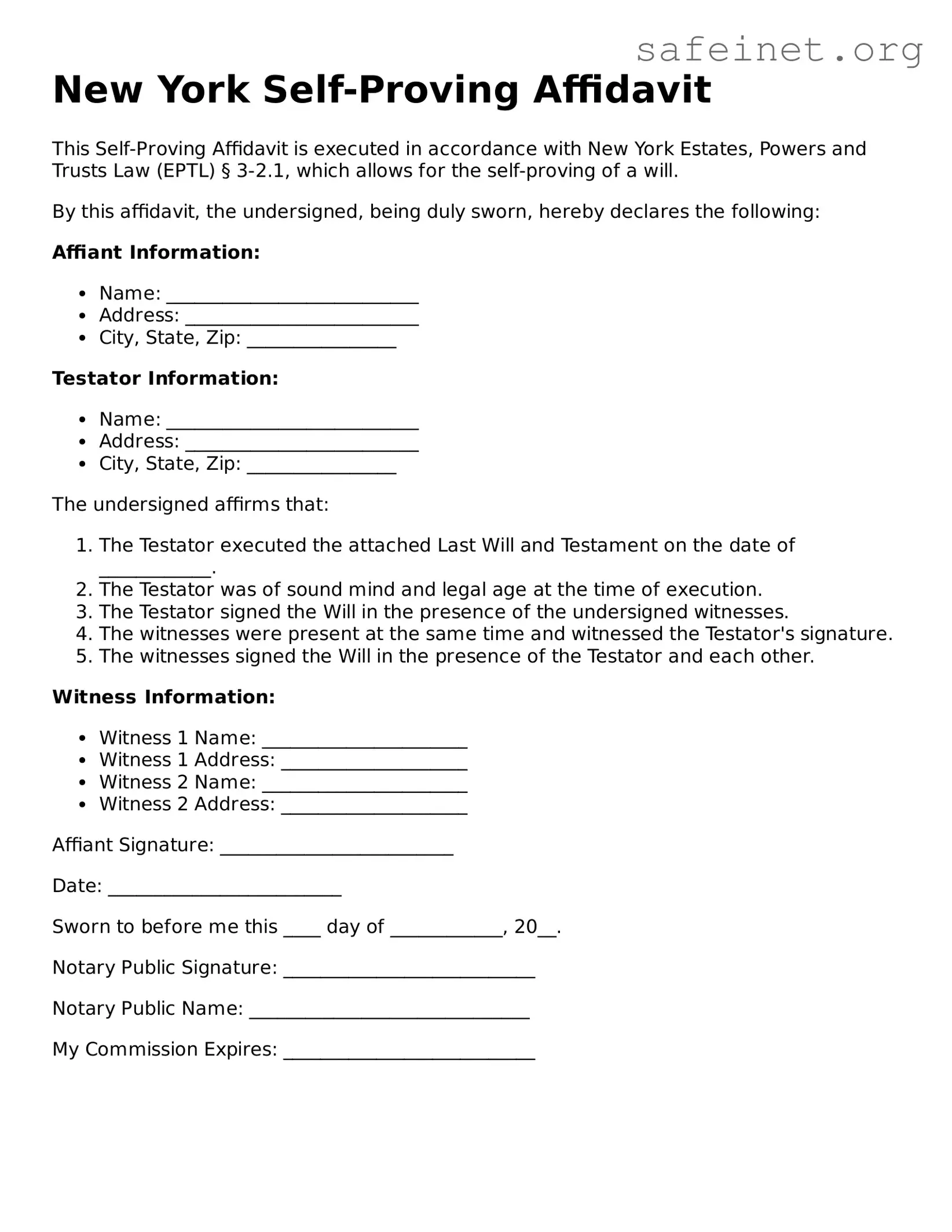
New York Self-Proving Affidavit
This Self-Proving Affidavit is executed in accordance with New York Estates, Powers and Trusts Law (EPTL) § 3-2.1, which allows for the self-proving of a will.
By this affidavit, the undersigned, being duly sworn, hereby declares the following:
Affiant Information:
Testator Information:
The undersigned affirms that:
Witness Information:
Affiant Signature: _________________________
Date: _________________________
Sworn to before me this ____ day of ____________, 20__.
Notary Public Signature: ___________________________
Notary Public Name: ______________________________
My Commission Expires: ___________________________
| Fact Name | Description |
|---|---|
| Definition | A New York Self-Proving Affidavit is a legal document that allows a will to be validated without the need for witnesses to testify in court. |
| Governing Law | This affidavit is governed by the New York Estates, Powers and Trusts Law (EPTL) § 3-2.1. |
| Purpose | The primary purpose of this affidavit is to simplify the probate process by confirming the validity of a will. |
| Requirements | To be valid, the affidavit must be signed by the testator and two witnesses in the presence of a notary public. |
| Notarization | Notarization is essential. It provides an additional layer of verification for the signatures on the will. |
| Revocation | A self-proving affidavit does not revoke a will. It simply enhances its validity during probate. |
| Use in Probate | This affidavit can be submitted to the probate court to expedite the process, eliminating the need for witness testimony. |
| Format | The affidavit must follow a specific format as outlined in New York law to be considered valid. |
| Accessibility | Individuals can obtain a self-proving affidavit form from various legal resources, including online legal services and law offices. |
After obtaining the New York Self-Proving Affidavit form, you will need to complete it accurately to ensure it serves its purpose. Follow these steps carefully to fill out the form correctly.
What is a New York Self-Proving Affidavit?
A New York Self-Proving Affidavit is a legal document that allows a will to be validated without the need for witnesses to testify in court. When a testator (the person who created the will) signs this affidavit in the presence of a notary and witnesses, it serves as proof that the will was executed properly. This can streamline the probate process significantly.
Why should I use a Self-Proving Affidavit?
Using a Self-Proving Affidavit can save time and reduce complications during the probate process. By having this affidavit, you eliminate the need for witnesses to come forward to confirm the will's validity. This is especially beneficial if witnesses are unavailable or have passed away. It provides peace of mind that your wishes will be honored without unnecessary delays.
How do I create a Self-Proving Affidavit?
To create a Self-Proving Affidavit in New York, you need to follow a few steps. First, ensure your will is properly drafted and signed by you and your witnesses. Next, have the witnesses and yourself sign the Self-Proving Affidavit in front of a notary public. This affidavit should be attached to the will. It’s important to check that the form meets all legal requirements to ensure its validity.
Can I use a Self-Proving Affidavit if my will was created without one?
If your will was created without a Self-Proving Affidavit, you cannot retroactively add one. However, you can create a new will that includes a Self-Proving Affidavit. It’s crucial to revoke the old will properly to avoid confusion. Consulting with a legal professional can help ensure that your new will is valid and meets your needs.
Is a Self-Proving Affidavit required for all wills in New York?
No, a Self-Proving Affidavit is not required for all wills in New York. While it simplifies the probate process, it is not a legal necessity. If you prefer to have witnesses testify in court about the will's validity, you can choose to do so. However, having a Self-Proving Affidavit can make things easier for your loved ones during a difficult time.
What happens if my Self-Proving Affidavit is not accepted?
If a Self-Proving Affidavit is not accepted, the will may still be valid, but the probate process may become more complicated. The court might require witnesses to testify about the will’s execution. This can lead to delays and additional legal challenges. To avoid this, ensure that your Self-Proving Affidavit is correctly completed and meets all legal standards.
Where can I find a Self-Proving Affidavit form?
You can find a Self-Proving Affidavit form through various online legal resources, law firms, or by consulting with an attorney. Many websites offer templates that you can customize to fit your needs. However, it’s wise to have any legal document reviewed by a professional to ensure it complies with New York law and accurately reflects your intentions.
Incomplete Information: Many individuals fail to provide all necessary details, such as names, addresses, and dates. Each section must be filled out accurately to avoid complications later.
Not Having Witnesses Present: The affidavit requires the presence of witnesses during the signing process. Skipping this step can invalidate the document.
Signatures Not in the Correct Order: The order of signatures is crucial. The testator should sign first, followed by the witnesses. Mixing up this order can lead to confusion and potential legal issues.
Failing to Notarize: A self-proving affidavit must be notarized. Neglecting to have a notary public witness the signatures means the affidavit may not be accepted in court.
Using Incorrect Language: The language used in the affidavit should be clear and precise. Ambiguities can create misunderstandings and complicate the probate process.
Not Keeping Copies: After filling out the affidavit, individuals often forget to make copies. Retaining a copy for personal records is essential for future reference.
Ignoring State-Specific Requirements: Each state has its own rules regarding affidavits. Failing to adhere to New York's specific requirements can render the document ineffective.
The New York Self-Proving Affidavit is a crucial document in the estate planning process, particularly in the context of wills. It serves to simplify the probate process by affirming the validity of a will without requiring the testimony of witnesses. Alongside this affidavit, several other forms and documents are commonly utilized to ensure a comprehensive legal framework for estate management. Below is a list of five such documents.
Each of these documents plays a significant role in estate planning and management, providing clarity and direction during what can be a complex process. Understanding their functions and interrelationships can help individuals navigate their legal responsibilities and protect their wishes effectively.
The New York Self-Proving Affidavit is similar to the Durable Power of Attorney. Both documents serve to ensure that an individual's wishes are honored even when they are unable to communicate them. A Durable Power of Attorney allows a person to designate someone to make decisions on their behalf regarding financial and legal matters. The self-proving affidavit, on the other hand, validates a will by confirming the testator's signature and the witnesses' presence, thereby facilitating the probate process.
Another comparable document is the Living Will. A Living Will outlines an individual's preferences for medical treatment in situations where they cannot express their wishes. Like the Self-Proving Affidavit, it is designed to uphold the individual’s intentions. While the Self-Proving Affidavit deals with the distribution of assets after death, the Living Will addresses healthcare decisions during life, reflecting the individual's desires in critical situations.
The Health Care Proxy shares similarities with the Self-Proving Affidavit as well. This document allows a person to appoint someone to make healthcare decisions on their behalf if they become incapacitated. Both documents emphasize the importance of respecting an individual’s wishes. While the Self-Proving Affidavit pertains to the validation of a will, the Health Care Proxy ensures that medical choices align with the individual's values and preferences.
The Revocable Living Trust is another document that bears resemblance to the Self-Proving Affidavit. A Revocable Living Trust allows a person to manage their assets during their lifetime and specifies how those assets should be distributed after death. Both documents aim to simplify the process of transferring assets and minimizing legal complications. However, while the Self-Proving Affidavit is focused on validating a will, the Revocable Living Trust serves as an alternative to a will for asset distribution.
Similar to the Self-Proving Affidavit, the Last Will and Testament is a foundational estate planning document. The Last Will specifies how a person's assets should be distributed after death. The Self-Proving Affidavit enhances the Last Will by providing a mechanism to verify its authenticity, thereby streamlining the probate process. Both documents work together to ensure that an individual's final wishes are honored.
The Codicil to a Will is akin to the Self-Proving Affidavit in that it serves to amend an existing will. A Codicil allows an individual to make changes or updates to their will without creating an entirely new document. Just as the Self-Proving Affidavit validates the will and its amendments, the Codicil must also adhere to specific legal requirements to ensure its enforceability.
The Affidavit of Heirship is another document that parallels the Self-Proving Affidavit. This affidavit is used to establish the identity of heirs in situations where a decedent did not leave a will. Both documents serve to clarify the intentions of the deceased. While the Self-Proving Affidavit confirms a will's validity, the Affidavit of Heirship helps determine rightful heirs, facilitating the distribution of assets.
The Financial Power of Attorney also shares characteristics with the Self-Proving Affidavit. This document allows an individual to designate someone to handle their financial matters. Both documents emphasize the importance of individual choice and control over personal affairs. While the Self-Proving Affidavit is concerned with posthumous asset distribution, the Financial Power of Attorney focuses on managing assets during the individual's lifetime.
The Will Contest Affidavit, while serving a different purpose, is related to the Self-Proving Affidavit. This document is used when someone challenges the validity of a will. It can provide evidence supporting or disputing claims made about the will. Both documents are involved in the probate process, but the Will Contest Affidavit addresses disputes, whereas the Self-Proving Affidavit aims to affirm the will's legitimacy.
Lastly, the Personal Representative's Affidavit is similar to the Self-Proving Affidavit in that it relates to the administration of an estate. This document is used by the personal representative to affirm their authority to act on behalf of the estate. Both documents play crucial roles in the probate process, with the Self-Proving Affidavit confirming the will's validity and the Personal Representative's Affidavit establishing the authority of the individual managing the estate.
When completing the New York Self-Proving Affidavit form, it’s important to approach the task with care. Here are some essential dos and don’ts to keep in mind:
Understanding the New York Self-Proving Affidavit form is essential for anyone involved in estate planning or handling a will. However, several misconceptions can lead to confusion. Here are five common misunderstandings:
Many people believe that this affidavit is required for all wills in New York. In reality, while it simplifies the probate process, it is not mandatory. A will can still be valid without it, although having one can expedite matters.
This is a misconception. While it is advisable to consult with an attorney, individuals can prepare the affidavit themselves as long as they follow the legal requirements outlined in New York law.
Some think that using this affidavit means witnesses are no longer necessary. However, witnesses are still required when the will is executed. The affidavit serves to affirm their signatures later during probate.
This is not true. The affidavit is typically kept with the will, but it does not need to be filed with the court at the time of probate. It is presented later to validate the will.
This misconception can lead to significant issues. The affidavit can be revoked or modified just like any other part of a will, as long as the proper legal procedures are followed.
Clearing up these misconceptions can help individuals navigate the complexities of estate planning more effectively. Understanding the role of the Self-Proving Affidavit can save time and reduce stress in the probate process.
When it comes to the New York Self-Proving Affidavit form, understanding its purpose and proper usage can make a significant difference in the estate planning process. Here are some key takeaways to keep in mind:
By keeping these points in mind, you can navigate the process of creating a Self-Proving Affidavit with greater ease and confidence.