The New York Quitclaim Deed form serves as a crucial tool for property owners looking to transfer their interest in real estate without the complexities often associated with traditional deeds. This form allows individuals to convey their rights to a property to another party, making it particularly useful in situations like family transfers, divorce settlements, or estate planning. Unlike warranty deeds, which guarantee a clear title, quitclaim deeds do not provide such assurances; they merely transfer whatever interest the grantor has in the property, if any. The simplicity of the form can be appealing, as it requires less documentation and fewer formalities. However, it’s essential for both the grantor and grantee to understand the implications of this transfer. Proper completion of the form includes essential details such as the names of both parties, a description of the property, and the signature of the grantor. Once executed, the deed must be filed with the county clerk to make the transfer official. Understanding these key aspects can help individuals navigate the process smoothly and ensure that their property interests are handled appropriately.
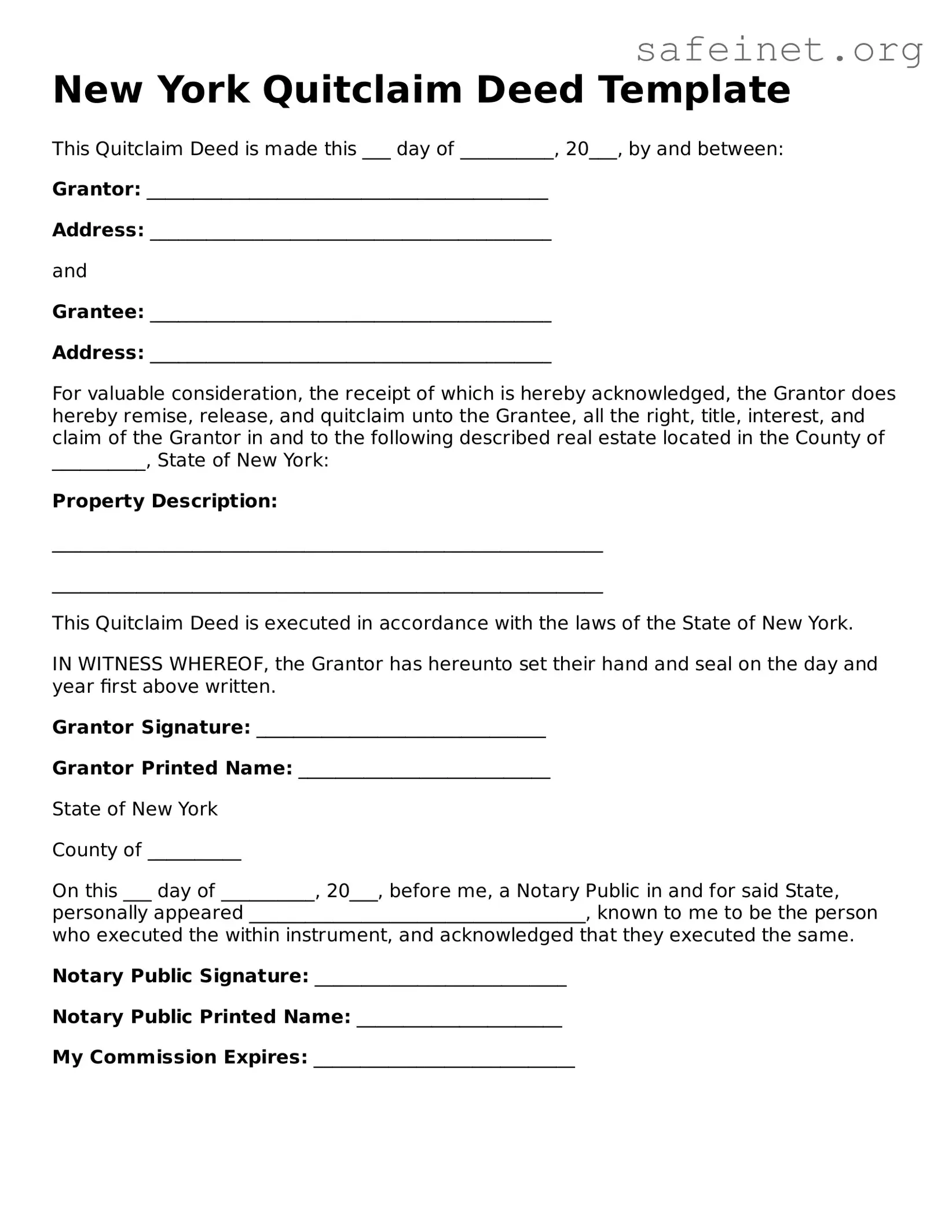
New York Quitclaim Deed Template
This Quitclaim Deed is made this ___ day of __________, 20___, by and between:
Grantor: ___________________________________________
Address: ___________________________________________
and
Grantee: ___________________________________________
Address: ___________________________________________
For valuable consideration, the receipt of which is hereby acknowledged, the Grantor does hereby remise, release, and quitclaim unto the Grantee, all the right, title, interest, and claim of the Grantor in and to the following described real estate located in the County of __________, State of New York:
Property Description:
___________________________________________________________
___________________________________________________________
This Quitclaim Deed is executed in accordance with the laws of the State of New York.
IN WITNESS WHEREOF, the Grantor has hereunto set their hand and seal on the day and year first above written.
Grantor Signature: _______________________________
Grantor Printed Name: ___________________________
State of New York
County of __________
On this ___ day of __________, 20___, before me, a Notary Public in and for said State, personally appeared ____________________________________, known to me to be the person who executed the within instrument, and acknowledged that they executed the same.
Notary Public Signature: ___________________________
Notary Public Printed Name: ______________________
My Commission Expires: ____________________________
| Fact Name | Description |
|---|---|
| Definition | A quitclaim deed is a legal document used to transfer ownership of real estate from one party to another without any warranties or guarantees. |
| Governing Law | The use and execution of quitclaim deeds in New York are governed by the New York Real Property Law. |
| Requirements | In New York, a quitclaim deed must be signed by the grantor and notarized. It should also be recorded with the county clerk's office to be effective against third parties. |
| Limitations | Since a quitclaim deed does not guarantee clear title, the grantee assumes the risk of any existing liens or encumbrances on the property. |
After gathering the necessary information, you are ready to fill out the New York Quitclaim Deed form. This form is an essential document for transferring property ownership. Once completed, it will need to be signed, notarized, and filed with the appropriate county office.
What is a Quitclaim Deed in New York?
A Quitclaim Deed is a legal document used to transfer ownership of real estate from one party to another without making any guarantees about the property title. In New York, it allows the grantor (the person transferring the property) to convey their interest in the property to the grantee (the person receiving the property). This type of deed is often used among family members or in situations where the grantor does not want to be liable for any potential title issues.
When should I use a Quitclaim Deed?
A Quitclaim Deed is commonly used in specific situations, such as transferring property between family members, adding or removing a spouse from the title after marriage or divorce, or when property is being transferred as part of a settlement. It is important to note that this deed does not guarantee that the property is free from liens or other claims.
What information is required to complete a Quitclaim Deed?
To complete a Quitclaim Deed in New York, you will need to include the names and addresses of both the grantor and grantee, a legal description of the property, the county where the property is located, and the date of the transfer. Additionally, the grantor must sign the deed in the presence of a notary public.
Is a Quitclaim Deed the same as a Warranty Deed?
No, a Quitclaim Deed is not the same as a Warranty Deed. A Warranty Deed provides guarantees from the grantor regarding the title, including that they hold clear title to the property and have the right to sell it. In contrast, a Quitclaim Deed does not offer any such assurances. It simply transfers whatever interest the grantor may have in the property.
Do I need to file the Quitclaim Deed with the county?
Yes, after completing the Quitclaim Deed, it must be filed with the county clerk's office in the county where the property is located. Filing the deed is essential for making the transfer of ownership public and protecting the rights of the grantee.
Are there any fees associated with filing a Quitclaim Deed in New York?
Yes, there are typically fees associated with filing a Quitclaim Deed in New York. These fees can vary by county. It is advisable to check with the local county clerk’s office for the exact filing fees and any additional costs that may apply.
Can I revoke a Quitclaim Deed after it has been executed?
Once a Quitclaim Deed has been executed and filed, it cannot be revoked unilaterally. The grantor cannot take back the transfer of property without the consent of the grantee. If a change needs to be made, it may require a new deed or other legal action.
Is legal assistance necessary when preparing a Quitclaim Deed?
While it is not legally required to have an attorney prepare a Quitclaim Deed, it is often advisable. Legal assistance can ensure that the deed is completed correctly and complies with all local laws. An attorney can also help address any specific concerns about the property title or the implications of the transfer.
Failing to include all required parties' names. Ensure that both the grantor (the person giving the property) and the grantee (the person receiving the property) are clearly stated.
Not providing a complete legal description of the property. A vague description can lead to confusion and disputes later on.
Forgetting to sign the deed. Without the grantor's signature, the document is not valid.
Neglecting to have the deed notarized. A notarized deed is essential for it to be accepted by the county clerk.
Using incorrect dates. Ensure that the date of execution is accurate to avoid potential legal issues.
Not checking local filing requirements. Each county may have specific rules regarding the submission of a Quitclaim Deed.
Overlooking the need for a tax identification number. Including this number can streamline the filing process.
A Quitclaim Deed is often accompanied by several other documents to ensure a smooth property transfer process. Each of these documents serves a specific purpose and helps clarify ownership and rights. Below is a list of common forms and documents that may be used alongside a Quitclaim Deed in New York.
Understanding these documents can help ensure that the property transfer process is clear and efficient. Each document plays a role in protecting the rights of both the buyer and the seller, contributing to a successful transaction.
The New York Quitclaim Deed is often compared to the Warranty Deed, which is another common property transfer document. Unlike a quitclaim deed, a warranty deed provides a guarantee that the seller holds clear title to the property and has the right to transfer it. This means that if any issues arise regarding the title, the seller is legally responsible for resolving them. This added layer of protection makes warranty deeds more suitable for buyers who want assurance about the property’s legal standing.
Another document similar to the Quitclaim Deed is the Bargain and Sale Deed. This type of deed conveys property without any warranty of title, much like a quitclaim deed. However, a Bargain and Sale Deed typically implies that the seller has some interest in the property and may have the right to sell it. This can provide a little more confidence to the buyer, as it suggests that the seller has not simply abandoned the property.
The Special Warranty Deed also bears similarities to the Quitclaim Deed. This deed offers a limited warranty, meaning the seller guarantees that they have not encumbered the property during their ownership. While it does not provide the same level of assurance as a full warranty deed, it does give some protection to the buyer against claims that arose while the seller owned the property, making it a middle ground between a quitclaim and a full warranty deed.
The General Warranty Deed is another document that shares characteristics with the Quitclaim Deed. Like the warranty deed, it guarantees that the seller has clear title to the property. However, it goes a step further by protecting the buyer against any claims that may arise from the property's history, even before the seller owned it. This comprehensive protection is a key distinction from the Quitclaim Deed, which does not provide any guarantees.
A Deed of Trust is also relevant in this discussion. While not a direct substitute for a quitclaim deed, it serves a different purpose in property transactions. This document is used primarily in financing arrangements, where the property is used as collateral for a loan. The borrower transfers the property to a trustee, who holds it until the loan is repaid. This type of deed emphasizes the financial aspect of property ownership rather than the transfer of title.
The Affidavit of Heirship is similar in that it can be used to transfer property without a formal deed, particularly when someone passes away without a will. This document establishes the heirs of a deceased person and can help facilitate the transfer of property to them. While it does not serve the same function as a quitclaim deed, it is another way to convey property rights, particularly in cases of inheritance.
A Lease Agreement also shares some similarities with the Quitclaim Deed, particularly in the context of property rights. While a quitclaim deed transfers ownership, a lease agreement allows someone to use the property for a specified period without transferring ownership. This document outlines the rights and responsibilities of both the landlord and tenant, making it essential for rental situations.
Finally, the Bill of Sale can be likened to a Quitclaim Deed in that it is a document used to transfer ownership of personal property rather than real estate. While a quitclaim deed is focused on land and buildings, a Bill of Sale serves to formalize the sale of items like vehicles, equipment, or furniture. Both documents serve to confirm the transfer of ownership, albeit in different contexts.
When filling out the New York Quitclaim Deed form, it’s important to follow certain guidelines to ensure the process goes smoothly. Here are some dos and don'ts to keep in mind:
When dealing with the New York Quitclaim Deed form, several misconceptions can lead to confusion. Understanding these can help ensure a smoother property transfer process.
While a Quitclaim Deed does transfer the grantor's interest in the property, it does not guarantee that the grantor holds clear title. If there are any liens or claims against the property, the new owner may still face issues.
Although often used in family transactions, Quitclaim Deeds can be utilized in any situation where the grantor wants to transfer their interest in a property. This includes sales, gifts, and other arrangements.
Even though Quitclaim Deeds are simpler than other types of deeds, they still need to be signed, notarized, and recorded with the county clerk to be legally effective.
While a Quitclaim Deed transfers the grantor's interest, it does not prevent the new owner from challenging ownership if there are disputes. Legal action can still be pursued if necessary.
Filling out and using a New York Quitclaim Deed can be straightforward, but there are essential points to keep in mind to ensure everything goes smoothly. Here are some key takeaways:
By keeping these takeaways in mind, you can navigate the Quitclaim Deed process more effectively and ensure a smoother transfer of property ownership in New York.