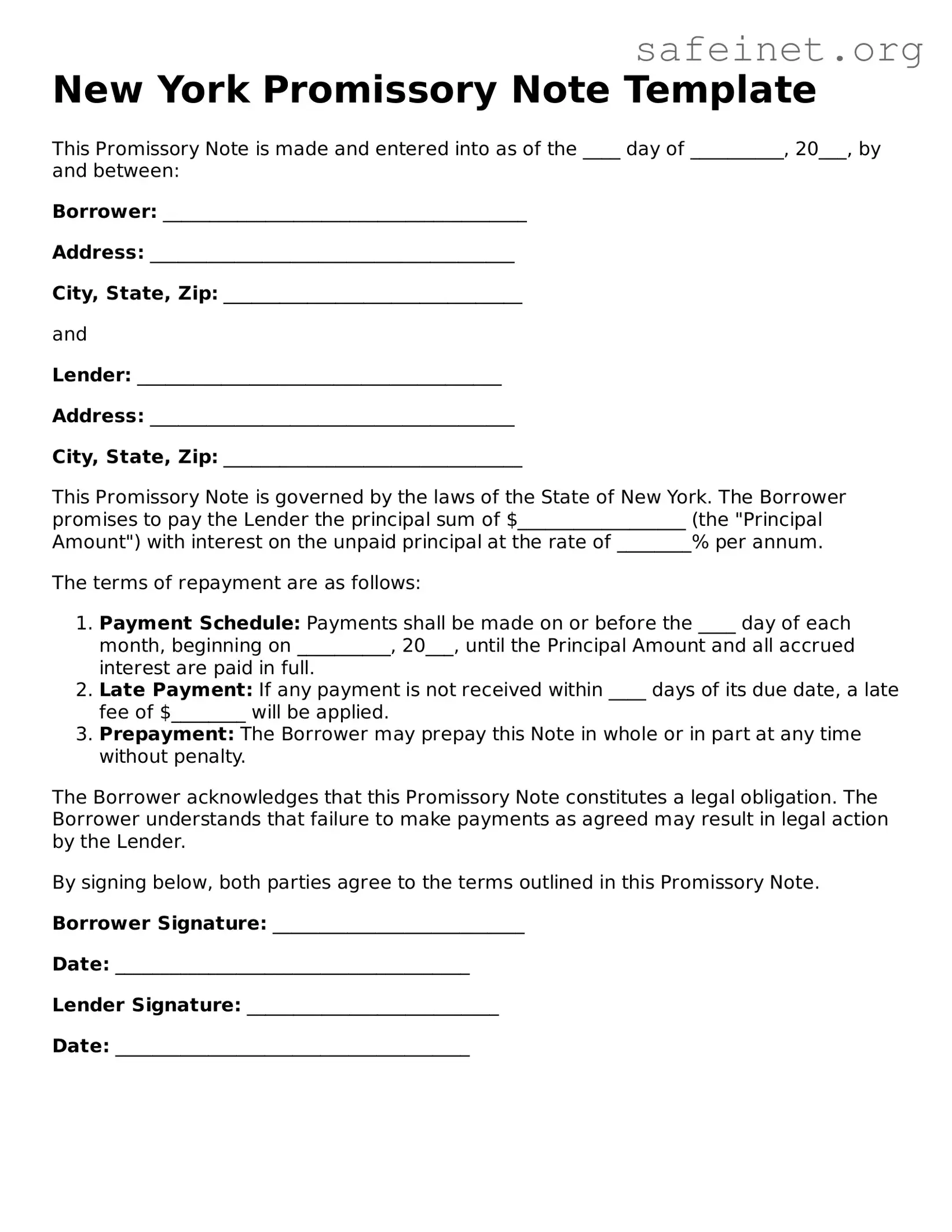
The New York Promissory Note form serves as a crucial document in financial transactions, outlining the borrower's promise to repay a specified amount to the lender under agreed-upon terms. This form includes essential details such as the principal amount, interest rate, repayment schedule, and any applicable late fees. It also specifies the maturity date, which indicates when the full amount is due. The document may require signatures from both parties, establishing a legally binding agreement that protects the interests of both the borrower and the lender. Additionally, the form can include clauses addressing default conditions, allowing for clear recourse in case of non-payment. Understanding the components of this form is vital for anyone involved in lending or borrowing, ensuring that all parties are aware of their rights and obligations throughout the loan period.
New York Promissory Note Template
This Promissory Note is made and entered into as of the ____ day of __________, 20___, by and between:
Borrower: _______________________________________
Address: _______________________________________
City, State, Zip: ________________________________
and
Lender: _______________________________________
Address: _______________________________________
City, State, Zip: ________________________________
This Promissory Note is governed by the laws of the State of New York. The Borrower promises to pay the Lender the principal sum of $__________________ (the "Principal Amount") with interest on the unpaid principal at the rate of ________% per annum.
The terms of repayment are as follows:
The Borrower acknowledges that this Promissory Note constitutes a legal obligation. The Borrower understands that failure to make payments as agreed may result in legal action by the Lender.
By signing below, both parties agree to the terms outlined in this Promissory Note.
Borrower Signature: ___________________________
Date: ______________________________________
Lender Signature: ___________________________
Date: ______________________________________
| Fact Name | Description |
|---|---|
| Definition | A promissory note is a written promise to pay a specified amount of money to a designated person or entity at a future date or on demand. |
| Governing Law | The New York Uniform Commercial Code (UCC) governs promissory notes in New York. |
| Parties Involved | Typically, there are two parties: the maker (who promises to pay) and the payee (who receives the payment). |
| Interest Rates | Interest can be included in the note, and it must be clearly stated. New York law allows for certain maximum interest rates. |
| Signature Requirement | The maker must sign the note for it to be legally binding. An electronic signature is acceptable under New York law. |
| Transferability | Promissory notes are generally transferable. The payee can sell or endorse the note to another party. |
| Default Consequences | If the maker defaults, the payee can take legal action to collect the owed amount, including interest and fees. |
| Use in Transactions | Promissory notes are often used in loans, real estate transactions, and business deals to document payment obligations. |
After you have gathered the necessary information, you are ready to fill out the New York Promissory Note form. This form will require specific details about the loan agreement between the lender and the borrower. Carefully follow the steps below to ensure that all information is accurately provided.
Once you have completed the form, make sure to keep a copy for your records. It’s important to have documentation of the agreement. Both parties should retain their copies in case any questions arise in the future.
What is a New York Promissory Note?
A New York Promissory Note is a legal document that outlines a borrower's promise to repay a specified amount of money to a lender under agreed-upon terms. This document serves as a written record of the debt and includes details such as the loan amount, interest rate, repayment schedule, and any penalties for late payment. It is important for both parties to understand the terms clearly before signing.
Who typically uses a Promissory Note in New York?
Individuals, businesses, and financial institutions commonly use Promissory Notes. They are often utilized in personal loans between friends or family, business loans, and real estate transactions. Anyone who lends money may find it beneficial to have a Promissory Note to ensure that the terms of repayment are clear and legally enforceable.
What are the essential components of a New York Promissory Note?
A well-drafted New York Promissory Note should include the following components: the names and addresses of the borrower and lender, the principal amount of the loan, the interest rate, the repayment schedule, and any late fees or penalties. Additionally, it may include clauses regarding default, prepayment, and governing law. These elements help protect the interests of both parties involved.
Is a Promissory Note legally binding in New York?
Yes, a Promissory Note is legally binding in New York, provided it meets the necessary legal requirements. Both parties must agree to the terms, and the document should be signed and dated. It is advisable to have the note notarized to add an extra layer of authenticity, although this is not always required.
Can a Promissory Note be modified after it is signed?
Yes, a Promissory Note can be modified after it is signed, but both parties must agree to the changes. It is essential to document any modifications in writing and have both parties sign the amended agreement. This ensures that the new terms are clear and enforceable, preventing potential disputes in the future.
What happens if the borrower defaults on the Promissory Note?
If the borrower defaults, meaning they fail to make payments as agreed, the lender has several options. They may pursue legal action to recover the owed amount, which can include filing a lawsuit. The lender may also have the right to charge late fees or interest on the overdue amount, depending on the terms outlined in the note. It is crucial for both parties to understand the consequences of default before entering into the agreement.
Do I need a lawyer to create a New York Promissory Note?
While it is not legally required to have a lawyer draft a Promissory Note, consulting with one can be beneficial. A lawyer can help ensure that the document complies with New York laws and adequately protects your interests. If you are unfamiliar with the terms and conditions, seeking legal advice may provide peace of mind and clarity.
Failing to include the borrower's name and address accurately. This information is crucial for identifying the parties involved.
Not specifying the loan amount clearly. The total amount borrowed should be stated in both numbers and words to avoid confusion.
Omitting the interest rate. If applicable, the interest rate must be included to outline the cost of borrowing.
Neglecting to define the repayment terms. This includes the payment schedule, due dates, and any grace periods.
Not including a default clause. This clause outlines the consequences if the borrower fails to make payments as agreed.
Forgetting to sign and date the form. Both the borrower and lender must sign to validate the agreement.
Leaving out the witness or notary section. Depending on the situation, having a witness or notary can add an extra layer of legitimacy.
Using vague language. Clear and precise wording helps prevent misunderstandings about the terms of the loan.
A New York Promissory Note is a critical document used in lending transactions. However, it is often accompanied by other forms and documents that help clarify the terms of the loan and protect the interests of both parties involved. Below are some commonly used documents alongside a Promissory Note.
These documents collectively enhance the clarity and enforceability of the lending arrangement. Understanding their roles can help borrowers and lenders navigate the complexities of financial transactions more effectively.
The New York Promissory Note form shares similarities with a Loan Agreement. Both documents outline the terms under which a borrower receives funds from a lender. A Loan Agreement typically includes detailed information about the loan amount, interest rates, repayment schedule, and any collateral involved. Like the Promissory Note, it serves as a legal contract that binds both parties to the agreed-upon terms, ensuring that the lender has a legal recourse should the borrower fail to repay the loan as specified.
A Secured Promissory Note is another document that bears resemblance to the New York Promissory Note. This type of note not only establishes a borrower's promise to repay but also specifies that the loan is backed by collateral. If the borrower defaults, the lender has the right to seize the collateral to recover the owed amount. This added layer of security distinguishes it from an unsecured Promissory Note while maintaining the same fundamental principles of repayment and legal obligation.
The Demand Note is also comparable to the New York Promissory Note. This document allows the lender to demand repayment at any time, rather than following a set schedule. While both documents serve as a promise to pay, the Demand Note offers more flexibility for the lender, as it can be called in whenever deemed necessary. This can be particularly beneficial in situations where the lender may require immediate access to their funds.
An Installment Note is similar in that it outlines a borrower's obligation to repay a loan, but it specifically details a series of payments over time. Each installment typically includes both principal and interest, and the repayment schedule is clearly defined. Like the Promissory Note, it is a legally binding agreement, but the Installment Note emphasizes the structured approach to repayment, making it easier for borrowers to plan their finances.
Finally, a Mortgage Note is akin to the New York Promissory Note in that it represents a promise to repay a loan, but it is specifically tied to real estate transactions. This document outlines the borrower's commitment to repay the mortgage loan, and it often includes terms related to interest rates and payment schedules. The key difference lies in the fact that a Mortgage Note is secured by the property itself, giving the lender the right to foreclose if the borrower defaults on the loan.
When filling out the New York Promissory Note form, it’s essential to follow specific guidelines to ensure accuracy and legality. Here’s a list of things you should and shouldn't do:
Understanding the New York Promissory Note form is essential for anyone involved in lending or borrowing money. However, several misconceptions can lead to confusion. Here are eight common misunderstandings:
By addressing these misconceptions, individuals can navigate the complexities of the New York Promissory Note form more effectively and make informed decisions regarding lending and borrowing.
Filling out and using the New York Promissory Note form requires attention to detail and understanding of its components. Here are some key takeaways to consider:
By following these guidelines, you can create a promissory note that serves its intended purpose effectively.