When couples decide to marry, they often consider the financial implications of their union. A New York prenuptial agreement serves as a proactive measure to address these concerns. This legal document outlines how assets and debts will be managed during the marriage and what will happen in the event of a divorce. It can specify the division of property, spousal support, and even the handling of future income. By establishing these terms in advance, couples can reduce potential conflicts and misunderstandings down the line. Furthermore, a well-drafted prenuptial agreement can protect individual interests, especially for those entering the marriage with significant assets or those who own a business. Understanding the key components of the New York prenuptial agreement form is essential for couples looking to navigate their financial futures with clarity and confidence.
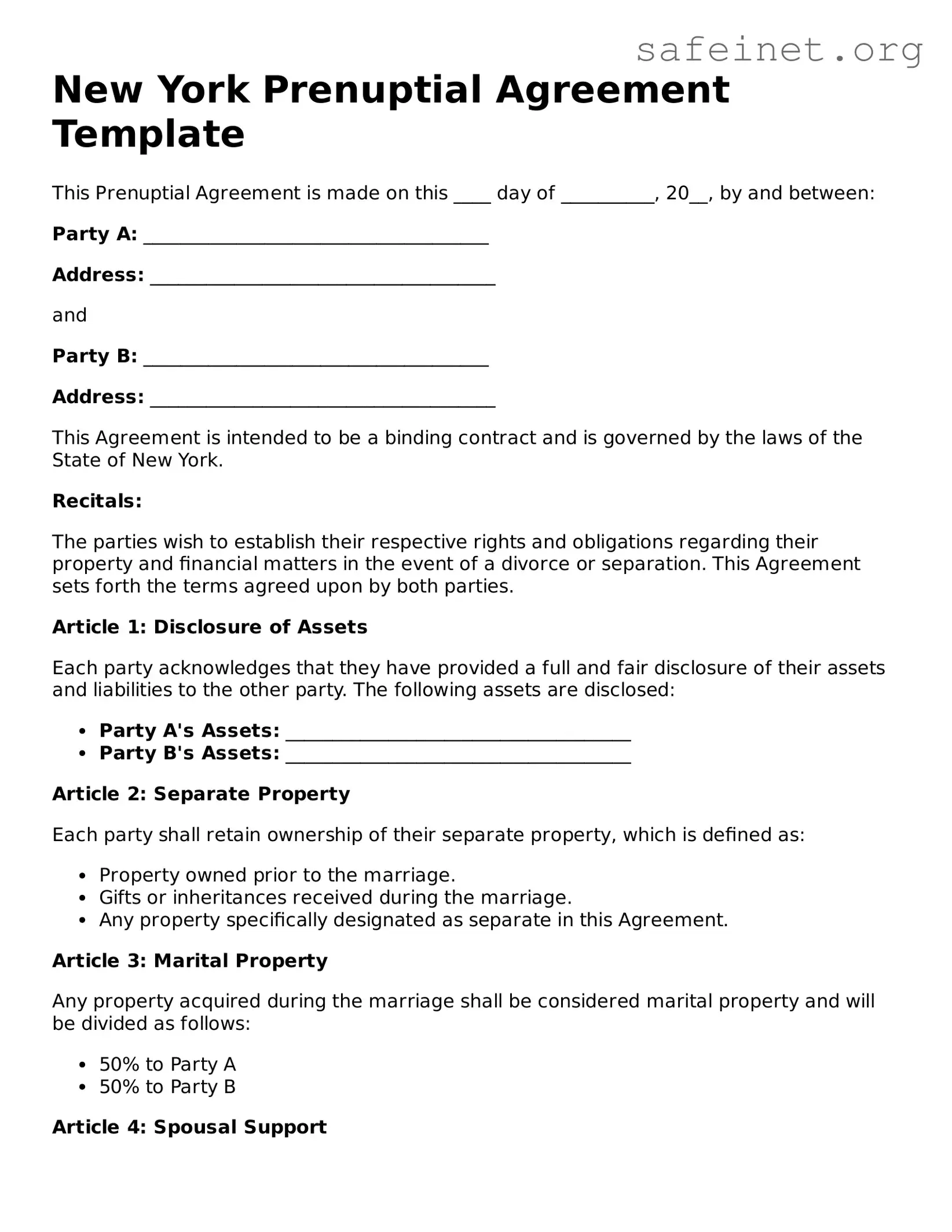
New York Prenuptial Agreement Template
This Prenuptial Agreement is made on this ____ day of __________, 20__, by and between:
Party A: _____________________________________
Address: _____________________________________
and
Party B: _____________________________________
Address: _____________________________________
This Agreement is intended to be a binding contract and is governed by the laws of the State of New York.
Recitals:
The parties wish to establish their respective rights and obligations regarding their property and financial matters in the event of a divorce or separation. This Agreement sets forth the terms agreed upon by both parties.
Article 1: Disclosure of Assets
Each party acknowledges that they have provided a full and fair disclosure of their assets and liabilities to the other party. The following assets are disclosed:
Article 2: Separate Property
Each party shall retain ownership of their separate property, which is defined as:
Article 3: Marital Property
Any property acquired during the marriage shall be considered marital property and will be divided as follows:
Article 4: Spousal Support
The parties agree that in the event of a divorce, the following terms will apply regarding spousal support:
Article 5: Miscellaneous Provisions
This Agreement represents the entire understanding between the parties and supersedes any prior agreements. Amendments must be made in writing and signed by both parties.
Article 6: Governing Law
This Agreement shall be governed by and construed in accordance with the laws of the State of New York.
IN WITNESS WHEREOF, the parties have executed this Prenuptial Agreement as of the date first above written.
Party A Signature: ___________________________
Date: ___________________________
Party B Signature: ___________________________
Date: ___________________________
Witness Signature: ___________________________
Date: ___________________________
| Fact Name | Details |
|---|---|
| Definition | A prenuptial agreement is a contract between two individuals before marriage that outlines the distribution of assets and responsibilities in the event of divorce or separation. |
| Governing Law | New York Domestic Relations Law governs prenuptial agreements in New York State. |
| Written Requirement | The agreement must be in writing to be enforceable. Oral agreements are not valid. |
| Full Disclosure | Both parties must provide a complete and honest disclosure of their financial situations. This includes assets, debts, and income. |
| Voluntary Agreement | Both parties must enter into the agreement voluntarily, without coercion or undue pressure. |
| Legal Representation | It is advisable for both parties to seek independent legal counsel before signing the agreement to ensure understanding and fairness. |
| Enforceability | The agreement can be challenged in court if it is found to be unconscionable or if proper procedures were not followed during its creation. |
| Modification | Prenuptial agreements can be modified after marriage, but any changes must also be in writing and signed by both parties. |
Filling out a prenuptial agreement form is an important step for couples considering marriage. This document outlines how assets will be handled during the marriage and in the event of a divorce. It is essential to approach this process thoughtfully and collaboratively.
Following these steps will help ensure that the prenuptial agreement is thorough and reflective of both parties' wishes. It is advisable to consult with a legal professional to address any specific concerns or questions that may arise during the process.
What is a prenuptial agreement in New York?
A prenuptial agreement, often referred to as a "prenup," is a legal contract made by two individuals before they get married. In New York, this agreement outlines how assets and debts will be divided in the event of a divorce or separation. It can also address issues like spousal support. By establishing these terms in advance, couples can reduce potential conflicts and misunderstandings later on.
What should be included in a New York prenuptial agreement?
While each prenuptial agreement can be tailored to the couple’s specific needs, certain common elements should be included. These typically consist of a detailed list of each partner's assets and debts, provisions for how property will be divided, and guidelines for spousal support. Couples may also choose to include clauses about financial responsibilities during the marriage and how to handle future income or investments.
Are prenuptial agreements enforceable in New York?
Yes, prenuptial agreements are generally enforceable in New York, provided they meet certain legal requirements. To be valid, the agreement must be in writing and signed by both parties. Additionally, it should be executed voluntarily and without coercion. Courts will typically uphold these agreements unless they are found to be unconscionable or if one party did not fully disclose their financial situation.
Can a prenuptial agreement be modified after marriage?
Yes, a prenuptial agreement can be modified after marriage if both parties agree to the changes. This typically involves drafting a new agreement or an amendment to the existing one, which must also be in writing and signed by both spouses. It’s important to ensure that any modifications are clear and legally binding to avoid future disputes.
Do I need a lawyer to create a prenuptial agreement in New York?
Not fully disclosing assets and debts: It is crucial to provide a complete picture of your financial situation. Omitting any assets or debts can lead to complications later on.
Using vague language: Clarity is key in a prenuptial agreement. Ambiguous terms can create confusion and potential disputes in the future.
Failing to consider future changes: Life circumstances can change. Failing to address how the agreement will adapt to future situations, like children or significant income changes, can lead to issues.
Not seeking legal advice: Many individuals attempt to navigate the process without professional guidance. Consulting with an attorney can help ensure that the agreement is fair and legally sound.
Not discussing the agreement with your partner: Open communication is essential. Not discussing the terms can lead to misunderstandings and feelings of distrust.
Ignoring state laws: Each state has specific laws governing prenuptial agreements. Ignoring these can render the agreement unenforceable.
Not having the agreement reviewed before signing: A final review by both parties and their legal representatives ensures that everyone understands the terms and agrees to them.
Rushing the process: Taking the time to carefully draft and review the agreement is essential. Rushing can lead to mistakes that could have long-term consequences.
Not updating the agreement: After major life events, such as the birth of a child or a significant change in income, it is important to revisit and potentially revise the agreement.
When preparing a New York Prenuptial Agreement, several other forms and documents may be necessary to ensure a comprehensive understanding of both parties' rights and obligations. Below is a list of commonly used documents that can accompany a prenuptial agreement.
Each of these documents plays a significant role in providing clarity and security in financial and personal matters. When preparing a prenuptial agreement, consider consulting with a legal professional to ensure all necessary documents are properly drafted and executed.
A cohabitation agreement is a legal document that outlines the rights and responsibilities of partners who live together but are not married. Similar to a prenuptial agreement, it addresses issues such as property ownership, financial obligations, and the division of assets in the event of a breakup. Both agreements aim to provide clarity and protection for individuals entering into a partnership, whether marital or non-marital. The focus is on defining expectations and minimizing potential disputes in the future.
A postnuptial agreement is executed after a couple is married and serves a similar purpose to a prenuptial agreement. It can address the same issues, such as asset division and financial responsibilities, but is particularly useful if circumstances change during the marriage, such as the acquisition of significant assets or changes in income. Both documents help couples establish clear terms regarding their financial arrangements, thus reducing uncertainty in the event of divorce or separation.
A separation agreement is relevant for couples who have decided to live apart but are not yet divorced. This document outlines the terms of the separation, including asset division, child custody, and support obligations. Like a prenuptial agreement, it aims to clarify the rights and responsibilities of each party, helping to prevent conflicts during the separation process. Both documents serve as a proactive approach to managing potential disputes.
A marital settlement agreement is created during divorce proceedings. It details how assets and debts will be divided, as well as arrangements for child custody and support. Similar to a prenuptial agreement, it seeks to provide a clear framework for the couple's financial and parental responsibilities. Both agreements emphasize the importance of mutual consent and understanding, aiming to facilitate a smoother transition during significant life changes.
A domestic partnership agreement is designed for couples who choose to enter into a domestic partnership rather than marriage. This document outlines the rights and responsibilities of each partner, similar to a prenuptial agreement. It can address issues like property ownership, financial responsibilities, and healthcare decisions. Both types of agreements aim to protect the interests of each partner and provide a clear understanding of their relationship dynamics.
An estate plan, while primarily focused on the distribution of assets after death, shares similarities with a prenuptial agreement in that both documents address the management of assets. An estate plan typically includes wills, trusts, and powers of attorney, which can help ensure that an individual's wishes are honored. Both documents reflect a desire to protect one's interests and provide clarity regarding asset management, whether during life or after death.
A business partnership agreement is relevant for individuals entering into a business relationship. Like a prenuptial agreement, it outlines the rights and responsibilities of each partner, including profit sharing, decision-making authority, and exit strategies. Both agreements aim to establish clear expectations and reduce the potential for conflict, ensuring that all parties understand their roles and obligations within the partnership.
When filling out the New York Prenuptial Agreement form, it is important to approach the process with care and attention to detail. Below is a list of six essential do's and don'ts to consider.
By adhering to these guidelines, individuals can help ensure that their prenuptial agreement is fair, clear, and legally sound.
When it comes to prenuptial agreements in New York, many misconceptions can lead to confusion and hesitation. Understanding the truth behind these myths can help couples make informed decisions about their future. Here are seven common misconceptions about the New York Prenuptial Agreement form:
This is not true. Prenuptial agreements can benefit anyone, regardless of their financial status. They provide clarity and protection for both partners, ensuring that each person's rights and responsibilities are clearly defined.
While they do address divorce, prenuptial agreements can also outline financial responsibilities during the marriage. This can help prevent misunderstandings and conflicts later on.
In New York, prenuptial agreements are generally enforceable as long as they meet specific legal requirements. These include being in writing and signed by both parties voluntarily.
While prenuptial agreements can cover many financial aspects, they cannot include provisions regarding child custody or support. Courts typically handle those matters separately based on the best interests of the child.
This is a misconception. Couples can modify their prenuptial agreements at any time, as long as both parties agree to the changes and the modifications are documented in writing.
Many view prenuptial agreements as a proactive step toward financial transparency. They encourage open communication about finances, which can strengthen a relationship.
While it is possible to create a prenuptial agreement without legal assistance, it is highly advisable to consult with a lawyer. An attorney can ensure that the agreement is legally sound and that both parties understand their rights.
By dispelling these misconceptions, couples can approach the topic of prenuptial agreements with confidence and clarity. Open discussions about finances and future expectations can lead to a stronger partnership.
When considering a prenuptial agreement in New York, it’s essential to understand the process and implications. Here are some key takeaways to keep in mind:
Understanding these points can help ensure that the prenuptial agreement serves its intended purpose and protects both parties involved.