In the bustling landscape of New York, the Power of Attorney form serves as a crucial tool for individuals seeking to delegate authority and make important decisions on their behalf. This legal document allows one person, known as the principal, to appoint another, referred to as the agent or attorney-in-fact, to handle various matters ranging from financial transactions to healthcare decisions. Understanding the nuances of this form is essential, as it can be tailored to meet specific needs, whether for a limited duration or for a more extended period. The New York Power of Attorney form is designed to ensure that the principal's wishes are respected, providing clarity and security in times of uncertainty. It includes key components such as the scope of authority granted to the agent, any limitations on that authority, and the necessary signatures to validate the document. Additionally, the form requires the agent to act in the best interests of the principal, fostering trust and accountability in this important relationship. By familiarizing oneself with the intricacies of the Power of Attorney form, individuals can navigate their options confidently, ensuring their affairs are managed according to their preferences.
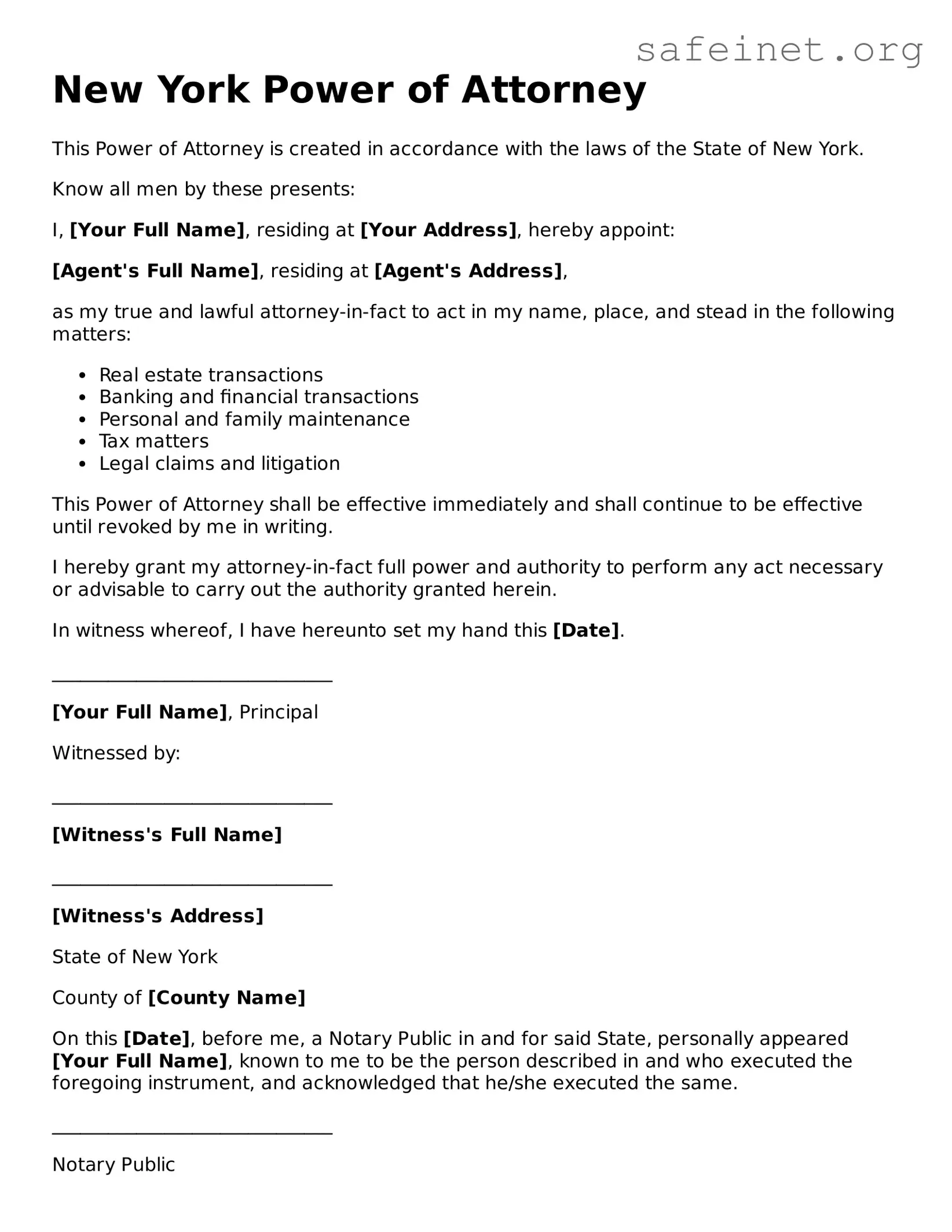
New York Power of Attorney
This Power of Attorney is created in accordance with the laws of the State of New York.
Know all men by these presents:
I, [Your Full Name], residing at [Your Address], hereby appoint:
[Agent's Full Name], residing at [Agent's Address],
as my true and lawful attorney-in-fact to act in my name, place, and stead in the following matters:
This Power of Attorney shall be effective immediately and shall continue to be effective until revoked by me in writing.
I hereby grant my attorney-in-fact full power and authority to perform any act necessary or advisable to carry out the authority granted herein.
In witness whereof, I have hereunto set my hand this [Date].
______________________________
[Your Full Name], Principal
Witnessed by:
______________________________
[Witness's Full Name]
______________________________
[Witness's Address]
State of New York
County of [County Name]
On this [Date], before me, a Notary Public in and for said State, personally appeared [Your Full Name], known to me to be the person described in and who executed the foregoing instrument, and acknowledged that he/she executed the same.
______________________________
Notary Public
My Commission Expires: [Expiration Date]
| Fact Name | Description |
|---|---|
| Definition | A Power of Attorney (POA) is a legal document that allows one person to act on behalf of another in legal or financial matters. |
| Types | New York recognizes several types of POA, including General, Limited, and Durable Power of Attorney. |
| Governing Laws | The New York Power of Attorney form is governed by the New York General Obligations Law, specifically Article 5, Title 15. |
| Execution Requirements | The document must be signed by the principal in the presence of a notary public and, in some cases, witnesses. |
| Durability | A Durable Power of Attorney remains effective even if the principal becomes incapacitated. |
| Revocation | The principal can revoke the Power of Attorney at any time, provided they are mentally competent. |
Filling out the New York Power of Attorney form requires careful attention to detail. This document allows an individual to designate another person to act on their behalf in financial matters. Below are the steps to complete the form accurately.
What is a Power of Attorney in New York?
A Power of Attorney (POA) is a legal document that allows you to appoint someone else to make decisions on your behalf. This can include financial decisions, medical decisions, or other matters. In New York, this document can be tailored to suit your specific needs, granting broad or limited powers to your agent.
Who can be appointed as an agent in a Power of Attorney?
In New York, you can appoint anyone you trust as your agent. This can be a family member, friend, or professional advisor. However, it's important to choose someone responsible and capable of handling your affairs. The agent must be at least 18 years old and mentally competent.
Do I need to have a lawyer to create a Power of Attorney?
While it is not legally required to have a lawyer to create a Power of Attorney in New York, consulting one can be beneficial. A lawyer can help ensure that the document meets all legal requirements and accurately reflects your wishes. This can prevent potential issues down the line.
What powers can I grant in a Power of Attorney?
You can grant a wide range of powers in a Power of Attorney. These can include managing bank accounts, paying bills, selling property, and making healthcare decisions. You can specify which powers your agent has, allowing you to maintain control over your affairs.
How do I revoke a Power of Attorney?
If you decide to revoke a Power of Attorney, you must do so in writing. You should notify your agent and any institutions or individuals who were aware of the original POA. It’s also advisable to create a new Power of Attorney if you want to appoint someone else.
What happens if I become incapacitated and do not have a Power of Attorney?
If you become incapacitated without a Power of Attorney, your loved ones may need to go through a court process to obtain guardianship. This can be time-consuming and costly. Having a POA in place can help avoid this situation and ensure your wishes are followed.
Is a Power of Attorney effective immediately?
A Power of Attorney can be effective immediately or can be set to take effect at a later date or upon a specific event, such as your incapacity. This is known as a "springing" Power of Attorney. Make sure to clearly outline your preferences in the document.
Not specifying the powers granted. When filling out the form, it’s crucial to clearly outline the specific powers you wish to grant to your agent. Vague language can lead to confusion or misuse.
Failing to sign the document. A Power of Attorney is not valid without the proper signatures. Ensure that you, as the principal, sign the document in the designated area.
Not having the form notarized. In New York, a Power of Attorney must be notarized to be valid. Skipping this step can render the document ineffective.
Choosing the wrong agent. Selecting someone who is not trustworthy or capable can lead to complications. It’s important to choose an agent who understands your wishes and can act in your best interest.
Not including alternate agents. Life is unpredictable. If your primary agent is unable to serve, having an alternate agent designated can ensure your affairs are managed without interruption.
Overlooking specific limitations. If there are certain actions you do not want your agent to take, be sure to specify these limitations in the document. This helps protect your interests.
Using outdated forms. Laws can change, and using an outdated Power of Attorney form may lead to issues. Always use the most current version of the form to ensure compliance.
Not discussing the document with the agent. Communication is key. Your agent should be aware of their responsibilities and your wishes to avoid misunderstandings later.
Ignoring the need for updates. Life changes, and so may your preferences. Regularly review and update your Power of Attorney to reflect any changes in your situation or relationships.
Assuming the form is one-size-fits-all. Each individual’s needs are unique. Tailor the Power of Attorney to fit your specific circumstances and requirements.
When creating a Power of Attorney in New York, several other forms and documents may be useful to ensure comprehensive management of legal and financial matters. Each of these documents serves a specific purpose and can complement the Power of Attorney effectively.
Using these documents in conjunction with the Power of Attorney can create a comprehensive plan for managing your legal and financial affairs. It is essential to consider your specific needs and consult with a professional if necessary.
The Durable Power of Attorney is similar to the New York Power of Attorney form in that it allows an individual to appoint someone else to manage their financial and legal affairs. This document remains effective even if the principal becomes incapacitated, ensuring that their interests are protected. Like the New York version, it requires clear language and signatures from both parties to be valid.
The Medical Power of Attorney grants a designated individual the authority to make healthcare decisions on behalf of another person. This document is crucial when the individual is unable to express their wishes due to illness or injury. Similar to the New York Power of Attorney, it must be executed according to state laws and may require witnesses or notarization.
The Springing Power of Attorney becomes effective only upon a specific event, typically the incapacitation of the principal. This type of document is similar to the New York Power of Attorney in that it allows for the delegation of authority, but it differs in its activation criteria. Both documents require clear terms and the principal's consent.
The Financial Power of Attorney focuses specifically on financial matters. It allows an agent to handle banking, investments, and real estate transactions. Like the New York Power of Attorney, it must be detailed about the powers granted and can be tailored to fit individual needs, ensuring the principal's financial interests are managed appropriately.
The Limited Power of Attorney restricts the agent's authority to specific tasks or time frames. This document is similar to the New York Power of Attorney in that it allows for delegation but differs in its scope. It is often used for particular transactions, such as selling property, making it essential to clearly define the agent's powers.
The Healthcare Proxy is akin to the Medical Power of Attorney, allowing a person to appoint someone to make medical decisions on their behalf. It is similar to the New York Power of Attorney in that it addresses healthcare matters, but it typically does not cover financial decisions. Both documents emphasize the importance of understanding the principal's wishes.
The Living Will outlines a person's preferences regarding medical treatment in end-of-life situations. While it does not grant decision-making authority to another person, it complements the Medical Power of Attorney. Both documents serve to express an individual's healthcare wishes, reflecting the importance of clear communication in medical scenarios.
The Revocable Trust allows individuals to manage their assets during their lifetime and designate beneficiaries after death. It is similar to the New York Power of Attorney in that it provides a framework for asset management. However, a trust can offer more comprehensive control over assets, while a Power of Attorney focuses on decision-making authority.
The Guardianship Agreement establishes a legal relationship where one individual is appointed to care for another, often a minor or incapacitated adult. This document is similar to the New York Power of Attorney in that it involves delegation of authority, but it is typically court-approved and may involve more oversight and responsibility.
The Advance Directive combines elements of a Living Will and a Medical Power of Attorney. It allows individuals to express their healthcare preferences while also designating someone to make decisions on their behalf. Like the New York Power of Attorney, it emphasizes the importance of understanding and communicating one's wishes regarding medical treatment.
When filling out the New York Power of Attorney form, it is important to follow certain guidelines to ensure the document is valid and effective. Below are six recommendations to consider.
By adhering to these do's and don'ts, the process of completing the Power of Attorney form can be more straightforward and effective.
When it comes to the New York Power of Attorney form, many people hold misconceptions that can lead to confusion. Here are six common misunderstandings:
This is not true. Anyone can benefit from a Power of Attorney, regardless of age or health. It can be useful for anyone who wants to ensure their financial and legal matters are handled by someone they trust.
While a Power of Attorney does grant significant authority, the powers can be limited. The document can specify what the agent can and cannot do, allowing for tailored control over specific matters.
This is incorrect. A Power of Attorney can be revoked at any time, as long as the person who created it is mentally competent. Revocation should be done in writing to avoid any confusion.
While agents have a fiduciary duty to act in the principal's best interest, not all actions may be clearly defined. Misunderstandings can arise, so it’s important to choose someone trustworthy.
This is a common mix-up. A Power of Attorney deals with financial and legal decisions, while a living will focuses on healthcare decisions. They serve different purposes and should be created separately.
Each state has its own laws and requirements regarding Power of Attorney forms. It’s essential to use the correct form for New York to ensure it is valid and enforceable.
Understanding these misconceptions can help individuals make informed decisions about their legal and financial planning.
Filling out and using a Power of Attorney (POA) form in New York can be a significant step in managing your financial and legal affairs. Here are some key takeaways to consider:
Taking the time to understand these key points can help ensure that your Power of Attorney serves its intended purpose effectively and compassionately.