When it comes to establishing a limited liability company (LLC) in New York, one of the most essential documents you'll encounter is the Operating Agreement. This form serves as a foundational blueprint for how your LLC will function, outlining the rights and responsibilities of its members. It covers a variety of important aspects, including management structure, voting procedures, and profit distribution. Additionally, it addresses how decisions are made and what happens if a member wants to leave the company or if new members are introduced. By clarifying these elements, the Operating Agreement not only helps prevent disputes among members but also provides a clear path for the LLC's operations. Whether you're a seasoned entrepreneur or a first-time business owner, understanding the significance of this document is crucial for ensuring your LLC runs smoothly and in compliance with New York laws.
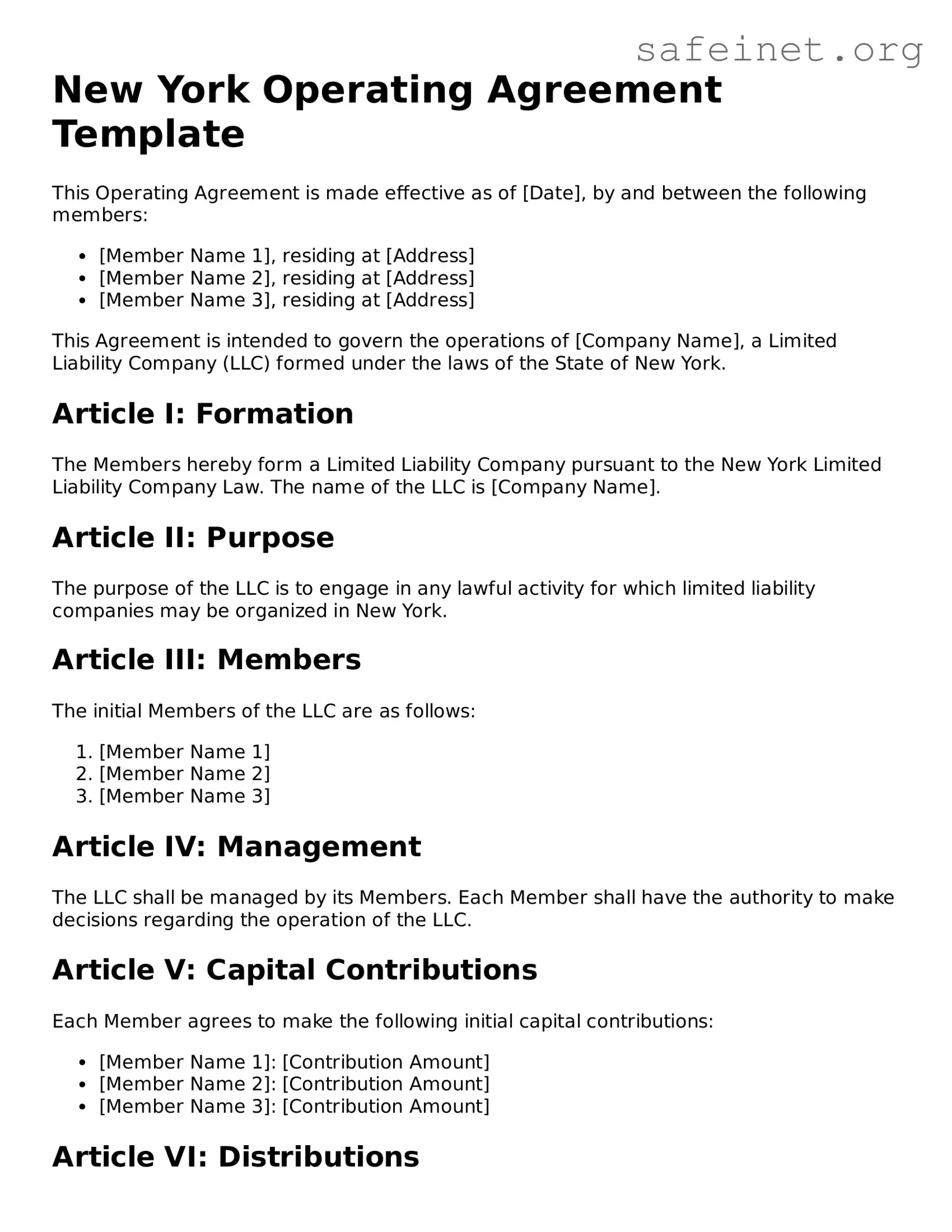
New York Operating Agreement Template
This Operating Agreement is made effective as of [Date], by and between the following members:
This Agreement is intended to govern the operations of [Company Name], a Limited Liability Company (LLC) formed under the laws of the State of New York.
Article I: Formation
The Members hereby form a Limited Liability Company pursuant to the New York Limited Liability Company Law. The name of the LLC is [Company Name].
Article II: Purpose
The purpose of the LLC is to engage in any lawful activity for which limited liability companies may be organized in New York.
Article III: Members
The initial Members of the LLC are as follows:
Article IV: Management
The LLC shall be managed by its Members. Each Member shall have the authority to make decisions regarding the operation of the LLC.
Article V: Capital Contributions
Each Member agrees to make the following initial capital contributions:
Article VI: Distributions
Distributions of profits and losses shall be allocated to the Members in proportion to their respective capital contributions.
Article VII: Amendments
This Agreement may be amended only by a written agreement signed by all Members.
Article VIII: Governing Law
This Agreement shall be governed by and construed in accordance with the laws of the State of New York.
IN WITNESS WHEREOF, the Members have executed this Operating Agreement as of the date first above written.
______________________________
[Member Name 1]
______________________________
[Member Name 2]
______________________________
[Member Name 3]
| Fact Name | Description |
|---|---|
| Definition | The New York Operating Agreement is a document that outlines the management structure and operating procedures of a Limited Liability Company (LLC) in New York. |
| Governing Law | This agreement is governed by the laws of the State of New York, specifically under the New York Limited Liability Company Law. |
| Members' Rights | The agreement details the rights and responsibilities of the members, including voting rights and profit distribution. |
| Management Structure | It specifies whether the LLC will be managed by its members or by appointed managers. |
| Amendments | Provisions for amending the agreement are included, allowing members to make changes as needed. |
| Dispute Resolution | The agreement may outline procedures for resolving disputes among members, which can help avoid litigation. |
| Duration | The duration of the LLC, whether it is perpetual or for a specific term, is stated in the agreement. |
| Compliance | Having an operating agreement is not legally required in New York, but it is highly recommended for clarity and protection. |
Completing the New York Operating Agreement form is an important step for any business entity. This document outlines the management structure and operational procedures of your company. Follow the steps below to ensure you fill out the form correctly.
Once you have filled out the form, it is essential to keep a copy for your records. The signed Operating Agreement should be stored in a safe place, as it may be needed for future reference or legal purposes.
What is a New York Operating Agreement?
A New York Operating Agreement is a legal document that outlines the management structure and operating procedures of a limited liability company (LLC) in New York. It details the rights and responsibilities of the members, how profits and losses will be distributed, and the process for making decisions. This agreement helps prevent misunderstandings among members and provides a clear framework for the operation of the LLC.
Is an Operating Agreement required in New York?
While New York law does not mandate that LLCs have an Operating Agreement, it is highly recommended. Having this document in place can protect members’ interests and establish guidelines for the company’s operations. If disputes arise, an Operating Agreement serves as a reference point to resolve issues. Furthermore, banks and investors may require an Operating Agreement when opening business accounts or providing funding.
What should be included in the Operating Agreement?
An effective Operating Agreement should include several key elements. These include the name and purpose of the LLC, details about the members and their ownership percentages, procedures for admitting new members, and guidelines for decision-making. Additionally, it should outline how profits and losses will be shared and the process for dissolving the LLC if necessary. Clarity in these areas helps ensure smooth operations and reduces the potential for conflict.
Can the Operating Agreement be changed after it is created?
Yes, the Operating Agreement can be amended after it is created. Changes may be necessary due to shifts in membership, business goals, or legal requirements. To make amendments, the process typically requires a vote or agreement among the members, as specified in the original Operating Agreement. It is important to document any changes in writing to maintain a clear record of the LLC’s governance.
Incomplete Information: Many individuals fail to provide all required details. This includes missing names, addresses, or specific roles of members. Ensure that each section is thoroughly filled out to avoid delays.
Incorrect Member Designations: Some people mistakenly designate members or managers incorrectly. It is essential to clearly outline who has decision-making authority and what their roles entail.
Omitting Important Provisions: Key provisions, such as profit distribution or dispute resolution methods, are sometimes overlooked. These elements are crucial for the smooth operation of the business.
Failure to Update the Agreement: As businesses evolve, so do their needs. Neglecting to update the Operating Agreement when changes occur can lead to confusion and legal issues down the line.
Not Seeking Legal Advice: Many individuals attempt to complete the form without consulting a legal professional. This can result in misunderstandings or errors that could have been easily avoided with proper guidance.
When establishing a business in New York, particularly a limited liability company (LLC), the Operating Agreement is a crucial document. However, there are several other forms and documents that you may need to consider to ensure your business operates smoothly and complies with state regulations. Below is a list of important documents often used alongside the New York Operating Agreement.
Having these documents in place not only helps in establishing your LLC but also ensures that you are prepared for future growth and compliance. Always consider consulting with a professional to tailor these documents to fit your specific business needs.
The New York Operating Agreement is similar to a Partnership Agreement, which outlines the roles, responsibilities, and profit-sharing arrangements among partners in a business. Both documents serve as foundational agreements that govern the internal workings of a business entity. While the Operating Agreement is specific to limited liability companies (LLCs), the Partnership Agreement is tailored for partnerships, emphasizing the collaborative nature of the business and the relationships between partners.
Another document that shares similarities is the Bylaws of a corporation. Bylaws establish the rules and procedures for managing a corporation, including how meetings are conducted and how decisions are made. Like the Operating Agreement, Bylaws provide a framework for governance. Both documents aim to clarify the structure of the organization and ensure that all members understand their rights and obligations.
A Shareholder Agreement also resembles the New York Operating Agreement. This document governs the relationship between shareholders in a corporation, detailing the rights and obligations of each shareholder, including voting rights and transfer of shares. Similar to the Operating Agreement, it is designed to prevent disputes and ensure smooth operations within the company by clearly defining expectations and responsibilities.
The Joint Venture Agreement is another comparable document. This agreement outlines the terms of a temporary partnership between two or more parties for a specific project or purpose. Like the Operating Agreement, it details the contributions, roles, and profit-sharing arrangements of each party involved. Both documents facilitate collaboration and help manage the relationship between the parties, ensuring that everyone is on the same page.
A Limited Partnership Agreement also shares characteristics with the New York Operating Agreement. This document defines the roles of general and limited partners in a limited partnership, including their rights, responsibilities, and profit-sharing arrangements. Both agreements aim to protect the interests of the parties involved and clarify the structure of the business, promoting transparency and accountability.
The Membership Agreement is another document that bears similarities to the Operating Agreement. This agreement outlines the rights and obligations of members in an LLC, including membership interests and voting rights. Like the Operating Agreement, it serves to govern the relationship between members and establish procedures for decision-making, ensuring that all members understand their roles within the organization.
Lastly, the LLC Formation Certificate, while primarily a filing document, shares the goal of establishing a legal framework for the business. This certificate is required to officially create an LLC and typically includes basic information about the company, such as its name and address. While the Operating Agreement goes into greater detail about the internal operations and governance, both documents are essential for the formation and legitimacy of the LLC.
When filling out the New York Operating Agreement form, it is important to approach the task with care and attention to detail. Here’s a helpful list of things you should and shouldn't do to ensure that your agreement is both effective and compliant.
By following these guidelines, you can create a solid foundation for your LLC that helps prevent misunderstandings and disputes in the future. A well-prepared Operating Agreement serves as a crucial document for your business’s success.
Many people have misconceptions about the New York Operating Agreement form. Here are nine common misunderstandings and clarifications:
This is not true. While it is highly recommended, New York does not legally require every LLC to have an Operating Agreement. However, having one can help define the management structure and operating procedures.
This is a misconception. Even single-member LLCs can benefit from having an Operating Agreement to clarify ownership and management roles.
This is incorrect. The Operating Agreement is an internal document and does not need to be filed with New York state. It should be kept on file for reference.
This is misleading. Members can amend the Operating Agreement as needed, provided they follow the procedures outlined within the document itself.
This is false. While legal advice can be helpful, LLC members can draft their own Operating Agreement without needing a lawyer.
This is a common error. The Articles of Organization are filed with the state to form the LLC, while the Operating Agreement outlines the internal rules and management of the LLC.
This is not always necessary. While it is good practice for all members to sign, the agreement can still be valid even without every member's signature, depending on the circumstances.
This is incorrect. The Operating Agreement can cover a wide range of topics, including management structure, decision-making processes, and member responsibilities.
This is a misconception. It is advisable to review and update the Operating Agreement periodically, especially when there are significant changes in the business or membership.
When filling out and using the New York Operating Agreement form, several important points should be considered. Below is a list of key takeaways to keep in mind.