The New York Notice to Quit form is an essential document for landlords and tenants navigating the complexities of rental agreements. This form serves as a formal notice to tenants, indicating that they must vacate the premises by a specified date, typically due to non-payment of rent or lease violations. It outlines the reasons for the eviction and provides a timeline for the tenant to respond or remedy the situation. The Notice to Quit is a critical first step in the eviction process, ensuring that landlords follow legal protocols while protecting their rights. Tenants, on the other hand, should understand the implications of receiving such a notice, as it can impact their housing stability. Knowing how to properly fill out and serve this form is vital for landlords to avoid potential legal issues. Understanding the nuances of the Notice to Quit can help both parties navigate the often challenging landlord-tenant relationship more effectively.
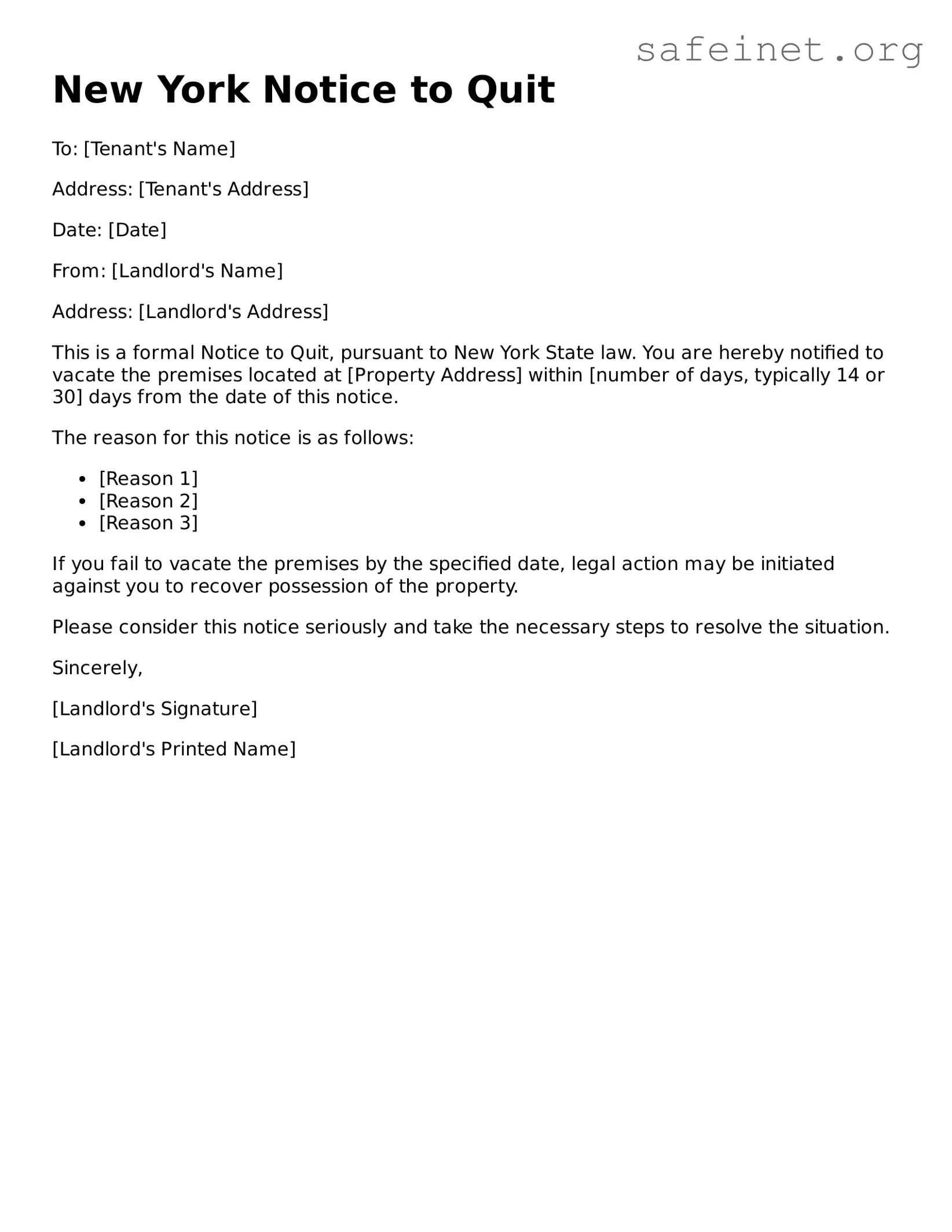
New York Notice to Quit
To: [Tenant's Name]
Address: [Tenant's Address]
Date: [Date]
From: [Landlord's Name]
Address: [Landlord's Address]
This is a formal Notice to Quit, pursuant to New York State law. You are hereby notified to vacate the premises located at [Property Address] within [number of days, typically 14 or 30] days from the date of this notice.
The reason for this notice is as follows:
If you fail to vacate the premises by the specified date, legal action may be initiated against you to recover possession of the property.
Please consider this notice seriously and take the necessary steps to resolve the situation.
Sincerely,
[Landlord's Signature]
[Landlord's Printed Name]
| Fact Name | Description |
|---|---|
| Purpose | The New York Notice to Quit form is used by landlords to inform tenants that they must vacate the rental property. |
| Governing Law | This form is governed by New York Real Property Law § 711. |
| Notice Period | Typically, a 14-day notice is required for non-payment of rent, while other lease violations may require a 30-day notice. |
| Delivery Methods | The notice can be delivered in person, by certified mail, or by posting it on the property. |
| Tenant Rights | Tenants have the right to contest the eviction in court if they believe the notice is unjustified. |
| Form Requirements | The form must include specific information, such as the tenant's name, the address of the property, and the reason for eviction. |
| Legal Consequences | Failure to comply with the notice can lead to legal eviction proceedings initiated by the landlord. |
| Signature Requirement | The landlord or their authorized agent must sign the Notice to Quit to make it valid. |
| Response Time | Tenants typically have the specified notice period to respond or vacate the property. |
| Additional Resources | Landlords and tenants can seek assistance from local housing authorities or legal aid organizations for guidance. |
After completing the New York Notice to Quit form, the next step involves delivering the notice to the tenant. This delivery must be done in accordance with state laws to ensure it is legally valid. It is important to keep a copy of the notice for your records.
What is a Notice to Quit in New York?
A Notice to Quit is a formal document that a landlord provides to a tenant, indicating the intention to terminate a lease or rental agreement. This notice is typically issued when a tenant fails to pay rent or violates other terms of the lease. It serves as a first step in the eviction process, giving the tenant an opportunity to remedy the situation or vacate the property.
Who can issue a Notice to Quit?
In New York, a landlord or their authorized agent can issue a Notice to Quit. This document is essential for landlords seeking to regain possession of their rental property. It is important that the notice is served correctly to ensure that the eviction process can proceed smoothly if necessary.
How long does a tenant have to respond to a Notice to Quit?
The response time can vary depending on the reason for the notice. Typically, if the notice is due to non-payment of rent, tenants are given 14 days to pay the overdue rent or vacate the premises. For lease violations, the time frame may differ, often ranging from 10 to 30 days, depending on the nature of the violation.
What should be included in a Notice to Quit?
A Notice to Quit should clearly state the reason for the eviction, the date by which the tenant must vacate the property, and any relevant details about the lease agreement. It should also include the landlord's contact information and a statement about the tenant's right to contest the notice if they believe it to be unjust.
Can a tenant contest a Notice to Quit?
Yes, tenants have the right to contest a Notice to Quit. If they believe the notice is invalid or that they have rectified the issue (such as paying overdue rent), they can respond to the landlord. It is advisable for tenants to document any communications and seek legal advice if they feel their rights are being violated.
What happens if a tenant does not comply with the Notice to Quit?
If a tenant fails to comply with the Notice to Quit by the specified date, the landlord may proceed with legal action to evict the tenant. This process typically involves filing an eviction lawsuit in the local housing court, where both parties can present their cases.
Is a Notice to Quit the same as an eviction notice?
While a Notice to Quit is a type of eviction notice, it is not the final step in the eviction process. It is the initial notice that informs the tenant of the landlord's intent to terminate the lease. An eviction notice, on the other hand, is issued after the Notice to Quit if the tenant does not vacate the property or remedy the lease violation.
Do I need to use a specific form for a Notice to Quit?
While there is no official state form for a Notice to Quit in New York, it is crucial that the notice is written clearly and contains all necessary information. Landlords can create their own notice, but it is wise to follow best practices and consult legal resources to ensure compliance with state laws.
Incorrect Tenant Information: Many people fail to provide accurate details about the tenant, such as their full name or current address. This can lead to delays in the eviction process.
Missing Signature: It’s essential to sign the Notice to Quit. Some individuals forget to sign, which invalidates the notice.
Improper Delivery Method: The Notice must be delivered in a specific manner. Some people do not follow the legal requirements for delivering the notice, which can complicate matters.
Failure to State Grounds for Eviction: Not clearly stating the reason for eviction can lead to confusion. It is important to specify the grounds, whether it’s non-payment of rent or lease violations.
Inaccurate Dates: Providing incorrect dates regarding when the rent was due or when the notice was served can create legal issues. Always double-check these details.
Not Following Local Laws: Different jurisdictions may have specific requirements for the Notice to Quit. Failing to adhere to local laws can invalidate the notice.
Neglecting to Keep Copies: It’s crucial to retain copies of the Notice for your records. Some people overlook this step, which can be problematic if disputes arise later.
Using the Wrong Form: There are various types of notices for different situations. Using the incorrect form can lead to complications in the eviction process.
Ignoring Tenant's Rights: Some landlords forget that tenants have rights. It’s important to ensure that the notice complies with tenant protection laws.
The New York Notice to Quit form is an essential document for landlords seeking to terminate a lease agreement. However, several other forms and documents may accompany it to ensure a smooth legal process. Below is a list of commonly used documents that often go hand-in-hand with the Notice to Quit.
Understanding these accompanying documents can significantly impact the eviction process. Each plays a vital role in ensuring that both landlords and tenants are aware of their rights and responsibilities. Proper documentation helps facilitate a smoother resolution and minimizes potential disputes.
The New York Notice of Termination is similar to the Notice to Quit form in that both documents serve to inform a tenant of the end of their tenancy. The Notice of Termination specifies the reason for the termination and the time frame in which the tenant must vacate the premises. This document is often used in cases of lease violations or non-payment of rent, providing a clear outline of the tenant's obligations and the consequences of failing to comply.
The Eviction Notice, often referred to as a Summons and Complaint, shares similarities with the Notice to Quit form as both initiate the process of removing a tenant from a property. While the Notice to Quit is typically a precursor to eviction, the Eviction Notice is a formal legal document that is filed with the court. It outlines the reasons for eviction and informs the tenant of their right to contest the eviction in court.
The Rent Demand Notice is another document akin to the Notice to Quit. This notice specifically addresses situations involving unpaid rent. It formally requests payment from the tenant and may serve as a precursor to further legal action if the rent remains unpaid. Like the Notice to Quit, it establishes a timeline for the tenant to respond or take action.
The Lease Violation Notice is similar in that it addresses specific breaches of the lease agreement. This document outlines the nature of the violation, such as unauthorized pets or noise complaints, and typically provides a timeframe for the tenant to remedy the situation. Both the Lease Violation Notice and the Notice to Quit aim to ensure compliance with lease terms.
The Notice of Default functions similarly to the Notice to Quit by notifying the tenant of a failure to comply with lease terms. This document is often used in cases of mortgage defaults but can also apply to rental agreements. It serves as a formal warning that legal action may follow if the default is not corrected within a specified period.
The 30-Day Notice to Vacate is another related document, primarily used in month-to-month tenancy situations. This notice provides the tenant with a full 30 days to vacate the property without needing to provide a reason. While the Notice to Quit may be issued for specific violations, the 30-Day Notice is a more general notice that can be issued for any reason, including the landlord's decision to terminate the rental agreement.
The Notice of Rent Increase is similar in that it communicates important information to the tenant regarding their lease. While it does not require the tenant to vacate, it does inform them of changes to their rental obligations. This document must comply with local laws regarding notice periods and can affect the tenant's decision to continue their tenancy.
The Notice of Intent to Vacate is often used by tenants rather than landlords, but it serves a similar purpose in communicating intentions regarding the rental agreement. This document informs the landlord of the tenant's decision to leave, allowing for appropriate preparations for the property. Both notices facilitate communication regarding tenancy status.
Lastly, the Habitability Notice highlights issues related to the condition of the rental property. This document informs the landlord of necessary repairs or maintenance that must be addressed to ensure the property is livable. While it does not directly lead to eviction, it can be a precursor to a Notice to Quit if the landlord fails to address the concerns raised.
When filling out the New York Notice to Quit form, it's important to follow certain guidelines to ensure that the process goes smoothly. Here are six things you should and shouldn't do:
By adhering to these dos and don'ts, you can help ensure that the process is conducted properly and legally.
The New York Notice to Quit form is often misunderstood. Here are some common misconceptions about this important document:
Many people believe the Notice to Quit can be used for all eviction situations. However, it is specifically designed for cases where a tenant has violated lease terms or failed to pay rent.
Some think that the Notice to Quit must always be delivered directly to the tenant. In reality, it can also be sent via certified mail, which is a valid method of service.
Receiving a Notice to Quit does not mean tenants lose all their rights. They still have the opportunity to respond and contest the eviction in court.
Many assume that a Notice to Quit is the last step before eviction. In fact, it is just the first step in the eviction process and does not guarantee that eviction will occur.
Some believe that there is a one-size-fits-all Notice to Quit form. In reality, landlords can create their own, as long as it meets legal requirements.
Many tenants think they can ignore the Notice to Quit without consequences. Ignoring it can lead to further legal action and potential eviction.
Some people think there is no deadline for serving a Notice to Quit. However, landlords must serve it within a specific timeframe, depending on the reason for eviction.
While many associate the Notice to Quit with non-payment, it can also be issued for other lease violations, such as property damage or illegal activities.
Many believe that after receiving a Notice to Quit, tenants cannot negotiate with their landlord. However, communication can often lead to resolutions that avoid eviction.
The New York Notice to Quit form serves as a formal document used by landlords to notify tenants of their lease violation or non-payment of rent.
It is essential to provide clear details in the notice, including the specific reason for the eviction and the time frame for the tenant to vacate the premises.
The notice must be delivered in accordance with New York state laws, which may include personal delivery, certified mail, or posting on the property.
Failure to properly fill out or serve the Notice to Quit may lead to delays in the eviction process or dismissal of the case in court.