When engaging in various legal transactions in New York, understanding the Notary Acknowledgement form is crucial. This form serves as a vital tool in confirming the identity of the signer and ensuring that they are signing documents voluntarily and with a clear understanding of their content. Typically used for real estate transactions, contracts, and other legal documents, the Notary Acknowledgement provides a layer of protection against fraud. It includes essential details such as the name of the signer, the date of the acknowledgment, and the notary's signature and seal. This simple yet powerful form not only enhances the credibility of the documents but also facilitates smoother legal proceedings. Knowing how to properly complete and utilize this form can save time and prevent potential legal issues down the line.
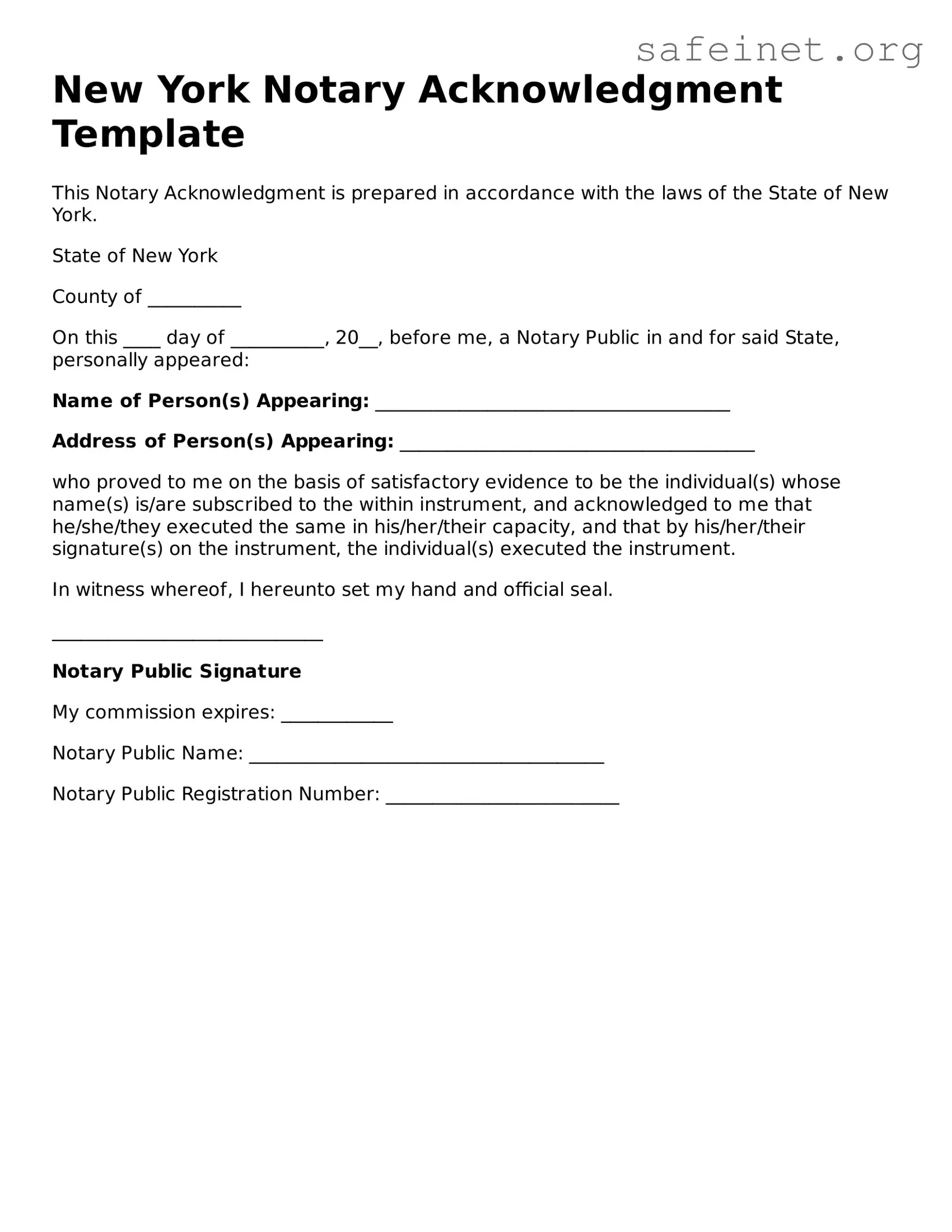
New York Notary Acknowledgment Template
This Notary Acknowledgment is prepared in accordance with the laws of the State of New York.
State of New York
County of __________
On this ____ day of __________, 20__, before me, a Notary Public in and for said State, personally appeared:
Name of Person(s) Appearing: ______________________________________
Address of Person(s) Appearing: ______________________________________
who proved to me on the basis of satisfactory evidence to be the individual(s) whose name(s) is/are subscribed to the within instrument, and acknowledged to me that he/she/they executed the same in his/her/their capacity, and that by his/her/their signature(s) on the instrument, the individual(s) executed the instrument.
In witness whereof, I hereunto set my hand and official seal.
_____________________________
Notary Public Signature
My commission expires: ____________
Notary Public Name: ______________________________________
Notary Public Registration Number: _________________________
| Fact Name | Description |
|---|---|
| Definition | A New York Notary Acknowledgment form is a document that verifies the identity of a signer and confirms that they willingly signed a document. |
| Governing Law | The use of Notary Acknowledgment forms in New York is governed by the New York Executive Law, Section 135. |
| Purpose | This form serves to prevent fraud and ensure that documents are executed properly. |
| Signer's Presence | The signer must appear in person before the notary public when the acknowledgment is made. |
| Notary's Role | The notary public is responsible for confirming the identity of the signer and ensuring they understand the document they are signing. |
| Required Information | The form typically requires the signer's name, the date of signing, and the notary's official seal. |
| Legal Effect | A properly executed acknowledgment can enhance the enforceability of the document in legal proceedings. |
Filling out the New York Notary Acknowledgment form is a straightforward process. Once completed, the form will be ready for use in various legal and official matters. Follow these steps carefully to ensure accuracy.
Once these steps are complete, the form will be ready for submission or filing as needed.
What is a New York Notary Acknowledgement form?
The New York Notary Acknowledgement form is a legal document used to verify the identity of a person signing a document. This form confirms that the signer appeared before a notary public and acknowledged that they signed the document willingly and without coercion. It is often required for various legal documents, including deeds, contracts, and affidavits, to ensure their validity in New York State.
Who can act as a notary public in New York?
In New York, a notary public must be at least 18 years old, a resident of the state, or have a business address in New York. They must also pass an exam and be appointed by the state. Notaries are authorized to perform notarial acts, which include taking acknowledgments, administering oaths, and certifying copies of documents.
How do I complete a Notary Acknowledgement form?
To complete a Notary Acknowledgement form, the signer must first fill out the document they wish to have notarized. Then, the signer should go to a notary public with the completed document. The notary will verify the signer's identity, typically by checking a government-issued ID. After confirming the identity, the notary will complete the form by filling in the required information and affixing their signature and seal.
Is a Notary Acknowledgement form required for all documents?
No, a Notary Acknowledgement form is not required for all documents. However, many legal documents, particularly those involving real estate transactions or court filings, often require notarization to be considered valid. It is important to check the specific requirements for the type of document you are working with to determine if notarization is necessary.
What happens if a Notary Acknowledgement form is not completed correctly?
If a Notary Acknowledgement form is not completed correctly, the document may be deemed invalid. This could lead to legal complications, such as issues in court or problems with property transactions. It is essential to ensure that all information is accurate and that the notary follows the proper procedures to avoid any potential issues.
Incorrect Signer Information: People often forget to include the full name of the signer. This can lead to confusion and may invalidate the acknowledgment.
Missing Date: Failing to write the date of the acknowledgment is a common mistake. Without a date, the document may not be considered complete.
Notary Signature and Seal: Some individuals neglect to ensure that the notary's signature and seal are present. This is crucial for the document's legitimacy.
Incorrect Notary Jurisdiction: It’s important to indicate the correct jurisdiction. Mistakes here can lead to questions about the notary’s authority.
Failure to Identify the Document: Not specifying what document is being acknowledged can create issues later. Clearly identifying the document is essential for clarity.
When dealing with legal documents, especially in New York, the Notary Acknowledgment form is commonly used. However, it is often accompanied by several other important forms and documents that serve various purposes. Understanding these documents can help ensure that your legal processes run smoothly.
Each of these documents plays a significant role in various legal processes. Having a clear understanding of their purposes can empower individuals to navigate legal requirements more effectively. When preparing to use the Notary Acknowledgment form, consider the accompanying documents that may be necessary to support your legal needs.
The New York Notary Acknowledgment form shares similarities with the Affidavit. Both documents serve to affirm the truthfulness of statements made by an individual. In an affidavit, a person swears under oath to the accuracy of the information provided, while the notary acknowledgment confirms that the individual personally appeared before the notary and verified their identity. This mutual emphasis on authenticity ensures that the documents carry legal weight and can be relied upon in various legal proceedings.
Another document akin to the Notary Acknowledgment is the Power of Attorney. Like the acknowledgment, a Power of Attorney requires the principal to appear before a notary to confirm their identity and intentions. This document grants authority to another person to act on behalf of the principal in legal matters. Both forms are crucial in establishing trust and verification, ensuring that the parties involved are who they claim to be and that their consent is genuine.
The Deed also shares characteristics with the Notary Acknowledgment. A deed is a legal document that conveys property ownership and often requires notarization to be valid. Similar to the acknowledgment, the notary’s role is to verify the identity of the signers and ensure that they are signing voluntarily. This verification process helps to prevent fraud and provides a layer of protection for all parties involved in the transaction.
In addition, the Certificate of Acknowledgment is closely related to the Notary Acknowledgment form. This certificate is often attached to various legal documents to confirm that a notary has witnessed the signing of the document. Like the Notary Acknowledgment, it serves to authenticate the signatures, ensuring that the individuals involved have been properly identified and that they willingly executed the document.
The Jurat is another document that bears resemblance to the Notary Acknowledgment. In a jurat, the notary certifies that the signer has sworn to the truth of the contents of a document. While the acknowledgment focuses on the identity of the signer and their willingness to sign, the jurat emphasizes the act of swearing an oath. Both documents require the presence of a notary, reinforcing the importance of verification in legal matters.
Finally, the Statutory Declaration is similar to the Notary Acknowledgment in that it is a written statement declared to be true. In many cases, a statutory declaration must be signed in front of a notary. While an acknowledgment confirms that a person has signed a document, a statutory declaration serves as a formal assertion of facts, often used when a sworn affidavit is not necessary. Both documents play vital roles in affirming the truthfulness of statements made in various legal contexts.
When filling out the New York Notary Acknowledgement form, it is important to follow specific guidelines to ensure accuracy and compliance. Here are five things you should and shouldn't do:
Understanding the New York Notary Acknowledgement form can be challenging. Here are nine common misconceptions that people often have:
Being aware of these misconceptions can help you navigate the notarization process more effectively. Always consult a professional if you have specific questions or concerns.
When dealing with the New York Notary Acknowledgment form, understanding its components and proper usage is essential. Here are key takeaways to consider: