In the bustling world of business, where ideas and innovations are often the lifeblood of success, protecting sensitive information is paramount. The New York Non-disclosure Agreement (NDA) form serves as a crucial tool for individuals and organizations looking to safeguard their proprietary information from unauthorized disclosure. This legally binding document outlines the obligations of parties involved, ensuring that confidential information remains protected during discussions, negotiations, or collaborations. Key components of the NDA include a clear definition of what constitutes confidential information, the duration of the confidentiality obligation, and the specific circumstances under which information can be disclosed. By establishing trust and clarity between parties, the New York NDA not only fosters healthy business relationships but also minimizes the risk of legal disputes arising from information breaches. Whether you’re a startup sharing your groundbreaking ideas or a seasoned corporation negotiating a merger, understanding the nuances of this form is essential for maintaining your competitive edge.
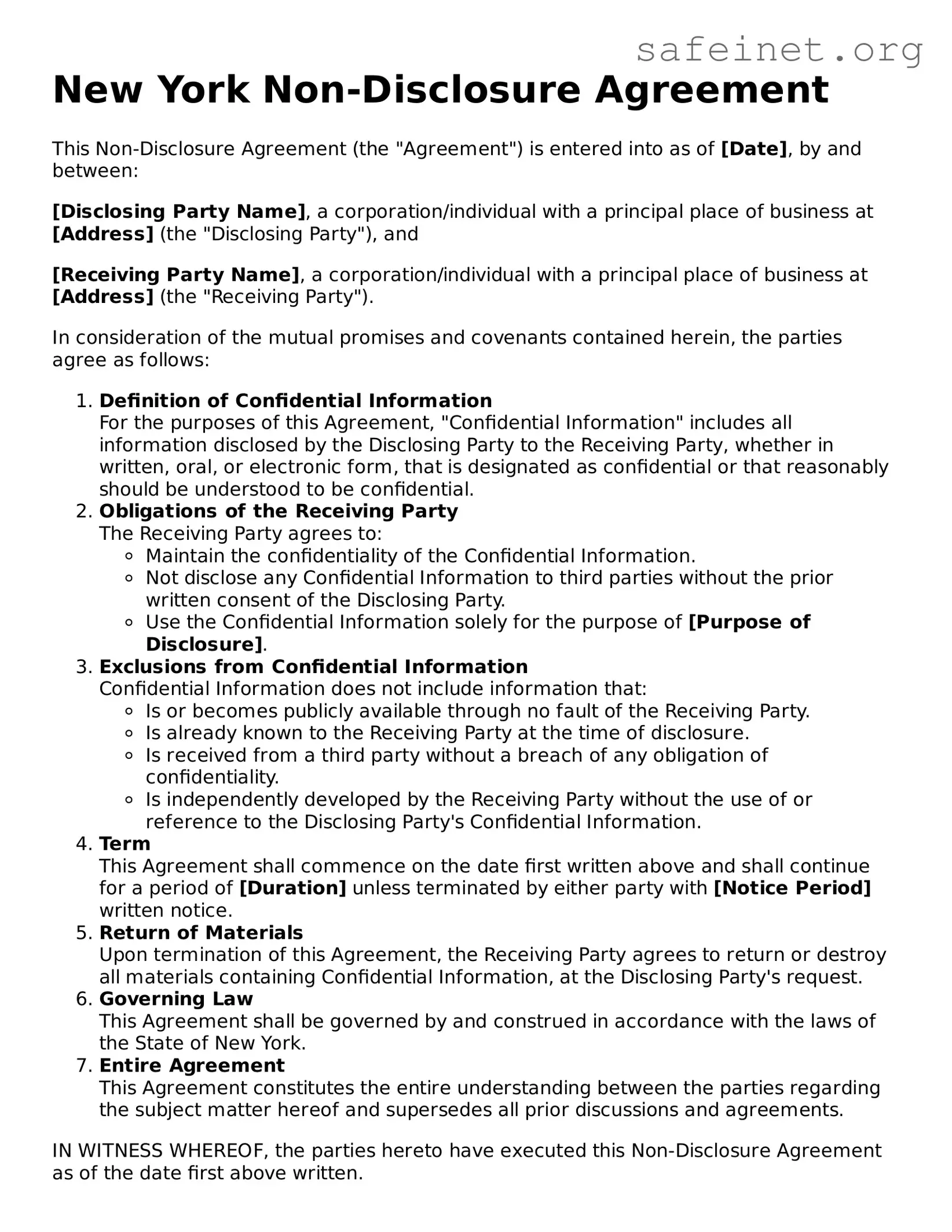
New York Non-Disclosure Agreement
This Non-Disclosure Agreement (the "Agreement") is entered into as of [Date], by and between:
[Disclosing Party Name], a corporation/individual with a principal place of business at [Address] (the "Disclosing Party"), and
[Receiving Party Name], a corporation/individual with a principal place of business at [Address] (the "Receiving Party").
In consideration of the mutual promises and covenants contained herein, the parties agree as follows:
IN WITNESS WHEREOF, the parties hereto have executed this Non-Disclosure Agreement as of the date first above written.
Disclosing Party:
_______________________________
[Name]
[Title]
[Date]
Receiving Party:
_______________________________
[Name]
[Title]
[Date]
| Fact Name | Description |
|---|---|
| Definition | A Non-disclosure Agreement (NDA) is a legal contract that protects confidential information shared between parties. |
| Governing Law | The NDA is governed by New York state law. |
| Parties Involved | The agreement typically involves a disclosing party and a receiving party. |
| Duration | The duration of confidentiality obligations is usually specified in the agreement. |
| Permitted Disclosures | The NDA outlines circumstances under which confidential information may be disclosed. |
| Consequences of Breach | Violating the NDA can lead to legal action and financial penalties. |
Filling out the New York Non-disclosure Agreement form requires careful attention to detail. After completing the form, it will need to be signed and dated by all parties involved. Ensure that all information is accurate and complete before submission.
What is a Non-disclosure Agreement (NDA)?
A Non-disclosure Agreement, commonly referred to as an NDA, is a legally binding contract that establishes a confidential relationship between parties. It ensures that sensitive information shared between them remains private. NDAs are often used in business settings to protect trade secrets, proprietary information, and other confidential data.
Why would someone need a New York Non-disclosure Agreement?
A New York Non-disclosure Agreement is essential for individuals and businesses that want to protect their confidential information when engaging with others. This could include discussions about business ventures, employee agreements, or partnerships. By using an NDA, parties can legally enforce confidentiality and prevent unauthorized disclosure of their sensitive information.
What should be included in a New York Non-disclosure Agreement?
An effective New York NDA should clearly define the confidential information being protected, outline the obligations of the parties involved, specify the duration of confidentiality, and identify any exclusions to the agreement. Additionally, it should include provisions for remedies in case of a breach and clarify the governing law, which in this case would be New York law.
How long does a Non-disclosure Agreement last?
The duration of an NDA can vary based on the specific terms agreed upon by the parties. Generally, the confidentiality obligations last for a specified period, which can range from a few years to indefinitely, depending on the nature of the information. It is important for the parties to discuss and agree on this timeframe when drafting the agreement.
Are there any limitations to what can be protected by an NDA?
Yes, there are limitations. An NDA cannot protect information that is already publicly known, independently developed by the receiving party, or disclosed through legal means. Additionally, information that the receiving party is required to disclose by law or court order is not covered by the NDA. It is crucial for parties to understand these limitations when drafting the agreement.
What are the consequences of breaching a Non-disclosure Agreement?
Breaching an NDA can lead to serious legal consequences. The disclosing party may be entitled to seek damages, which could include compensatory damages for any losses incurred due to the breach. In some cases, injunctive relief may be sought to prevent further disclosure. The specific consequences will depend on the terms outlined in the NDA and the nature of the breach.
Incomplete Information: One common mistake is failing to provide all necessary information. Parties often neglect to fill out their names, addresses, or other identifying details, which can render the agreement unenforceable.
Vague Definitions: Individuals sometimes use ambiguous language when defining confidential information. Clarity is essential; vague terms can lead to disputes about what is protected.
Omitting Duration: Many people forget to specify the duration of the confidentiality obligation. Without a clear timeframe, the agreement may be seen as indefinite, which can be problematic.
Ignoring Governing Law: Not indicating which state’s laws govern the agreement is another frequent error. This omission can complicate legal proceedings if a dispute arises.
Neglecting to Sign: Failing to sign the agreement is a straightforward yet critical mistake. An unsigned document lacks legal validity, regardless of its content.
Not Including Exceptions: Some individuals overlook the need to outline exceptions to confidentiality. For instance, information that is already public or independently developed should be addressed.
Overly Broad Restrictions: Drafting overly broad confidentiality clauses can lead to enforceability issues. Courts may reject agreements that impose unreasonable restrictions on a party’s ability to operate.
Failing to Consider Third Parties: Many people forget to address the involvement of third parties. If confidential information is shared with others, the agreement should specify how those parties are bound.
Inadequate Remedies: Not specifying remedies for breach of the agreement can weaken its effectiveness. Clear consequences help ensure compliance and provide a path for recourse.
Relying on Templates: While using templates can be helpful, relying solely on them without customization can lead to issues. Each situation is unique and may require specific provisions.
A Non-disclosure Agreement (NDA) is a crucial document for protecting sensitive information. When dealing with confidential information, several other forms and documents may be necessary to ensure comprehensive protection and clarity. Below is a list of commonly used documents that often accompany an NDA in New York.
Using these documents in conjunction with a Non-disclosure Agreement can help create a more secure and clear framework for business relationships. It is essential to ensure that all parties understand their rights and obligations regarding confidential information.
The New York Non-Disclosure Agreement (NDA) shares similarities with the Confidentiality Agreement. Both documents serve to protect sensitive information shared between parties. A Confidentiality Agreement may be broader in scope, covering various types of confidential information beyond trade secrets. Like the NDA, it establishes the obligations of the receiving party to keep the disclosed information private and outlines the consequences for breaches. This ensures that sensitive business information remains secure and is not disclosed to unauthorized individuals.
Another document similar to the NDA is the Non-Compete Agreement. While the primary focus of a Non-Compete Agreement is to prevent individuals from engaging in business activities that compete with their employer, it often includes clauses that protect confidential information. Both agreements aim to safeguard a company's proprietary information, but the Non-Compete Agreement additionally restricts the individual's ability to work in similar fields for a specified period after leaving the company. This dual focus on confidentiality and competition helps businesses maintain their competitive edge.
The Non-Solicitation Agreement also bears resemblance to the New York NDA. This document restricts an individual from soliciting clients or employees from a former employer. Like the NDA, it aims to protect a company’s interests and confidential relationships. While the NDA focuses on safeguarding sensitive information, the Non-Solicitation Agreement emphasizes the protection of business relationships and employee retention. Together, these agreements create a comprehensive framework for protecting a company's assets and relationships.
Lastly, the Proprietary Information Agreement (PIA) is another document that parallels the New York NDA. A PIA specifically addresses the protection of proprietary information, which may include trade secrets, business strategies, and technical data. Similar to the NDA, it requires the receiving party to maintain confidentiality and outlines the specific types of information considered proprietary. Both documents ensure that sensitive business information is not disclosed or misused, thereby fostering trust and cooperation between parties involved in business transactions.
When filling out the New York Non-disclosure Agreement form, it is essential to approach the task with care. Here are five things you should and shouldn't do.
Non-disclosure agreements (NDAs) are important legal tools used to protect sensitive information. However, several misconceptions about them can lead to confusion. Here are nine common misconceptions about the New York Non-disclosure Agreement form:
Understanding these misconceptions can help individuals and businesses navigate the complexities of non-disclosure agreements more effectively. It is always wise to seek legal advice when drafting or signing an NDA to ensure that it meets specific needs and complies with the law.
When filling out and using the New York Non-disclosure Agreement (NDA) form, there are several important points to keep in mind. These takeaways can help ensure the agreement is effective and legally binding.
These key points will help in creating a comprehensive NDA that protects sensitive information effectively.