In the competitive landscape of today's job market, the New York Non-compete Agreement form serves as a crucial tool for employers seeking to protect their business interests while navigating the complexities of employee mobility. This form outlines the terms under which employees may be restricted from engaging in similar work with competitors after leaving a job, thereby safeguarding sensitive information and trade secrets. Key aspects of the agreement include the duration of the restriction, the geographic scope, and the specific activities that are prohibited. Employers must ensure that the terms are reasonable and not overly burdensome, as courts in New York may scrutinize these agreements to ensure they are enforceable. Additionally, the form often includes clauses addressing the consequences of breach, highlighting the importance of clarity and mutual understanding between parties. As the workforce continues to evolve, understanding the implications of such agreements is essential for both employers and employees alike.
New York Non-Compete Agreement Template
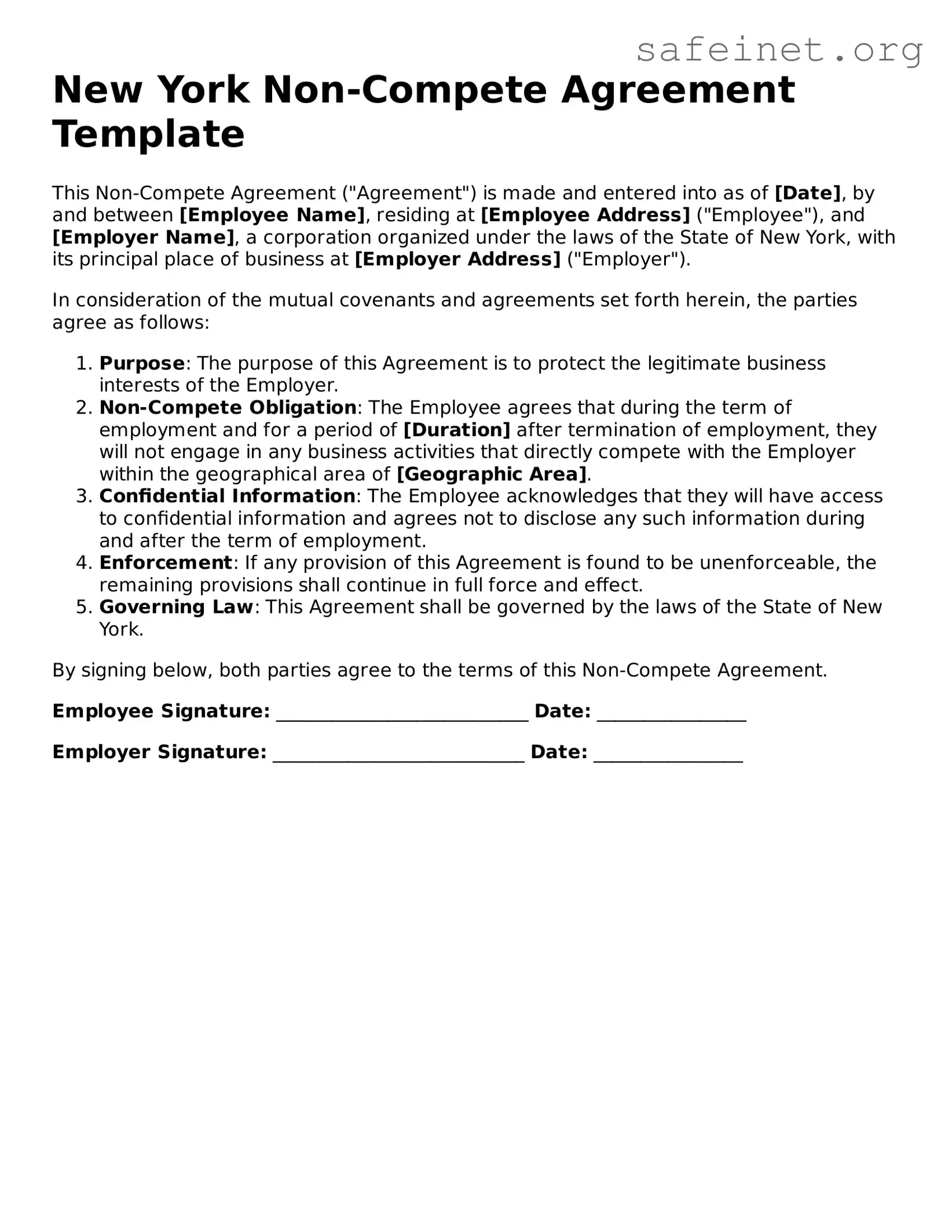
This Non-Compete Agreement ("Agreement") is made and entered into as of [Date], by and between [Employee Name], residing at [Employee Address] ("Employee"), and [Employer Name], a corporation organized under the laws of the State of New York, with its principal place of business at [Employer Address] ("Employer").
In consideration of the mutual covenants and agreements set forth herein, the parties agree as follows:
By signing below, both parties agree to the terms of this Non-Compete Agreement.
Employee Signature: ___________________________ Date: ________________
Employer Signature: ___________________________ Date: ________________
| Fact Name | Description |
|---|---|
| Definition | A non-compete agreement restricts an employee from working for competitors after leaving a job. |
| Governing Law | New York State law governs non-compete agreements. |
| Enforceability | These agreements must be reasonable in time, geography, and scope to be enforceable. |
| Consideration | There must be consideration, such as a job offer or promotion, for the agreement to be valid. |
| Duration | Typically, non-compete agreements last for one to two years, depending on the circumstances. |
| Exceptions | Some employees, like those in certain professions, may have different rules regarding non-compete clauses. |
Completing the New York Non-compete Agreement form requires careful attention to detail. Once filled out, the form will serve as a binding document between the parties involved, outlining the terms and conditions of the non-compete agreement.
What is a Non-compete Agreement in New York?
A Non-compete Agreement is a legal contract between an employer and an employee. It restricts the employee from working for competitors or starting a competing business for a specified period after leaving the company. In New York, these agreements must be reasonable in scope and duration to be enforceable.
Are Non-compete Agreements enforceable in New York?
Yes, Non-compete Agreements can be enforceable in New York, but they must meet certain criteria. They should protect legitimate business interests, such as trade secrets or client relationships, and should not impose undue hardship on the employee. Courts will evaluate the reasonableness of the agreement based on its duration, geographic scope, and the nature of the employee's work.
What should be included in a Non-compete Agreement?
A well-drafted Non-compete Agreement should include the following elements: a clear definition of the restricted activities, the duration of the restrictions, the geographic area covered, and the legitimate business interests being protected. Additionally, it’s advisable to include a clause that addresses the consequences of a breach of the agreement.
How long do Non-compete Agreements typically last in New York?
The duration of Non-compete Agreements in New York can vary, but they generally range from six months to two years. The reasonableness of the time frame is crucial; agreements that are too lengthy may be deemed unenforceable. Each case is evaluated based on its specific circumstances.
Can I negotiate the terms of a Non-compete Agreement?
Yes, employees can negotiate the terms of a Non-compete Agreement before signing. It’s important to discuss any concerns with your employer, such as the duration or geographic restrictions. A mutually agreeable contract can help ensure that both parties are satisfied and understand their rights and obligations.
What happens if I violate a Non-compete Agreement?
If you violate a Non-compete Agreement, the employer may take legal action against you. This could include seeking an injunction to prevent you from working for a competitor or claiming damages for any losses incurred due to the breach. It’s essential to understand the potential consequences before agreeing to such terms.
Not Reading the Entire Agreement: Many individuals rush through the document without fully understanding its terms. This can lead to unintended consequences.
Failing to Specify Duration: The length of time for the non-compete clause is crucial. Leaving this blank or unclear can render the agreement ineffective.
Ignoring Geographic Scope: The area in which the non-compete applies should be clearly defined. A vague or overly broad geographic scope can lead to legal disputes.
Omitting Consideration: A non-compete agreement must have consideration, such as a job offer or monetary compensation. Without this, the agreement may not hold up in court.
Not Including Exceptions: Individuals often forget to outline any exceptions to the non-compete. These exceptions can protect future job opportunities.
Using Ambiguous Language: Clear and precise language is vital. Ambiguities can lead to misinterpretations and potential legal challenges.
Neglecting to Seek Legal Advice: Many people fill out the form without consulting a legal professional. This oversight can result in serious ramifications down the line.
Not Keeping a Copy: After submitting the agreement, individuals often fail to keep a copy for their records. This can create issues if disputes arise later.
When drafting a Non-compete Agreement in New York, several other documents may accompany it to ensure clarity and legal enforceability. Each of these documents serves a specific purpose in the employment relationship and can help protect both the employer's and the employee's interests.
These documents collectively contribute to a comprehensive legal framework that governs the employer-employee relationship. Understanding their purpose and interplay is essential for both parties to navigate the complexities of employment law effectively.
A Non-disclosure Agreement (NDA) is a legal contract designed to protect sensitive information shared between parties. Like a Non-compete Agreement, an NDA restricts certain actions to safeguard proprietary knowledge. For instance, when an employee is privy to trade secrets or confidential business strategies, an NDA ensures that this information does not get disclosed to competitors or the public. Both agreements aim to protect a business's interests, although an NDA focuses more on confidentiality rather than limiting competition directly.
A Non-solicitation Agreement is another document that shares similarities with a Non-compete Agreement. This type of agreement prohibits an individual, typically an employee, from soliciting clients or employees of a company after leaving their position. While a Non-compete Agreement restricts an individual from working with competitors in general, a Non-solicitation Agreement specifically targets the relationships that the individual developed during their employment. Both serve to protect a company’s business relationships and client base.
An Employment Agreement often includes clauses that are reminiscent of those found in a Non-compete Agreement. This document outlines the terms of employment, including job responsibilities, compensation, and conditions for termination. Within an Employment Agreement, an employer may include a Non-compete clause to prevent the employee from engaging in competitive activities post-employment. Thus, while the Employment Agreement serves a broader purpose, it can incorporate elements that align closely with the objectives of a Non-compete Agreement.
When filling out the New York Non-compete Agreement form, it's essential to approach the process with care. The following list outlines key actions to take and avoid.
Many people have misunderstandings about the New York Non-compete Agreement. Here are four common misconceptions:
This is not true. New York courts will only enforce a non-compete agreement if it is reasonable in scope, duration, and geographic area. If a court finds the agreement overly restrictive, it may be deemed unenforceable.
This misconception overlooks the fact that non-compete agreements can vary significantly. Some may only restrict employment with specific competitors, while others may have limited timeframes. It's essential to review the terms carefully.
Not all employees are subject to non-compete agreements. Typically, these agreements are more common for higher-level employees or those with access to sensitive information. Entry-level positions may not require such agreements.
This is incorrect. Employees may challenge the enforceability of a non-compete agreement in court. Factors such as changes in job responsibilities or the nature of the employment relationship can influence the outcome.
When filling out and using the New York Non-compete Agreement form, keep these key takeaways in mind: