When it comes to managing vehicle-related transactions in New York, the Motor Vehicle Power of Attorney form is an essential tool that empowers individuals to delegate authority to another person. This form is particularly useful when you need someone else to handle tasks like registering a vehicle, obtaining a title, or transferring ownership on your behalf. By designating an agent, you can ensure that these important matters are taken care of efficiently, even if you cannot be present. The form requires specific information, including the names and addresses of both the principal and the agent, as well as a clear description of the powers being granted. It's important to note that this form must be signed and dated, and while it does not require notarization, having it notarized can add an extra layer of legitimacy. Understanding the nuances of this document can save you time and hassle, especially in situations where vehicle transactions are time-sensitive. Whether you’re selling a car, purchasing a new one, or simply need someone to handle the paperwork, knowing how to effectively use the Motor Vehicle Power of Attorney form is crucial for a smooth process.
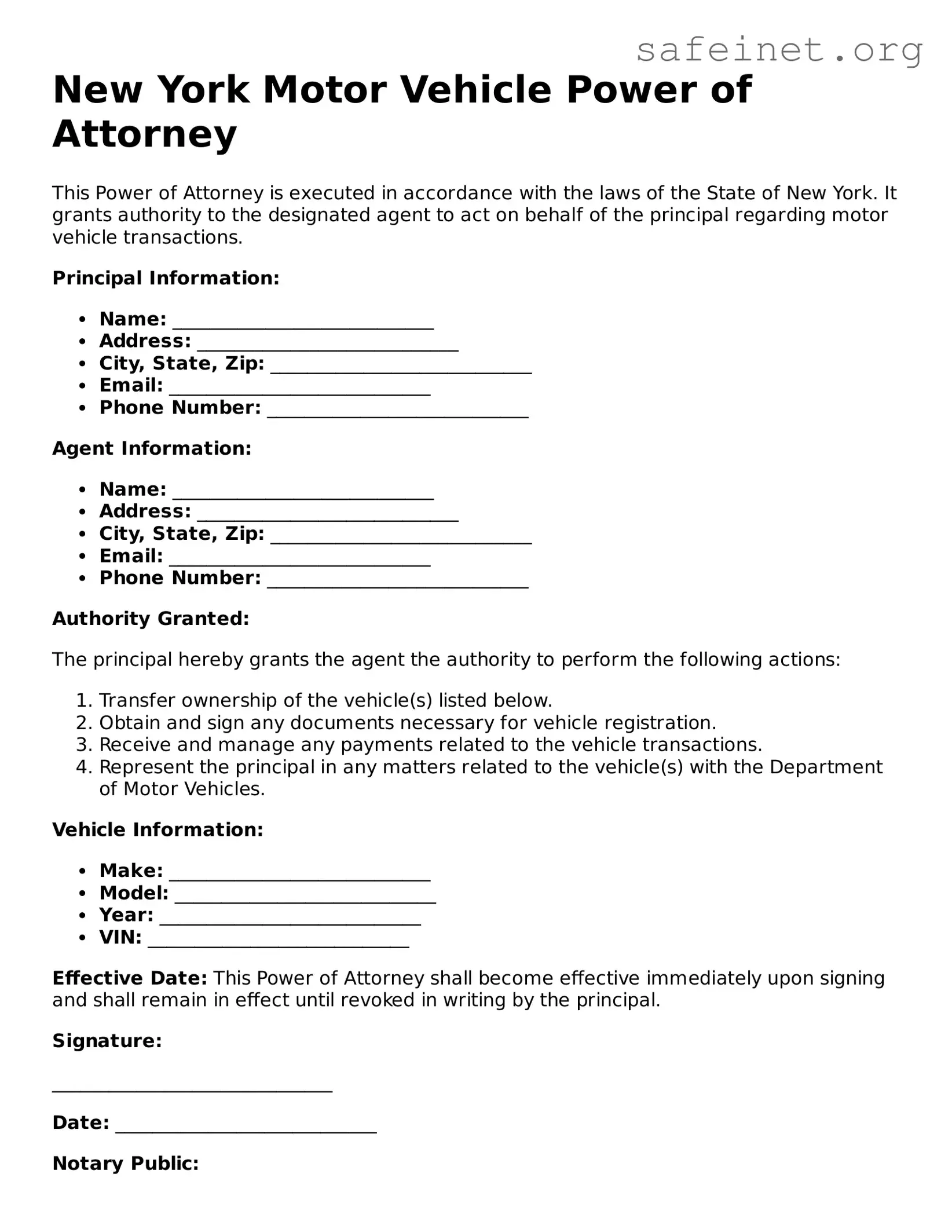
New York Motor Vehicle Power of Attorney
This Power of Attorney is executed in accordance with the laws of the State of New York. It grants authority to the designated agent to act on behalf of the principal regarding motor vehicle transactions.
Principal Information:
Agent Information:
Authority Granted:
The principal hereby grants the agent the authority to perform the following actions:
Vehicle Information:
Effective Date: This Power of Attorney shall become effective immediately upon signing and shall remain in effect until revoked in writing by the principal.
Signature:
______________________________
Date: ____________________________
Notary Public:
State of New York
County of ____________________________
Subscribed and sworn to before me this _____ day of __________, 20__.
______________________________
Notary Public Signature
| Fact Name | Description |
|---|---|
| Purpose | The New York Motor Vehicle Power of Attorney form allows an individual to designate another person to handle motor vehicle transactions on their behalf. |
| Governing Law | This form is governed by New York State Vehicle and Traffic Law. |
| Eligibility | Any individual who is the owner of a motor vehicle can complete this form to authorize another person. |
| Signature Requirement | The form must be signed by the principal (the person granting authority) in the presence of a notary public. |
| Revocation | The Power of Attorney can be revoked at any time by the principal, provided they notify the agent and any relevant parties. |
| Agent Authority | The agent can perform tasks such as signing documents, transferring titles, and registering vehicles. |
| Form Availability | The form is available online through the New York State Department of Motor Vehicles (DMV) website. |
| Validity | The Power of Attorney remains valid until it is revoked or the principal passes away. |
Filling out the New York Motor Vehicle Power of Attorney form is straightforward. Once you complete it, you can authorize someone to handle specific tasks related to your vehicle on your behalf.
What is the New York Motor Vehicle Power of Attorney form?
The New York Motor Vehicle Power of Attorney form is a legal document that allows an individual, known as the principal, to designate another person, called the agent, to act on their behalf regarding motor vehicle transactions. This can include tasks such as registering a vehicle, transferring ownership, or obtaining a title. By granting this authority, the principal can ensure that necessary actions are taken even when they are unable to do so personally.
Who can be designated as an agent in the Motor Vehicle Power of Attorney?
In New York, the agent can be any person that the principal trusts to handle their motor vehicle affairs. This could be a family member, a friend, or even a professional, such as an attorney or a car dealer. It is important for the principal to choose someone responsible, as the agent will have significant authority over the principal's vehicle-related matters.
How is the Motor Vehicle Power of Attorney form completed?
To complete the form, the principal must provide their name and address, as well as the name and address of the agent. The specific powers being granted should be clearly indicated, and the form must be signed and dated by the principal. In some cases, it may also require notarization to enhance its validity. Ensuring that all information is accurate and complete is crucial to avoid potential issues down the line.
Is the Motor Vehicle Power of Attorney form revocable?
Yes, the Motor Vehicle Power of Attorney can be revoked at any time by the principal, as long as they are mentally competent to do so. To revoke the document, the principal should provide written notice to the agent and, if possible, to any third parties that may have relied on the original power of attorney. It is advisable to create a new document stating the revocation to eliminate any confusion.
What should be done with the form once it is completed?
After completing the Motor Vehicle Power of Attorney form, the principal should provide a copy to the agent. It is also wise to keep a copy for personal records. If the agent needs to perform specific transactions, they may need to present the original form to the appropriate authorities, such as the Department of Motor Vehicles. Therefore, ensuring that the agent has access to the original document is important.
Are there any limitations to the powers granted in the form?
Yes, the powers granted in the Motor Vehicle Power of Attorney can be limited based on the principal's preferences. The principal may specify particular actions that the agent is authorized to perform or set a time frame for the authority to be effective. It is essential for the principal to clearly outline these limitations in the form to avoid any misunderstandings regarding the scope of the agent's authority.
Failing to provide complete information about the principal. This includes missing details such as the full name, address, and driver's license number.
Not signing the form. The principal's signature is essential for the form to be valid.
Using an outdated version of the form. Ensure that the most current version is used to avoid any compliance issues.
Not specifying the powers granted. Clearly outline what the attorney-in-fact can do on behalf of the principal.
Neglecting to date the form. A date is necessary to establish when the authority begins.
Overlooking the need for a witness or notarization. Depending on the situation, these may be required for the form to be legally binding.
Failing to provide the attorney-in-fact's information. The full name and address of the person being granted authority must be included.
Not keeping a copy of the completed form. Retaining a copy is important for both the principal and the attorney-in-fact for future reference.
The New York Motor Vehicle Power of Attorney form allows an individual to designate another person to act on their behalf regarding motor vehicle transactions. When using this form, you may also need several other documents to ensure a smooth process. Below is a list of commonly used forms that complement the Power of Attorney.
Using these forms in conjunction with the New York Motor Vehicle Power of Attorney can help facilitate various vehicle-related transactions. Being prepared with the right documentation will save time and reduce potential complications.
The New York Motor Vehicle Power of Attorney form shares similarities with the Durable Power of Attorney. Both documents empower an individual, known as the agent or attorney-in-fact, to act on behalf of another person, referred to as the principal. The Durable Power of Attorney remains effective even if the principal becomes incapacitated, ensuring that the agent can continue to manage the principal's affairs. This feature is crucial for individuals who want to ensure their financial and legal matters are handled seamlessly, even during times of personal crisis.
Another document that resembles the New York Motor Vehicle Power of Attorney is the Medical Power of Attorney. This form allows a designated individual to make healthcare decisions for someone who is unable to do so. Similar to the Motor Vehicle Power of Attorney, it grants specific authority to the agent, tailored to the principal's wishes regarding medical treatment and care. Both documents emphasize the importance of trust, as the principal must select someone they believe will act in their best interest.
The Limited Power of Attorney is also comparable to the New York Motor Vehicle Power of Attorney. This document restricts the authority of the agent to specific tasks or situations, which can include managing vehicle-related transactions. Just like the Motor Vehicle Power of Attorney, it allows for designated responsibilities without granting full control over the principal's affairs. This limitation helps maintain a level of oversight while providing the agent with the necessary authority to act effectively.
A similar document is the Real Estate Power of Attorney. This form empowers an agent to manage real estate transactions on behalf of the principal, such as buying, selling, or leasing property. Both the Real Estate Power of Attorney and the Motor Vehicle Power of Attorney require clear, explicit language to outline the powers granted to the agent. They serve as tools for individuals who may be unable to attend to their real estate or vehicle matters personally, ensuring that these important transactions can proceed smoothly.
The Business Power of Attorney is another document that aligns with the Motor Vehicle Power of Attorney. This form is used to delegate authority for business-related decisions and transactions. Both documents are designed to facilitate actions that the principal may not be able to perform themselves, whether due to time constraints or physical limitations. They empower agents to act in the best interest of the principal, ensuring that necessary business dealings continue without interruption.
Additionally, the Financial Power of Attorney bears similarities to the New York Motor Vehicle Power of Attorney. This document allows an agent to manage the principal's financial matters, such as banking and investments. Like the Motor Vehicle Power of Attorney, it can be tailored to grant specific powers or be broad in scope. Both forms are vital for individuals seeking to ensure their financial affairs are handled appropriately, especially when they are unable to do so themselves.
Lastly, the Special Power of Attorney can be compared to the New York Motor Vehicle Power of Attorney. This type of document grants the agent authority to perform specific acts on behalf of the principal, much like the Motor Vehicle Power of Attorney focuses on vehicle-related tasks. Both forms are useful when the principal needs assistance with particular transactions but does not wish to relinquish control over their entire range of affairs. They provide a focused approach to delegation, ensuring that specific needs are met without unnecessary complications.
When filling out the New York Motor Vehicle Power of Attorney form, it is essential to follow specific guidelines to ensure the process is smooth and legally binding. Here are seven important dos and don'ts to consider:
Adhering to these guidelines will help ensure that your Power of Attorney is processed efficiently and effectively.
The New York Motor Vehicle Power of Attorney form can be confusing. Here are eight common misconceptions about this form, along with clarifications.
While many people associate this form with selling a vehicle, it can also be used for various purposes, such as transferring ownership, registering a vehicle, or obtaining a duplicate title.
This form is designed for use by individuals, so anyone can fill it out. However, seeking legal advice is always a good idea if you have questions.
Notarization is not a requirement for this form in New York. However, having it notarized can add an extra layer of authenticity.
The Power of Attorney remains valid until the task is completed or revoked by the principal, not just for a limited time.
The person you designate must be trustworthy, as they will have the authority to make decisions regarding your vehicle.
While this form is specific to New York, a Power of Attorney can be recognized in other states, depending on their laws.
Even if you are available, a Power of Attorney can simplify transactions and make the process smoother for all parties involved.
The form is straightforward. As long as you provide the required information, it should not pose any difficulties.
Filling out the New York Motor Vehicle Power of Attorney form requires attention to detail and understanding of its purpose. Here are some key takeaways to keep in mind: